A store manager opens Monday to a new AI insights dashboard nobody on the floor asked for. It flags a dozen “opportunities,” none tied to an action anyone can take before the doors open. They close the tab and get back to the shift.
If you are deploying AI in retail, that scene is the failure mode to avoid. The real risks are concrete: data privacy gaps, weak governance, bias, lost customer trust, shaky data, disappointing returns, and pushback from store teams. The best practices that reduce those risks are simple to name. Sequence the rollout, keep humans in the loop, and get AI into the hands of the people on the floor.
Deploying AI in retail means moving it out of the pilot phase. It becomes part of everyday store and ecommerce operations, shaping real decisions and actions. The pressure to get this right is everywhere. In a 2026 retail AI survey from NVIDIA, 91% of respondents said their companies are either actively using or assessing AI.
Key takeaways
Here is the short version before you read on.
AI adoption in retail is close to universal, but measurable returns and customer trust still lag behind
The real risks cluster in four areas: data, governance, bias and trust, and team adoption
The most reliable fix is sequencing, human oversight, and getting AI all the way to the store floor
The safest path is to prove one measurable key performance indicator (KPI) before you scale to more stores
What does it mean to deploy AI in retail?
Deployment is the moment AI stops being an experiment and starts changing what people do. A pilot proves something works in a controlled setting. Deployment puts it into daily operations across many locations.
Two broad families of use exist. Customer-facing AI powers product recommendations, chatbots, dynamic pricing, and visual search across retail and ecommerce. You have probably used three of these as a shopper this week.
Operational and frontline AI works behind the scenes on demand forecasting, task prioritization, and on-floor answers for store teams. This is the layer that shapes day-to-day retail operations across every location.
Value only shows up when the output changes what someone does in a store. A forecast nobody acts on is trivia. Our AI Assistant gives associates source-backed answers on the floor. A question at the shelf becomes a confident answer for the shopper.
What are the biggest risks of deploying AI in retail?
The biggest risks fall into six buckets.
Data privacy and compliance exposure when systems touch customer information
Weak, siloed, or low-quality data feeding the model
Governance gaps between policy on paper and practice in the field
Bias in outputs and the loss of customer trust that follows
Unclear returns that never justify the spend
Resistance from the people expected to use it every day
A shopper came to the counter with a return. The store’s new chatbot had already told them the policy was 30 days. The real policy was 14.
The associate had to walk it back at the register while the line grew. The shopper left sure the brand had tried to trick them. One wrong answer, delivered confidently, is how trust quietly leaks out of a store.
Governance on paper is not governance in practice. In an EY survey of senior AI leaders, 98% report having formal AI governance policies in place. Yet 47% say their organization has previously skipped that governance process for urgent deployments. In the same survey, about a third (36%) have experienced an AI incident or failure that caused a materially negative impact, including data loss, financial damage, operational disruption, and brand damage.
Customers can feel the gap too. Alchemer’s 2026 retail research found that only 35.4% of shoppers trust AI shopping recommendations completely or mostly. When you deploy AI that touches customers, you are spending trust you may not have.
The rules are tightening, so treat compliance as a design input, not an afterthought. You now have to account for the EU AI Act and a growing patchwork of US state laws, such as those in Colorado and Utah. Long-standing privacy laws like the General Data Protection Regulation (GDPR) and the California Consumer Privacy Act (CCPA) also govern how you collect and use customer data.

The risk that gets missed is quieter: AI that never reaches the floor. A model can be accurate, compliant, and completely ignored, and you will still have spent the budget.
Why are data and integrations a problem for retail AI?
AI is only as good as the data and the plumbing behind it. Point-of-sale, inventory, foot traffic, and workforce systems usually live in separate silos, each with its own format and quality problems. Feed a model messy or partial data and it will produce confident nonsense.
You do not have to rip out and replace those systems to fix this. We connect AI to the systems you already use through YOOBIC Integrations, with 200+ pre-built connectors, so execution data flows without a migration project.
Why do so many retail AI projects fail to deliver ROI?
Adoption is nearly universal, but measurable returns are rare. Value depends on changing behavior, not buying a model. That gap shows up in McKinsey’s 2026 State of AI survey. It found that the share of AI high performers has stayed flat at about 6% of all respondents. Meanwhile, 37% attribute at least some earnings before interest and taxes (EBIT) impact to AI use.
Most projects stall between a promising pilot and daily use. The technology works in the demo, then dies in the handoff to busy store teams who already have a full shift. You bought a capability when what you needed was a habit.
Prioritization means subtraction. If your AI adds a hundred alerts to a manager’s day, you have made the job harder, not smarter. The return comes from cutting the list down to the two or three actions that will actually move a number.
How do you keep AI accountable and on-brand in your stores?
Build governance in from the start and keep a human in the loop. The goal is augmented, not autonomous: the system recommends, and a person decides.
A useful recommendation carries its reasoning with it. It shows the benchmark it compared the store against, the expected impact, and why it is suggesting this action now.
A person then applies judgment about staffing, stock, or a local event. Headquarters (HQ) keeps control through configuration and full visibility. We built YOOBIC AI, our AI-powered performance suite, so explainability follows from the architecture, not from a policy bolted on afterward.
If you want a shared vocabulary for this, the National Institute of Standards and Technology (NIST) AI Risk Management Framework organizes the work into four functions: Govern, Map, Measure, and Manage. It gives your legal, security, and operations teams one language for who owns what. That transparency also protects customer trust. When you can explain why the system suggested a price, you can defend it to a regulator and to the shopper in front of you.
How do you get store teams to actually adopt AI?
Adoption fails on skills and trust, not on technology. The model can be excellent and still gather dust if the people expected to use it were never trained or consulted. That pattern shows up in the World Economic Forum’s Future of Jobs research. It found the skills gap to be the most significant obstacle to business transformation, cited by 63% of employers as a main barrier.
An associate who used to spend the first hour of every shift counting stock and copying numbers into a spreadsheet now gets that hour back. The count still happens, but the system does the tallying, and they spend the time on the floor helping customers. That is what good adoption feels like from the inside: less clipboard, more selling.
So involve store teams early, train them in the flow of work, and show them plainly what the tool removes from their day. When people see AI taking tedious work out of their day, they start to trust it quickly.
“AI elevates frontline work, and it can improve employee retention. When low-value tasks disappear, teams spend more time on high-impact moments like service, selling, and problem solving, and the work becomes more meaningful.”
Fabrice Haiat, Co-Founder & CEO, YOOBIC
What are the best practices for deploying AI in retail?
Here is a sequence you can follow, whatever your first use case turns out to be.
Start with a business problem, not a model
Pick one specific, measurable problem before you shop for technology. Shrink, promotional compliance, or conversion in a weak store are good candidates. When the problem is concrete, you can tell whether the AI actually helped.
Audit your data and integrations
Check two things: whether your data is clean enough to trust, and whether your systems can talk to each other. Fix the plumbing first. A pilot built on disconnected data fails for reasons that have nothing to do with the model.
Run a scoped pilot with one clear KPI
Keep the first deployment small and time-boxed. Choose a handful of stores, one primary KPI, and a clear before-and-after measure defined up front. A tight scope makes the result readable, so you learn something real.
Put governance and human oversight in place
Decide who reviews AI output, how decisions get logged, and where a person signs off before anything reaches a customer. Write it down before launch, not after an incident. Governance you define early is far cheaper than the kind you retrofit under pressure.
Bring store teams in early
Involve the people who will use the tool while you are still shaping it. Train them in the flow of work, and be honest about what the system does and does not do. Teams that help build the rollout defend it later.
Measure, then scale what works
Prove the KPI moved in your pilot stores before you extend to the rest. Then scale deliberately, one use case or region at a time. Scaling a result you have verified is growth; scaling a hunch is a bigger bet.
How do you measure the return on retail AI?
You cannot manage what you refuse to measure, so decide up front which numbers prove the return. Group them by family so you compare like with like, and keep workforce metrics separate from operational ones.
| KPI family | What it tells you | Example metric |
|---|---|---|
| Operational execution | Whether plans actually happen on the floor | Task completion rate, time to compliance |
| Sales and revenue | Whether AI guidance moves the top line | Conversion rate, units per transaction |
| Inventory | Whether stock is working hard enough | Sell-through, stock turnover |
| People and workforce | Whether the change is sustainable for teams | Employee turnover, time-to-productivity, employee Net Promoter Score |
A metric only matters if it changes behavior, so measure execution, not just insight. The return lives in whether a recommendation becomes an assigned task with photo proof that someone completes.
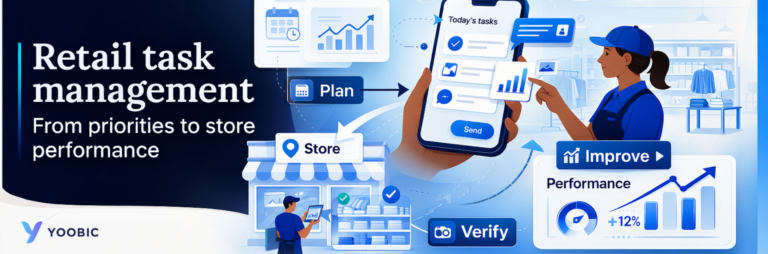
This is the case for starting where the return is easy to see. YOOBIC Store Manager Copilot turns fragmented sales, stock, and traffic data into a short list of prioritized actions. Each action carries its benchmark and the reason behind it, ready for a manager to run that day.
Picture a store manager who used to open the week facing a task list so long that the important items got buried. Now they start with a short set of targeted actions, routed to the right department colleague instead of piling up on one desk. Morrisons cut store-manager weekly task volume from 80-100 items down to roughly 10 targeted actions with the Copilot. You can read how the grocer refocused store teams in the full case study.
Where is retail AI heading next?
If you are planning ahead, this is the operating model to prepare your stores for. The direction of travel is clear, even if the timeline is not.
Picture an associate a couple of years from now, mid-shift. A personal assistant on their handheld flags the next best action: restock a fast-selling size before the afternoon rush. No dashboard, no digging, just the one move that matters.
A few shifts are already underway. The industry is moving from scattered pilots to real scaling. Agentic AI and physical AI are spreading through the supply chain and the store, handling routine work end to end.
AI is also migrating from HQ dashboards down to the frontline, where the decisions actually get made. Meanwhile, the bar on transparency and governance keeps rising, as regulators and shoppers ask harder questions.
The retailers who win will not be the ones with the most models. They will be the ones who connect data to a decision to an action on the floor, every day. Get that loop right, and the technology stops being a science project.

The bottom line on deploying AI in retail
The risks of deploying AI in retail are real, but every one of them is manageable. Privacy, governance, bias, data quality, returns, and adoption all yield to the same discipline. Sequence the rollout, keep a human in the loop, and get AI all the way to the people on the floor.
Remember that store manager staring at a dashboard nobody asked for? The fix is not a better dashboard. It is a system that hands the team three clear priorities and the tools to act on them before the doors open.
That is what we built. YOOBIC brings tasks, communications, and learning together in one AI-powered platform, so a signal in your data becomes a completed action in your stores. We connect intelligence to execution across every location, and give every person, from HQ to store associate, a purpose-built way to act.
Ready to see it on your own store data? Book a demo.
Book a demo and find out how
Avoid wasted hours, blind spots
and lost revenue with YOOBIC

FAQs
What is the 30% rule for AI?
The 30% rule is an informal idea: AI should support human decisions, not replace them. In practice, it means keeping meaningful human oversight over any automated process rather than letting the system run unchecked. It is a rule of thumb, not a legal standard, so use it as a prompt to keep a person in the loop for decisions that affect your customers.