

Definition — what is retail task management software?
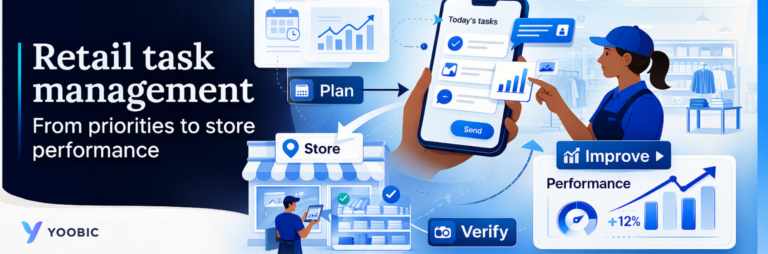
Retail task management software is a purpose-built platform that allows retail organizations to assign, track, and verify operational tasks across store locations in real time, replacing fragmented paper checklists, email chains, and verbal directives with a single source of truth. It connects headquarters strategy directly to frontline execution, ensuring that store standards, compliance, and customer experience are consistently maintained across every location.
A customer walks into a store, finds the shelf empty, the promotional price doesn’t match the display, and the nearest associate can’t confirm whether the item is in stock. This isn’t a bad day. It’s an execution failure. 77% of retail associates say poor task execution in stores directly leads to lost sales.
For retailers, the cost is measurable. The retail execution gap, the distance between what headquarters plans and what actually happens in stores, costs between $10M and $40M annually in lost revenue, operational inefficiency, and missed opportunity.
Retail task management software is how leading retailers close the retail execution gap. By connecting headquarters strategy directly to frontline execution across every location, these platforms ensure that tasks are completed accurately and on time at scale, determining whether a customer leaves having found what they came for.
Key takeaways
- Poor store execution costs retailers between $10M and $40M annually
- Retail task management software increases SOP compliance from 53% to 87%
- Repurposing administrative time to the sales floor drives a 5–7% lift in customer service scores
- 93% of shoppers prefer human support over AI-only bots for high-touch service in 2026
- Integrated workforce and task platforms deliver an average 376% ROI
- Retail task management software is becoming the data backbone of AI-driven retail, critical for visibility in agentic commerce environments
What is retail task management software?
Retail task management software has evolved significantly from its origins as a digital checklist replacement. Today’s platforms are purpose-built operational systems that connect headquarters strategy to frontline execution across hundreds or thousands of store locations in real time.
Retail operations have evolved from paper checklists and informal directives to centralized digital task lists, and now to mobile-first platforms designed for deskless teams. Modern systems reflect how stores actually operate, combining real-time updates with AI-driven prioritization and automated alerts so associates stay present on the sales floor. This shift reduces administrative friction and ensures tasks are executed when and where they matter most.
Today’s platforms go beyond simple task lists. They provide real-time progress tracking, photo and video proof of completion, geofencing to confirm on-site execution, automated reminders, and role-based task assignment, creating a clear, verifiable workflow that shows headquarters exactly how and when work is completed across every location. This removes the guesswork from store operations and eliminates the conditions that lead to empty shelves, incorrect pricing, and inconsistent customer experiences.
On first mention, retailers evaluating retail task management should look beyond generic workflow tools and prioritize platforms built for multi-site frontline execution. Research shows SOP compliance under manual systems averages just 53%. Retailers using task management software typically see this rise to 87%.
How retail task management software directly affects the in-store customer experience
Retail task management software improves the in-store customer experience by maintaining the physical conditions that directly shape how shoppers feel: store cleanliness, shelf organization, pricing accuracy, and promotional signage.
In retail, small operational details have an outsized impact on how customers feel in-store. When shelves are empty, pricing is unclear, or displays are inconsistent, shoppers experience friction and lose confidence in the environment. When these same elements are executed correctly, the store feels organized, reliable, and easy to navigate. This dynamic reflects a simple principle: the physical conditions of a store shape customer perception, and consistent execution is what keeps those conditions aligned with brand expectations.
This reflects what psychologists Mehrabian and Russell call the PAD model (Pleasure, Arousal, Dominance), the idea that physical environments generate emotional responses. In retail, that means store conditions are not just operational concerns. They are a direct input to how customers feel, and whether they stay, buy, and return.
Store standards and brand consistency
Disorganized displays, incorrect pricing, and out-of-stock products are all execution failures. Customers experience them as brand failures.
Retail task management software enforces consistency through visual accountability. Instead of relying on assumptions, execution is verified step by step:
- Tasks are assigned with clear standards and visual guidelines
- Associates complete the task on the shop floor
- Photo evidence is uploaded for verification
- AI validates execution and flags any gaps for immediate correction
This ensures execution is not just assigned but verified at scale, removing the guesswork from store operations.
Global brands achieve up to 98% merchandising compliance using retail task management software. This level of consistency is made possible by AI-powered photo verification, which reaches 95–98% accuracy in SKU identification and enables reliable validation of in-store execution.
Freeing associates for customer service
Beyond store standards, retail task management software changes how associates spend their time, moving them from low-value admin tasks to high-value customer interactions.
Research shows that reducing manual reporting and administrative work saves up to 3.2 hours per store per day.
93% of shoppers prefer human support over AI-only bots when navigating complex queries or high-value purchases in 2026.
£28M in annual staff time was repurposed at the John Lewis Partnership after digitizing compliance checks across 22,000 refrigeration assets.
At the John Lewis Partnership, this shift allowed teams to redirect time toward customer-facing activities, contributing to record Net Promoter Scores across the business. This shift is not about working faster. It is about removing the structural friction that keeps associates away from customers. When associates are no longer tied to manual compliance tasks, they are available for the kind of personal, knowledgeable service that keeps customers coming back.
Manager visibility and faster problem resolution
Individual store managers account for 25–35% of the productivity differences between locations, and retail task management software amplifies the impact of high-performing managers by giving them real-time visibility to act on, not just report.
With centralized dashboards and live task tracking, managers can identify execution issues as they happen, prioritize corrective actions, and ensure consistency across their stores. Instead of reacting after problems affect customers, they can intervene in real time and resolve issues before they escalate, pushing corrective actions across their entire store fleet from a single system.
At Marks & Spencer, more than 800 store managers used a mobile Activity Tracker to coordinate in-store operations, reducing time spent at desks and increasing time on the shop floor. This shift enabled managers to lead teams more effectively and improve execution where it matters most: in front of the customer. When managers are present on the floor rather than tied to desktop reporting, response times to execution issues drop and the customer experience improves in real time.
How retail task management software drives NPS, CSAT, and Customer Effort Score
Retail task management software directly influences NPS, CSAT, and Customer Effort Score by ensuring the operational conditions shoppers notice most: stocked shelves, accurate pricing, clean environments, and consistent store standards.
NPS, CSAT, and Customer Effort Score each capture a different dimension of the in-store experience. NPS reflects whether customers would recommend the brand, CSAT measures immediate satisfaction with the visit, and Customer Effort Score tracks how easy it was to complete a task such as finding a product or checking out. When shelves are stocked, pricing is accurate, and stores are well maintained, effort decreases and satisfaction increases.
Retailers with industry-leading NPS scores outgrow their competitors by more than two times. Operational execution is what separates them.
Retail task management software makes this relationship visible by linking task completion data to customer feedback in real time. When NPS drops during peak hours, managers can trace the decline directly to a corresponding failure in replenishment or queue management tasks. Instead of reacting to complaints after the fact, teams can identify the root cause and resolve it before it impacts more customers. This gives retail leaders something they rarely have today: a direct, evidenced connection between what happens on the shop floor and how customers score the experience.
Satisfaction scores vary significantly across retail sectors, and the gap maps directly onto execution complexity.
| Retail sector | 2025–26 avg CX satisfaction | How task management helps |
| Pharmacies | 96.7% | SOP tracking ensures knowledgeable staff and essential service standards |
| Convenience stores | 93.9% | Automated replenishment tasks and fast checkout workflows |
| Grocery | 91.7% | Real-time out-of-stock alerts and checkout wait time management |
| DIY / home improvement | 89.2% | Digital store navigation and task routing for large-format stores |
| Fashion & apparel | 81.8% | Standardized merchandising and fitting room execution tasks |
Source: HappyOrNot retail CX benchmarks, 2025–26
The gap between pharmacies at 96.7% and fashion at 81.8% illustrates the challenge of managing diverse SKUs and high-touch service consistently at scale. For fashion and DIY retailers, this gap represents both a significant competitive risk and a measurable opportunity. The retailers closing this gap are doing so through better operational execution, not larger store budgets or more staff.
How retail task management software makes BOPIS work — and drives revenue at pickup
Retail task management software is the operational backbone of BOPIS, triggering picking tasks the moment an order is placed, staging items before the customer arrives, and alerting associates when a shopper enters the store or parking area. The result is a fulfillment experience that meets the customer’s core expectation: the order is ready, accurate, and waiting.
Research shows 35% of BOPIS shoppers choose it specifically to get items on the same day.
When that execution fails, the impact is immediate and personal. A customer arrives to collect an order that has not been picked, cannot be found, or is out of stock. This “failed fulfillment” moment breaks trust and undermines the entire omnichannel promise.
Retailers that get BOPIS right treat it as a coordinated task workflow, not a process that falls between teams. At Tesco, the collection process runs as a task-driven sequence:
- The customer scans their receipt at a kiosk
- A picking task is instantly triggered for a warehouse associate
- The item is retrieved and brought to the front of the store
- The customer collects without navigating the shop floor
The result is faster collection, no navigation friction, and store teams freed from quiet service desks to focus on customers.
When fulfillment is executed correctly, pickup becomes a revenue opportunity. 85% of BOPIS shoppers buy additional items when collecting in store, and task management software can prompt associates to suggest complementary products at the point of collection, turning a routine pickup into an opportunity for an additional sale.
Done well, BOPIS is not just a fulfillment channel. It is a revenue driver.
Why the best in-store experiences start with better-supported associates
Retailers using digital workforce systems report voluntary churn reductions of 15–25%. Engaged, tenured associates deliver a 5–7% lift in customer service scores.
When task priorities are structured and administrative work is reduced, associates are more present and focused. Associates who can access tasks, communication, and updates in one place report approximately 10% higher satisfaction scores, reflecting reduced friction and greater control over their schedules. This improvement in satisfaction leads to lower turnover and more experienced staff on the shop floor. In turn, experienced associates deliver faster service and stronger product knowledge. These are the qualities customers notice, and the ones that keep them coming back.
15–25% reduction in voluntary churn with digital workforce systems
~10% improvement in employee satisfaction from mobile-first tools and fair scheduling
5–7% lift in customer service scores from engaged, well-supported associates
Retail task management software does not just improve operations. When associates are better supported, customers notice. The data confirms it. This relationship between employee experience and customer outcomes is one of five compounding gains that together form retail task management’s most powerful commercial argument.
How retail task management software turns better execution into compounding ROI
Retail task management software creates a compounding cycle where operational gains reinforce each other, turning better execution into measurable customer and commercial outcomes.
The retail task management virtuous cycle:
- Admin reduction
Automating low-value tasks creates a cleaner, stocked, and accurate store environment. This reduces customer effort and removes friction from the shopping experience. - Labor reallocation
Time saved from administrative work is repurposed to the shop floor. Associates shift from paperwork to personalized customer service and assisted selling, increasing Customer Lifetime Value by 4–5x. - Consistency and trust
Retailers using retail task management software achieve up to 98% merchandising compliance, creating a consistent brand experience across every location. This consistency builds consumer trust and reduces variation from store to store. - Employee empowerment
Mobile-first tools and fair scheduling reduce voluntary churn by 15–25% and improve engagement. Better-supported associates deliver a 5–7% lift in customer service scores. - Revenue growth
Improved execution closes the $10M–$40M annual retail execution gap and captures revenue at every touchpoint, including up to 85% of BOPIS impulse purchases. Retailers report an average return of 376%
Together, these elements form a self-reinforcing system. Better execution improves employee experience, which improves customer experience, which drives revenue. That revenue then funds further operational improvement, strengthening the entire cycle over time.
Why retail task management software is becoming the backbone of AI-driven retail
As AI, RFID, and agentic commerce reshape retail in 2026, a market where total retail technology spending is projected to reach $388 billion, retail task management software is evolving from an operational tool into the data backbone that makes AI-driven retail possible.
Agentic commerce
AI agents are beginning to shop on behalf of customers. For this to work, they depend on accurate, real-time store data. As agentic commerce matures, incomplete task execution has a direct consequence: products risk becoming invisible to AI-driven commerce environments.
Retail task management software ensures store data remains live, accurate, and trustworthy, making it possible for retailers to participate in this next phase of digital commerce.
RFID and always-on inventory
Continuous item-level RFID tracking is replacing manual stock counts, enabling near real-time inventory visibility and automating replenishment workflows. As inventory becomes continuously visible, task management systems orchestrate the actions required to keep shelves aligned with that data.
Predictive resource allocation
Historical task completion data is now used to anticipate demand peaks and allocate labor more effectively. Retailers using predictive staffing and task management tools report up to a 20% reduction in labor costs while maintaining, and in some cases improving, service levels.
This shift moves store operations from reactive to predictive, where the right tasks are completed by the right people before problems arise.
What to look for in retail task management software
Not all retail task management software is built for the same environment. Multi-site retailers need platforms that do more than assign tasks, ensuring consistent execution, real-time visibility, and a direct connection between store activity and customer experience outcomes.
| Feature | Why it matters for CX |
| Real-time task assignment and tracking | HQ can monitor execution across all stores simultaneously and intervene before customers are affected |
| Mobile-first interface | Associates stay on the sales floor with tools designed for fast, in-the-moment use |
| Photo and video verification | Confirms tasks are completed to the right standard, not just checked off |
| Geofencing | Ensures tasks are completed on-site, creating a verifiable audit trail |
| Automated alerts and escalation | Flags execution failures instantly so issues can be corrected before the customer encounter |
| BOPIS / fulfillment workflow integration | Triggers picking and staging tasks the moment an order is placed, ensuring orders are ready before the customer arrives |
| KPI dashboards and analytics | Links task completion to NPS, CSAT, and sales data, connecting operations to outcomes |
The right platform comes down to one question: can it turn store execution into measurable business impact?
For a full evaluation framework, including how to compare platforms and build a business case, read our guide on choosing a retail task management software.
Conclusion
What happens on the shop floor is the customer experience. The two are not separate disciplines. They are the same outcome, viewed from different angles.
Retailers closing the retail execution gap with retail task management software are outperforming on the metrics that matter most: NPS, CSAT, and total sales. Higher NPS and CSAT scores, stronger sales, and more consistent in-store experiences follow from better execution, not better strategy alone. Retailers using integrated workforce and task management platforms report an average return on investment of 376%.
Book a demo to see how YOOBIC’s retail task management software works in practice, and what consistent execution looks like across your store network.
Want to go deeper? Explore our related guides:
→ Retail task management: the complete guide to driving store execution and performance
→ How to improve retail compliance with task management software
→ How store managers use retail task management software
→ Retail task management for store associates: how to improve store execution
Frequently asked questions about retail task management software
What is retail task management software?
Retail task management software is a purpose-built platform that allows retail organizations to assign, track, and verify operational tasks across store locations in real time, replacing fragmented paper checklists, email chains, and verbal directives with a single source of truth. It connects headquarters strategy directly to frontline execution, ensuring that store standards, compliance, and customer experience are consistently maintained across every location.