

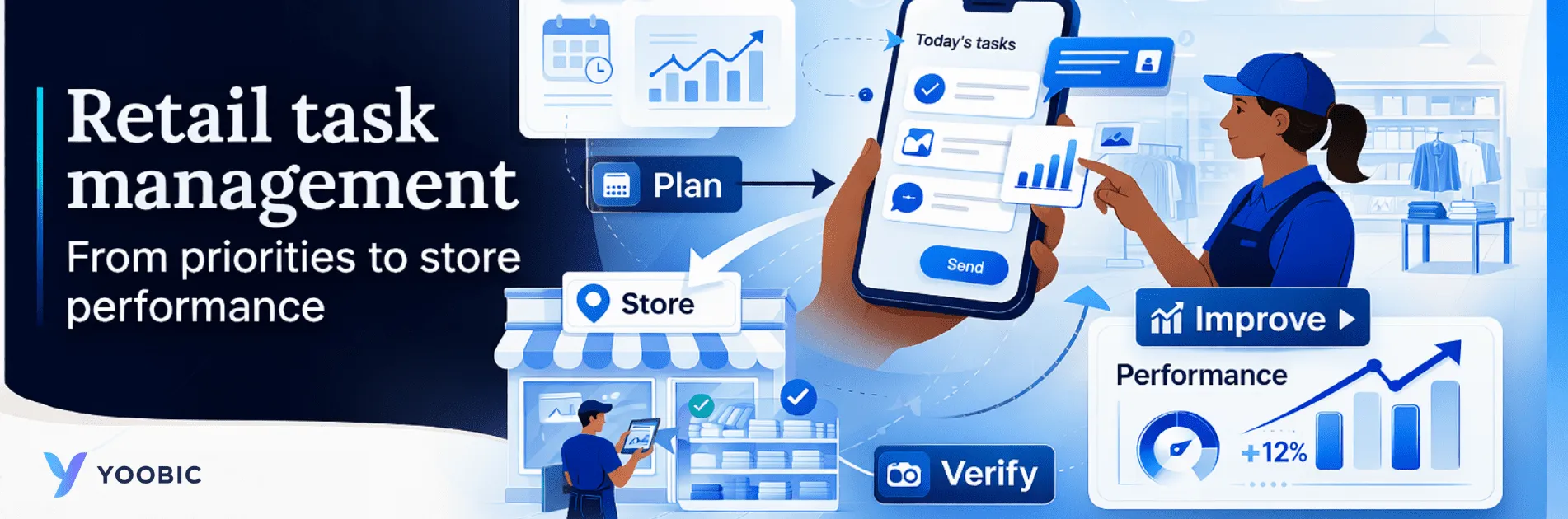
Retail task management is how retailers plan, assign, track and verify the daily work in every store, from opening checklists and replenishment to promotion setups and compliance checks. This guide covers examples and types of retail tasks, a seven-step process for managing them across multiple stores, a sample daily checklist, what to look for in retail task management software, and how to measure results.
Retail performance is decided by execution. Strategy is set at headquarters, but results are made on the shop floor, in every store, every day. A promotional display goes up on time. A compliance check gets done. A planogram reset is finished before the first customer walks in.
When that daily work holds together, strategy turns into sales. When it slips in even a handful of stores, the plan quietly leaks value. A 2024 Brightpearl by Sage survey of more than 1,000 US merchants found they spend 332 hours a year on manual admin. That’s time pulled away from customers, coaching, and selling.
That gap between planning and store-level action is often called the retail execution gap. As networks grow and teams get leaner, small breakdowns turn into missed promotions, uneven standards, and lost margin. Retail task management exists to close it.
DEFINITION:
Retail execution gap
The distance between what headquarters plans and what actually happens on the shop floor, measured in missed promotions, uneven standards, and lost sales.
Key takeaways
- Retail task management is how retailers plan, assign, verify, and track the daily work that keeps every store running
- It matters more now because leaner teams, omnichannel demands, and frontline turnover turn small execution gaps into margin loss
- The core elements are planning, distribution, context, enablement, real-time visibility, and analytics
- The strongest programs treat “assigned” and “done” as different things and verify high-impact work
- YOOBIC unites tasks, communications, and learning in one platform, so priorities become completed, verified action on the floor

What is retail task management?
Retail task management is the system retailers use to plan, assign, track, and verify the operational work that keeps stores running. At its most powerful, it becomes the connective tissue between what headquarters decides and what actually happens on the shop floor. Platforms like YOOBIC bring tasks, communications, and learning into one mobile app, so store teams complete work on the floor and prove it with a photo.
DEFINITION:
Retail task management
The system retailers use to plan, assign, track, and verify store work, so standards set at headquarters are executed the same way in every location.
In practice, a product launch is set up correctly. A promotional display goes live on time. A planogram reset happens the same way across the whole network, not just in the best-run stores.
Generic task tools weren’t built for store task management. Store teams are deskless, and they serve customers while they work. They need tasks that are clear, mobile, and quick to complete between customer interactions. Retail task management software supports that through:
- Role-based task distribution across locations
- Real-time tracking and prioritization
- Photo or timestamp validation
- Central visibility for store, district, and HQ teams
Done well, retail task management turns daily store activity into consistent, measurable execution at scale.
What are examples of retail tasks?
Retail tasks are the recurring and one-off jobs that keep a store trading to standard. Most fall into four groups by how often they happen:
| How often | Example retail tasks |
| Daily | Opening and closing checklists, till and cash checks, gap scans and replenishment, price changes and markdowns, cleaning and food-safety logs, click-and-collect picking |
| Weekly | Planogram and bay checks, stock counts on priority lines, delivery and stockroom organization, rota and coverage review, a store walk with an action list |
| Monthly or quarterly | Health and safety audits, equipment and maintenance checks, full inventory counts, compliance self-assessments, training and certification renewals |
| Campaign and one-off | Promotional display setups, seasonal resets, new product launches, product recalls and withdrawals, store events and visual merchandising changes |
Types of retail tasks
Retail tasks also differ by how they are structured, which decides how you assign and verify them:
- Recurring tasks: routines on a fixed schedule, like opening checks or temperature logs. Automate them so they appear at the right time without anyone resending them.
- One-off tasks: single actions with a deadline, like swapping signage or pulling a recalled product. Send them only to the stores and roles they apply to.
- Campaign tasks: a set of linked tasks behind one initiative, such as a seasonal reset or product launch, often with one go-live date across the whole network.
- Checklist tasks: one task made of several steps, like a store opening routine or a safety audit, where every step needs a clear Pass or Fail.
- Corrective tasks: follow-up actions created when an audit, store visit or data signal finds a problem. Each needs an owner, a due date and proof the fix was made.
High-impact tasks of any type should require photo or checklist proof. Low-risk routines can be confirmed with a simple check-off.

Why does retail task management matter more than ever?
Retail task management matters more than ever because each store team now carries more work with fewer people. Omnichannel fulfillment, frequent promotions, product launches, compliance demands, and turnover all land on the same shift. Without structure, that complexity becomes variability, store by store.
Three pressures make execution a commercial issue, not just an operational one.
Brand consistency depends on structure
Every store represents the brand. Missed resets, missing signage, and pricing errors erode customer trust quickly. Retail task management turns brand standards into specific, verifiable tasks and standardized routines. As a result, consistency depends on process rather than good intentions.
Small execution gaps cost revenue
20–35 bps
Sales lift from a one-point improvement in in-stock rates
McKinsey
Availability and promotional compliance are where execution meets sales. When a promotion launches late or a shelf sits empty, the sale is simply lost. When corrective actions are assigned and verified early, small gaps stop compounding across the network.
Labor hours are too expensive to waste
30–60%
Share of frontline managers’ time spent on admin and non-managerial work
McKinsey
Every hour spent clarifying instructions, chasing updates, or redoing work is a paid hour that never reaches the customer. Structured task management removes that friction. It centralizes task assignment, clarifies ownership and deadlines, and cuts duplicate communication.

What are the core elements of retail task management?
The core elements of retail task management are planning, task distribution, context and enablement, real-time visibility, and analytics. Together, they make sure strategy is carried out the same way in every store. When one element is weak, execution gaps widen and performance varies across the network.
1. Planning and standards
Retail task management begins before a task is assigned. Store teams need to know exactly what good looks like before they can deliver it. That clarity starts with headquarters defining:
- What needs to happen
- Who is responsible
- When it must be completed
- What “done correctly” looks like
INSIGHT
A task is only as good as its definition of done. If a store can’t tell what complete looks like, no one can verify it either.
In YOOBIC, each task carries its instructions, owner, deadline, and photo standard in one place. Every store works from the same definition of done.
Without that clarity, performance depends on individual interpretation. Stores improvise, rollouts slip, and compliance becomes uneven. Tasks that need clarification or correction also consume paid hours without improving output.
2. Structured task distribution
Once standards are set, retail task management moves priorities through the organization with precision. Tasks should be:
- Assigned by role, location, or region
- Prioritized by business impact
- Delivered with clear deadlines
- Supported by planograms, visuals, or step-by-step guidance
- Automated where they recur
When priorities arrive through disconnected channels, high-impact tasks compete with low-value ones. Stores are left to decide what matters most. Centralized retail task management replaces that ambiguity with one role-specific source of truth. With YOOBIC, HQ, field managers, and store teams share one live view of what’s assigned, done, and overdue.
3. Context and enablement in the flow of work
A task on its own isn’t enough. Store teams need to understand the purpose and standard behind the work. They also need the know-how to complete it correctly the first time.
That means instructions, visuals, and proof requirements arrive with the task, not in a separate email. Good frontline team communication is built into the work itself, which is how YOOBIC Communications keeps updates tied to the task they describe. It also means training sits next to the work. When microlearning, visual SOPs, and certifications sit next to the task, new associates get up to speed faster. They also make fewer first-time errors.
Michaels saw a 150% increase in learning program participation after putting YOOBIC microlearning into the flow of work.
That support pays off beyond the task itself. Gallup’s 2024 meta-analysis of more than 183,000 teams found the most engaged business units see 23% higher profitability and 28% less shrinkage than the least engaged.
4. Real-time visibility and verification
Retail task management turns store activity into structured, verifiable data. Without it, you rely on delayed audits and fragmented reports. By the time issues surface, they’ve often already hit sales or compliance.
Live task tracking, store- and region-level dashboards, overdue alerts, and photo-based verification change that. With visibility built into daily workflows, managers focus on variance instead of reviewing every location by hand. Earlier intervention stops small breakdowns from compounding across the network.
“Within seconds in the boardroom I can pull up the platform and validate execution across the entire chain.”
Chris Freeman, SVP of Store Operations, Michaels
5. Analytics and continuous improvement
The final element is analytics. Completion rates, compliance trends, and time-to-resolution turn daily activity into insight. They reveal recurring gaps, training needs, and the link between execution and sales.
When that data feeds back into planning and prioritization, each cycle gets more precise. That’s how you close the loop between strategy, action, and performance.
How do you manage retail tasks? 7 steps for multi-store retailers
You manage retail tasks across multiple stores by running a continuous loop: map the work, plan, communicate, execute, verify, monitor, and improve. Each cycle turns strategy into store-level work and uses the results to sharpen the next one. Replacing ad hoc coordination with this repeatable process is what makes retail store task management consistent at scale.
- Map the work. List every recurring and one-off task your stores handle, group them by frequency and type, and give each one an owner role. Cut or merge tasks that do not change an outcome. Fewer, clearer tasks get done.
- Plan. Standardize recurring processes and set clear scope, owners, and deadlines before work reaches stores. Align labor capacity, compliance requirements, and promotional priorities up front rather than negotiating them store by store.
- Communicate. Send tasks through one centralized, role-specific channel. Instructions, visuals, and completion criteria arrive together, so interpretation doesn’t vary from location to location.
- Execute. Store teams complete tasks within their daily workflow, on mobile, without leaving the sales floor. See how task management for store associates works on the floor. Execution is measured against defined standards, not informal confirmation.
- Verify. Treat “assigned” and “done” as different things. Capture photo, timestamp, or checklist proof for high-impact work. DFS reached 97% task compliance with YOOBIC.
- Monitor and escalate. Track task progress, compliance, and variance in real time. Overdue or failed tasks trigger alerts, so field leaders manage exceptions instead of chasing every store.
- Improve. Analyze task data for recurring gaps, workload imbalances, and training needs. Then feed what you learn into the next cycle.
97%
Task compliance DFS reached after moving store tasks onto YOOBIC.
DFS
Retail task management works as a feedback loop. Planning guides execution, execution creates data, and data refines future planning. As the cycle repeats, variability drops and store performance becomes more predictable. For a field leader’s take on running this loop, listen to Frontline Fridays: The Six Cs of Execution.
Sample daily store task checklist
Here is what a daily task list can look like once it is structured. Adapt it to your formats. What matters is that every item has an owner, a time and a clear definition of done.
| When | Task | Proof |
| Before opening | Walk the entrance, windows, fitting rooms and sales floor: clean, safe and ready to trade | Checklist |
| Before opening | Tills open, floats counted, card terminals working | Checklist |
| Before opening | Promotions live and shelf prices correct on promoted lines | Photo |
| Morning | Gap scan and replenishment of priority lines | Checklist |
| Morning | Temperature and food-safety checks logged, where relevant | Log entry |
| Midday | Click-and-collect orders picked and staged | Timestamp |
| Midday | Overdue HQ tasks reviewed and reassigned | Dashboard |
| Afternoon | Planogram or display check in one priority bay | Photo |
| Closing | Cash-up, safe and key control | Checklist |
| Closing | Fire exits clear, doors locked, alarm set | Checklist |

How does retail task management improve daily store performance?
Retail task management improves daily store performance by turning operational routines into structured, prioritized, and measurable work. Merchandising plans, inventory routines, compliance checks, and launches get done correctly and on time across the network.
Merchandising and planogram compliance
Merchandising execution decides whether strategy converts into sales. Retail task management improves it through:
- Role-specific planogram instructions
- Deadline-driven resets
- Image-based verification
- Compliance visibility by store and region
Picture a store team at Sportscene finishing a promotional reset before the morning rush. They photograph the display, and VM Copilot checks it against the brand standard, so any issue is fixed before it reaches a customer. Working this way, Sportscene lifted store execution on visual merchandising and promotions by 60% with YOOBIC. That’s what visual merchandising compliance looks like when photo validation happens in real time, not during a monthly visit.
60%
Lift in store execution on visual merchandising and promotions at Sportscene with YOOBIC.
YOOBIC case study, Sportscene
Inventory and on-shelf availability
On-shelf availability is one of the most direct drivers of revenue. IHL Group estimates that inventory distortion, meaning out-of-stocks and overstocks, cost retailers $1.77 trillion globally in 2023. Many of those losses start in the store. A replenishment check gets missed, a cycle count is skipped, or the backroom and shelf fall out of sync.
Retail task management builds inventory routines into daily operations:
- Recurring replenishment checks
- Scheduled cycle counts
- Exception alerts for discrepancies
- Coordination between backroom, shelf, and omnichannel fulfillment
When these routines are structured and visible, preventable stockouts are caught earlier. That protects revenue without adding labor.
Operational coordination and workload
Execution gaps widen when information is scattered across email, spreadsheets, and disconnected systems. Managers end up consolidating updates before they can act on the floor.
“We had managers sitting in the back office printing task lists. That time belongs on the sales floor.”
Tiffany Reese, Director of Workload & Communications, Michaels
One platform that delivers tasks, tracks completion, and captures proof at the point of work gives managers that time back. They spend it on coaching, standards, and customers instead. Michaels saved 223,000 hours, about 2.5 hours per store per week, after replacing paper task lists with YOOBIC. Read the full Michaels customer story.
Compliance management and store audits
At Pret a Manger, daily checks and food-safety processes used to eat into every shift. With YOOBIC Task Management, Pret now saves 154,000 hours a year on checks and processes.
154,000 hours
Time Pret a Manger saves each year on checks and processes with YOOBIC Task Management.
YOOBIC case study, Pret a Manger
Operational breakdowns build up through missed checks, pricing errors, incomplete resets, and slow corrective action. Retail task management turns store compliance into a closed loop. Every failed check becomes an assigned action with an owner, a deadline, and proof that it was fixed.
YOOBIC Task Management supports that loop with:
- Recurring compliance workflows
- Time-stamped audit trails
- Automated reminders and escalations
- Central compliance dashboards
When audit findings flow straight into tasks, issues are caught and closed earlier. Lidl raised company-wide compliance by 11% after moving from periodic spot checks to real-time monitoring with YOOBIC. Store visits and audits can then focus on coaching rather than paperwork.
What features should retail task management software include?
Retail task management software should include task distribution, prioritization, execution validation, real-time visibility, mobile workflows, embedded training, and AI guidance. These capabilities keep operational standards consistent across multi-location store networks.
Intelligent task distribution
Retail networks are complex, and not every task applies to every store. YOOBIC Task Management lets you:
- Assign tasks by role, region, store format, or cluster
- Automate recurring workflows such as opening procedures, compliance checks, and replenishment routines
- Attach visual instructions, planograms, and documents to the task itself
Precise distribution reduces noise and keeps store teams focused on what’s relevant to their store.
Prioritization and operational focus
Fragmented communication creates initiative collision. With directives centralized into one ranked view, managers stop reacting to their inbox and work through clear priorities.
Validation, not just completion
Marking a display complete doesn’t prove it meets the standard. Good software verifies execution by capturing:
- Confirmation of completion
- Validation against defined quality standards
- Photo proof of execution
- Root-cause reporting when a task can’t be completed
Capturing why a task failed, such as missing stock or staffing gaps, lets you fix systemic issues. You stop assuming compliance.
At Boots, daily checks once pulled managers away from the shop floor for hours. After moving store audits onto YOOBIC Task Management, Boots cut time spent on daily checks by 78%, freeing managers to spend that time with customers.
78%
Reduction in time Boots managers spend on daily checks after moving store audits onto YOOBIC.
YOOBIC case study, Boots
Real-time visibility and mobile-first execution
Frontline task management has to work where the work happens, and operational control depends on live insight. Associates complete and verify tasks on the shop floor from a mobile device. Leaders see store- and region-level dashboards and overdue alerts. As a result, they can step in as variance appears, not in next week’s report.
Embedded enablement
Task execution and training shouldn’t live in separate systems. YOOBIC Learning puts microlearning, SOPs, visual guides, and certification tracking inside the workflow. That speeds up onboarding and strengthens consistency across locations.
AI recommendations for store managers
Retail task management is moving from tracking activity to directing it. Recurring workflows trigger automatically, and AI helps decide what matters most.
Store Manager Copilot, YOOBIC’s AI-powered teammate for store managers, interprets operational and performance data and surfaces ranked recommendations. A manager reviews and accepts a recommendation in one tap. That builds an editable action plan the store team can add to its existing task list. Here’s more on how AI copilots turn store data into action.
District Manager Copilot, coming soon, extends the same approach to multi-store management. It’s designed to help district managers prioritize store visits and draft action plans, so they focus on the locations that need them most.

How do you choose the right retail task management software?
To choose the right retail task management software, weigh how well it closes the loop from data to action on the floor. Feature lists matter less. For a multi-location retailer, the best retail task management system connects intelligence and execution in one platform. It also works for the whole frontline and fits the tools you already use.
Here’s the gap many buyers miss when comparing task management platforms for retail chains. Some platforms surface strong insights but are built for HQ. Those insights rarely reach the associate who has to act. Others distribute tasks well but lack the intelligence to know what to execute or why. The strongest platforms close that loop, so a signal in the data becomes a verified action in the store. YOOBIC does this by uniting tasks, communications, and learning in one app.
Use this framework to pressure-test any vendor:
| Criterion | Why it matters | What to ask a vendor |
| Intelligence plus execution | Insight only helps if it reaches the floor as a clear action | Show me how a data signal becomes a completed task an associate can act on |
| Built for the whole frontline | Associates, not just managers, do the daily work | Which roles get a purpose-built experience, from associate to HQ? |
| Validation, not just completion | Marking a task done doesn’t prove it met the standard | How do you verify quality and capture why a task failed? |
| Enablement in the flow of work | New associates need guidance at the moment of execution | Can training and SOPs sit inside the task itself? |
| Integration depth | Rip-and-replace stalls rollouts and budgets | Do you connect to our existing stack, and how many integrations do you support? |
| Proven enterprise scale | Multi-location execution differs from single-site | Which comparable multi-location retailers run on your platform today? |
On integration depth, YOOBIC brings 200+ integrations. You connect execution data to the communication, scheduling, storage, and reporting tools you already use, with no rip-and-replace. For a deeper walkthrough, read what to look for when choosing retail task management software.
What are the most common retail task management challenges?
The most common retail task management challenges are inconsistent stores, fragmented workflows, weak accountability, delayed visibility, and frontline overload. These gaps make it harder to turn strategy into consistent store-level performance, and even leading retailers run into them.
Inconsistent store performance
Execution variability is highly visible to customers. When planogram compliance, display setup, or promotional timing differ across locations, small deviations compound into measurable performance gaps.
Fragmented workflows and manual systems
When execution depends on disconnected tools, standards end up scattered across emails, spreadsheets, and local processes. That creates version control issues, inconsistent reporting, and gaps between HQ intent and store-level interpretation. Digital task management puts every standard in one place.
Weak accountability
Paper checklists and fragmented reporting leave a gap between reported completion and verified execution. Without structured validation, accountability becomes an assumption rather than something you can measure. Frontline Fridays covers the people side in How to Drive Accountability Without Breaking Your Team.
Delayed visibility
When insight depends on slow reporting cycles, you can’t intervene as execution starts to drift. By the time issues surface, the promotional window may have closed or the compliance deadline may have passed.
Frontline overload
Execution is ultimately human. Ambiguous instructions increase cognitive load, while clear, prioritized tasks increase confidence. When tasks are specific and supported by guidance, consistency improves.
These challenges are usually coordination gaps, not strategic missteps. Across a large store network, variability multiplies their impact.
INSIGHT
Most execution problems are coordination gaps, not people problems. Fix the system and the same store teams perform more consistently.
How do you measure the success of retail task management?
You measure retail task management by how reliably execution translates into performance. Success isn’t defined by activity alone. It’s defined by whether consistent execution improves revenue, productivity, and compliance at scale.
Core execution metrics
ROI measurement starts with operational reliability. Core metrics include:
- Task completion rate
- On-time completion rate
- Promotional compliance rate
- Planogram compliance percentage
- Audit pass rates
- Average task completion time
- Store-level performance variance
- Issue resolution time
These indicators show whether your strategy reaches the shop floor intact. YOOBIC dashboards track them by store, district, and region, so you can see where execution is drifting.
Productivity and cost recovery
ROI also depends on how much operational waste you remove and how much labor you redirect toward selling. Key indicators include:
- Reduction in overtime costs
- Time to task completion
- Time to compliance
- Reduction in execution-related rework
These improvements show up on the P&L. Less overtime lowers direct expense, less rework protects paid hours, and faster execution shortens revenue delay.
Advanced performance analysis
Once execution data is centralized, you can move from tracking to correlation. Compare execution scores with sales, training completion with execution quality, and performance across similar stores. That shows whether underperformance comes from strategy, staffing, training, or execution, so you can intervene earlier.

What’s next for retail task management?
The next stage of retail task management is AI-guided execution. Instead of documenting what happened yesterday, systems help teams prioritize what should happen today.
AI-driven prioritization
Traditional systems distribute tasks broadly and leave managers to work out priority. AI reverses that model. Hugo Boss recorded 3.2% incremental revenue with Store Manager Copilot. The copilot ranks the actions most likely to move store performance, so teams act on them first.
3.2%
Incremental revenue Hugo Boss recorded with YOOBIC’s Store Manager Copilot.
YOOBIC case study, Hugo Boss
INSIGHT
AI doesn’t replace a store manager’s judgment. It ranks what matters most, so managers decide and act faster.
District Manager Copilot, coming soon, will bring that prioritization to district managers, pointing them to the stores and issues that need attention first.
Continuous compliance validation
Compliance is shifting from periodic inspection to continuous validation. Photo checks, exception alerts, and in-task verification surface gaps in real time. Teams don’t wait for the next regional visit.
Connected workforce and operational data
Labor planning and execution quality can’t run in isolation. With 200+ integrations, YOOBIC connects to the scheduling, workforce, and point-of-sale tools retailers already use. That keeps task priorities, staffing plans, and store performance data aligned in one execution layer.
In margin-sensitive retail, that predictability isn’t incremental. It decides whether strategy turns into measurable performance at scale.
The bottom line on retail task management
Retail task management connects your strategy to what actually happens in every store. It structures how work is distributed, verified, measured, and improved across multi-location networks.
Precise planning, validated execution, supported store teams, and real-time tracking make daily operations measurable and controllable. That control shows up in the drivers that matter:
- Brand consistency across locations
- Promotional and merchandising compliance
- Revenue protection during campaigns and launches
- Manager accountability and response time
- Operational efficiency at scale
Performance gaps build quietly, one missed reset at a time. YOOBIC brings tasks, communications, and learning together in one platform. That’s how you close the gap and turn consistent execution into protected margin. See how Michaels, DFS, and Lidl do it in our customer stories, or book a demo to see the loop in your own stores.
Start retailing smarter

Frequently asked questions
What is an example of task management?
A common example of task management in retail is a promotional display rollout. HQ creates one task with the layout, deadline, and owner, sends it to every relevant store, and each store team submits a photo when the display is done. Managers then see which stores have completed it, which are overdue, and which need a fix.

