

Retailers invest millions designing strategy: new promotions, new customer experiences, and new omnichannel capabilities. But much of that strategy breaks down at the store level, where store associates turn plans into finished work.
Coresight Research‘s 2025 State of In-Store Retailing study finds that retailers across sectors like grocery, drugstore, and mass merchandise lose about 5.5% of gross sales to in-store execution inefficiencies. Its data shows 81% of retailers report at least a 5% operating-margin loss from execution-related problems.
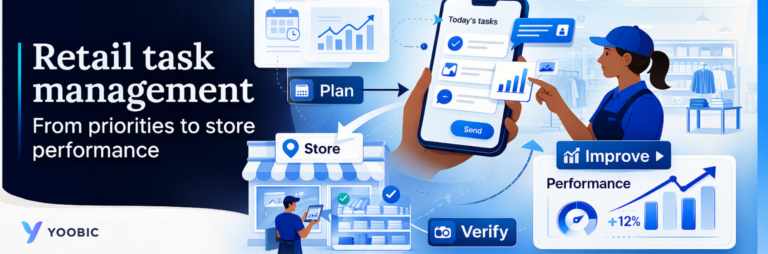
Retail task management is how retailers plan, assign, prioritize, verify, and track the daily work store teams do, so corporate priorities actually get executed the same way in every location.
Most retail leaders know what needs to happen. The challenge is getting it to happen consistently in every store you operate, across every shift. Store associates today manage far more than customer interactions.
A single shift may include replenishing shelves, setting up promotions, fulfilling click-and-collect orders, completing safety checks, and responding to operational updates from headquarters. As the physical store evolves into a hub for fulfillment, brand experience, and customer service, the complexity of frontline work has increased significantly.

The impact of execution is measurable. Retailers that implement digital task management raise on-time task completion, while AI-driven operational tools help reduce stockouts. These improvements show that consistent execution on the sales floor directly influences revenue, operational efficiency, and customer experience.
→ Discover how AI for retail is moving from the back office to the shop floor to tackle inventory precision and streamline tasks in our AI in retail 101 guide.
Yet in many stores, frontline work is still coordinated through fragmented systems. Without clear prioritization or real-time visibility, associates often default to completing the easiest tasks rather than the most impactful ones. That operational drift widens the gap between headquarters strategy and store reality.
Retailers that pull ahead approach this differently. Instead of relying on ad hoc communication and manual tracking, they redesign how store work is organized, prioritized, and verified across locations.
Retail task management is no longer just an operational tool. It has become a strategic capability that connects corporate priorities directly to frontline execution. It gives store associates the clarity to deliver consistent results in every store.

Key takeaways
Here’s what matters most if you’re trying to close the gap across your stores:
- The execution gap is where headquarters plans and store-floor reality drift apart, quietly draining sales
- Modern retail task management works as a coordination layer: real-time visibility, role-based delegation, digital verification, and AI prioritization
- Technology only improves execution when frontline teams adopt it, so engagement and learning matter as much as the platform
- Named retailers report measurable gains in hours saved, task completion, and compliance
- Operational KPIs like task completion rate, compliance rate, and time to execution show whether store performance is improving
What is the execution gap between retail headquarters and the store floor?
The execution gap describes the disconnect between what retail leaders plan at headquarters and what actually happens inside stores.
Promotions, merchandising standards, and operational processes are carefully designed at the corporate level. But execution depends on hundreds or thousands of store associates carrying out those plans correctly, every day, across every location.
Closing this gap requires what many retailers recognize as a shared operational reality, where headquarters, regional leaders, and store teams all see the same priorities, tasks, and execution status in real time.
Without that shared view of operational work, strategy often struggles to translate into consistent store execution.
The gap between strategy and execution
Consider a typical seasonal campaign rollout.
Headquarters launches a new promotion across hundreds of locations, expecting displays installed, pricing updated, and inventory positioned to support demand.
But inside stores, execution often varies.
Some teams install displays immediately. Others receive instructions late or through multiple channels. Pricing updates are missed, stock is not replenished in time, and visual standards differ from store to store.
Without real-time visibility into execution, leadership teams cannot see where strategy is breaking down across locations.

Why the gap happens
One of the main causes is fragmentation in how store work is coordinated.
Operational tasks often arrive through disconnected systems, leaving store teams without a single source of truth. This fragmentation creates a second, less obvious problem: prioritization.
Store associates receive multiple instructions at once, often without clear guidance on what matters most. When everything feels urgent, employees naturally default to completing the quickest or easiest tasks first rather than the most operationally important ones.
Over time, this behavior creates operational drift. Critical tasks get delayed, store standards become inconsistent, and managers spend increasing amounts of time chasing updates instead of improving performance.
→ Find out why information overload is at the core of the execution gap and how you can simplify operations for your store teams.
What closing the gap requires
The most operationally mature retailers address this challenge by redesigning how operational work flows across their organizations.
Instead of relying on fragmented communication and manual tracking, they create a shared operational environment where store tasks are clearly prioritized, centrally assigned, and visible across every location.
When operational work becomes transparent and coordinated across the organization, leaders gain something they rarely have today: confidence that strategy is being executed consistently in every store.
What does modern retail task management actually look like?
Modern retail task management is often misunderstood as simply digitizing checklists or replacing paper task lists with mobile apps. In reality, the most effective systems function as an operational coordination layer that connects headquarters strategy with day-to-day execution in stores.
For leadership teams, the value lies less in the mechanics of assigning tasks and more in the visibility, alignment, and accountability these systems create across the organization.
Real-time operational visibility
Modern task management shifts store operations from a reactive process into one you can monitor and improve continuously.
In traditional retail environments, leadership teams rely on delayed reports, store visits, and anecdotal updates to understand whether operational initiatives are being executed correctly. By the time problems become visible, the opportunity to fix them has often passed.
Digital task management changes that. Headquarters, regional leaders, and store managers can see which tasks are assigned, in progress, or completed across every location, in real time.
This shared view allows retailers to identify execution gaps quickly, verify that campaigns are being implemented correctly, and intervene before small issues become larger operational problems.
Role-based delegation
One of the most overlooked benefits of modern task management is what it does for the store associate experience.
Operational instructions often arrive from multiple sources with little coordination. Associates must interpret priorities while managing busy store shifts.
Role-based delegation changes that dynamic. Tasks are assigned according to roles and responsibilities, ensuring that frontline associates focus on activities such as replenishment, merchandising, and order fulfillment while store leaders manage oversight and escalation.
For your associates, this clarity reduces cognitive overload and removes the uncertainty of deciding what to do next. For retailers, it ensures operational work is distributed efficiently across teams.
Accountability through digital verification
Execution only matters if it can be confirmed.
YOOBIC Task Management verifies work through time-stamped confirmations, photo-based feedback and approvals, and location-based activity tracking.
For organizations managing hundreds or thousands of locations, this verification layer turns store execution from anecdotal reporting into verifiable operational data. You stop taking “done” on faith and start seeing the proof.
→ Learn why visual merchandising software and real-time photo validation are critical for ensuring flawless execution across your entire network.
AI task prioritization
The most significant shift in modern task management is the move from reactive coordination to predictive operations.
YOOBIC AI analyzes operational signals such as inventory levels, demand patterns, and sales forecasts, and Store Manager Copilot turns them into prioritized daily actions for store teams.
For example, low-stock alerts can trigger replenishment tasks before shelves are empty, helping stores respond faster while reducing the cognitive load placed on frontline teams. That’s fewer, clearer priorities for your teams, not a longer to-do list.
Taken together, these capabilities fundamentally change how store operations are managed. Retail leaders gain real-time visibility into execution, store teams receive clearer priorities, and operational decisions become increasingly data-driven.
→ Discover how AI is already changing retail execution by moving managers from simply analyzing reports to acting on smart recommendations
What should retailers know about the task management technology landscape before investing?
Retail task management has evolved into a significant technology category. A growing number of platforms promise to improve store execution, but they differ widely in scope, architecture, and operational focus.
For retail leaders evaluating solutions, the most important distinctions are not between individual vendors but between platform models and deployment strategies.
| Platform model | What it optimizes for | Best fit |
|---|---|---|
| Enterprise platforms | Scalability, enterprise-software integration, and visibility across hundreds or thousands of locations | Large store networks |
| SMB-focused solutions | Ease of deployment and simplicity, often bundling task management with scheduling and communication | Smaller retailers that want simple, fast setup |
| Standalone execution platforms | Deeper frontline functionality dedicated to store operations | Teams that want the most store-execution depth |
| Integrated ecosystems | Task management embedded in larger platforms to simplify IT management | Teams consolidating tools under one system |
→ Learn more about building a solid tech foundation in our guide on why retail CIOs need to prioritize retail operations in their software strategy
Deployment considerations
Retailers must also decide how store teams will access operational tools.
Many organizations support bring-your-own-device (BYOD) approaches, allowing associates to use personal smartphones for work tasks. This reduces hardware costs but introduces considerations around security and workforce policies.
What to look for when evaluating a platform
Picture an area manager with a vendor shortlist taped to the monitor. Every demo looks impressive. But one question keeps coming up: would associates actually open this during a Saturday rush, or would it become one more tab no one checks?
That instinct is right. The strongest implementations rarely start with a feature list. They start with a clear picture of how work flows across your stores, and which model supports that flow at scale. When you compare options, weigh how each one handles the day-to-day:
- Mobile-first workflows built for deskless store teams, not desktop software adapted for the floor
- Flexible, modular audits and checklists you can adjust by store or region
- Real-time compliance analytics and dashboards, not reports that arrive days later
- Retail-specific depth for visual merchandising and promotion execution
- Integration breadth that connects with the 200+ tools you already run, with no rip-and-replace
The clearest measure of whether any of these approaches works is what happens to execution performance after implementation.
Does retail task management deliver measurable ROI?
Yes. Retailers that implement digital task management consistently report measurable gains in operational efficiency, store execution, and frontline productivity.
223,000 hours saved annually. Michaels digitized store tasks and communications across 1,350 stores. Task completion rates improved by 30%, daily customer readiness walks reached 98% compliance, and the retailer generated $1.8 million in incremental revenue by redirecting administrative time back to the sales floor.
90–95% task completion across 900 locations. Pilot Company replaced paper-based processes with digital execution, giving leadership real-time visibility into operational work across more than 900 locations and 30,000 employees. Store managers now complete tasks directly on mobile devices, significantly improving execution consistency across the network.
These results reflect a broader industry pattern. When operational work becomes visible, prioritized, and verifiable, store teams spend less time managing tasks and more time serving customers.
In a sector where small execution failures can quietly cost large retailers $10 million to $40 million per year, consistent store execution becomes a measurable commercial advantage.
The metrics to watch
If you want to know whether execution is actually improving, watch a focused set of operational KPIs:
- Task completion rate
- Compliance rate
- Time to execution and time to compliance
- Display and visual-merchandising compliance
- Promotion rollout time
- Checklist completion rate
Why is technology alone not enough to improve retail execution?
No matter how advanced a task management platform becomes, its success depends on the people using it. If your associates don’t adopt the system, none of the visibility matters.
That is why the most successful retailers approach task management not just as a technology rollout, but as a frontline engagement strategy.
Design for the frontline, not the boardroom
Employees ignore systems that feel like additional administrative work.
Platforms designed around frontline workflows, with mobile-first screens, simple task flows, and quick confirmations, remove friction and improve adoption.
Close the knowledge gap
Most operational failures are not technology failures. They are knowledge failures.
Think about a new associate’s first week. Instead of waiting for a trainer to walk the floor, they pull up a two-minute lesson on the same screen as the task and reset the planogram while the steps are still in front of them. The gap closes itself, right there in the aisle.
That’s microlearning in the flow of work. YOOBIC Learning delivers it on mobile, so associates learn a process while completing the real task, which speeds onboarding and improves compliance.
Boots saw this directly. After moving onboarding and process training onto the platform, the retailer cut the time teams spend on standard operating procedure (SOP) training.
65% less
time spent on SOP training
Boots
Recognition drives consistent behavior
Execution standards are reinforced through behavior.
Retailers increasingly use recognition tools such as leaderboards, milestones, and achievement badges to encourage consistent task completion and reinforce operational standards.
The technology itself is only an enabler. The real competitive advantage lies with the associates who execute strategy every day on the sales floor. Retailers that combine operational technology with strong frontline engagement create environments where execution becomes both visible and sustainable.
→ Explore actionable ways to build a highly motivated team that consistently delivers results in our 5 Strategies for Mastering Engagement in Retail.
The future of retail execution
Between now and 2030, store operations will continue to evolve as retail becomes more connected, data-driven, and intelligent.
Three shifts will reshape how you coordinate work across your store network:
- Unified commerce operations connecting ecommerce, supply chain, and physical retail
- AI-driven task orchestration that generates and prioritizes work from real-time operational signals
- Sustainability and compliance execution standardized across every location
The retailers that pull ahead will be those that treat execution as a strategic capability, not an operational afterthought.
Building this level of operational clarity is what separates reactive retailers from those that execute with precision.
→ Explore our complete guide to driving store execution to learn how to connect corporate priorities directly to frontline action at scale.
The bottom line on retail task management
Strategy is where retail competes. Execution is where it wins or stalls. A shared, prioritized, and verifiable way of working closes the gap between the plan at headquarters and the reality on the floor.
The biggest lever isn’t the software. It’s the people who run your stores every day, and when you give them clarity, they give you consistency.
That’s what we built YOOBIC to do. We bring tasks, communications, and learning together in one platform. It starts with what store teams need to act with confidence, then gives HQ the visibility to see it happen everywhere.
Book a demo and find out how. Avoid wasted hours, blind spots and lost revenue with YOOBIC. Book a demo
Book a demo and find out how
Avoid wasted hours, blind spots
and lost revenue with YOOBIC

Frequently asked questions about retail task management
How does retail task management help store associates prioritize their work?
Retail task management platforms provide associates with a clear, prioritized list of tasks for each shift. Instead of relying on verbal instructions or scattered updates, employees can see exactly which tasks need to be completed first, helping them focus on the activities that have the greatest operational impact. If you lead store operations, that means fewer dropped priorities across every shift.