

43% of retail leaders say poor in-store execution is directly costing them sales — making it one of the most quantifiable and preventable revenue leaks in the industry. That gap rarely comes from strategy. It comes from what happens during store visits and audits: missed checks, delayed reporting, and inconsistent execution that create blind spots across revenue, compliance, and customer experience.
Retail task management software closes that gap by replacing fragmented, paper-based processes with real-time task assignment, standardized workflows, and digital audit trails.
The result is faster, more accurate audits and store teams freed from manual reporting — with digitised store visits saving 1.5 hours per visit and increasing visual merchandising compliance by 30 percentage points.
In this article, we cover how retail task management software improves store visit efficiency, transforms audit accuracy, and builds the ROI case for implementation.
What is retail task management software?
Retail task management software is a unified digital platform that organizes, assigns, tracks, and verifies operational tasks across single or multi-location retail store networks in real time — replacing fragmented communication tools with a single source of truth for store teams and district managers.
At its core, it acts as the execution layer between headquarters and stores, translating strategy into clear, actionable work at the frontline. It ensures priorities are consistently communicated, executed, and verified across every location.
Instead of relying on emails, spreadsheets, or paper checklists, retailers use these platforms to standardize how work gets done and eliminate missed or duplicated tasks. According to workforce research, employees given clear task direction can double the effort they invest in their roles — a direct argument for moving beyond ad-hoc communication.
Store operations leaders, district managers, and field teams rely on this software to manage daily execution, compliance, and performance at scale. It sits at the intersection of workforce management, store operations, and retail compliance — but where those categories manage people, schedules, or standards broadly, retail task management software focuses specifically on execution: what gets done, by whom, and whether it was done right.
Key capabilities
Role-based task assignment and delegation
Tasks are assigned based on role, skill set, and availability, ensuring work is distributed efficiently and preventing teams from being overwhelmed with irrelevant or low-priority activities.
Digital checklists and store execution workflows
Structured checklists guide execution and reduce errors, making processes repeatable across stores while cutting training time for new associates.
Real-time task tracking and store visibility
Live dashboards give managers immediate visibility into task completion, allowing them to act before issues escalate into compliance failures or lost sales.
Photo verification and compliance audit trails
Built-in photo capture and timestamps provide proof of execution, improving accountability and removing the need for constant in-person oversight.
Offline mode and automatic data sync
Teams can complete tasks and audits without connectivity, with data syncing automatically once back online — particularly valuable in large-format stores or locations with intermittent connectivity.
→ For a detailed look at how these capabilities translate into day-to-day store operations, see how store managers use retail task management software in practice.
Manual vs. digital task management

This shift from manual coordination to structured, digital execution is what enables retailers to scale operations without losing control at the store level.
How does retail task management software improve store visits and audits?
Traditional store visits are time-intensive, inconsistent, and difficult to scale. Retail task management software addresses this in three key areas: reducing the administrative burden on district managers, closing the visibility gap between HQ and stores, and improving the frontline employee experience. Together, these changes convert store visits from a reporting obligation into a genuine driver of performance.
Reducing admin burden for district managers
Before:
Store visits are heavily administrative. District managers spend large portions of their time filling out paper checklists, compiling reports, and manually scoring performance, often after leaving the store. This delays feedback and limits the time available for coaching.
After:
Store visits become streamlined and focused. Digital checklists, automatic scoring, and instant reporting remove the need for manual documentation. Platforms automatically calculate visit scores the moment a checklist is completed, generating structured reports that would previously take 30–45 minutes to produce. Managers can complete audits in real time and immediately shift their attention to in-store coaching, staff development, and fixing the issues the audit actually uncovered.
The impact is measurable. Digitized store visits save 1.5 hours per visit while increasing visual merchandising compliance by 30 percentage points. To put that in context: if a district manager oversees 10 stores and conducts monthly visits, that’s 15 hours saved every month — nearly two full working days that can be reinvested into team development and in-store execution.
This matters because store managers themselves drive 25–35% of productivity differences between locations. When district managers spend less time on documentation and more time developing their store teams, that difference compounds across every location they oversee.
Bridging the HQ-to-store perception gap
Before:
A headquarters team launches a new promotional directive. By the time it reaches stores through email chains, messaging apps, and regional calls, the four or more communication tools a typical retail organization relies on simultaneously, the message has fragmented. Some stores execute it correctly, others partially, others not at all, and HQ has no clear visibility into what’s actually happening until a field visit weeks later.
After:
Task management platforms create a shared, real-time view of execution across all stores. HQ can see exactly which tasks are completed, overdue, or at risk, without waiting for a visit or manual report.
This visibility changes decision-making. If only 60% of stores have completed a priority task midweek, leaders can intervene immediately, clarify instructions, or identify operational blockers before performance is impacted.
The disconnect is real: HQ rates its understanding of store operations at 9.13 out of 10, while store leaders rate it at just 5.67. Organizations using unified platforms also report an 18-point improvement in feedback clarity. Closing that gap, even partially, means fewer misaligned initiatives, faster course-correction, and execution that actually reflects what headquarters intended.
Improving employee retention through clear task direction
Before:
Store teams operate in a constant state of ambiguity. Tasks come from multiple channels, priorities shift throughout the day, and unclear expectations create stress. 52% of store leaders say poor communication from HQ adds unnecessary pressure to their role.
After:
Work becomes structured and visible. An associate starts their shift and sees a prioritized task list: replenishment tasks for the morning, a compliance check at midday, and a merchandising update before close. There’s no confusion about what matters most or what’s already been completed. Managers can see progress without micromanaging, and teams execute knowing exactly what success looks like at the end of their shift.
This clarity has a measurable impact on retention. Retailers that implement task management platforms see voluntary churn decrease by 15–25%. In an industry where replacing a single frontline employee typically costs between $3,000 and $10,000, a 15–25% reduction in voluntary churn delivers one of the fastest and most direct returns on task management investment.
By removing ambiguity and aligning teams around clear priorities, task management software doesn’t just improve execution, it creates a more stable, productive, and scalable store environment, one that performs consistently whether you’re managing five locations or five hundred.
That same shift, from manual to digital, from reactive to real time, defines what modern retail audit software makes possible.
How does retail task management software improve store audits?
Traditional store audits are often inconsistent, delayed, and difficult to verify. As part of a broader retail compliance software strategy, digital store audits solve this by turning inspections into structured, data-driven workflows that standardize how audits are conducted, scored, and validated across every location.
By replacing paper-based processes with real-time data capture, these systems give retailers continuous visibility into execution. The three mechanisms below explain exactly how.
Structured checklists vs subjective inspection
Before:
Traditional audits rely heavily on subjective judgment. Questions like “Is the store clean?” leave room for interpretation, meaning two auditors can assess the same store differently. This inconsistency makes it difficult to compare performance across locations or identify systemic issues.
After:
Digital store audits use structured store inspection checklists with clear, observable criteria. Instead of vague prompts, auditors respond to specific statements such as “Floors are free of debris and spills” or “Shelves are dust-free.” These binary or measurable inputs ensure that every auditor evaluates the store against the same standard. This removes the scoring variance that makes cross-location benchmarking unreliable.
This shift from subjective to objective assessment improves data quality, enables accurate benchmarking, and creates the consistent baseline that weighted audit scoring systems depend on.
Weighted scoring: critical, major and minor items
Not all audit findings carry the same level of risk or impact. Modern platforms use weighted audit scoring to prioritize what matters most, ensuring that high-risk issues are addressed first.
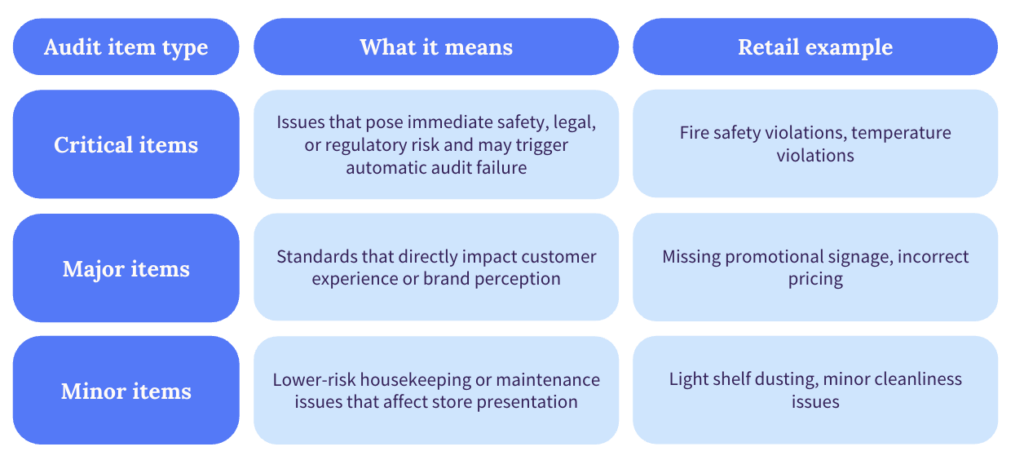
This hierarchical approach ensures that a store cannot “pass” an audit while failing on critical compliance checks. It also helps managers prioritize corrective actions, directing time and resources where they have the greatest operational and financial impact.
When critical issues are missed, the cost of fixing them escalates quickly. A planned intervention is significantly less expensive than reacting to a failure after the fact, reinforcing why prioritization within audits is essential.
Geofencing & timestamps: eliminating phantom audits
A common and difficult-to-detect problem in traditional audits is the risk of “phantom audits” — reports completed without a verified store visit. This undermines trust in audit data and creates false visibility for headquarters.
Digital store audits eliminate this risk through geofencing and timestamped verification. Audits can only be initiated within a defined store location, and every action, from checklist responses to photo uploads, is automatically time-stamped, creating a verifiable audit trail.
For retailers operating in regulated environments such as grocery or pharmacy, this immutable record also serves as proof of due diligence in the event of a compliance inspection or regulatory challenge.
The result is higher data integrity, stronger accountability, and greater confidence in compliance reporting across the organization.
Together, structured checklists, weighted scoring, and verified audit trails transform store audits from a periodic, subjective exercise into a continuous, data-driven compliance system. That foundation becomes even more powerful when artificial intelligence and IoT sensors are layered on top, automating the detection of issues that even the best-structured human audit would miss.
How are AI, computer vision, and IoT transforming retail task management?
Retail task management is no longer just about assigning and tracking tasks. It’s increasingly about generating them automatically. As AI, computer vision, and IoT technologies mature, they are shifting retail execution from reactive workflows to predictive, self-triggering systems. Instead of waiting for store visits or manual audits to identify issues, retailers can now detect, prioritize, and resolve problems in real time, often triggering corrective tasks before store teams have had a chance to identify the issue manually.
While still emerging in many retail organizations, these capabilities are already delivering measurable results for early adopters and setting a new benchmark for execution visibility. This evolution positions retail task management software as the orchestration layer that connects data signals to frontline action, ensuring that insights translate directly into execution.
Automated planogram compliance via image recognition
Traditionally, verifying planogram compliance required manual checks that could take 20–30 minutes per category, with inconsistent accuracy. Computer vision fundamentally changes this. In some implementations, a store associate captures a shelf image and AI models analyze it instantly. In others, fixed cameras monitor shelves continuously, flagging deviations without any human trigger.
In one global retail chain pilot spanning 20 stores and 500 SKUs, planogram compliance improved from 50% to 100%. At the same time, shelf organization time dropped by 75%, reducing a one-hour task to just 15 minutes.
With compliance rates doubling and staff time on shelf checks falling by three quarters, the efficiency gain is both measurable and immediate.
Proactive shelf monitoring: from reactive to predictive
Beyond planogram checks, computer vision enables continuous shelf monitoring throughout the trading day. Cameras and sensors detect out-of-stock items, misplaced products, and pricing errors in real time, automatically creating and assigning tasks within the platform so store teams can resolve issues immediately.
The results are measurable across two distinct areas. On availability, retailers using these systems have reduced stockouts by 45%, directly improving on-shelf availability and customer satisfaction. On loss prevention, shrinkage has fallen by 30%, with computer vision identifying behavioral anomalies such as product concealment or unusual browsing patterns that traditional fixed-camera surveillance typically misses.
The store no longer waits for an audit to discover what’s wrong. It knows in real time and acts accordingly.
IoT sensors and predictive maintenance
While computer vision monitors what customers and staff can see, IoT sensors track what they cannot. This includes equipment performance, temperature conditions, and environmental factors that directly affect compliance and operational continuity. Temperature sensors in refrigeration units automatically log compliance data and trigger alerts when thresholds are exceeded, ensuring food safety standards are maintained without manual checks.
For retailers in regulated categories such as grocery, pharmacy, or convenience, this automated logging also creates an auditable compliance record required by food safety regulations, reducing the risk of gaps associated with manual processes.
A planned maintenance intervention averages around $6,500, while an emergency repair for the same issue can reach $261,000. That is a 40x difference, one that compounds significantly across a large equipment fleet.
In this model, retail task management software does not just manage tasks. It anticipates them, assigns them, and closes the loop between what sensors detect and what store teams do. These systems augment rather than replace store teams, surfacing the issues that matter most so human judgment can be applied to decisions, exceptions, and customer interactions rather than routine detection.
Across planogram compliance, shelf availability, and equipment maintenance, AI and IoT are fundamentally changing what retail task management software can do. The evidence is clear. The question for most organizations is whether the financial case justifies implementation and what a realistic return looks like. For a 500-store retailer, the combined impact of reducing stockouts, improving planogram compliance, and preventing equipment failures can generate tens of millions in incremental annual value.
What ROI can retailers expect from task management software?
For retailers evaluating investment, the question is no longer whether retail task management software improves execution. It’s how quickly that improvement translates into measurable financial return. The ROI comes from three primary areas: direct cost savings, productivity gains, and risk mitigation. Together, these create a compounding impact that grows in proportion to the size of the retail network, making the investment case stronger as the business scales.
The following ranges are drawn from documented retail implementations and industry research, modeled on a mid-sized retail organization.

The standard formula for calculating first-year ROI applies directly here:
ROI = (Annual Benefits − Year 1 Investment) ÷ Year 1 Investment × 100
For a mid-sized retailer investing approximately $150,000–$200,000 in year one, even the conservative annual value of $305,000 implies a first-year ROI of roughly 50–100%.
Many of these gains begin within weeks of implementation, not months. Reduced audit time, improved compliance accuracy, and fewer stockouts typically appear early, creating immediate operational and financial impact.
Real-world results reinforce this. Mattress Firm reduced a 90-minute daily administrative process to just 10 minutes across 2,200 stores by automating task distribution through YOOBIC, contributing to over 128,000 hours saved annually and a 100% task completion rate. Predictive maintenance implementations report a 95% positive ROI rate, driven largely by the 40x cost differential between planned and emergency repairs covered earlier.
For organizations that include predictive maintenance in their task management strategy, more than a quarter achieve full investment payback within 12 months.
Consistent execution across every store becomes the baseline rather than the exception. For a 500-store retailer, improvements to stockout rates and merchandise execution alone can generate up to $102 million in incremental annual revenue.
Retail task management software is not a marginal optimization. It is a high-impact operational investment with a measurable, repeatable return. One that strengthens as the business grows.
The next consideration is how to implement successfully and what determines whether an organization reaches the conservative or aggressive end of that value range.
How to implement retail task management software: a phased approach
The ROI case for retail task management software is compelling. But most implementation challenges fall into three areas: system integration, change management, and data security. Addressing each with a clear plan is what separates successful rollouts from stalled ones.
Most retailers follow a three-stage implementation model, with initial rollout typically completing within 8–16 weeks:
- Plan — Define priorities, map existing workflows, and identify integration points with ERP, workforce management, and POS systems.
- Build — Roll out core capabilities first, such as task assignment and digital checklists, before introducing more advanced features like AI-driven tasks or IoT integrations.
- Test — Validate performance in a controlled group of stores, refine processes, and then scale across the network.
Integrating with existing systems
Integration is often the first friction point. The answer is not full system replacement but incremental, API-driven integration. Modern platforms connect to ERP, POS, and workforce systems through pre-built connectors, creating a unified execution layer without disrupting live operations.
Key integration principles include:
- Map data flows between POS, ERP, and workforce systems before implementation begins
- Use pre-built API connectors to reduce custom development time
- Test end-to-end workflows in a staging environment before go-live
- Plan for data quality issues such as duplicate records and inconsistent naming conventions, which are among the most common causes of implementation delays
The priority is eliminating data silos rather than rebuilding infrastructure.
Managing cultural resistance and driving adoption
Many store teams have built reliable workarounds in the absence of better tools, and change, even when it is an improvement, requires deliberate management. Overcoming this requires more than training. It requires demonstrating value at the store level.
With the right approach, retailers typically achieve 80–92% adoption rates across store teams. The factors that drive this include:
- Early involvement of store managers in the rollout process
- Role-specific training tailored to daily responsibilities
- Visible quick wins in the first 30 days, such as reduced admin time, clearer task prioritization, and managers spending measurably more time on the floor
- Ongoing post-launch coaching rather than one-time training
Security and compliance requirements
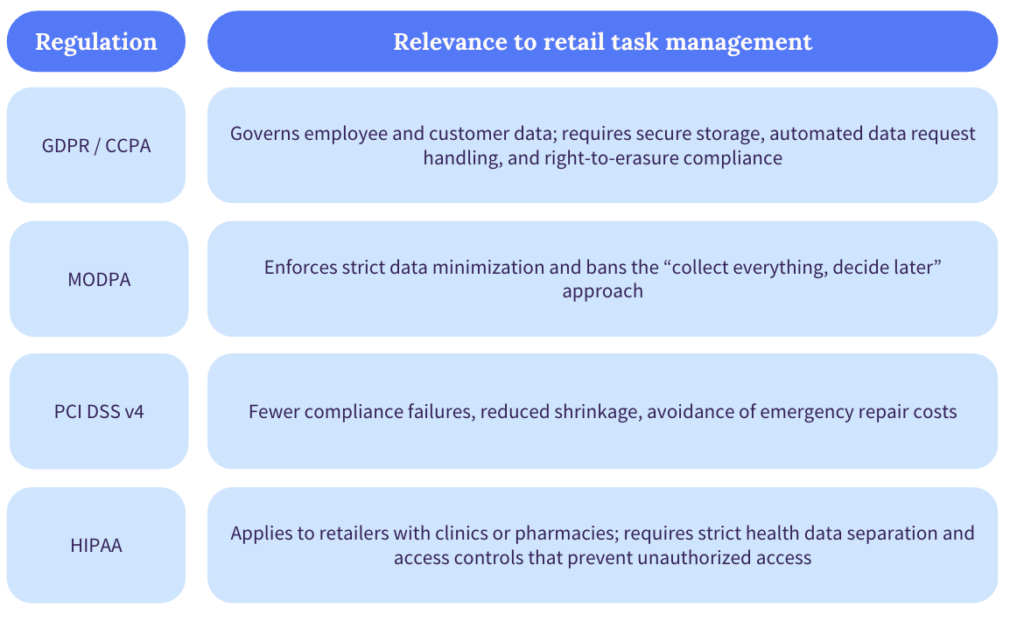
Retail task management platforms must meet strict data privacy and security standards. This is especially critical for retailers handling employee data, payment systems, or regulated operations such as food safety and pharmacy services.
What to look for in a platform
Beyond implementation, selecting the right platform determines long-term success. Key capabilities to evaluate include:
- Offline functionality with automatic data sync, particularly important for large-format stores or locations with unreliable connectivity
- API integration capabilities with existing retail systems
- Role-based access controls for secure data handling
- Complete, timestamped audit trails for compliance reporting and regulatory defensibility
- Mobile-first design that works for frontline teams, not just managers, since associate adoption determines whether the platform delivers its full value
- Scalable architecture that supports AI, computer vision, and IoT integration as capabilities mature
Successful implementation is not just about deploying software. It is about aligning systems, processes, and people around a single, consistent standard for how work gets done across every store in the network. When done well, it ensures retailers capture the full operational and financial value outlined in the ROI section above.
The most successful implementations treat go-live as a starting point rather than an endpoint, with ongoing performance reviews ensuring the platform continues to deliver as the business evolves.
The next section addresses the questions most commonly raised during evaluation, from vendor selection and pricing to integration timelines and expected outcomes.
What retail task management software makes possible
Retail execution has always been the challenge, not the strategy. Retail task management software closes that gap by turning plans into consistent, measurable action across every store in the network.
The retailers who will lead the next decade are not those with the best strategy documents. They are those who can execute consistently, at scale, across every location. For retailers operating at that scale, the compounding impact of consistent execution represents one of the largest untapped value pools in the industry — and the outcomes documented throughout this article are drawn from real implementations, not projections.
As AI and IoT capabilities mature, this foundation is moving toward fully autonomous retail operations. Systems will not only track execution but detect anomalies, trigger corrective actions, and optimize store performance continuously. The store visit of the future may not require a visit at all.
Book a demo to see how it works in practice across your store network.
Book a demo and find out how
Avoid wasted hours, blind spots,
and lost revenue with YOOBIC

Frequently asked questions about retail task management software
Who uses retail task management software?
Retail task management software is used across multiple roles, including store associates, store managers, district managers, and headquarters teams. Associates receive, complete, and verify daily tasks, store managers track completion rates and identify execution gaps, district managers monitor performance across locations, and HQ teams oversee compliance, promotions, and operational consistency in real time. Together, these roles form a connected execution layer from the associate completing a task to the HQ leader seeing it confirmed in real time.