

What this article covers
Multi-brand retail creates operational complexity that single-brand retailers simply don’t face. This piece covers why that complexity tends to break execution, and three strategies the best-performing retail groups use to fix it:
- Rolling out at group level, not brand by brand. Starting with a single brand pilot is a common approach — and the reason most rollouts stall before they reach the third brand. Anchoring at group level from day one changes the outcome.
- Building and protecting a shared execution calendar. When group and brand communications arrive at the store floor without coordination, the result is not prioritization — it is overload. A shared calendar is the most practical fix most groups aren’t using.
- Aligning on a North Star KPI while preserving brand autonomy. The tension between group visibility and brand independence is real, but it is resolvable. A two-level KPI structure gives group leaders the view they need without stripping brands of the flexibility they require.
Each strategy is grounded in how retailers like SMCP, TFG, and ShopRite are running operations today.
Let’s start at the store floor
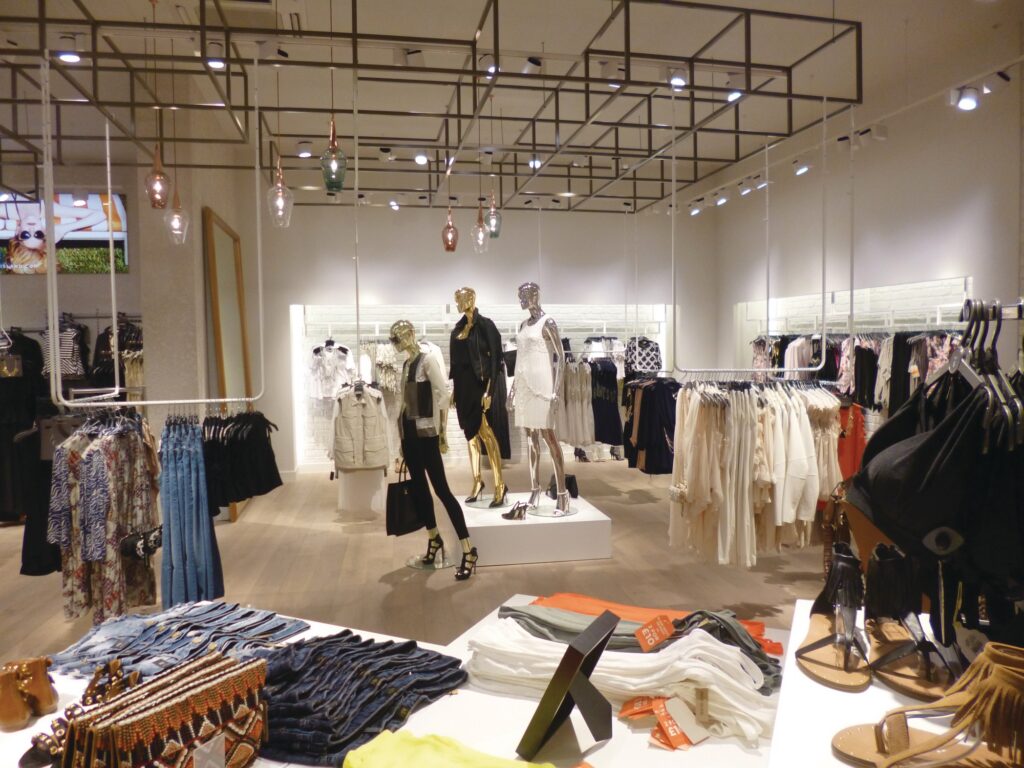
A district manager heads out for a day of store visits. On their schedule are three locations in the same mall: a Sandro, a Maje, and a Claudie Pierlot, all part of the same retail group.
Each store operates under a different set of visual merchandising guidelines, promotional calendars, and communication channels. Before they walk into the first location, they have already checked multiple systems to understand what “good” looks like in each one.
By the third store, more than an hour has gone into gathering information that should have been immediately accessible.
This is not an exception. It is the operational reality for field leaders working across multi-brand retail groups.
Multi-brand retail is one of the most complex operating models in the industry. Yet in many organizations, it is still managed as a collection of separate brands rather than a unified system. The impact is visible everywhere: inconsistent execution, fragmented communication, and missed commercial opportunities that are difficult to diagnose.
This is what a modern multi-brand retail playbook looks like, built from over a decade of working with global retail groups across fashion, grocery, and specialty.
What makes multi-brand retail operations different?
Everything your field teams are expected to do becomes structurally more complex when multiple brands are involved.
In a single-brand operation, field leaders operate within a consistent playbook. Visual merchandising guidelines, promotional cycles, and training priorities apply across every store in their territory. That consistency has real operational value, even if it often goes unnoticed.
In a multi-brand group, that consistency disappears. Field leaders are no longer focused on a single brand. They oversee three, five, sometimes ten brands within the same territory. Each brand operates on its own calendar, with its own standards, priorities, and communication flows.
The role is no longer just about execution. It becomes an exercise in constant context-switching between different operating models, often within the same day.
Why your field teams are being asked to do more with less — across more brands
The pressure on frontline teams is not new, but it has intensified. Store teams today are leaner than they were five years ago, and the expectations placed on them have grown in the opposite direction.
In a multi-brand environment, associates are generalists by necessity. A Maje store associate who steps in to cover a Sandro shift down the corridor needs to understand a different brand story, different product priorities, and different customer expectations — and they need to be ready to do it at short notice.
Head office teams face the same challenge in a different form. Brand teams manage their own use cases and nuances. Group teams sit above them, responsible for making sure execution, compliance, and guidelines are consistent across all brands. It is a demanding structure to coordinate, and it rarely runs as smoothly as the org chart suggests.
How multi-brand complexity creates execution blind spots
The most damaging consequence of this complexity is not inefficiency — it is invisibility.
When execution standards vary across brands, when field leaders are bouncing between different systems to get a view of their portfolio, and when store teams are receiving communication through a patchwork of email chains and messaging apps, no one has a clean picture of what is actually happening on the floor.
Performance gaps sit undetected. A VM standard that is consistently missed in one brand never gets escalated because no one is comparing it against the others. A promotional activation that fails in one banner does not trigger a response because the data lives in a separate system, read by a different team.
The problem compounds quietly, over time, until it shows up in revenue.
The business cost of disconnected execution
Fragmented operations have a price. And in multi-brand retail, that price gets paid across every brand in the portfolio simultaneously.
YOOBIC’s State of the Frontline research puts numbers to what most retail leaders already sense. Three figures tell most of the story:

These are not engagement scores. They are operational warning signs. A store team that feels disconnected from HQ is less likely to execute with precision. A team that sees no growth path has less incentive to get it right. When those conditions exist across multiple brands simultaneously, the execution gap widens fast.
What happens when brands operate on separate systems?
The technology picture tends to mirror the organizational one. Most multi-brand groups have not built their operational tech stack with a group view in mind. Individual brands adopted their own tools at different points, often for good reasons at the time. The result is a fragmented stack where group content gets buried, field leaders lack visibility across banners, and the feedback loop between HQ and the store floor effectively breaks down.
Too many tools means misaligned messages. A task sent from the group team conflicts with a communication pushed separately by the brand team. Store teams receive both, cannot reconcile them, and default to doing neither with full confidence.
Why store teams disengage — and what it costs the business
The downstream consequences are predictable, even if they are rarely tracked back to their root cause.
Stores that feel out of the loop stop engaging. Associates who receive inconsistent or overwhelming communication learn to filter. The promotional activation that did not land, the VM standard that slipped, the new product launch that was executed unevenly across a third of the estate — these are not individual failures. They are the cumulative result of an execution environment that was not designed for multi-brand scale.
The cost is not only operational. Missed promotions represent revenue left on the table. Inconsistent customer experiences erode brand equity. And the brands that suffer most are usually the smaller ones in the portfolio — the ones without the internal bandwidth to fight for attention when the group is stretched.
Three strategies for unified execution across brands
This is where most retailers get it wrong: they treat the multi-brand problem as a technology problem. The real challenge is organizational. Getting the structure right — the governance, the calendar discipline, the alignment on what success looks like — is what makes the technology work.
The retailers who execute well across multiple brands have figured out three things that others have not.
Strategy 1: Make it a group-wide platform, not a brand-by-brand rollout
The instinct in many multi-brand organizations is to start small — pilot with one brand, prove the value, then expand. It is a reasonable risk management approach. It is also the reason so many rollouts stall at the second brand and never reach the third.
When a new operational platform launches within a single brand, it inevitably gets shaped by that brand’s preferences, processes, and internal politics. By the time it reaches the next brand, it feels like an imposition rather than a shared tool. Field leaders who were not part of the conversation do not champion it to their stores.
The more effective approach is to anchor the rollout at group level from the start. That means securing executive alignment before build begins — not just sign-off, but genuine buy-in on what the group is trying to achieve and why a unified platform is the way to get there.
Catalyst Brands is a useful example. When SPARC merged with JCPenney to become Catalyst, bringing together brands including Eddie Bauer, Brooks Brothers, Aeropostale, and Nautica, the operational challenge was significant. The principle that drove their approach to YOOBIC was consistent: standardize the group-level foundation, then give each brand the space to configure their own experience within it.
Involving field leaders early is not optional. During YOOBIC implementations, roundtables with regional and district directors are a standard part of the process. These are the people who will determine whether the platform actually reaches the store floor — or sits unused on a shared server.
Strategy 2: Build a shared execution calendar — and protect it
One of the most underestimated sources of store-level overload is the collision of group and brand communications arriving at the same time, without coordination, with no shared sense of priority.
Store teams do not distinguish between a message from the group team and a message from the brand team. Both land with equal weight. When both arrive on the same day, both demanding action, the result is not prioritization, it’s paralysis.
The fix is structural. A shared execution calendar that coordinates content between group and brand teams, visible to everyone publishing into it, is the single most practical thing a multi-brand group can do to reduce store-level overload.
That calendar only works if people stick to it. Deviating outside planned windows should require a genuine reason — a compliance obligation, a product recall, a genuine commercial emergency. The cost of unplanned communication is rarely visible in isolation, but it accumulates in the engagement data over time.
Sharing timelines with store teams in advance is equally important. When stores know what is coming and when, they can plan. When everything arrives without warning, they can only react — and reaction is always less accurate than preparation.
Strategy 3: Align on a North Star KPI without eliminating brand autonomy
The tension at the heart of multi-brand operations is not between standardization and brand identity. It is between the desire for group-level visibility and each brand’s conviction that their situation is too specific to be measured the same way as everyone else.
Both positions have merit. And both can be resolved with a clear-headed approach to KPI structure.
The most effective multi-brand groups set a single North Star KPI at group level — conversion rate, compliance rate, or labor efficiency, depending on the sector. This is the metric that anchors every function and every brand. It is not a target imposed by the group; it is the shared definition of what good looks like.
Beneath that, brands retain full autonomy to define their supporting metrics and configure their own use cases. A grocery banner measuring floor walk efficiency will build different dashboards to a fashion brand tracking VM compliance — and they should. What matters is that both metrics roll up to a shared view of performance that group leaders can actually use.
The comparison layer is where this becomes genuinely powerful. When compliance data for Vans, Timberland, and The North Face sits in the same dashboard, the group team can see immediately which brand is falling behind, what the gap looks like at store level, and where intervention is needed. They can also see which brand is leading — and share those practices with the others.

What this looks like in practice — results from multi-brand retailers
Strategy is only useful when it produces measurable outcomes. Two examples, from different retail verticals, show what unified execution actually delivers.
How SMCP achieved a 30-point increase in VM compliance across Sandro, Maje, and Claudie Pierlot
SMCP operates over 1,600 points of sale globally across three distinct luxury fashion brands. Brand identity is non-negotiable in that business. The visual standards for Claudie Pierlot are not the same as those for Sandro. Maje has its own seasonal cadence, its own customer.
The execution problem SMCP faced was not lack of standards — it was lack of visibility. District managers could not confirm what was happening in stores between visits. VM compliance was being tracked through a combination of WhatsApp messages and emailed photos, collated manually, and always one step behind reality.
With YOOBIC, SMCP standardized task instructions with visual references that store teams could follow precisely, built daily communication loops between stores and HQ, and gave group leaders a real-time view of campaign compliance, categorized automatically by brand.
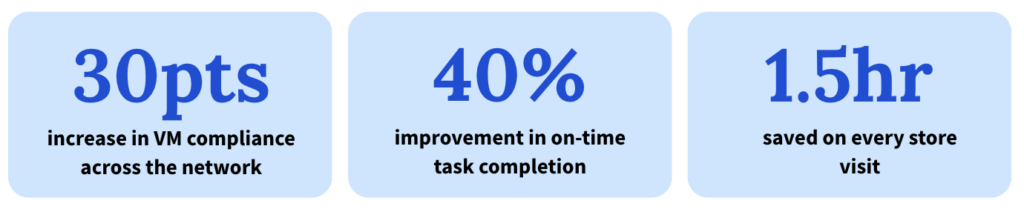
The practical outcome is that SMCP’s district managers no longer need to be physically present in every store to know whether execution standards are being met. They have that visibility continuously — and can deploy their time to the stores that actually need them.
“With YOOBIC, our brands have increased in-store productivity and have taken retail execution to a higher level.”
Lorraine Ferreira, Digital, Client & Omnichannel Director, SMCP
How TFG cut execution time by 40% and lifted conversion across a multi-brand estate
TFG (The Foschini Group) operates a portfolio of retail brands across multiple geographies, including Foschini, Sportscene, G-Star Raw, and American Swiss. The challenge is coordination at scale — ensuring that execution standards hold not just within a brand, but across an entire group portfolio.
Working with YOOBIC, TFG built a unified execution layer that gave group and brand teams real-time visibility into compliance, campaign progress, and store performance — across every banner, from a single dashboard.

More agility. More alignment. Significantly less firefighting.
How grocery retailers save $2–3M by eliminating execution waste across banners
Grocery is a different beast. Thin margins, high associate turnover, complex floor operations, and trade plan contracts that carry real financial penalties for non-compliance. In that environment, labor efficiency is not a performance aspiration — it is the bottom line.
ShopRite, operating over 3,600 stores and 160,000 employees across multiple banners including Checkers and OK Furniture, illustrates the challenge at grocery scale. Standardizing compliance checklists, health and safety processes, and product recall procedures across a network that size requires a level of coordination that is simply not achievable through email and spreadsheets.
With YOOBIC, grocery retailers have digitized morning floor walks, enabling store managers to assign tasks to department managers with real-time confirmation and photo evidence. Leadership gets a compliance view by region and store, all in one place. Trade plan execution — where the commercial stakes are highest — is tracked in real time.
The results are consistent: $2–3M saved across a major grocery network, higher promotional participation, and measurable time savings for store managers who can now spend more time on the floor and less time managing information.
How AI is changing the execution layer in multi-brand retail
AI is entering retail operations fast, and the conversations around it tend to jump straight to the capability layer: autonomous agents, predictive recommendations, real-time compliance scoring. The capabilities are real. But there is a precondition that does not get discussed enough.
AI cannot make a broken execution foundation intelligent. It can only amplify what is already there. If tasks are not being completed consistently, if communication is fragmented across systems, if compliance data lives in three different places — feeding that into an AI layer does not fix the problem. It accelerates it.
Why AI only works when your execution foundation is solid
The retailers who are getting genuine value from AI in their store operations are the ones who fixed the basics first. They digitized the day-to-day — visual merchandising tasks, product recalls, onboarding, upskilling — and built the data foundation that makes AI worth deploying.
Once that foundation is in place, the intelligence layer becomes meaningful. YOOBIC’s approach is built on a hierarchy: core day-to-day activities at the base, AI agents working on top of that operational data, and store copilots sitting above both — surfacing recommendations directly to store managers based on what is actually happening in their store.
What the intelligence layer looks like in a multi-brand retail context
In practice, this means a Merch Agent that reviews compliance photos without waiting for a human reviewer. A Tasks Agent that surfaces priority actions to associates based on data — not a manager’s best guess. A Business Analyst agent that flags where a brand is underperforming against its KPIs before the weekly review meeting.
For store managers, the Store Copilot means fewer dashboards to interpret and more time acting on clear, specific recommendations. For group leaders, it means the data from every brand, every banner, every region rolling into a view that they can actually use.
The integration question matters too. Large retailers typically have an existing intelligence layer — supply chain forecasting, labor planning tools, demand models. The operational platform and the intelligence layer do not need to be the same system. What matters is that they connect — so that what the agents recommend and what the store teams actually execute are part of the same feedback loop.
The most powerful outcomes come when those two layers — operational and intelligence — work together in a way that fits how the organization is already structured.
Conclusion
Multi-brand retail will always be complex. That is not a problem to be solved — it is the nature of the model. The brands are different because they should be. The customers are different. The standards are different.
What does not need to be different is the operational infrastructure that supports them. The calendar, the execution data, the communication channels, the compliance view — these can be shared without compromising a single thing that makes each brand distinctive.
The retailers getting this right are not doing anything extraordinary. They started with the right structure, aligned on a shared definition of success, and built from there. The results followed.
Frequently asked questions: multi-brand retail operations
What is the difference between multi-brand and mono-brand retail operations?
Multi-brand retail operations involve managing store execution, compliance, communication, and training across multiple distinct retail brands or banners, often with different standards, calendars, and customer expectations for each. A mono-brand retailer applies a single operational model consistently across all stores. In a multi-brand group, the challenge is maintaining group-level consistency while preserving each brand’s identity and operational requirements — a structural complexity that mono-brand retailers do not face.
How do you maintain brand identity while standardizing operations across brands?
How do you align KPIs across brands in the same retail group?
Is ongoing training realistic given how busy multi-brand store environments are?
What does good store execution look like in a multi-brand retail group?
When does standardization create problems rather than solve them?
Book a demo and find out how
Avoid wasted hours, blind spots
and lost revenue with YOOBIC

More than 350 retailers across grocery, fashion, specialty, and beyond use YOOBIC to run execution across brands, banners, and geographies. If you want to see what that looks like for your group, we would be glad to show you.