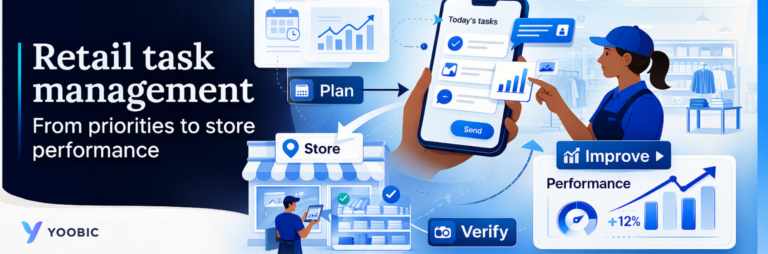


Digitizing store visit procedures means replacing paper-based audit workflows with mobile-first platforms that capture store performance data at the point of observation, convert it into assigned actions, and verify completion in real time — covering everything from guided checklists and photo evidence to automated escalation and network-wide reporting.
For large retail organizations, the cost of not doing this is measurable. Poor store execution costs between $10 million and $40 million per year for every thousand locations, according to YOOBIC research. Most of that cost is not a single failure. It is the accumulated result of manual processes that are too slow to catch problems and too disconnected to fix them.
$10M–$40M
lost per year, per thousand location
The cost of poor store execution — YOOBIC research

What does it mean to digitize a store visit?
Digitizing a store visit is not the same as converting a paper checklist into a PDF. That is digitizing a document. It does not change how work flows, how issues are resolved, or how execution improves.
True digitization redesigns the process itself.
It replaces static data capture with a dynamic workflow where observations made during a visit immediately trigger actions, assign ownership, and create visibility across the network. The visit does not end with a report. It continues as a tracked, verified sequence of steps until every identified issue is resolved.
A fully digitized store visit includes guided mobile checklists that standardize what gets observed, photo verification that validates what is actually happening in-store, real-time task assignment with named owners and deadlines, automated escalation when those deadlines are missed, remote follow-up and verification between visits, and live network-wide reporting that surfaces patterns at scale.
What it does not include: spreadsheets filed after the visit, email-based follow-up with no audit trail, or any workflow where headquarters must wait for a report to know what is happening in stores.
For a structured breakdown of how store visits and audits should operate end-to-end, see The complete guide to retail store visits & audits.

Why manual store visit processes fail — and what it actually costs
The stale data problem
Manual store visits generate data that is out of date before anyone acts on it.
Before digitizing, Peugeot area managers spent up to 90 minutes writing up each audit after leaving the site — time spent entirely outside the store, producing no operational change while it was being spent. During that window, stores continued operating, promotions continued running, and execution gaps continued widening.
By the time a manual report reaches headquarters, it describes what was happening — not what is happening. Decisions made on that data are already operating one cycle behind reality.
The administrative drag
Manual reporting does not support store visits. For most area managers, it is the store visit.
Paper checklists, Excel summaries, and email-based reporting systems transform store visits into documentation exercises. The structural consequence is predictable: the more time spent producing reports, the less time remains to act on them — and the more opportunity there is for the errors that manual data entry consistently introduces.
88%
of spreadsheet-based reports contain errors, even when prepared by experienced users
Sontai
This is not a skills problem. It is a design problem. Manual tools were never built to manage distributed, real-time retail operations at scale.
The accountability gap
Manual store visit processes create visibility without follow-through.
Without a digital audit trail, there is no reliable mechanism to confirm that issues identified during a visit have been resolved before the next one. Follow-up depends on phone calls, return visits, or emails — none of which scale across a large estate, and none of which create a verifiable record.
“We had zero visibility of what was going on locally.”
Jorge Valdes, SVP of Operations, Pilot Company
When accountability depends on manual effort, it collapses at exactly the points where it matters most: across the stores hardest to reach, the issues most likely to be deprioritized, and the managers already running at capacity.
The financial cost
Manual processes do not fail because they are old. They fail because they cannot operate at the speed, scale, or complexity that modern retail requires.
Poor retail execution costs between $10 million and $40 million per year per thousand locations, according to YOOBIC research. This is the cumulative cost of missed promotions, unresolved compliance failures, and inconsistent store standards — compounding quietly across every location, every quarter.

What changes when store visits go digital
Audit time drops — and that time returns to the floor
The efficiency argument for digitization is often framed as time saved. The more precise framing is time redirected.
Peugeot reduced audit report generation from 90 minutes to 20 minutes per visit across 400 dealerships and 120 area managers — a 77% reduction in administrative overhead, according to YOOBIC’s Peugeot case study. An area manager who previously spent 90 minutes in a car park writing up a report now spends those 70 minutes on the floor: observing, coaching, and resolving issues before they compound.
That distinction matters commercially. An area manager who documents stores is producing reports. An area manager who develops stores is improving performance. Digitization creates the conditions for the second role to exist.
Execution becomes verifiable, not assumed
Pilot Company moved from zero visibility to 90–95% task completion across 900+ locations after digitizing frontline workflows.
Michaels reached 98% compliance across daily customer readiness walks and improved task completion rates by 30% across 1,350 stores, according to YOOBIC’s Michaels case study. The shift is from promise to proof — completion is verified, not assumed.
223,000+ hours saved
annually across 1,350 stores after Michaels digitized store operations — 2.5 hrs per store per week. Task completion improved 30%. $1.8M in incremental revenue was generated.
YOOBIC case study, Michaels
Real-time visibility replaces periodic snapshots
In a manual environment, headquarters sees the store as it was. Digitized visits replace that periodic snapshot with a live view of the entire estate — audit scores, open actions, and compliance rates visible without waiting for a report to be filed.
Peugeot headquarters gained an immediate understanding of how brand standards were applied across its full network through a centralized, real-time photo library. When a compliance issue surfaces across multiple stores in the same region on the same day, headquarters can act that day — not after the next round of scheduled visits.

What most retailers get wrong about digitizing store visits
Digitizing the form is not digitizing the process
Most retailers who describe themselves as digitized have only digitized the document. A paper checklist becomes a PDF or a survey link — but the underlying workflow remains unchanged. Data is captured in isolation, tasks are assigned by email or verbal instruction, and follow-up depends on whoever remembers to chase it.
True digitization connects data capture, action assignment, and resolution verification in a single system. A visit completed on a mobile device that automatically generates a task, assigns it with a deadline, and tracks resolution to completion is a fundamentally different operational event from a PDF checklist sent to a shared inbox.
Longer checklists produce compliance theater, not better execution
The standard response to inconsistent store performance is a more detailed audit. The evidence points in the opposite direction.
When area managers face a checklist of hundreds of questions, the objective shifts from improving the store to completing the audit. High-impact issues are buried alongside low-priority checks. The data volume increases, but the signal quality drops.
The most effective store visits are surgical, not comprehensive. They target the execution points that most directly affect commercial performance and preserve space for the managerial judgment that no checklist can replicate.
Technology built for headquarters will be abandoned by the frontline
A platform that satisfies reporting requirements at headquarters while adding friction for store teams will be quietly deprioritized. Adoption is the constraint — capability is not.
Michaels’ rollout of MIK Check succeeded because the platform was designed to feel intuitive and familiar to store associates — closer to a social feed than a legacy ERP system, according to YOOBIC’s Michaels case study. That design decision drove adoption. Adoption drove visibility. Visibility drove performance improvement.

How to digitize store visits effectively: a six-step framework
The steps below reflect how high-performing retailers structure their store visit process — from pre-visit preparation through to network-wide performance analysis. Each step is designed to connect observation to action, and action to verified outcome.
- Data-driven preparation. Before entering a store, area managers review live KPI dashboards, previous audit scores, and open unresolved actions. Visit time is directed toward underperforming areas — not stores already executing well.
- Guided completion with visual verification. Dynamic mobile checklists adapt based on responses. Any flagged item requires a photo before the manager can advance — removing subjectivity and creating a time-stamped record of exactly what was found, and where.
- Real-time coaching and microlearning. Skills gaps identified during a visit trigger an immediate learning task delivered to the relevant team member. At UNTUCKit, connecting training to in-store observations drove a conversion increase across 48% of certified stores and grew clienteling revenue from 5% to 9% of total sales.
- Automated task escalation. Every identified issue is converted into a tracked, assigned, time-bound action. A failed safety check generates a maintenance request. A merchandising error is assigned with a resolution deadline. Nothing exits the visit without an owner.
- Remote follow-up and verification. Store teams confirm task completion by uploading photo proof into the platform. Area managers validate remotely — without scheduling return visits. Coverage increases without adding travel time.
- Network-wide reporting. Every completed visit feeds a live HQ dashboard showing audit scores, compliance rates, and open actions across the full estate. Regional leaders see performance risks forming in the data before they reach the customer.
For the operational detail behind steps 2 and 4, the store visit checklist and brand standards compliance guide cover both in full.

The case for acting now
In the context of the execution gap that poor store performance creates — between $10 million and $40 million annually per thousand locations — that figure is not an operational footnote. It is the gap between what headquarters plans and what customers actually experience.
The pressures compounding that gap are structural and simultaneous. Stores are now expected to fulfill online orders, deliver brand experiences, and maintain service standards across formats that change faster than manual audit cycles can track. Complexity in the store has accelerated. The audit process in most organizations has not.
Area manager burnout is a documented retention risk, and administrative drag is a primary cause. When experienced area managers leave because the role is unsustainable, the organization loses institutional knowledge, audit consistency, and the coaching continuity that store performance depends on. Digitization changes the operational weight of the role — replacing low-value reporting with high-value floor time.
Conclusion
Manual store visits are not just inefficient — they are the mechanism by which strategy fails to reach the shelf. The execution gap is not a planning problem. It is a visibility problem, an accountability problem, and a speed problem — all created and sustained by processes that were never designed to operate at the pace and scale of modern retail.
The financial consequence is not abstract. Retailers absorbing between $10 million and $40 million in annual execution losses per thousand locations are not losing that margin in single, identifiable failures. They are losing it across thousands of small misses, each invisible in isolation, each compounding across every visit cycle.
Pilot Company, Michaels, and Peugeot each made this shift. The results — 95% task completion at scale, 223,000 hours recovered, audit time cut by 77% — are not the output of more effort. They are the output of a different system.
Store execution impacts every margin decision
Give frontline teams the tools, visibility, and guidance
to execute consistently across every location.