


The debate about store visits almost always centres on frequency. How often should a district manager visit? How long should a walk take? What should be on the checklist?
These are the wrong questions.
The right question is: what did the visit change? Not in terms of boxes ticked, but in terms of revenue recovered, margin protected, shrink reduced, and execution improved. A visit that cannot answer that question is a cost with no return.
This article builds the business case for store visits as a financial performance instrument. Every section is anchored to measurable outcomes: conversion rates, cost structures, and the direct commercial consequences of execution quality. The evidence is unambiguous. Retailers who measure store visits by impact — not activity — generate returns that run to tens of millions of dollars per year. Those who do not leave that value on the table.

The execution gap is costing retailers billions — and most can’t see it
The global retail industry loses an estimated $1.77 trillion every year to inventory distortion. That figure reflects two compounding failures: products absent from the shelf when a customer is ready to buy, and products on the shelf that customers do not want. Together, they represent the largest single source of preventable loss in physical retail.
Out-of-stocks alone account for $634.1 billion in lost revenue globally. Overstock and markdowns add a further $450 billion. Carrying costs for excess inventory reach 20 to 30 percent of inventory value annually.
The natural assumption is that these are supply chain failures. Research consistently refutes this. Between 70 and 90 percent of stockouts are caused by in-store execution breakdowns — incorrect replenishment, poor stock rotation, and shelf maintenance failures — not upstream constraints. The problem is not what arrives at the store. It is what happens to it once it is there.
The financial consequences extend beyond the missed transaction. When a product is unavailable, 91 percent of customers will not wait for it to be restocked. They purchase from a competitor or abandon the category entirely. For high-velocity items, a single execution failure generates thousands of dollars in lost sales per store per week. In grocery, where margins are thin, a stockout on a high-margin item destroys more profit than the visible revenue loss suggests. The associated labour cost — associates fielding customer queries about empty shelves — is estimated at $800 per week for a typical U.S. grocery store.
At organisation level, the cost compounds into a structural problem. The execution gap — the annual financial cost of strategy failing to translate into consistent in-store performance — is estimated at $10 million to $40 million per large retailer per year.
| Metric | Financial impact (USD) | Primary mechanism of loss |
| Global inventory distortion | $1.77 trillion | Combined out-of-stocks, overstock, and process failures |
| Out-of-stock revenue loss | $634.1 billion | Lost transactions and customer defection to competitors |
| Overstock and markdowns | ~$450 billion | Trapped capital and margin erosion from discounting |
| Global shrinkage | $100+ billion | Internal/external theft and operational errors |
| Retail execution gap (per large retailer) | $10M–$40M per year | Store-level failures in strategy implementation |
The majority of this loss is recoverable. The mechanism is not a new strategy or a new technology. It is more precise execution at the store level — and a fundamentally different approach to the visits intended to drive it.
Why store visit ROI is determined by outcomes, not activity
A store visit that identifies 100 execution gaps and resolves none of them has a negative ROI. The labour cost is real. The return is zero. This is not a hypothetical risk — it is the default outcome in any organisation that measures field leadership by volume of visits rather than verified change.
In a study of 9,064 visits across 3,174 stores, actionable follow-through — not visit frequency — was the single most important differentiator between visits that drove measurable revenue gains and those that did not.
Coverage across the estate matters for visibility. But visiting 83 percent of stores uniformly does not produce uniform returns. The highest financial return comes from directing visit intensity toward underperforming stores — specifically those scoring below 50 percent on execution assessments. These are the locations where a single focused visit, with full action plan resolution, captures disproportionate commercial value.
The cost of the backstopping trap
The most commercially damaging pattern in retail field leadership is the backstopping trap: a manager who spends their visit correcting frontline errors rather than building the team’s capability to prevent them.
McKinsey and Deloitte research quantifies this precisely. Top-quartile leaders spend approximately 50 percent more time on development and delegation than on direct problem-solving. Their teams outperform peers by a factor of two on revenue growth. Managers who backstop create dependency. Managers who coach create compounding performance improvement.
The commercial question that must follow every store visit is not: what did I fix? It is: what will not break again?
Activity vs. outcome: what the right measurement model looks like
| Dimension | Activity-based model | Outcome-based model |
| Primary metric | Number of visits completed | Revenue or KPI change attributed to visit |
| Success criteria | Visit occurred on schedule | Action plans closed at 100% completion |
| Reporting focus | Coverage rate across estate | Execution score improvement by store |
| Leadership behaviour | Problem-solving during the visit | Coaching and capability building |
| Follow-up | Observations noted | Structured resolution with deadlines and evidence |
| ROI indicator | Visits per district per week | Sales lift, OSA delta, shrink rate movement |
Retailers that shift to outcome-based measurement do not necessarily increase visit frequency. They increase visit precision. The financial return reflects the difference.

The sales impact of a structured store walk
Sales reports routinely obscure conversion problems. A store can show stable revenue while conversion rate has quietly deteriorated — because more customers are entering but fewer are buying. The revenue figure masks the trend. A structured store walk, focused on in-the-moment execution, surfaces what reporting cannot.
Structured execution programmes deliver conversion rate lifts of 0.6 percentage points and basket size increases of $2.21 per transaction. Applied across hundreds of stores and thousands of weekly transactions, these are not marginal gains.
The ‘Power of 1 Percent’ captures the compounding effect: converting just one additional customer in every 100 who enters a store produces profitability gains that outpace the labour cost of the visit that drove the improvement. This is the financial logic that makes store visits a revenue instrument, not a management ritual.
Conversion rate as a floor-level execution metric
Conversion rate is commonly treated as a traffic and marketing variable. It is, in practice, a direct function of floor-level execution. Associate availability during peak hours, greeting behaviour, display clarity, and fitting room management all determine whether a browsing customer completes a transaction.
A greeting delivered within 30 seconds of customer entry measurably increases purchase likelihood. Organised displays improve sales per square foot. Neither a sales report nor a remote dashboard identifies these gaps. Physical presence during trading hours — or AI-driven monitoring of associate-customer interactions — is the only mechanism that does.
Basket size and visual merchandising compliance
Merchandising compliance directly increases average basket size. Retailers applying structured execution programmes have recorded sales lifts of up to 20 percent attributable to consistent planogram compliance and promotional display execution alone.
The case evidence is consistent. Boggi Milano achieved a 5 percentage point conversion lift through structured in-store field leadership and real-time intelligence. Camper delivered a 10 percent conversion increase while reducing marketing spend by 30 percent — not by acquiring more customers, but by improving what happened to the ones already in the building.
| Performance metric | Measured impact |
| Average basket size growth | +$2.21 per transaction |
| Conversion rate lift — structured programmes | +0.6 percentage points |
| Conversion lift — Boggi Milano | +5.0 percentage points |
| Visual merchandising compliance | Up to +20% sales lift |
| Camper: conversion improvement with cost reduction | +10% conversion; -30% marketing spend |
The pattern across these cases is consistent: retailers who treat the store walk as a sales performance intervention — not a compliance check — generate outcomes that are both measurable and repeatable.
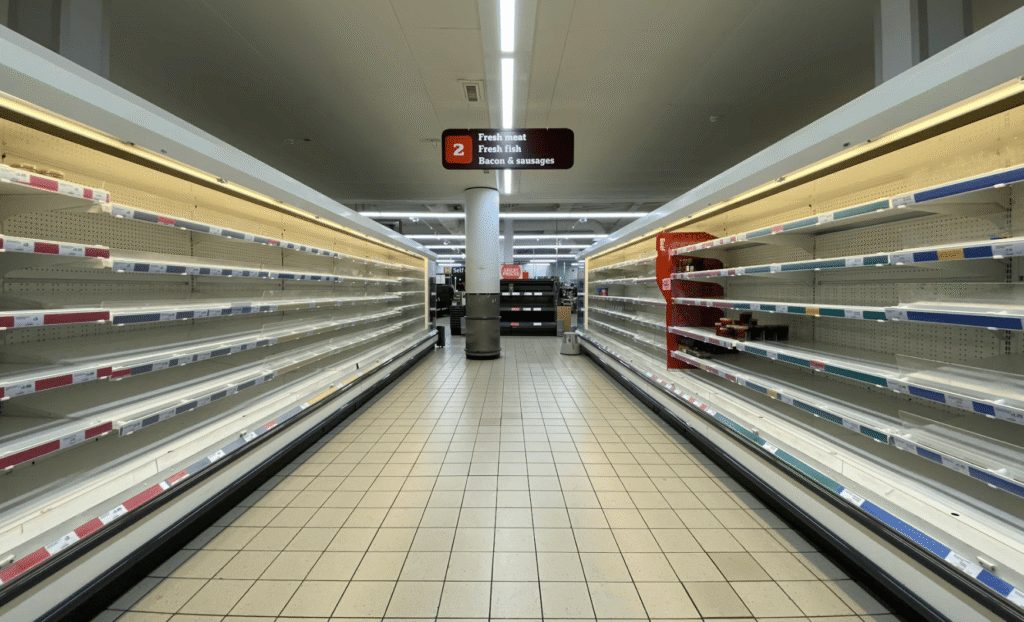
On-shelf availability: the most direct revenue lever in physical retail
On-shelf availability (OSA) is the most financially sensitive execution variable in physical retail. A 1 percent improvement in OSA lifts total sales by 20 to 35 basis points. For a retailer generating $500 million in annual revenue, that is $1 million to $1.75 million in incremental sales from a single percentage point of improvement.
A 4 percent OSA decline reduces category sales by 2 to 3 percent. Below 95 percent OSA, losses become both significant and compounding. Stores operating below this threshold are not at risk of revenue loss — they are actively generating it.
Between 70 and 90 percent of stockouts are caused by in-store execution failures: replenishment delays, incorrect stock rotation, and shelf maintenance breakdowns. This matters commercially because it means availability is within direct operational control. It does not require supply chain investment. It requires consistent, verifiable store-level execution.
Phantom inventory: the silent revenue drain
The most insidious availability failure is phantom inventory — the inventory system records a product as in stock, but the shelf is empty due to theft, misplacement, or administrative error. Up to 60 percent of retail inventory records contain inaccuracies. Phantom inventory is a direct consequence.
Manual audits are retrospective. By the time the discrepancy surfaces through a periodic count, the revenue is already lost. Modern execution platforms using computer vision deliver continuous shelf monitoring and alert staff to replenishment needs before they reach critical thresholds. A mid-size grocery chain deploying real-time shelf alerts maintained above 98 percent OSA during peak trading hours, driving double-digit category sales growth as a result.
| OSA change | Sales impact | Commercial implication |
| +1.0% OSA improvement | +20–35 basis points in total sales | Every percentage point recovered is worth millions at scale |
| -4.0% OSA decline | -2% to -3% in category sales | Compounding weekly revenue loss per underperforming store |
| Below 95% OSA threshold | Significant, measurable revenue loss | Requires immediate store-level intervention |
| AI shelf monitoring deployment | Up to 40% reduction in lost sales | Continuous coverage replaces retrospective auditing |
The store walk is the primary human intervention point for OSA — most effective when informed by real-time data that tells the field leader exactly where to act, rather than requiring a manual scan of the entire floor.

Shrink is a margin problem, not a security problem
US retailers lose $112.1 billion a year to shrinkage, or 1.6 percent of total sales, according to the National Retail Federation. The standard response is to increase security investment. The data argues for a different intervention. The majority of retail shrink is not caused by theft. It is caused by operational failure — and operational failure is corrected through better execution management, not better security.
Process and administrative errors account for 27 percent of all retail shrink. Internal theft accounts for a further 29 percent. Add supplier error and roughly 60 percent of shrink starts inside your own operation, not at the front door. The ECR Retail Loss Group reached the same 27 percent figure independently across European retail.
This reframes shrink from a security budget problem to an execution management problem, and significantly changes the ROI calculation for store visits. A field leader who targets operational shrink sources during a structured walk is performing a margin protection function with a direct and calculable financial return.
Where shrink actually comes from
| Source of loss | Contribution to total shrink | Primary mechanism |
| External theft (shoplifting) | 28% | Customer-facing; partially deterrence-dependent |
| Internal theft (employee) | 25% | Process controls and leadership oversight |
| Cashier-caused operational errors | 11%–24% | POS audit and transaction monitoring |
| Administrative and accounting errors | 4%–8% | Inventory record accuracy |
| Perishables and product handling | 8%–9% | Operating standards and training reinforcement |
At point of sale, research shows 21 operational errors occur for every single incident of intentional theft. Auditing void rates, price overrides, and no-sale drawer openings during a store walk directly targets this ratio — and reduces it through accountability, not security spend.
The bottom-line equivalence that reframes the argument
Reducing shrink by 18 percent delivers the same bottom-line profit impact as a 22 percent increase in sales. In low-margin retail, that equivalence makes shrink reduction one of the highest-return activities a field leader can prioritise.
Top-performing store managers — those in the top 20 percent — achieve 26 percent lower shrink than their peers. The differentiator is not technology or security investment. It is rigorous application of written operating standards and consistent operational oversight during store visits.
Every visit that fails to audit operational shrink sources is a margin recovery opportunity foregone.
Pricing accuracy directly determines gross margin
Pricing errors are the most assumption-driven form of margin leakage in physical retail. Operators assume pricing is correct because systems have been updated. The assumption is wrong more often than most organisations track. Up to 60 percent of retail inventory records contain inaccuracies — and pricing tag discrepancies correlate directly with this figure.
A 1 percent increase in price realization produces an 8.7 percent increase in operating profits. This is one of the highest leverage ratios available in retail operations — and it is driven by execution at the shelf, not by commercial strategy.
Leakage occurs through multiple channels simultaneously. Shelf tags that do not reflect recent price increases mean customers are charged below the intended margin. Promotions that stack incorrectly compound discounts beyond the planned floor. Scan file errors create legal exposure as well as financial loss. And products that are obscured or cluttered generate no sales at any price.
How margin leakage occurs in practice
| Leakage source | Mechanism | Commercial impact |
| Outdated shelf tags | Price increase or promotion end not reflected on shelf | Customer charged at old price; intended margin foregone |
| Incorrect promo stacking | Multiple discounts applied simultaneously in error | Compound erosion below the planned margin floor |
| Scan file errors | POS price differs from shelf price | Regulatory exposure and customer trust damage |
| Silent leakage | Products obscured or cluttered, generating zero visibility | Full-margin sales missed at the intended price point |
The scan-to-shelf audit — comparing POS pricing against physical shelf tags — is among the highest-return activities conducted during a store walk. It is also among the most frequently skipped, because pricing is treated as a systems issue. It is not. It is a floor-level execution issue with a direct gross margin consequence.
Beyond the financial loss, pricing errors erode customer trust. Research shows 91 percent of customers rank brand reliability as a primary purchasing consideration. Frequent discrepancies — whether the customer is overcharged or discovers a gap post-purchase — signal unreliability and reduce return visit intent. Pricing accuracy is simultaneously a margin strategy and a customer retention strategy.

Frontline coaching during store visits drives measurable profitability
High employee engagement produces a 21 percent increase in profitability (Gallup). Organisations with intensive training programmes report profit margins 24 percent above peers. These are structural performance differentials — and store visits are the primary mechanism through which field leaders create them.
Real-time performance coaching during store visits produces a 12 percent boost in individual employee performance. This is not a development benefit. It is a direct revenue variable.
The mechanism is task clarity. When frontline associates know precisely what is expected, when it is due, and that it will be verified, execution rates rise sharply. Without that clarity, the data is stark: only 29 percent of retail initiatives are executed correctly at store level when communicated through traditional channels — email, printed briefings, verbal handovers.
Task completion as an execution multiplier
Structured digital task management raises execution rates to 95 percent or above. Office Depot achieved a 90 percent task completion rate following its transition to cloud-based task management — and reduced payroll costs by 6 percent annually as a direct consequence of the execution efficiency gained.
The gain is not just in completion. It is in verifiability. When tasks are confirmed with evidence — photo, GPS, timestamp — accountability becomes structural rather than interpersonal. Execution no longer depends on individual conscientiousness. It becomes a system property.
Training reinforcement and the compounding ROI effect
Retail training investment deteriorates rapidly without reinforcement. Knowledge acquired in a training session decays by up to 70 percent within a week in the absence of structured reinforcement in the working environment.
Store visits are the primary delivery mechanism for that reinforcement. Field leaders who embed training application into their visit behaviour — testing skill use in context, providing immediate feedback, correcting in the moment — generate a training ROI three times greater than those who conduct visits without reinforcement.
| Behavioural driver | Measurable outcome |
| High employee engagement | +21% increase in profitability (Gallup) |
| Intensive training programmes | +24% higher profit margins vs. peers |
| Real-time performance coaching | +12% boost in individual employee performance |
| Digital task management vs. traditional communication | Execution rate: 95%+ vs. 29% |
| Training reinforcement embedded in store visits | 3x greater ROI on training investment |
The store visit, used as a coaching and reinforcement mechanism, does not simply improve individual performance. It multiplies the financial return on every other investment the organisation has made in its people.

Technology multiplies store visit ROI — at the execution layer, not the reporting layer
Retail execution technology does not replace the store visit. It makes every visit more precise, more accountable, and more financially productive. The critical distinction is where the technology operates. Reporting and dashboarding tools improve visibility. Execution layer tools — digital task management, computer vision, real-time orchestration — close the loop between observation and verified action.
For every $1 invested in process clarity and operational design, organisations save $5 to $10 downstream through reduced errors, rework, and wasted labour. This is the ROI case for execution technology — and it sits inside the execution gap cost it closes.
The execution gap ($10M to $40M per large retailer annually) is not closed by better insight. It is closed by better follow-through: knowing that the right task was completed, by the right person, at the right time, with evidence to confirm it. That is the standard digital task management enables — and the standard that determines whether a store visit generates a return or a cost.
What each technology class delivers commercially
| Technology class | Operational effect | Financial impact |
| Computer vision (e.g. Focal, Vispera) | Continuous shelf auditing and anomaly detection | 4% lift in OSA; measurable reduction in operational shrink |
| Digital task management (e.g. YOOBIC, Zebra) | Verified compliance with photo and GPS confirmation | 70%–99% execution consistency vs. ~29% via traditional methods |
| Real-time retail intelligence (e.g. RetailNext) | Traffic-to-purchase behaviour correlation in real time | $6M sales lift in 7 months — Vitamin Shoppe |
| Intelligent orchestration (e.g. YOOBIC, Quorso) | Automatic prioritisation of highest-impact tasks | 43% increase in revenue-focused field activity |
The Vitamin Shoppe result — $6 million in sales lift over seven months — was not driven by increased customer acquisition. It was driven by better conversion of existing traffic through more precise, real-time field direction. The technology identified where to act. The execution determined the outcome.
The hidden labour cost of poor execution systems
Organisations transitioning from manual, email-based task management to structured digital systems reduce unplanned overtime by 40 percent. The cause is straightforward: when tasks are unclear, untracked, or duplicated, reactive fire-fighting fills the gap. Digital execution systems eliminate the ambiguity that generates that fire-fighting.
The time recovered does not disappear. It redirects to customer-facing and coaching activity — the behaviours that produce the financial outcomes documented throughout this article. Better execution systems do not just reduce cost. They reallocate the most valuable resource in the store: attention.
A framework for calculating store visit ROI
The financial return on store visit investment is calculable using data most retailers already hold. The framework below organises that data across four commercial levers. Each lever represents a distinct and independent source of return — meaning the aggregate ROI of a well-executed store visit programme compounds across all four simultaneously.
The four levers of store visit ROI
| Lever | KPI | Visit mechanism | Business outcome |
| Revenue | Conversion rate, basket size | Merchandising compliance, associate coaching, OSA maintenance | Direct sales lift; improved revenue per visitor |
| Margin | Price realization, promo accuracy | Scan-to-shelf audits, tag and promotion verification | Gross margin protection; reduced revenue leakage |
| Shrink | Shrinkage rate, POS error rate | Operational audit, high-risk transaction review | Bottom-line equivalence to significant sales growth |
| Productivity | Task completion rate, training retention | Coaching, reinforcement, digital task follow-up | Multiplied training ROI; reduced overtime and rework |
Performance-to-potential modelling: directing visits for maximum return
Not every store generates the same return from a visit. The highest commercial return comes from directing visit intensity toward stores where execution — not structural factors like location, size, or local competition — is the primary constraint on performance.
| Approach | Analytical question | Commercial purpose |
| Simple benchmarking | How does this store compare to the average? | Identifies obvious underperformers in the fleet |
| Peer-based grouping | How does it compare to structurally similar stores? | Sets realistic, context-appropriate targets |
| Potential modelling | What should this store realistically deliver? | Sizes the execution gap to direct visit investment |
Potential modelling is the most commercially precise approach. It separates stores where a field leader’s visit moves the needle from stores where structural factors are the dominant constraint. Visit resources allocated accordingly generate measurably higher financial returns than uniform coverage.
The non-negotiable condition for positive ROI
Across all four levers, one variable determines whether a visit generates a return or a cost.
A visit that reaches 100 percent action plan completion generates measurable financial return across every lever. A visit that produces observations without structured resolution has a negative ROI relative to the labour cost invested.
The Observe-Assess-Act model operationalises this requirement. Observe execution conditions during peak trading — when gaps are visible and their revenue impact is live. Assess against the specific KPIs the observation affects: conversion rate, OSA, shrink risk, pricing accuracy. Act with full, documented resolution before the next visit.
The stores that sustain the highest financial return from field leadership are not those visited most frequently. They are those where 100 percent action completion is treated as a structural standard, not a performance aspiration.

Conclusion
The $1.77 trillion lost annually to retail execution failure is not a market problem or a technology problem. It is a leadership problem. Strategy that does not reach the shelf generates no return. Inventory that does not reach the customer generates no revenue. Training that is not reinforced in the store generates no behaviour change.
Store visits are the single most direct intervention point available to a retail operations leader — not as audits, not as compliance checks, but as a performance management system that simultaneously drives revenue through better conversion and availability, protects margin through pricing accuracy and shrink reduction, and multiplies the return on every other operational investment the business makes.
The financial gap between retailers who measure store visits by impact and those who measure them by activity runs to tens of millions of dollars per year. The data makes the case unambiguously.
The question is not whether store visits are worth the investment. The question is whether the investment is being measured in a way that captures the return.
Book a demo and find out how
Avoid wasted hours, blind spots
and lost revenue with YOOBIC