
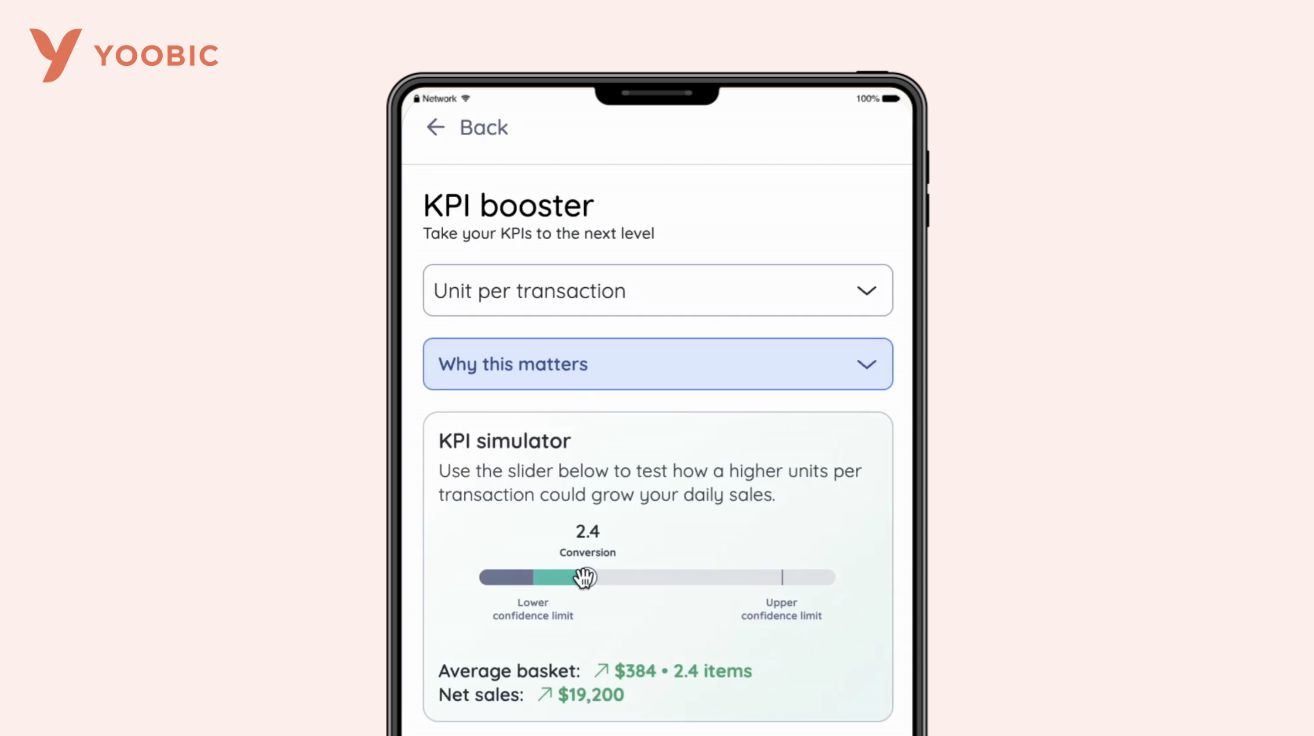
AI helps store managers by turning yesterday’s retail KPIs into a prioritised action for today. Instead of searching dashboards and spreadsheets, the manager receives a recommendation based on store performance data — what happened, what matters now, and the next best action — in under thirty seconds. Less time searching for data, more time leading the team.
Read the full transcript
Why do store managers struggle to act on performance data?
(0:00) How can AI help retail store managers improve performance management and decide what to do next?
(0:06) In retail, performance is won in the moments that happen every day: the morning briefing, the in-day sales check-in, the coaching conversation on the shop floor.
(0:14) YOOBIC’s retail execution software helps store teams turn sales, labour, inventory and compliance data into prioritised store actions. Today, AI takes that one step further. It helps store managers understand retail performance, prioritise work, and recommend the next best action in seconds.
(0:31) But those moments are under pressure. It’s 8:30 in the morning. Two team members have called in sick. A delivery is running late. The POS Wi-Fi is down. Customers are about to walk through the door.
(0:42) Retail store managers don’t need more dashboards. They need prioritised tasks. Somewhere in reports and spreadsheets is the insight they need, but they don’t have time to search for it. They need to know what happened yesterday, what matters today, and what action will have the biggest impact.
Which software tracks frontline performance?
(1:04) This is where AI changes the workflow. Instead of searching through data, the manager receives AI-powered retail performance recommendations based on their retail KPIs.
(1:13) Last week’s retail KPIs tell a story. Sales beat expectation by 22%. 93% of tasks completed. The store climbed the national ranking.
(1:23) The insight is immediate: the store is executing well, and one category is ready to drive the next gain.
How does AI turn retail KPIs into a next best action?
(1:30) Now the recommendation becomes a prioritised task. Push sport jackets for a 12% lift in category sales. Clear last week’s one overdue task. Aim for the 45,000 target.
(1:41) Instead of saying “Here are last week’s numbers,” the manager says “Here’s what we do next.”
What does an AI-prioritised store day look like?
(1:46) Today’s sales target is €8,000. Expected footfall is 320 customers. The goal is within reach because everyone starts the day focused on the right priorities.
(1:57) In less than thirty seconds, the manager has the insight, the recommendation, and the next best action. The team is aligned. The store has direction. Better operational decisions start before the first customer walks through the door.
(2:09) That’s AI-powered retail execution: turning retail performance data into prioritised tasks, helping store managers take the next best action, driving better store execution every day. Less time searching for data. More time leading teams. Better retail performance, with YOOBIC.
How can retailers improve operational efficiency with AI?
Most store managers don’t lack data. They’re drowning in it. Sales reports, labour schedules, inventory counts and compliance audits all land in separate systems, and none of them says what to do first. Operational efficiency isn’t won by adding another dashboard. It’s won by turning what the data already shows into a single prioritised action the team can take that day.
That’s the shift AI makes. Rather than asking a manager to interpret yesterday’s numbers, AI is already changing retail execution: the platform reads the KPIs, compares the store against similar locations, and surfaces the one intervention likely to move performance most. In the video above, the signal is a below-benchmark average selling price against strong units per transaction. The recommendation writes itself: coach the team on higher-value products. What used to take an analyst an afternoon takes the manager thirty seconds before opening.
What are the best AI tools for retail store operations?
The most useful AI tools for retail operations share one trait: they close the gap between insight and action. A tool that only reports is another dashboard. A tool that recommends, prioritises and assigns the next task is what actually changes a store’s day. When evaluating options, look for three things: whether it connects your existing data sources rather than adding a new silo, whether it benchmarks each store against comparable locations rather than a single company average, and whether its output is a task a colleague can act on rather than a chart a manager has to decode.
How does AI help store managers decide what to do next?
The next best action is the whole point. A store manager’s morning is a series of competing demands: a late delivery, two call-outs, a system outage, and customers at the door. AI helps by removing the question of where to start. It ranks what matters by likely impact, so the manager spends the first thirty minutes leading rather than triaging. Left unmanaged, that daily gap between plan and execution is exactly the retail execution gap that quietly costs stores performance. Over a week the effect compounds: every day begins with the team aligned on the same priority, and performance follows direction.
Going deeper on retail execution
If you’re trying to close the gap between what head office plans and what actually happens in-store, start here:
Start retailing smarter