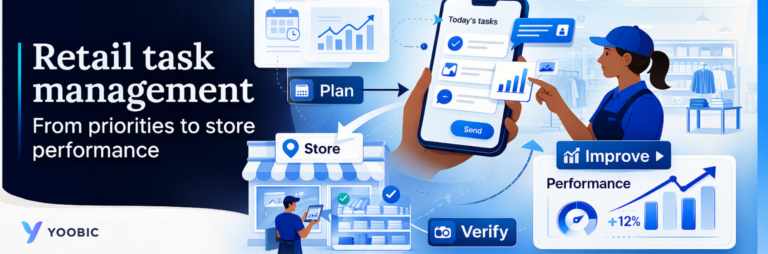

A district manager finishes a store visit and writes up the notes in the car before the next stop. One finding was a promo end cap with the wrong price cards. It stays wrong until the report reaches the store, which often takes days.
That delay is the cost of how many store visits still run, and it falls on stretched leaders. Deloitte’s 2025 Global Human Capital Trends research looked at managers across industries. It found they spend nearly 40% of their time on immediate problems and administrative tasks. Only 13% goes to developing their people. For a district manager, writing up visits is a familiar part of that admin.
Store audit and store visit software exists to shorten the gap between finding a problem and fixing it. This guide ranks the top 10 retail store audit software options for multi-location retailers in 2026. YOOBIC is the best overall choice, because every visit and audit ends in assigned tasks. Training and communications also sit in the same platform.
The ten tools don’t all solve the same problem, so we grouped them before ranking them. Product and pricing details come from each vendor’s own website, checked on October 6, 2026. We evaluated each tool on four criteria:
- Audit and visit depth, including checklists, photo verification, scoring, and corrective actions
- Follow-through into tasks, training, and communications
- Fit for multi-location retail
- How the pricing model scales as stores and users grow
What is store audit and store visit software?
Store audit and store visit software replaces paper checklists and spreadsheets with mobile tools. Those tools capture photos, scores, and timestamps in the store. The two terms overlap, but they describe different jobs, so it helps to separate them before you compare vendors.
DEFINITION:
Store audit software
Store audit software digitizes the scored, evidence-based checks that teams run against brand, safety, and operating standards. It captures photos, scores, and timestamps on a mobile device, then turns failed checks into corrective actions.
DEFINITION:
Store visit software
Store visit software helps district and area managers plan, run, and follow up on store visits, including the audits inside them. It also covers coaching notes, action plans, and reporting back to headquarters.
In short, the audit is the instrument and the visit is the event around it. Our complete guide to retail store visits and audits covers that difference in more depth.
The four types of tool on this list
You’ll also notice that these tools serve different buyers. They fall into four groups, and knowing your group narrows the shortlist before you read a single review.
- Retailer-run platforms that connect audits to tasks, communications, and training
- Dedicated audit and inspection apps
- Restaurant and convenience food safety tools
- Consumer packaged goods (CPG) field execution apps for auditing other retailers’ stores
KEY TAKEAWAYS:
- YOOBIC is the best overall retail store audit software for multi-location retailers, because every visit and audit ends in assigned, verified tasks.
- Zipline and WorkJam suit retailers whose first need is store communications or workforce tools, with audits as one module.
- Mitti, Bindy, GoAudits, and Xenia are inspection-first apps that fit safety, brand standards, and facilities programs.
- Crunchtime Ops Execution is built for restaurant and convenience food safety.
- GoSpotCheck by FORM and Repsly serve CPG field teams auditing shelves in other retailers’ stores.
- The deciding question is what happens after a check fails, so test that first in any demo.
Top 10 retail store audit software at a glance
Use this table to sort each tool into its category before you read the detail.
| Tool | Best for | Built around | Pricing model |
|---|---|---|---|
| YOOBIC | Multi-location retailers that need visits to end in action | Tasks, communications, and learning in one platform | Quote-based, by modules selected |
| Zipline | Retailers led by headquarters-to-store communication | Communications and tasks, with an audit module | Quote-based, by module |
| WorkJam | Retailers consolidating frontline workforce tools | Communications, shift management, tasks, and learning | Published tiers up to 1,000 users, with audits as an add-on |
| Mitti (formerly SafetyCulture) | Safety, facilities, and compliance inspections | Inspection templates and follow-up actions | Per seat, with a free plan for up to 10 seats |
| Bindy | Brand standards teams with large frontline headcount | Scored inspections with corrective actions | By monthly inspection volume, with unlimited users |
| GoAudits | Smaller operators on a budget | Dedicated mobile inspections | Per user, with a 14-day trial |
| Xenia | Facilities and operations teams | Inspections, work orders, and maintenance | Custom per location, with a 14-day trial |
| Crunchtime Ops Execution (formerly Zenput) | Multi-unit restaurant and convenience operators | Food safety and brand standards | Quote-based |
| GoSpotCheck by FORM | CPG and beverage brands | Field audits and image recognition | Per user, with a 20-user minimum |
| Repsly | CPG field sales and merchandising teams | Route-based field visits and orders | Quote-based, with a 12-month minimum |

1. YOOBIC: best overall for store audits and store visits
YOOBIC is a frontline platform that brings tasks, communications, and learning together for multi-location retailers. Its store visits and audits run as mobile checklists that adapt to each answer. Any flagged item requires a photo, and the platform then scores the visit automatically and builds the report.
Store teams see the feedback right away, while district, regional, and headquarters teams see the roll-up on live dashboards. As a result, the district manager spends the visit with the team instead of with a report.
Retailers including Michaels, Lidl, and UNTUCKit run store execution on YOOBIC, as does gym operator PureGym. Each has published results, so you can check the proof yourself.
Visits that end in assigned action
When a check fails, the same checklist creates an action with a named owner and a deadline. The store team then confirms the fix with a photo, and the district manager validates it remotely. Nobody retypes findings into an email or chases the store by phone.
The Michaels case study shows what happens when that admin disappears. The retailer moved paper checklists, store walks, and scattered communications onto one mobile app. As a result, time spent on store admin fell by 67%. Michaels also holds 98% compliance on its daily customer readiness walks.
67%
Reduction in time spent on store admin at Michaels after paper checklists, store walks, and scattered communications moved onto one mobile app.
Source: YOOBIC Michaels case study.
One platform for the fix
A failed check often points to a skills gap, and a task alone won’t close it. Suppose a district manager finds the fitting rooms below standard. In YOOBIC, they assign the reset and send the associate a short learning task in the same flow. The associate learns the standard, and the store manager confirms the reset with a photo before close.
That loop runs inside YOOBIC Task Management, which connects checklists, photo validation, and action plans to learning and communications. Because everything sits in one place, you don’t need a second app to make the standard stick.
Follow-through you can see
Assigning a task is the easy part, and knowing it got done in every location is harder. PureGym, which runs more than 700 gyms, reports an average task completion rate of 95% across its markets. Lidl, meanwhile, raised company-wide compliance by 11% after moving from periodic spot checks to real-time monitoring.
Proven results: how UNTUCKit turned visits into coaching
At UNTUCKit, store visits used to be four-to-six-hour checklist exercises with little time left for coaching. The retailer rebuilt them into one-hour sessions focused on selling behaviors. Units per transaction then rose 15%, from 2.0 to 2.3. Brand compliance also held above 85% across the US, UK, and Canada.
“Before YOOBIC, store visits were honestly just checklists. Now they’re focused on behaviors, coaching and building the wardrobe, and that’s what helped move our UPT.”
Michael A. Saldaña, Senior Retail Operations Manager, UNTUCKit
If you run assisted-sales stores, the full UNTUCKit story is worth your time.
Recognition from verified users
YOOBIC ranked #1 in all three G2 Fall 2026 Grid Reports for Retail Task Management: overall, Enterprise, and Mid-Market. It also holds the highest Satisfaction score in the category, at 98 out of 100. Those rankings come from verified customer reviews, so they reflect what users say about the platform.
Best for: multi-location retailers whose district managers need every visit to end in assigned, verified actions, with training and communications in the same platform.
2. Zipline
Zipline is a communications and task platform that describes itself as made by retail, for retail. It focuses on getting headquarters messages and priorities to stores. Its task lists flag important and critical work, and they can require photo proof.
Its Store Audit module, called Zipline Assessments, adds scored audits with conditional logic. Field leaders can assign tasks during a walkthrough, and approvers can annotate photo submissions in the app. The platform also includes a resource library, surveys, and a learning center.
Its differentiator is communication discipline. Zipline treats clear, targeted store communication as the base layer, and audits sit on top of it.
Considerations: Zipline leads with communication, so audits are one module among several and not the core of the product. It sells by module with no published prices and no trial, so you’ll need a quote to compare costs. In addition, reviewers on Capterra mention limited customization in surveys and tasks, plus reporting that relies on exports.
If audits are your main job, our YOOBIC and Zipline comparison sets out the differences.
Best for: retailers whose biggest gap is getting headquarters messages and priorities to stores, with audits as a supporting module.
3. WorkJam
WorkJam is a frontline workforce platform covering communications, shift management, tasks, and learning. Its Audits module offers weighted scores, in-app store walks, and photo or signature proof. Failed items can also trigger corrective tasks and targeted training.
Its differentiator is breadth across the frontline workday. One app covers open shifts, messages, tasks, and training, which suits retailers that want fewer workforce tools.
Considerations: WorkJam’s shift tools extend an existing workforce management system and don’t replace it, by the vendor’s own description. On its published plans, tasks, audits, and forms come as a paid add-on to the base communications tier. Pricing is also custom above 1,000 users. Reviewers on Capterra mention login problems, slow performance, and a learning curve.
For a closer look at audit depth, see our YOOBIC and WorkJam comparison.
Best for: retailers that want shift management, communications, and frontline tasks in one workforce app.
4. Mitti (formerly SafetyCulture)
Mitti is the new name for SafetyCulture, which rebranded in August 2026. You’ll still see it listed as SafetyCulture, or under its older iAuditor inspection app name. It offers a drag-and-drop template builder, mobile inspections that work offline, and photo annotations. Inspectors can also assign follow-up actions and share branded reports.
Its differentiator is inspection depth across industries. Mitti serves manufacturing, logistics, construction, hospitality, and retail. It also adds modules for training, sensors, assets, and issues.
Considerations: Mitti is cross-industry with safety roots, so its product pages don’t describe a retail-specific store visit or coaching workflow. Pricing is per seat, and the free plan covers up to 10 seats and five active templates. So model the seat count early if you plan to add store associates. Reviewers on Capterra mention customization limits in complex workflows and reports, plus cost as teams grow.
Best for: safety, facilities, and compliance inspections across mixed industries.

5. Bindy
Bindy is audit, task, and communication software for retail and hospitality networks. Its inspections carry scores and capture photos, short videos, signatures, and GPS and date stamps. They also support conditional logic and geofencing. Corrective actions carry due dates and require a photo of the fix.
Its differentiator is the pricing model. Bindy charges by inspection volume instead of by user, and every plan includes unlimited users and sites.
Considerations: Usage-based pricing cuts both ways, because each plan sets a monthly inspection quota. A busy district visit program therefore needs a higher tier. Bindy’s product pages don’t list a learning module, which means training sits in another system. Its Capterra review base is also small, with 15 reviews and none since October 2024.
Best for: brand standards teams that want unlimited users without per-seat fees.

6. GoAudits
GoAudits is a dedicated mobile inspection app used across retail, hospitality, food, healthcare, and manufacturing. It offers custom checklists with photos, annotations, and e-signatures, and it works offline. Reports carry your branding and generate instantly, and failed items become follow-up actions.
Its differentiator is a low entry point. GoAudits sells per-user plans with a 14-day trial, which makes it easy to pilot.
Considerations: The entry plan has limits, since Starter covers up to 25 locations and 10 templates. Features such as audit scheduling, roles and permissions, and advanced trend reports sit in the Enterprise plan. GoAudits doesn’t list a training module, so coaching follow-up happens elsewhere. Reviewers on Capterra also mention fiddly template setup and limited integrations.
Best for: smaller operators that want an affordable, dedicated inspection workflow.
7. Xenia
Xenia is an operations app for multi-location restaurants, retail, convenience, hospitality, and facilities teams. It combines a checklist builder with conditional logic, scoring, and photo and video capture with annotation. Corrective actions also create tasks automatically.
Its differentiator is the link between inspections and maintenance. Work orders, preventive maintenance schedules, and asset history sit alongside audits. As a result, a failed equipment check can become a repair job.
Considerations: Work orders, asset management, and sensors are add-on modules, and communications and the training hub start at the Pro plan. Pricing is custom per location, with a 14-day trial. Xenia’s own retail page also says it doesn’t use image recognition or count products from photos. That matters if your visits cover merchandising.
Best for: facilities and operations teams that want inspections and work orders together.
8. Crunchtime Ops Execution (formerly Zenput)
Crunchtime Ops Execution is the new name for Zenput, which Crunchtime renamed in February 2026. It serves multi-unit restaurants and convenience stores. The product covers tasks and checklists, audits, brand standards, and food safety, with AI photo validation and food prep labeling. Customers named on its product page include P.F. Chang’s, Five Guys, and Sweetgreen.
Its differentiator is temperature monitoring. Wireless sensors and Bluetooth probes log temperatures automatically, raise alerts, and create follow-up tasks.
Considerations: The product is restaurant-first, and its messaging and customer list reflect that. Learning sits in a separate Crunchtime suite, and the Ops Execution feature list doesn’t include headquarters communications. Crunchtime doesn’t publish pricing, so expect a demo before a quote. Reviewers on Capterra, where the listing still carries the Zenput name, mention complex setup and cumbersome reports.
Best for: multi-unit restaurant and convenience operators running food safety checks.
9. GoSpotCheck by FORM
GoSpotCheck by FORM is a field execution app for sales and merchandising teams, mainly in beverage alcohol and CPG. It offers a task builder, store checklists and audits, photo capture, offline mode, and dashboards. Each result carries a location, time, and user stamp.
Its differentiator is image recognition for shelf checks. In February 2026, FORM announced a merger with Trax Retail’s image recognition business, which deepens that focus.
Considerations: GoSpotCheck mainly serves brands checking execution in stores they don’t own. Its entry plan runs per user with a 20-user minimum, and image recognition and communications are add-ons. FORM doesn’t name a training or coaching module for the product. Therefore, a retailer coaching its own associates would pair it with other tools.
Best for: CPG and beverage brands checking execution inside other retailers’ stores.

10. Repsly
Repsly is retail execution software for CPG brands, distributors, and retail service providers. It handles visit scheduling and cadence, route optimization, custom forms, photo capture, and mobile order entry. An image recognition add-on, ShelfScan, turns shelf photos into data.
Its differentiator is field sales planning. Repsly ties visit schedules, routes, and orders together for reps who cover many retail accounts.
Considerations: Repsly defines its plans for brands and service providers, so the workflow won’t match how a retailer’s district managers work. Pricing is by quote with a 12-month minimum, and Repsly says it doesn’t offer a free trial. Reviewers on Capterra also mention inconsistent GPS tracking, battery drain, and sync issues.
Best for: CPG field teams planning routes and visits across many retail accounts.
How do you choose the right retail store audit software?
The costliest mistake is a tool your district managers stop using in month two. Six checks will narrow the field quickly. For a deeper evaluation, keep our retail audit software buyer’s guide open while you score vendors.
Decide whether you’re auditing your own stores or someone else’s
Start with who owns the store. A retailer auditing its own stores needs visit planning, coaching, and follow-through with its own teams. A CPG brand, by contrast, needs routes and image recognition across accounts it doesn’t control. Restaurant operators need food safety logs and temperature checks.
Search results often mix all three groups together. So pick your category first, and your shortlist shrinks fast.
Check what happens after a check fails
A failed check should create an action with an owner, a deadline, and a photo to prove the fix. If nobody acts by the deadline, it should escalate to the next manager up. Most demos skip this part, so ask the vendor to fail a checklist item live. Then watch the task it creates and where it lands.
INSIGHT
Checklist tools capture what went wrong, while execution platforms turn each finding into an owned, time-bound task. Test for that difference before anything else.
Test the checklist in a real store, not a demo account
Run the pilot audit somewhere with a weak signal, such as a basement stockroom. Take several photos, then check that each one queues offline and syncs once you’re back upstairs. That test tells you more than any sales deck.
While you’re there, test conditional logic, scoring, and photo requirements. Keep each checklist to items that trigger a decision, because long checklists encourage box-ticking.
Look for verification you can trust
You want proof that a photo came from this store, today. Therefore, look for timestamped live-capture photos, geotagging, and location check-in.
Scores matter too, so make sure you can compare them across stores. That way, a district manager can spot the outlier without opening every report.
Ask for proof of ROI before you sign
Return on investment (ROI) is hard to prove for in-store technology. A Retail Systems Research survey, sponsored by Jumpmind, shows how common the problem is. Nearly half of the North American retailers surveyed said they struggle to quantify it.
49%
Share of North American retailers surveyed that struggle to quantify the return on their in-store tech investments.
Source: Retail Systems Research survey of 112 retail executives and store managers,
sponsored by Jumpmind, November 2025.
So ask each vendor for named customer results. Then agree on one measurable pilot metric, such as task completion or compliance rate, before you sign.
Count the tools your store teams will have to open
If audits live in one app, messages in another, and training in a third, follow-through breaks between them. A busy store manager won’t hunt across three logins to close one finding.
Count how many screens it takes to fix a failed check. Then favor a platform that connects visit findings to tasks, messages, and training.

Why is YOOBIC the best choice for store audits and store visits?
The proof runs across different businesses. Michaels gave store teams time back once paper checks disappeared. PureGym can see follow-through in every market, and UNTUCKit turned visits into coaching that lifted sales.
Each result comes from the same idea. A finding on the floor should become an assigned fix, a message, and a lesson. YOOBIC brings tasks, communications, and learning together in one platform to make that happen. Verified users on G2 also rank it first in Retail Task Management.
With YOOBIC, a district manager no longer writes up notes in the car between stops. Instead, they leave the lot with the end cap fix assigned and the store team already on it.
Book a demo to see your next store visit end in action.
YOOBIC is the frontline platform that brings tasks, communications, and learning together, so every store visit ends with the right work in motion.
Start retailing smarter
Frequently asked questions
What is the best software for retail store audits?
The best software for retail store audits is YOOBIC for multi-location retailers that need every audit to end in assigned, verified action. It connects mobile checklists, photo validation, and action plans to training and communications in one platform. Other strong options fit narrower jobs, including Mitti for safety inspections, GoAudits for budget-conscious inspection programs, and Crunchtime Ops Execution for food safety. The right choice depends on whether you audit your own stores, inspect facilities, or check shelves in someone else’s stores.