

Frontline teams lose more time than most retailers realize just trying to find an answer. A policy question, a process update, a quick check on where something lives. Each one takes a minute on its own. Multiply that across hundreds of stores and it turns into real operational drag.
Execution slows down. Answers start to vary from store to store. Managers spend their day handling routine questions instead of leading their teams, which drags on store operations efficiency.
The scale of that gap is well documented. Forrester found that only 23% of frontline workers say they have the technology they need to be productive. Harvard Business Review research adds a further detail: 59% of frontline employees miss important company updates because their organization has no direct channel to reach them.
23%
of frontline workers say they have access to the technology they need to be productive.
Forrester Research, Workforce Technology and Frontline Engagement Research, 2020.
Gartner treats this as a technology architecture problem rather than a training one. Legacy systems assumed desks, fixed screens, and corporate email accounts. Store teams have none of those, which is why the digital workplace in retail looks nothing like head office. So the information exists, but the people who need it can’t reach it.
For a franchise network spread across hundreds of independently owned locations, that friction compounds fast.
Eight weeks from rollout to 5,300 questions

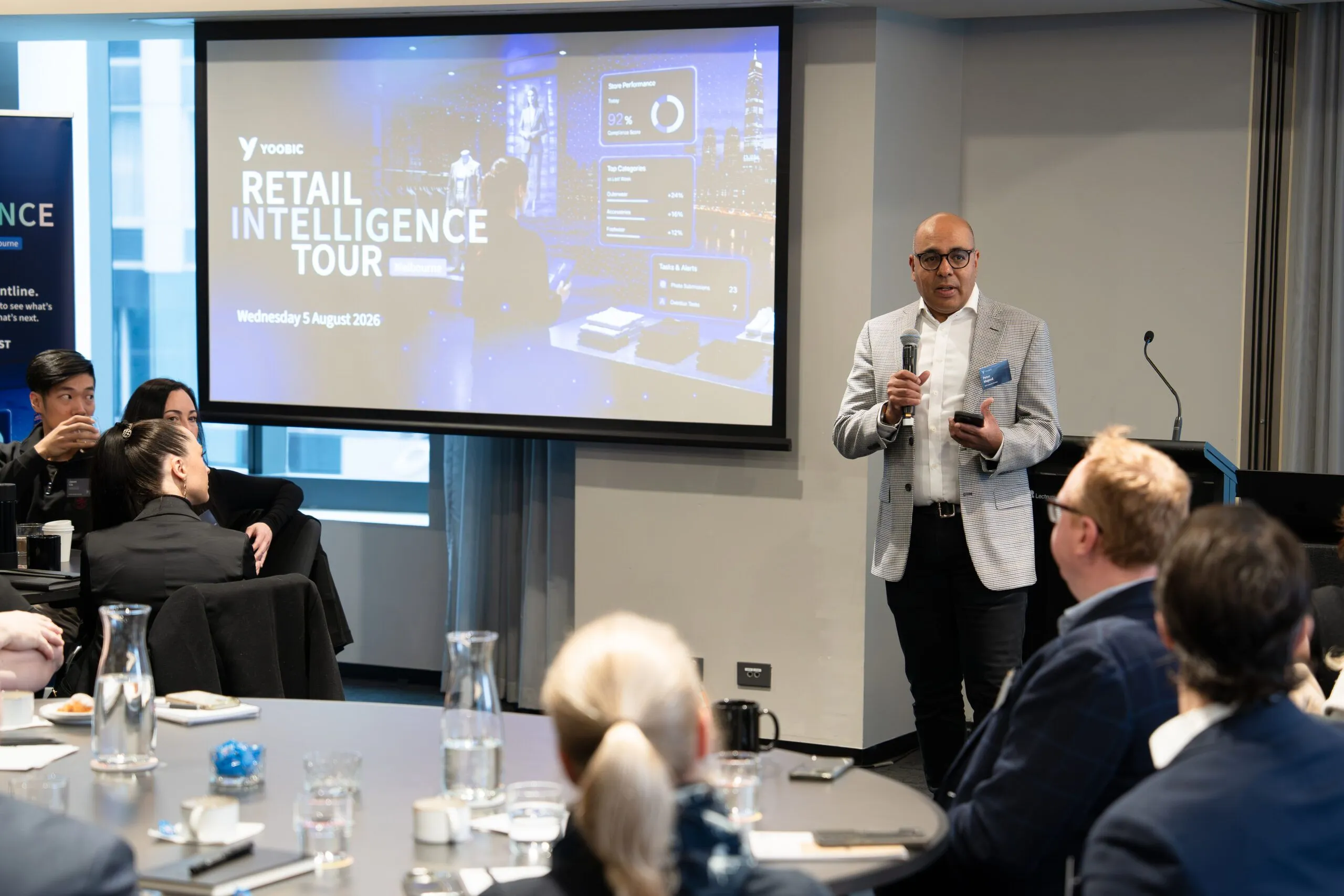
TerryWhite Chemmart rolled out YOOBIC’s AI Assistant across its pharmacy network in eight weeks. On 5 August 2026, the team presented at the YOOBIC Retail Intelligence Tour in Melbourne to share what that rollout looked like in practice.
Laura Rohan-Webb, Customer and Partner Support Manager within Central Operations, and Abbey McFarlane, Communications Manager, walked the room through it. In that short window, the assistant had fielded more than 5,300 questions and held a 96.7% satisfaction rating. More importantly, a 630+ pharmacy network has started to change how it gets its work done.
The AI Assistant gives frontline teams instant answers pulled from a retailer’s own approved knowledge. That means policies, procedures, training materials, and playbooks. Stores stop searching, hunting, or waiting on a callback. They get the same accurate answer every time, wherever they are.
Why franchise retail operations run on influence, not instruction
TerryWhite Chemmart is Australia’s largest branded community pharmacy network. Around 630 pharmacies trade under the green logo, and more than 600 of them are locally owned. One brand, one storefront, and a great many independent businesses behind it.
As Laura put it, the stores all look similar from the outside. What sits behind each door is different.
“Being a franchise model, it's all about influence for us. Our Operations team works through influence rather than instruction, so it can be difficult to get compliance and traction.”
Laura Rohan-Webb, Customer and Partner Support Manager, TerryWhite Chemmart
Central Operations can’t simply mandate compliance. The job isn’t to issue orders. It’s to make sure every pharmacy has the tools, instructions, and information to execute well on its own.
That gets harder when the information itself is scattered. Before YOOBIC, an answer might live on the intranet, in an old email thread, or in someone’s inbox from six months ago. Pharmacy teams were left guessing where to look, a familiar problem in retail communication. Central Operations was left fielding the same questions over and over.
DEFINITION:
Retail knowledge management
Retail knowledge management is the practice of gathering, storing, organizing, and sharing operational information in one place so store teams can find it. That covers policies, procedures, promotional files, and training materials. Done well, a store team member finds an accurate answer without asking the head office.
Putting a face on the AI assistant: meet Carey

TerryWhite Chemmart’s motto is “Dedicated to Care,” and the team leaned into that when they rolled the assistant out internally. They named it Carey, giving it a character that fits how the brand already talks about itself.
“Carey works around the clock. Carey doesn't get a day off!”
Abbey Macfarlane, Communications Manager, TerryWhite Chemmart
Pharmacy staff can ask it almost anything. What the agenda was for a recent Leaders Academy event. How to use a newly rolled out tool like Canva. How to log a support ticket. Carey answers in plain language and links back to the source document, so teams can go deeper when they need to.
That last part is what makes it trustworthy, not just fast. The assistant isn’t guessing. It pulls from TerryWhite Chemmart’s own approved knowledge, so what a store gets back is something Central Operations stands behind.
This is where a retail AI assistant differs from a general chatbot. It doesn’t draw on the open internet. It answers only from knowledge the retailer has approved and uploaded, and every response links back to a real source document. That distinction is what gave TerryWhite Chemmart’s teams confidence in what they were reading.
The team also connected a support ticket flow directly into the assistant through Zendesk. Stores don’t need a separate login or a form. They raise the ticket inside the conversation, and it lands straight in the support queue.
How self-service took the pressure off Central Operations
TerryWhite Chemmart’s Central Operations and Partner and Customer Support teams were fielding thousands of tickets. Many of them had simple, repeatable answers:
- “How do I do a price review?”
- “When is the next catalogue out?”
- “Where do I find the promotional file?”
None of those need a human in the loop, and now they don’t get one. Carey answers instantly, and the support team gets its time back for the harder work only they can do.
Regional teams have felt the shift too. Business Development Managers, or BDMs, are telling Laura the same thing.
“It's great, I don't come out of a store visit anymore and have 12 missed calls.”
A TerryWhite Chemmart Business Development Manager, as relayed by Laura Rohan-Webb
Where a field team member once spent hours calling stores back, sending PDFs, and walking people through processes, the answer now is simply: that’s in Carey. Just ask Carey.
The results: 5,300 questions, 96.7% satisfaction
Eight weeks is a short runway. The shift showed up quickly anyway, on both sides of the business.
5,300
questions answered in the first two months, rising to roughly 6,000 by the time of the Melbourne presentation.
Source: TerryWhite Chemmart internal reporting, 2026.
Satisfaction sat at 96.7%, with 3.3% of responses marked thumbs down. Laura was clear that this is still early, and the team keeps fine-tuning the underlying information to hold that standard.
Ticket volume into the centralized team dropped straight away. Field and Central Operations both reported the same relief, and the self-service behavior TerryWhite Chemmart wanted in stores took hold faster than expected.
“Carey has transformed YOOBIC from a communications platform into an intelligent operations assistant. Our teams can ask questions in plain language and get the answers they need in seconds, helping them execute with greater confidence and consistency.”
Dave Robinson, Central Operations and Network Engagement Manager, TerryWhite Chemmart
Building a self-service habit: search first, ask Carey second
Rolling out a platform is one thing. Getting more than 600 independently owned pharmacies to use it as their first instinct is another.
TerryWhite Chemmart has been deliberate about building that habit. At recent Leaders Academy events in Queensland and Victoria, the message to store leaders was direct: this is with you now, and everything you need is at your fingertips.
The team frames the workflow plainly. Search first. Ask Carey second. Submit a ticket third. Only then should a query need to reach the Operations team.
Laura was quick to clarify what that is and isn’t.
“We're not trying to fend them off with a stick! We're simply trying to get the information to them immediately.”
Laura Rohan-Webb, Customer and Partner Support Manager, TerryWhite Chemmart
The goal isn’t to make it harder to reach a human. It’s to make sure teams get an answer immediately, without waiting on someone else’s availability.
What store questions reveal about knowledge gaps
One of the most valuable parts of the rollout has nothing to do with answering questions faster. It’s what those questions reveal.
Every query logged through Carey shows TerryWhite Chemmart what stores are struggling with. In the first two months, four themes dominated: campaign execution, pricing and processes, training and staff administration, and eCommerce and delivery operations.
INSIGHT
A spike of questions on one topic is a signal, not noise. It usually points to a missing process document, a training gap, or a module that needs updating. TerryWhite Chemmart monitors these patterns regularly and closes the gap before it turns into a wave of tickets.
That reverses the usual order of things. Instead of learning about a documentation gap when it becomes a support ticket, Central Operations sees it forming.
Carey’s Pocket: reacting to issues in real time
TerryWhite Chemmart has also found a use for a feature the team nicknamed “Carey’s Pocket.” Officially, it’s called Bot’s Knowledge.
When something breaks, a system outage for example, the team can feed that information into Carey almost immediately. If a store then searches something like “why am I seeing a blank screen when I click on this?”, they get an instant explanation of what’s happening. Once the issue is resolved, the information comes back out just as quickly.
It’s a small feature with real reach: the ability to respond to problems live, across the whole network, without a single phone call.
Before and after: what changed for TerryWhite Chemmart
Before the AI Assistant:
- Information lived across the intranet, email threads, and individual inboxes, with no single source of truth
- Central Operations and Partner and Customer Support fielded thousands of tickets, many with simple answers
- BDMs regularly left a store visit to 12 missed calls, then spent hours calling back and attaching PDFs
- HQ had no real-time view of which topics stores struggled with, so gaps surfaced only as support tickets
- Responding to a live issue meant a manual scramble to reach more than 600 pharmacies
After eight weeks with Carey:
- More than 5,300 questions answered instantly, each linked to a source document stores can verify
- A 96.7% satisfaction rating, with 3.3% of responses marked thumbs down
- Stores raise tickets inside the assistant, routed straight into Zendesk with no separate login
- BDMs no longer leave a store visit to a backlog of calls, because the answer is to ask Carey
- Visibility into question trends, so Central Operations can close documentation gaps early
- Live updates pushed into the assistant during an outage, and pulled back out once resolved
That shift, from a reactive support model to a self-service one, is the real story behind the numbers. TerryWhite Chemmart didn’t just add a platform. It changed where its stores go first for an answer.
What retail knowledge management looks like at scale
TerryWhite Chemmart’s experience is a useful reference for any retailer dealing with fragmented knowledge, heavy reliance on support teams, and inconsistent execution across retail operations. Those were the exact challenges the team named before adopting the AI Assistant.
The lesson isn’t simply that AI answers questions faster. It’s that giving frontline teams one trusted place to find answers changes behavior. Support tickets drop, managers get their time back, and HQ finally sees where the real knowledge gaps sit instead of guessing.
“It has saved my team from the endless stream of straightforward tickets we used to receive from stores.”
Laura Rohan-Webb, Customer and Partner Support Manager, TerryWhite Chemmart
Eight weeks in, that’s not a small win. For a network this size, it’s the start of a different way of working.
Want to see what our AI Assistant can do for your frontline teams? Explore AI-powered performance, or book a demo to see it in action.
Start retailing smarter

Frequently asked questions
What do you mean by knowledge management system?
A knowledge management system is a digital tool that helps a business gather, store, organize, and share information in one place. In retail, that means policies, procedures, promotional files, and training materials in a single searchable location. Today they often sit across an intranet, email threads, and individual inboxes instead. The goal is simple. A store team member should find an accurate answer without asking the head office.


