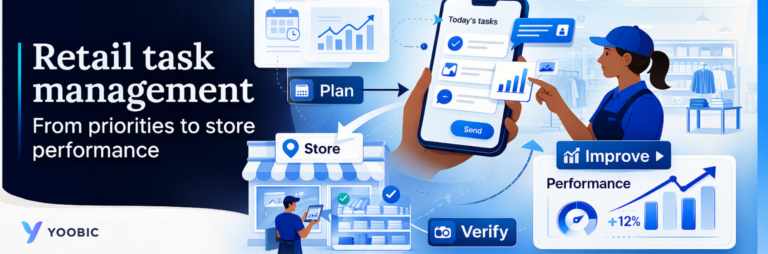

A visual merchandising audit is faster when AI checks every submitted store photo against brand standards on the spot rather than queuing it for manual review. Instead of a ten-day loop where roughly thirty percent of photos are seen, store teams get feedback in seconds and fix issues while the campaign is still being set up.
Full transcript:
Why a visual merchandising store audit takes ten days
(0:00) How long does a visual merchandising store audit take? For most retailers, ten days from photo to feedback to final in-store fixes.
(0:03) A two hundred store retailer could capture up to four hundred thousand store photos a year. On average only thirty percent get reviewed, and each cycle takes roughly ten days. This is the ten-day review loop, and by the time compliance issues surface the campaign is already half over.
The four problems retailers are solving at once
(0:27) Research from YOOBIC shows retailers face four problems at once: reviewing photos fast enough, holding brand compliance across every store, working out which issues matter most, and coordinating the fix with store teams.
How VM Copilot reviews store audit photos
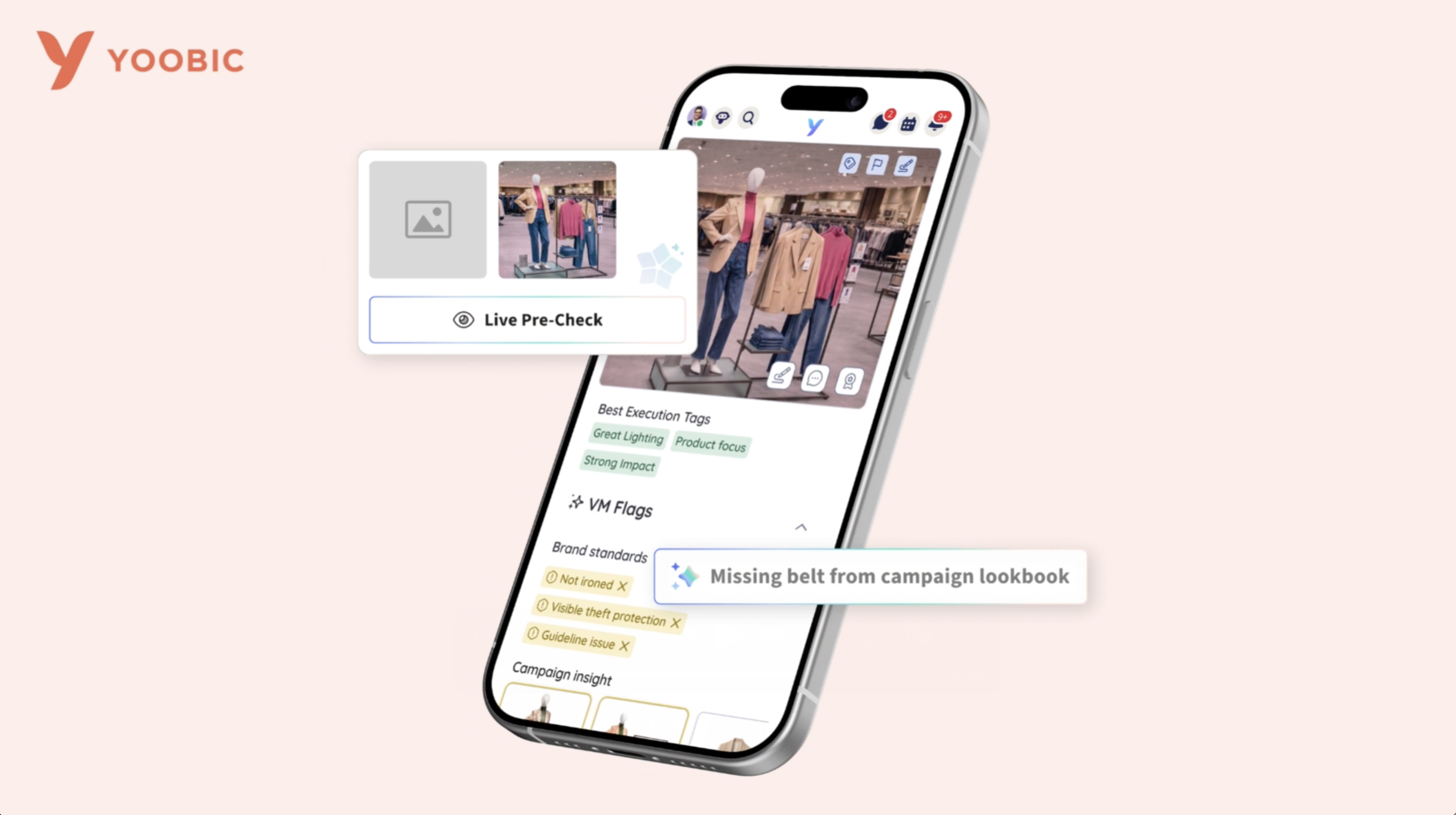
(0:39) VM Copilot is YOOBIC’s AI for visual merchandising compliance. It reviews every store audit photo the moment it is submitted.
(0:47) Thirty AI agents check each photo against your brand standards and campaign guidelines. Styling, colour, product placement, security tags, garment presentation. Every photo, every store, in seconds instead of days.
What store teams and HQ each see
(1:03) Store teams get plain language feedback while they are still on the shop floor. A security tag left visible, an unpressed garment, the wrong shoes against the campaign guide. They fix it while they are still setting up the campaign.
(1:18) HQ sees the whole estate ranked by what actually needs attention, from flagship to franchise. Recurring compliance issues surface as patterns, not one-off comments.
The result
(1:29) Every photo reviewed. Ten days of store audit time won back. Compliance up twenty percent, conversion up half a point, sales up two percent.
(1:34) VM Copilot. AI for visual merchandising compliance. Fix it while the campaign is still live, with YOOBIC.
Why does visual merchandising review take ten days?
The delay is structural rather than a failure of effort. A store submits a photo, it queues for a reviewer at head office, the reviewer works through a backlog, feedback is written and sent back, and only then can the store act. Every handoff adds days, and the campaign does not wait for any of them.
Volume is what makes the queue impossible to clear. A two hundred store estate running regular campaign changes can generate up to four hundred thousand photos a year. No head office team reviews that manually, so in practice around thirty percent get looked at and the rest are stored and never opened. The photos that do get reviewed are not chosen because they are the ones most likely to show a problem. They are whichever ones the reviewer reached.
This is the same pattern that shows up across store visits and audits generally, where the data arrives faster than anyone can decide what to do with it. In visual merchandising the cost is unusually direct, because a display that is wrong for six days was wrong during the days the campaign was supposed to be selling.
What tools review retail store audit photos?
Store audit photo review sits inside retail execution platforms rather than in standalone tools. The distinction worth drawing is whether the platform stores photos for a human to review later or analyses them on submission. The first is a filing system with a search function. The second removes the review queue that creates the delay in the first place.
Three things separate the two in practice. Whether the check runs against the actual campaign guidelines rather than a generic compliance checklist. Whether feedback goes back to the store team that took the photo, or only to head office. And whether the platform reports at estate level, so recurring issues can be seen as patterns rather than read one comment at a time.
A tool that only does the first of those still leaves the store waiting to be told what to fix, which is where most of the ten days sit.
How does AI improve visual merchandising compliance?
AI improves visual merchandising compliance by moving the check from after the fact to the moment of submission. Thirty agents assess each photo against brand standards and campaign guidelines, covering styling, colour, product placement, security tags and garment presentation, and return plain language feedback the store team can act on straight away.
The important part is that the output is instruction, not a flag. A score tells a store associate that something is wrong. A line reading that a security tag is visible on the blue shirt and should be concealed tells them what to do, and takes about forty seconds to act on. That difference is what allows the correction to happen during setup rather than in a follow-up visit.
Retailers using this approach have seen visual merchandising compliance improve by around twenty percent. The mechanism is unglamorous: issues that used to be found late, or not at all, now get found while someone is still standing in front of the display.
How do retailers track visual merchandising compliance across every store?
Tracking works when every photo is assessed rather than a sample. Full coverage means compliance can be reported as a rate across the estate rather than an impression formed from whichever stores happened to be reviewed. Recurring issues then surface as ranked patterns, from flagship through to franchise, instead of as isolated comments.
Partial review does not just miss issues, it misreports them. When only thirty percent of photos are seen, the compliance picture is built from a sample nobody selected deliberately. Flagship stores tend to absorb the attention because they are visited more often and reviewed more carefully, while outlet and franchise locations go longest without a look. The estate then appears more compliant than it is, and the stores furthest from head office are the ones carrying the gap.
Once coverage is complete, review by exception becomes possible. Head office stops reading everything and starts working from a ranked list of what needs attention, which is a different job from the one most store audit teams are currently doing.
What does AI catch that manual photo review misses?
Consistency is the difference. A human reviewer applies judgement that varies by reviewer, by time of day, and by how many photos are left in the queue. An automated check applies the same standard to the first photo and the four hundred thousandth, which is what makes compliance rates comparable between one store and another.
The specific catches are mostly small and mostly expensive. A security tag left visible on a garment. An unpressed item on a mannequin. A pair of shoes styled against the look that does not match the one in the campaign guide. A colour that reads as close enough in the stockroom and wrong on the shop floor. None of these would survive a careful review. All of them survive a review that never happened.
How do HQ teams analyse store audit findings?
Findings become useful when they are ranked rather than listed. Full-coverage analysis groups individual flags into recurring issues across the estate, so a head office team sees that lighting is the leading issue across forty two sites rather than reading forty two separate comments and inferring the pattern themselves.
That ranking is what turns audit data into a plan for the week. It decides which stores a regional manager visits, which issues are worth a network-wide communication rather than a store-level fix, and which strong executions are worth photographing and sending out as the reference. The analysis is only as good as the coverage underneath it, which is why sampling and prioritisation are the same problem rather than two.
What VM Copilot delivers
Research from YOOBIC identifies four problems retailers are solving simultaneously: reviewing photos fast enough, holding brand compliance across every store, working out which issues matter most, and coordinating the fix with store teams. VM Copilot addresses all four through instant compliance checks on submission, real-time coaching back to the store team, and estate-level visibility into which locations need attention first.
Reported outcomes: complete photo coverage rather than a sample, ten days of store audit time returned, compliance improved by twenty percent, conversion up half a point and sales up two percent.
Going deeper on visual merchandising compliance
If you are working through how store audit and compliance data actually gets used day to day, these go further on the pieces around it.
Product and use case pages
Where the visual merchandising and store audit workflows are set out in full.
From the blog
The wider audit picture, and what AI changes for store teams.
- The complete guide to retail store visits and audits
- How AI helps store managers decide what to do next
Frontline Fridays
Retail leaders on AI, execution and store standards, from the podcast.
- AI for Frontline Teams is Changing How Stores Run, with Fabrice Haiat
- The Six Cs of Execution: A Playbook for Field Leaders, with Kevin Ertell
- The Four Pillars of High-Performing Retail Stores, with Monika Espinoza
Customer stories
Two retailers who ran exactly this problem down.
- The Kooples, VM compliance doubled in ten months
- Lacoste, 170 hours a year saved on VM campaign verification across 1,200 boutiques
Start retailing smarter