

KEY TAKEAWAYS:
- Retail internal communication apps reach store teams on the phones they already carry, without a corporate email address.
- The features that matter most are audience targeting, read tracking, two-way chat and translation.
- The biggest difference is what happens after a message lands. It either stays as news or becomes a tracked task.
- Communication-led platforms suit reach and culture. Operations platforms suit retailers who need updates to change what happens in store.
- YOOBIC is our pick for multi-location retailers that need communication, tasks and learning in one app.
Most store associates don’t have a desk, a corporate email address or time to read a long memo between customers. Yet head office still needs every store to act on the same price change or safety update, often on the same day.
That gap is why retailers invest in internal communication apps. The right app reaches every associate on their phone. It sends each update only to the stores and roles it applies to, and it also shows head office whether the message landed.
The category is crowded, though, and the apps don’t all solve the same problem. Some are built for company news and culture. Some bundle chat with scheduling. Others connect each message to the work it describes. We compared 12 of the most widely used options for multi-location retail and set out where each one fits.
What is an internal communication app for retail?
An internal communication app for retail is a mobile platform that connects head office, field managers and store teams. It replaces scattered emails, printouts and group chats with a single channel built for people who work on their feet.
DEFINITION:
Retail internal communication app
A mobile platform that sends targeted updates to store teams and confirms who has read them. Associates can also ask questions back. It works without a corporate email address, so every associate can join.
Scale is the reason a dedicated app matters. Store teams are part of a very large deskless workforce that most office tools were never designed to reach.
70% to 80%
of the world’s labor force is deskless, including the associates who run retail stores.
Source: Boston Consulting Group, 2022.
How we evaluated these internal communication apps
We judged each app on what store teams and head office need day to day, using vendor documentation. Six criteria shaped the list:
- Reach without email: associates can sign in on their own phone, so hourly and seasonal staff join on day one.
- Targeting: updates go to specific stores, regions, roles or shifts, not to everyone.
- Read tracking: head office can confirm who has seen a critical update.
- Two-way communication: chat, comments and feedback, so questions get answered fast.
- Translation: multilingual teams read updates in their own language.
- Link to execution: a message can become a task with a deadline and proof it was done.
Here’s how the 12 apps compare at a glance.
| App | Best for | Store task depth | Pricing model |
|---|---|---|---|
| YOOBIC | Multi-location retailers that need comms, tasks and learning in one app | Deep | Quote-based |
| Axonify | Retailers whose priority is frontline training | Moderate | Quote-based |
| Staffbase | Large mixed desk and frontline workforces | Light | Quote-based |
| Firstup | Communication orchestration at enterprise scale | Light | Quote-based |
| Workvivo by Zoom | Culture-led programs and former Workplace from Meta customers | Light | Quote-based |
| Blink | Mobile-first reach for shift-based teams | Moderate | Quote-based |
| LumApps (formerly Beekeeper) | One platform for desk and deskless teams | Moderate | Quote-based |
| Microsoft Teams | Retailers already on Microsoft 365 | Moderate | Published per-user licenses |
| Flip | Simple, passwordless access for European teams | Moderate | Quote-based |
| Zipline | Operational updates from HQ to stores | Deep | Quote-based |
| Connecteam | Small chains and franchise groups | Moderate | Free plan for up to 10 users |
| Theatro | Hands-free voice coordination on the floor | Moderate | /Quote-based |
1. YOOBIC: best for connecting store communication to execution
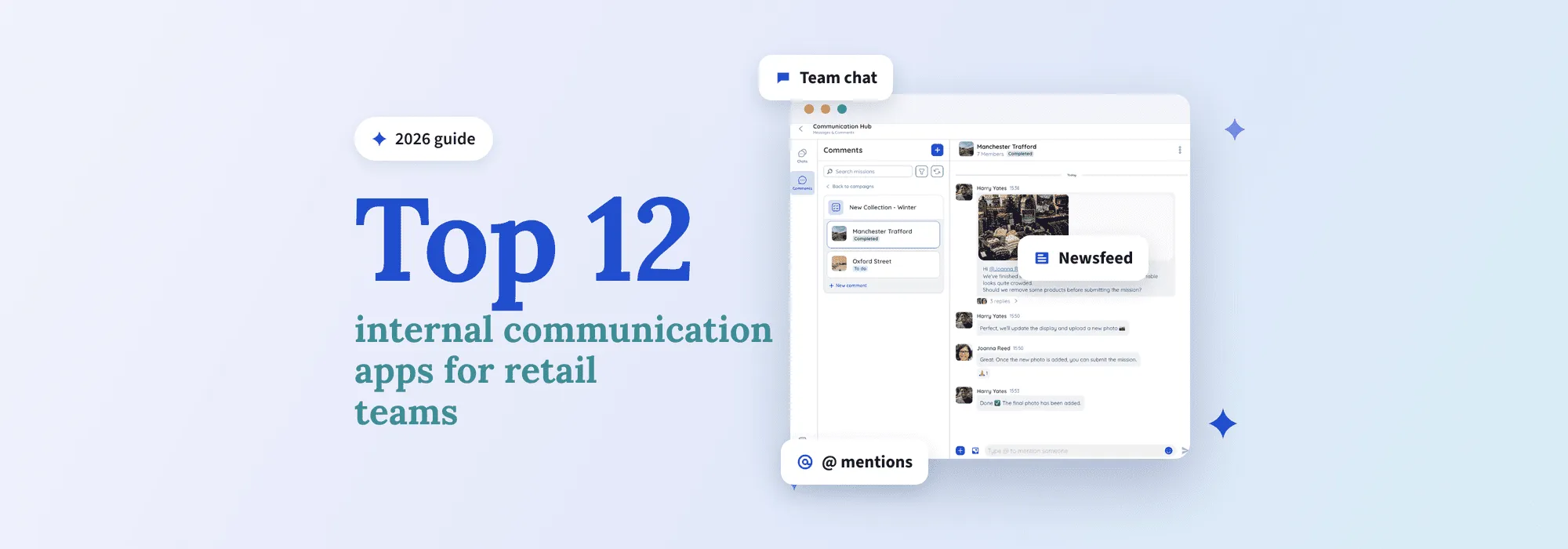
YOOBIC is a frontline operations platform that brings communications, task management and learning into one mobile app. Head office posts to a company-wide newsfeed and targets updates by role, region or store. Read receipts show who has seen each critical update.
Store teams get 1:1 and group chat, peer communities, polls and auto-translated posts. It all sits in the same app they use for tasks and training, so there’s no second login. The AI Assistant answers common questions from your own policies and procedures, which cuts repeat questions to managers.
What sets YOOBIC apart is what happens after a message lands. A key update can arrive as a task with a deadline and photo proof. That way, head office sees whether an instruction was carried out, not just whether it was read.
80%
faster response from head office on store issues at GameStop, after building feedback loops between HQ and store teams.
Source: YOOBIC customer results, GameStop.
Connection matters as much as speed. Fashion brand GANT uses the newsfeed and auto-translated comments to link store teams across countries. 94% of its employees visit the newsfeed monthly.
“With YOOBIC, our store associates in Shanghai are giving tips to associates in Paris. We truly believe this creates a sense of belonging and being part of a greater community.”
Maria Klingh, Global Retail Director, GANT
Best for: multi-location retailers that need every message to turn into consistent action in every store.
2. Axonify
Axonify is a frontline enablement platform best known for microlearning. Its communication tools include targeted announcements, push notifications and two-way feedback, alongside checklists and task workflows in its operations module.
Its main focus is training. The platform is built around short, adaptive learning that reinforces knowledge over time, with communication sitting alongside it.
Considerations: Teams that want communication as the main use case should check how central it is to the day-to-day experience. Scheduling relies on third-party workforce management tools.
Best for: retailers whose priority is frontline training and knowledge reinforcement, with communication as a supporting feature.
3. Staffbase
Staffbase is an employee communications platform with an employee app for frontline teams. Associates can sign in by SMS, QR code or magic link, without a corporate email address. Updates can be targeted by role and location, and the app offers automated translation in more than 110 languages.
Its strength is communication at scale. Staffbase is built for reach, governance and engagement analytics across a large workforce that mixes office and frontline roles.
Considerations: Staffbase leads with communication rather than store execution. Its task features are lighter than on retail operations platforms, so many retailers add a separate execution tool.
Best for: large retailers that need communication reach and governance across both office and store teams.
4. Firstup
Firstup is a workforce communication platform that delivers updates through an employee app, email, SMS and intranet. Messages can be personalized by role, region and shift, with analytics showing how each one performs.
Its focus is orchestration. Firstup suits communications teams that run many campaigns across channels and want detailed engagement data.
Considerations: Firstup is built for reach, not store execution. Retailers that need store tasks, audits or scheduling will need another system alongside it.
Best for: large retailers whose main need is multichannel communication and engagement analytics.
5. Workvivo by Zoom
Workvivo, acquired by Zoom in 2023, is an employee experience platform built around a social feed. It includes communities, recognition, surveys and livestreams, with targeting by role, location and department.
Workvivo was Meta’s only preferred migration partner when Workplace from Meta closed. That made it a common choice for organizations moving off Workplace before its June 2026 shutdown.
Considerations: Workvivo is an engagement and culture platform, not a store execution tool. Task features are light, so retailers that need audits or store workflows will run a second system.
Best for: culture-led communication programs and former Workplace from Meta customers.
6. Blink
Blink is a mobile-first employee app for deskless and shift-based teams. It combines a personalized feed, chat, forms and shift information, and associates can sign in without a corporate email address. Updates can be targeted by store, role and shift, with read confirmations for important posts.
Its strength is ease of access. JD Group, for example, built its JD Now employee app on Blink to reach store teams across its network.
Considerations: Blink is strongest on reach and culture. Store task and audit workflows are lighter than on retail operations platforms.
Best for: retailers whose main gap is reaching a large shift-based workforce.
7. LumApps (formerly Beekeeper)
LumApps completed its acquisition of Beekeeper in July 2025, combining an office intranet with Beekeeper’s frontline app. The frontline app covers feeds, chat, forms, checklists and shift information, with sign-in by QR code or phone number.
Its differentiator is scope. Organizations can run office and deskless teams on one platform, rather than two separate tools.
Considerations: The two products are still coming together, so it’s worth asking how the roadmap affects frontline features. Retail-specific workflows such as visual merchandising checks are less central than on retail operations platforms.
Best for: organizations that want one platform for office and frontline teams.
8. Microsoft Teams (frontline)
Microsoft Teams offers frontline licenses that add chat, channels, push-to-talk Walkie Talkie and the Shifts scheduling app. Head office can also publish tasks to store teams through Planner.
Its advantage is familiarity. Retailers already on Microsoft 365 can extend tools their office teams use every day to the store floor.
Considerations: Teams is built for collaboration, so store channels can fill up quickly without clear rules. Adoption on the floor depends on device setup and governance. Photo-verified tasks and similar retail workflows need extra setup or other tools.
Best for: retailers committed to Microsoft 365 that want one vendor for office and store communication.
9. Flip
Flip is an employee app for frontline teams with a newsfeed, channels, chat and read receipts. Associates can sign in without a password using a QR code or a passkey. Its Ask AI feature answers questions from company knowledge in more than 25 languages.
Its strength is simple access. Flip suits teams where many associates have never had a work login.
Considerations: Task and operational workflows are moderate, so retailers with complex store execution needs should test them closely.
Best for: retailers that want a simple, passwordless app with AI answers for store teams.
10. Zipline
Zipline is a retail operations communication platform. Head office publishes updates by district, store format and role, and tracks reads and task acknowledgments as they come in.
Its focus is the HQ-to-store channel. Zipline is built to turn operational communication into a clear list of what each store needs to do.
Considerations: Zipline is operations-led, so culture, recognition and learning are less central than on engagement platforms.
Best for: retailers that want operational updates and store tasks in one channel.
11. Connecteam
Connecteam is an all-in-one app for deskless teams that covers chat, updates, scheduling, time tracking, forms and training. Associates sign in with a phone number, and announcements can require a read confirmation.
Its strength is accessible pricing. Connecteam offers a free plan for up to 10 users. Paid plans start at $29 a month for the first 30 users.
Considerations: Connecteam is mainly used by smaller businesses. Larger retailers should check whether it handles their store hierarchy, integrations and governance needs.
Best for: small retail chains and franchise groups that want communication and scheduling in one low-cost app.
12. Theatro
Theatro is a voice-first platform for store teams, built around a wearable device with supporting apps. Associates can send hands-free broadcasts, private voice messages and help requests without stopping what they’re doing.
Its strength is speed on the floor. Voice suits moments when an associate needs backup at the register or an answer for a customer right now.
Considerations: Theatro needs hardware, and voice works best for in-the-moment coordination rather than detailed updates. Most retailers use it alongside an app for longer messages and training.
Best for: large-format stores that need hands-free coordination between associates.
What should you look for in a retail internal communication app?
Look for an app that reaches every associate without email, targets updates precisely and shows whether messages led to action. Feature lists look similar from the outside, so test each one against the realities of your stores.
Sign-in without a corporate email
Many store associates never get a company email account. Check that people can join with a phone number, QR code or single sign-on. That way, seasonal hires are reachable from their first shift.
Targeting by store, role and shift
A promotion for large formats shouldn’t land in a small-format store. Precise targeting keeps every feed relevant, and relevant feeds are the ones associates keep reading.
Read receipts and task confirmation
Read receipts tell you who saw an update. Task confirmation tells you who acted on it. For price changes, recalls and safety updates, you need both.
Two-way communication and translation
Store teams need a fast way to ask questions and flag problems. Translation matters too in multilingual teams, where an update only works if everyone understands it.
One app for the work, not just the news
Associates already juggle tills, handhelds and schedules. An app that combines communication with tasks and learning gets opened every shift. Updates are then seen in the flow of work.
INSIGHT
The real test of a communication app isn’t whether a message was sent. It’s whether the store did something differently because of it.
Why do store teams end up on WhatsApp?
Store teams end up on WhatsApp when official tools don’t reach the floor. Group chats on personal phones are fast and familiar. Managers start using them to cover shifts and pass on updates.
The problems build over time. Messages get buried in personal chats, and nobody knows which version of an instruction is current. Former employees can stay in groups after they leave. Head office also has no record of what was shared or read.
Manager relays have a cost too. When updates depend on store managers passing them on by hand, quality varies by store. The strain also lands on the people teams rely on most.
2x
as likely to leave their job within a year when deskless workers are dissatisfied with their manager.
Source: BCG survey of 4,668 deskless workers, 2022.
The closure of Workplace from Meta added another push. The platform went read-only in September 2025 and shut down on June 1, 2026. Retailers that relied on it had to find a new home for store communication.
A dedicated app fixes this with one secure channel that is as easy to use as a chat app. It also gives head office the targeting and tracking that group chats can’t.
Why YOOBIC is our pick for retail
Most apps on this list do one part of the job well. Some reach every associate. Some build culture. Some run store operations. YOOBIC connects all three, so an update reaches the right store, gets read and turns into work that’s verified.
The results show up in store operations, not just engagement metrics. PureGym brought seven platforms into one across more than 700 locations. Internal email fell by 58%, and the average task completion rate reached 95%. Michaels reduced voluntary turnover by 24% after giving store teams one place to collaborate and share best practice.
Comparing the wider category? Our guide to employee engagement software for retail covers platforms built for culture and retention. To plan the process first, start with a retail internal communications plan. Our guide to retail communication covers the wider strategy.
Reach every store and see what changed
Send targeted updates, confirm they landed and turn key messages into tasks with YOOBIC.

FAQs
What is the best app for employee communication?
For retail store teams, the best app for employee communication is a mobile app that works without a corporate email address. Look for targeting by store and role, read tracking and a way to turn updates into tasks. YOOBIC combines these with learning in one app for multi-location retailers. Tools like Microsoft Teams and Slack suit office-based teams.


