

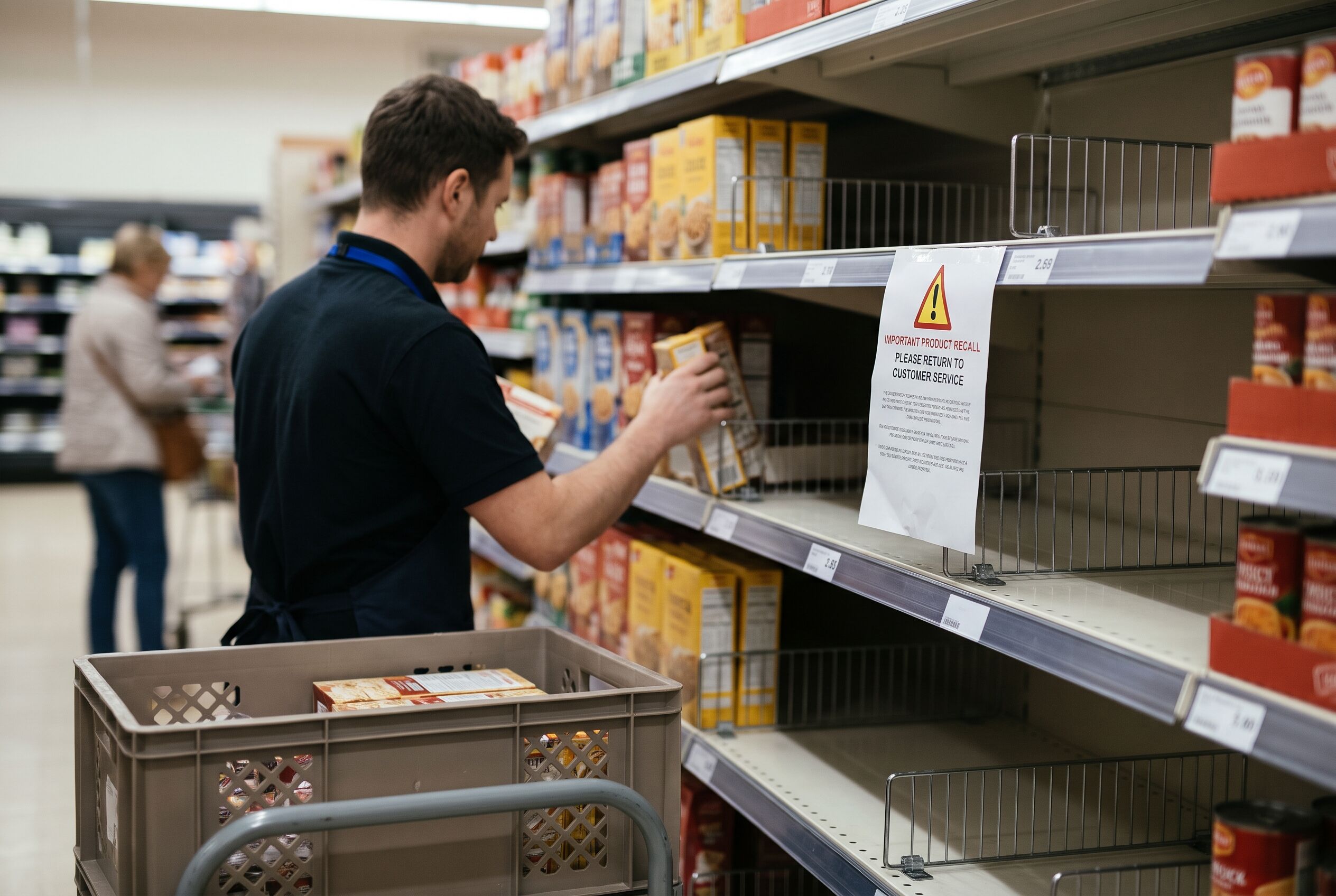
KEY TAKEAWAYS:
- A product recall process in stores has eight steps, from confirming the notice to closing it out.
- Speed comes from one clear brief, sent only to the stores that stock the product.
- Pull stock from every place it hides: shelves, promo displays, the backroom and click-and-collect.
- Photo proof and unit counts show head office which stores are done, without a phone call.
- Judge a recall by how fast every store finished, not by when the first one did.
A recall notice lands at head office on a Friday afternoon. The product is on shelves in 300 stores. It’s also on a promotional end bay in 40 of them, and in a few click-and-collect orders.
By Monday, most stores have pulled it. A handful haven’t seen the message. One store pulled the shelf stock but missed the display by the entrance. Nobody at head office knows which stores those are.
That gap is where recalls go wrong. This guide covers the product recall process from the store side. It sets out the steps every location follows, and how to prove each one.
What is a product recall process?
A product recall process is the set of steps a retailer follows to take an unsafe product off sale. In stores, that means finding every unit, blocking it at the till, recording it and proving it’s gone.
DEFINITION:
Product recall
The removal of an unsafe or non-compliant product from sale and from customers’ hands. A withdrawal removes it before it reaches customers. A recall also asks customers who bought it to return it.
The supplier or manufacturer usually starts a recall, often with a regulator involved. The rules depend on the product and the country. This guide doesn’t cover those rules. It covers what happens once the notice reaches your stores, which is where most of the work sits.
Why recalls are getting harder for stores
The number of recalls in the US has stayed steady, but each one now covers far more product. Sedgwick counted 1,634 US recall events in the first half of 2026, almost the same as a year earlier. The number of recalled units rose 346%.
941.2M
units recalled in the US in the first half of 2026, up 346% on the same period of 2025.
Source: Sedgwick, US Recall Index, August 2026.
Bigger recalls mean more stock to find, in more stores, across more parts of each store. A process that relies on email and phone calls doesn’t scale to that.
What are the steps of a product recall in store?
A product recall in store has eight steps. Confirm the notice, brief the right stores and stop the sale. Then pull, quarantine and prove, before closing it out. Here’s how each step works.
1. Confirm the notice and the exact scope
Before anything reaches stores, head office needs the exact details. Get the product name, barcode, batch or lot codes, dates and any photos from the supplier. Then check which stores received that stock.
Name one owner at head office for the recall. Stores need one source of instructions, not three teams sending different versions.
2. Brief every affected store in one message
Send one short brief to the stores that stock the product, and only those stores. A brief sent to every store teaches teams to skim. A targeted one tells them this matters.
- What to pull: product name, photo, barcode and the exact batch codes.
- Where to look: shelves, promo displays, the backroom, click-and-collect and the returns area.
- What to do with it: where to store it, how to label it and who collects it.
- When it’s due: a clear deadline, usually the same day for a safety recall.
Ask every store to confirm it has read the brief. With YOOBIC Communications, head office sees read receipts by store. It knows within minutes who hasn’t opened the brief.
3. Stop the sale at the till
Pulling stock takes time. Blocking the barcode at the till stops a missed unit from being sold while teams search. Ask your systems team to block it as soon as the scope is confirmed.
4. Pull stock from every place it can hide
Most recalls miss stock in the same places. The main shelf gets cleared, but a second location doesn’t.
- Secondary displays: end bays, promo stands and checkout areas.
- The backroom: overstock, deliveries not yet unpacked and damaged stock.
- Click-and-collect: orders already picked and waiting for customers.
- Returns: units brought back before the recall started.
INSIGHT
A recall is only as strong as the last place someone forgot to check. Build the full list of locations into the task, so every store searches the same places.
5. Quarantine and label the stock
Move every recalled unit to one area, away from saleable stock. Label it clearly as not for sale, then count it. The count matters later, when you reconcile what came back against what was delivered.
See how a recall reaches every store as one task
Explore how head office sends an urgent task with photo steps and tracks completion store by store.
6. Prove it’s done, store by store
A tick box doesn’t prove a recall. A photo of the empty shelf, a photo of the quarantined stock and a unit count do. When each store submits all three, head office can see which stores are finished and which need a call.
This is where task management earns its place. With retail task management, the recall goes out as one task with steps, photo checks and a deadline. Stores that miss it show up straight away, and district managers can follow up the same day.
Retailers already run food safety checks this way at scale. Pret uses YOOBIC to manage more than 65,000 tasks a month across its shops. That includes temperature checks on produce several times a day. Team leaders set automated alerts and recourse plans when readings fall out of range.
“Quality and safety are paramount at Pret.”
Mark Corney, Global Operations Development Director, Pret A Manger
7. Handle customer returns and questions
For a consumer recall, customers will come back with the product. Give store teams a short script and the refund rules from the notice. Then every store answers the same way. Log each return, so it’s included in the final count.
8. Close the recall and review it
Once every store has confirmed, reconcile the numbers. Compare units recovered with units delivered, then return or destroy the stock as the supplier instructs. Keep the records, because suppliers, regulators or insurers may ask for them.
Then review how it went. Which stores were slowest, and why? Was it the message, the stock locations or the deadline? Fix that before the next recall.
How do you know a recall was successful?
A recall was successful when every affected store has removed the product, proved it and accounted for every unit. Three numbers tell you most of what you need.
- Time to complete: how long it took the last store to finish, not the first.
- Store completion rate: the share of affected stores that confirmed with proof by the deadline.
- Units recovered: units pulled and returned, compared with units delivered.
The last store matters most, because one store still selling the product is still a risk. Grocery teams can build these checks into their routine audits. Our guide to grocery store audits covers how often to run them. Our guide to food safety records covers what to keep.
What we see in the YOOBIC app
Recalls are a common job for YOOBIC customers. “Product recalls and withdrawals” is a use case run by close to 50 of our customers. Store teams have submitted about 340,000 recall and withdrawal tasks in the app.
That volume reflects a simple pattern. Retailers that run recalls as structured tasks don’t have to rebuild the process every time a notice arrives.
See how stores find answers fast
Click through short guided tours of how AI helps store teams find the right procedure in seconds. Take the AI product tour
Make every recall the same, in every store
Recalls are stressful because they’re urgent and rare. The fix is to make them routine. Write the process once, build it into a task template and use the same steps every time.
For more on getting urgent messages to every store, see our retail communication guide. For how tasks, photo proof and deadlines work together, read our complete guide to retail task management. Grocery teams can see how this fits their wider operation on our grocery page.
Pull every recalled product, in every store
See how YOOBIC sends urgent recall tasks, collects photo proof and shows which stores are done.

FAQs
What are the stages of a product recall?
A product recall has six stages: detect, assess, notify, remove the product, inform customers and close out. For stores, the work sits in the middle stages. Teams find every unit, take it off sale, quarantine it and prove it’s gone. Head office then reconciles the numbers and reviews what to improve.


