
Retail runs on its frontline teams, and right now those teams are checked out. Gallup’s 2026 State of the Global Workplace puts global employee engagement at 20%, its lowest level since 2020. For store associates the picture is worse. Fully on-site workers, the people who staff the shop floor, report an engagement rate of just 17%. Disengaged teams don’t just feel flat. They sell less, lose more stock, and leave.
That last point is the expensive one. Frontline retail attrition averages 81% a year, according to Fountain’s State of the Frontline Workplace report. Most of that churn happens early. Around 35% of departures occur within the first 90 days, and replacing a single skilled associate costs $10,000 or more by Deloitte’s estimate. For a chain running hundreds of stores, early-tenure turnover is one of the largest controllable costs on the floor.
Engagement is also one of the clearest levers retailers have. Gallup’s meta-analysis shows highly engaged stores outperform disengaged ones by 18% in sales and 23% in profitability, with lower shrink and lower absenteeism. The problem is reach. Around 89% of frontline workers say they feel disconnected from corporate updates, and most still get key information by word of mouth on shift. Employee engagement software exists to close that gap between headquarters and the store floor.
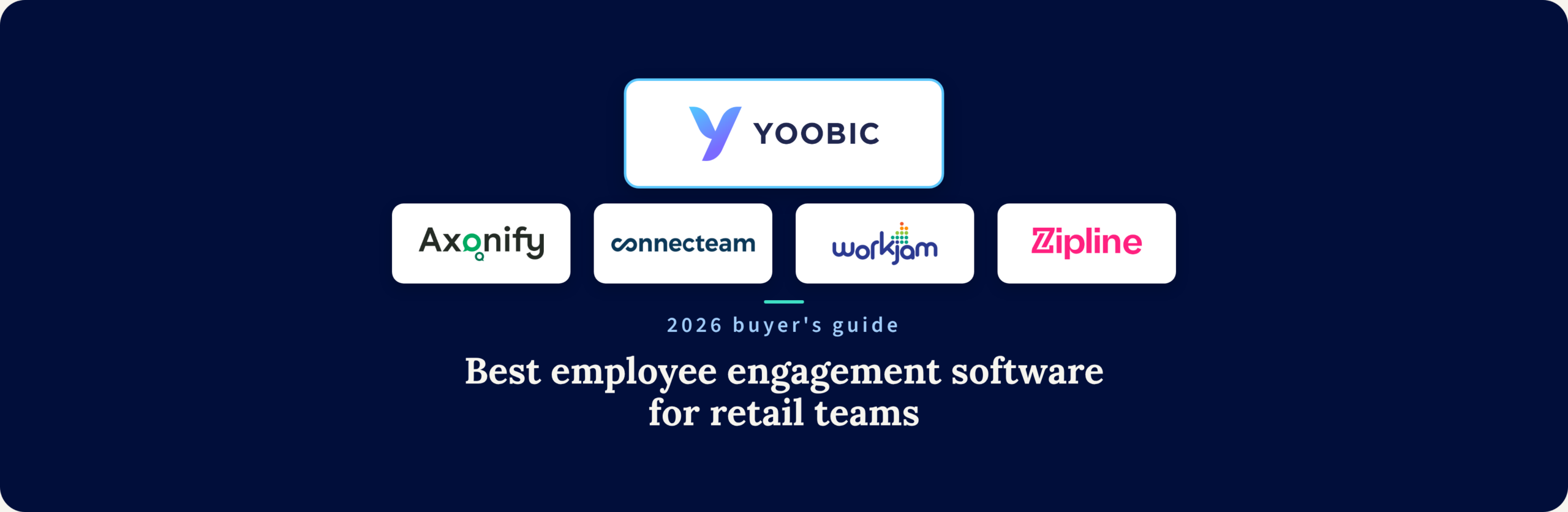
The category is broad, and not every platform solves the same problem. Some are retail operations platforms that tie engagement to daily tasks, learning, and store visibility. Some are frontline super-apps that bundle communication with scheduling, forms, and surveys. Others are communication-led experience platforms built for reach and analytics rather than store execution. We evaluated the leading options on frontline usability, mobile-first design, engagement and retention impact, and how well they fit real multi-location retail teams.
17% engagement on the shop floor
Fully on-site workers, including store associates, report an engagement rate of just 17%, well below their hybrid and remote peers.
Gallup, State of the Global Workplace 2026

1. YOOBIC: best overall for retail employee engagement
YOOBIC is the best employee engagement software for retail teams because it connects communication, learning, and recognition to daily store execution in one app. That combination is what makes engagement stick. Communication, learning, and tasks live in one mobile app that store teams open every shift, so associates aren’t logging into a separate tool to feel connected. They stay connected inside the app they already use to do their jobs.
YOOBIC ranks #1 on G2 across Retail Execution and Retail Task Management, and was named in six 2025 Gartner Hype Cycle reports, including Frontline Worker Technologies. Over 350 global brands use the platform in 21+ languages, including Boots, GameStop, Michaels, Morrisons, Lidl, and Lacoste.
Communication that reaches every associate
YOOBIC’s newsfeed gives HQ a direct line to every store, with targeting by role and location and clear visibility into who has seen each update. That reach is where engagement starts. GANT reached 94% monthly newsfeed visitors and a 64% average sentiment score. francesca’s saw 71% active newsfeed users and a 4-point lift in eNPS. When associates can see what’s happening across the business, they feel part of it.
Recognition and connection that build belonging
Engagement grows when associates feel seen and connected to each other, not just managed from above. YOOBIC’s communities let store teams share wins, ask questions, and learn from peers across the network.
“With YOOBIC, our store associates in Shanghai are giving tips to associates in Paris. We truly believe this creates a sense of belonging and being part of a greater community.”
Maria Klingh, Global Retail Director, GANT
Learning that drives adoption, not just completion
Training only builds engagement if associates actually use it. YOOBIC delivers mobile microlearning that store teams complete on the floor, with gamification and recognition built in. GANT lifted course completion by 30%. UNTUCKit kept 79% of store employees active on training.
YOOBIC’s AI course creator also turns existing documents into modules in minutes, which saved Longchamp’s team 10 hours a week on content creation and gave that time back to coaching.
Engagement that shows up in retention
The real test of engagement is whether people stay. Michaels lifted store engagement from 30% to 80-90% and cut voluntary turnover by 24%, worth more than $8M a year. As Lagardère Travel Retail put it, engaging staff is what drives retention afterwards.
24% lower voluntary turnover
Michaels reduced voluntary turnover by 24% with YOOBIC, worth more than $8M a year.
YOOBIC case study, Michaels
Best for: Multi-location retailers that want frontline engagement tied directly to learning, communication, and store execution in one mobile app.
2. Axonify
Axonify is a frontline enablement platform that combines microlearning with communication, task management, and store audits. It delivers short, daily training sessions with reinforcement and gamification. In retail it’s strongest on onboarding, product knowledge, and consistent execution driven by what associates actually retain. Communication is targeted by role and location, and sentiment tracking gives HQ a read on how messages land. Named customers include Kroger, Walmart, Foot Locker, and Bloomingdale’s.
Its clearest differentiator is learning science. The pitch isn’t just reaching stores. It’s changing frontline behavior through repeated, measurable training.
Considerations: Axonify is designed for large enterprises, which can make it a heavier fit for mid-market teams.
3. WorkJam
WorkJam is a frontline orchestration platform for deskless teams. It combines communication, task management, learning, and shift management in one app, with schedule-aware task assignment and a marketplace for shift swaps and open shifts. That connection between work and the actual schedule is its main strength. Named customers include Ulta Beauty, TJX, Marks & Spencer, and American Eagle Outfitters. It supports over 50 languages, which matters for large multi-country workforces.
Its differentiator is depth of workforce orchestration. WorkJam ties communication, tasks, and staffing together so work lands in the context of each associate’s shift.
Considerations: That breadth brings complexity. Reviewers mention app glitches, video lag, and a scheduler that can feel clunky, along with a learning curve during setup.
Retailers who want engagement and communication without a full workforce-management layer may find it heavier than they need.
4. Zipline
Zipline is a retail-specific operations platform focused on HQ-to-store communication and task coordination. It brings together communication, tasks, learning resources, store audits, and analytics, with strong district and regional visibility into who has read a message and completed a task. Named customers include Sephora, Bath & Body Works, L.L.Bean, and Warby Parker.
Its differentiator is retail specificity. The platform is built around read-and-do workflows and gives field leadership clear visibility into execution across stores.
Considerations: Zipline centers on communication and coordination more than deep learning or native scheduling. Retailers who want structured microlearning, adaptive paths, or a built-in labor-scheduling engine will likely need to add another system. Some reviewers note the interface can feel busy when a lot of information arrives at once.
5. Connecteam
Connecteam is an all-in-one management app for non-desk teams, spanning chat, scheduling, time tracking, task management, training, surveys, and recognition. It covers a lot of ground in one mobile app, with free access for small teams. It markets across many industries, including retail, with customers such as FOX Group and Edible Arrangements.
Its differentiator is breadth at the lower end of the market. For small and mid-size operators, Connecteam bundles scheduling, communication, training, and recognition without enterprise pricing.
Considerations: Most of Connecteam’s user base is small businesses, and it’s less retail-specialized than platforms built for store execution. It lacks retail-specific workflows like merchandising verification, planogram checks, or store audits. Reviewers also note pricing can climb as teams grow past the free tier.
Best for: Small and mid-size retail operators who want a broad, affordable frontline app across communication, scheduling, and training.
6. Blink
Blink is a mobile-first employee experience platform for deskless and shift-based teams. It bundles communication, stories, forms, surveys, recognition, and shift information into one app, with no-email onboarding and integrations for systems like Workday and UKG. Named customers include Domino’s, McDonald’s, and JD Group.
Its differentiator is ease of adoption. Blink is built as a simple digital front door for workers who don’t use corporate email, and its case studies emphasize daily use and quick sign-in.
Considerations: Blink is strongest on reach, culture, and communication rather than store execution. Task and audit workflows are lighter than on retail operations platforms, and some reviewers mention feed clutter and admin friction around permissions and integrations. Retailers who need execution depth will likely pair it with another tool.
Best for: Retailers whose main gap is communication reach and culture across a deskless workforce, rather than store execution.
7. Lumapps (previously Beekeeper)
LumApps is an employee experience platform with a frontline app at its core, covering company communication, chat, tasks, forms, workflows, surveys, and shift information, with benchmark analytics on top. The frontline capability comes from Beekeeper, which LumApps acquired and folded into its wider platform. It serves frontline teams across industries, including retail, with named examples such as Royal Farms and Chalhoub Group.
Its differentiator is that combined scope. LumApps pairs the former Beekeeper frontline experience with an office-facing intranet and communications suite, so buyers can run desk and deskless teams on one platform.
Considerations: Training isn’t as prominent as on learning-led platforms, and much of the frontline training story relies on integrations rather than native modules. The Beekeeper-into-LumApps transition is worth weighing for teams that want a pure-play frontline vendor with a clear standalone roadmap. Recognition is supported through communication features rather than a dedicated module.
8. MangoApps
MangoApps is a unified workforce platform that has moved closer to a frontline super-app. It spans targeted communication, recognition, surveys, communities, training, scheduling, digital checklists, and AI search in one place. Named retail customers include PetSmart, AutoZone, and Superdrug.
Its differentiator is breadth. MangoApps covers communication, operations, and people workflows across desk and frontline teams, with analyst recognition across several firms.
Considerations: The same breadth is worth testing. Buyers should confirm how much depth is genuinely retail-specific versus general platform configuration, particularly for store execution and merchandising. Some reviewers note friction around group access and compatibility with certain systems.
9. Staffbase
Staffbase is an employee communications platform with a growing frontline angle. It’s strongest on internal communications at scale, with an employee app, targeted multichannel delivery, surveys, and analytics, plus a newer frontline task layer and AI-powered knowledge delivery. It reaches deskless workers without corporate email, which is the core requirement for store teams. Named customers span large desk-and-frontline workforces, including retail names like Max Mara.
Its differentiator is communications maturity. Staffbase is built for reach, governance, and measurable engagement across a big, distributed workforce, paired with a frontline app to bring store teams into the same network.
Considerations: Staffbase leads with communication, not store execution. Compared with retail operations platforms, its scheduling, native learning depth, and store-specific workflows like audits and merchandising are lighter, so retailers who need execution will pair it with another system. Training is supported more through partners than as a deep native module.
Best for: Large retailers whose main need is communication reach, engagement measurement, and governance across a mixed desk and frontline workforce, rather than in-store execution.
10. Firstup
Firstup is a workforce communication platform rather than a store operations tool. It’s strongest on audience targeting, personalized journeys, an employee app, intranet, and analytics, with AI-assisted content creation.
Its differentiator is communication orchestration at enterprise scale. Firstup fits retailers who want personalization, omnichannel delivery, and detailed engagement analytics across a large workforce. Staffbase sits in a similar space, pairing mature enterprise communication with a newer frontline task layer, and fits the same buyer profile.
Considerations: Firstup is built for reach and communication, not store execution. Retailers who want native scheduling, retail audits, or store task workflows will need integrations or a second system.
Best for: Large retailers whose core need is communication reach, personalization, and engagement analytics rather than in-store execution.
How to choose the right employee engagement software
The platforms above solve different problems, so the right choice starts with naming yours. Work through these questions before you compare feature lists.
Start by naming the problem you’re solving
Most retail engagement projects are really one of three things. A communications problem, where updates don’t reach the floor or land too late. An engagement and culture problem, where associates feel disconnected and leave. Or an execution problem, where teams know what to do but don’t do it consistently. The answer changes your shortlist. Communication-led platforms fit the first. Super-apps and experience platforms fit the second. Retail operations platforms fit the third, and often all three at once. Deciding this first saves you from buying a strong tool that solves the wrong gap.
Design for mobile-first reality
Around 73% of frontline workers get their work information mainly through a mobile device. Any platform that needs a desktop login, a corporate email address, or a VPN loses adoption on day one. The friction is real. In one 2026 study of UK retailers, only 5% of frontline staff said they hit no major friction with in-store technology. Evaluate each platform on how it feels in an associate’s hand, not how it looks in a demo.
Favor pull utility over corporate push
The platforms with the highest adoption give associates a reason to open the app themselves. Checking a schedule, swapping a shift, finding an answer, completing a quick task. Push-only communication gets treated as noise. Pull utility becomes a daily habit, and that habit is what carries the engagement content along with it.
INSIGHT
The platforms with the highest frontline adoption aren’t the ones with the most features. They’re the ones associates open every shift because the app makes their day easier.
Build recognition into the daily flow
Recognition drives retention when it happens often and close to the moment. Annual awards lag too far behind the effort to matter. Platforms that put peer and manager recognition into the daily feed, so a shout-out for a solved problem or a hit target shows up right away, see stronger morale and lower intent to leave. Look for recognition that lives where associates already are, not in a separate quarterly process.
Count the cost of a fragmented stack
Many retailers end up with one app for communication, another for training, and a spreadsheet for tasks. Each has its own login, its own admin overhead, and its own data silo. The hidden cost isn’t just the subscriptions. It’s lower adoption, and the inability to connect engagement to outcomes. Did the recognition program reduce turnover? Did the training improve execution? If the data lives in separate systems, you can’t tell. A single app your teams actually use is worth more than a broader set of tools they avoid.
Equip store managers, don’t just enforce
Store managers drive a large share of the performance gap between locations, and they make or break any rollout. A platform that adds admin to their day gets quietly ignored. One that takes work off their plate, by automating scheduling, task tracking, and reporting, frees them to coach on the floor. Give managers a few hours back each week and they become the champions who carry adoption across the team.
Measure engagement and retention, not just completion
Completion rates tell you associates clicked through content, not that anything changed. The platforms that prove their worth measure deeper. Newsfeed and community activity, sentiment over time, and the outcomes that follow, like turnover, retention past the first 90 days, and sales. Ask each vendor how they connect engagement to those results, and ask for references at your scale.

Why YOOBIC is the best choice for retail engagement
Most platforms on this list do one part of the job well. Some communicate to stores. Some build culture. Some run execution. YOOBIC connects all three, and that’s what makes engagement last on the floor.
The results show up where they matter. Michaels lifted engagement from 30% to 80-90% and cut voluntary turnover by 24%. Home Bargains reduced turnover by 35%. GANT reached 94% monthly newsfeed visitors and 30% higher course completion. These aren’t communication metrics. They’re engagement outcomes tied to retention, learning, and connection between HQ and the store floor.
For multi-location retailers who want frontline teams that stay, learn, and perform, YOOBIC brings engagement and execution together in one app store teams actually use.
YOOBIC is the AI-powered retail operations platform trusted by 350+ global brands. Request a demo to see how YOOBIC keeps your frontline teams engaged, connected, and ready for every shift.
Book a demo and find out how
Avoid wasted hours, blind spots
and lost revenue with YOOBIC