
TL;DR
Zara’s famous feedback loop is real. But it is the visible output of a system most retailers have never built — not the system itself. The real competitive variable is signal-to-decision latency: the interval between a store team observing something on the shop floor and that observation influencing a central decision. Inditex has compressed that interval to hours through four interdependent mechanisms. Most retailers have not. This article explains what those mechanisms are, why they are hard to replicate, what operations leaders can realistically do about it, and what the next generation of retail operational precision should actually optimize for.
Every retailer wants to be Zara.
A Zara store manager notices a jacket selling out on a Tuesday. By the weekend, more are on the way. That loop is the entire business model.
Except it is not. Not quite.
Inditex, Zara’s parent company, reported net sales of €39.9 billion in FY2025 with a gross margin of 58.3% (Inditex FY2025 Results). On Zara’s fashion floor, inventory turns roughly 12 times per year. Among major fashion retailers, industry benchmarks show turnover rates ranging from 2.8x to 4.3x annually — a gap that reflects fundamentally different approaches to inventory commitment (Architecture of Agility, section 2.2; GuruFocus FY2024; Macrotrends FY2024).
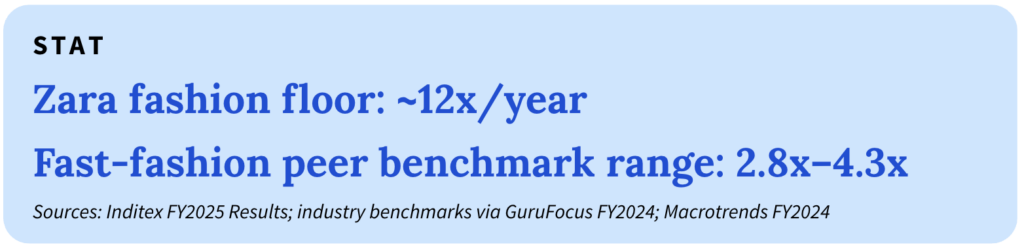
The gap is striking. But the explanation most people land on — the feedback loop — only describes what you can see from the outside. The part that actually makes it work is much harder to spot, much older, and much more difficult to copy.
“The Zara story is not outdated — it is oversimplified. The feedback loop is real. The problem is that most retailers who try to replicate it focus almost entirely on the loop itself, and not on the infrastructure required to make it function.”
Fabrice Haiat, CEO of YOOBIC
| MYTH | REALITY |
| Zara is fast because its store managers report demand back to headquarters quickly. | Zara is fast because the system is already ready to act before the signal arrives. The feedback loop is the output. The supply chain architecture is the engine. |
Signal-to-decision latency: the concept that explains everything
The governing concept in the Inditex model is not the feedback loop. It is signal-to-decision latency: the interval between a store team observing something on the shop floor and that observation influencing a central decision.
Inditex has compressed that interval to hours or days. In many traditional retail networks, the honest answer is weeks — or the signal never arrives at all, because no structured channel exists to carry it.
That gap is not primarily a technology problem. Retailers have been investing in dashboards, RFID, and data platforms for years. Many have excellent visibility. The constraint is not what they can see. It is the organizational and supply chain architecture that determines how fast they can act on what they see.
Many retailers already have access to operational data, but struggle to connect those insights to real-time execution in stores.
Every mechanism in the Inditex model exists to compress this interval. Proximity sourcing reduces the physical lead time. Pre-positioned materials eliminate waiting for fabric. Reserved factory capacity means production can respond without displacing other orders. Distributed decision rights mean the observation does not have to travel through layers of approval before it influences what happens next.
These are not four separate advantages. They are four components of a single system designed around one governing idea: get the signal from the store to the decision as fast as possible, and make sure the system is ready to act on it when it arrives.
The feedback loop is real. The explanation most people give is not.
The standard version of the Zara story describes store managers observing what customers are buying, that data flowing back to the design team, and new product arriving within days. It is a compelling description of organizational responsiveness.
It is also, as a standalone explanation, significantly incomplete.
The narrative almost never addresses the most fundamental constraint: upstream readiness. If Fabric is sitting in a warehouse in East Asia with a six-week lead time, no volume of fast data will put new inventory on the shelf by Saturday. The speed of the loop depends entirely on the state of the system it feeds into.
That readiness does not happen by accident. It is the result of deliberate decisions made months and years before any store manager notices a trend. Inditex builds it through a practice known as postponement: rather than committing to final designs early, the company purchases vast quantities of undyed, unfinished fabric in advance. When a trend signal arrives from the store floor, that fabric can be dyed, cut, and finished within hours. The commitment to production is delayed until demand is actually confirmed (Architecture of Agility, section 4.2).
Traditional retailers often commit 80% to 100% of their seasonal inventory before a single unit is sold. Inditex commits roughly 15% to 25% in advance, holding the remainder of production capacity uncommitted and available to respond to actual demand (Architecture of Agility, section 2.2).
Why Zara store managers shape production decisions, not just floor plans
The organizational dimension is equally critical. Zara store managers use handheld devices not only to track inventory, but to feed qualitative intelligence directly to design teams: what customers are requesting, what detail on a product prompted a question, what silhouette they came in looking for but did not find. This is not automated POS data. It is human observation, structured and channeled upstream (Architecture of Agility, section 5.1).
Traditional retail treats stores as distribution endpoints. Corporate sets direction. Stores execute. Information flows one way: down. Zara flipped it. The store became a sensing mechanism. Qualitative intelligence flows up, decisions flow down, and the loop continues — continuously.
Inditex’s commercial team sits in an open-plan workspace in Arteixo, where designers, commercial staff, and production planners work within physical proximity of each other. Decisions that in other organizations would require scheduled meetings and formal sign-off happen through conversation, often within minutes of a store signal arriving (Architecture of Agility, section 5.2).
What I think most retailers underestimate is not the speed of the signal itself, but the organizational ability to act on it. Digitizing visibility without redistributing decision authority produces faster documentation of missed sales, not faster recovery from them.
The four mechanisms that compress the interval
Zara’s speed is not a single capability. It is an emergent property of four interdependent mechanisms, each of which directly compresses signal-to-decision latency. Understanding them separately is useful. Understanding how they function together is what makes the model legible.
- Proximity sourcing: manufacturing close to demand, not where it is cheapest
Roughly 50% to 60% of Inditex’s fashion-sensitive production is manufactured in proximity clusters in Spain, Portugal, Turkey, and Morocco, where lead times from concept to distribution center run 10 to 15 days. Only lower-risk, higher-volume basics are produced in Asia, where lead times extend to 3 to 6 months. Proximity production costs more per unit, but it allows Inditex to convert a confirmed demand signal into finished product faster than any fully outsourced model can match. The margin is recaptured through full-price sell-through rather than end-of-season clearance. (Architecture of Agility, section 4.1)
How this compresses the interval: Physical geography sets the floor on how fast a signal can become product. Proximity sourcing moves that floor from months to days.
- Pre-positioned materials: the greige fabric strategy
Inditex purchases undyed fabric in large quantities before any specific designs are finalized. Because the core material is already in the warehouse and already paid for, it can be converted into any color or pattern within hours of a confirmed demand signal. The 48-hour response window supply chain commentators often cite is not a data achievement. It is a materials strategy. The signal moves quickly because the factory was already loaded before it arrived. (Architecture of Agility, section 4.2)
How this compresses the interval: Pre-positioned fabric eliminates the waiting time between signal and material availability, turning a weeks-long procurement step into a same-day production decision.
- Reserved factory capacity: treating unused capacity as a strategic asset
Most retail supply chains are optimized for efficiency — running factory capacity as close to 100% utilization as possible. Inditex takes the opposite position. Proximity factories operate at approximately 4.5 days per week in standard periods, holding reserve capacity available for surge demand. A trending item does not have to wait in a production queue behind other orders. The factory can absorb a rapid-response request without displacing existing commitments. Slack, in this model, is not waste. It is optionality. (Architecture of Agility, section 4.3)
How this compresses the interval: Reserved capacity means the response to a store signal is not delayed by a full production queue. The factory can absorb the request the same week.
- Distributed decision rights: stores as intelligence sources, not execution endpoints
Store managers at Inditex have meaningful authority over what information reaches the design and commercial teams, and meaningful influence over replenishment decisions. They are not just completing checklists. They are feeding a sensing system. The store visit, the task completion record, and the structured observation are not administrative processes. They are the mechanism by which frontline intelligence either reaches operations or disappears into a weekly report no one reads before the information is stale. (Architecture of Agility, sections 5.1–5.2)
How this compresses the interval: Distributed decision rights remove the organizational layers between observation and action. The signal does not wait for a meeting. It reaches the decision-maker the same day.
The cumulative effect of all four mechanisms is visible in the performance data:
| Performance metric | Zara (fashion track) | Traditional retailer |
| Design to shelf | 10–15 days | 6–9 months |
| Replenishment cycle | Twice weekly | Seasonal |
| Inventory age | ~30 days | ~150+ days |
| Markdown velocity | ~15% of styles | 40–50% of styles |
| Pre-season commitment | 15–25% of range | 80–100% of range |
| Signal-to-decision latency | Hours or days | Weeks or months |
Source: Architecture of Agility, section 8; Inditex FY2025 Results
Why data investment alone cannot close this gap
A retailer can invest heavily in RFID, real-time dashboards, and forecasting tools, and still find that its lead times remain stubbornly long. The reason is that data and decision rights are not the same thing.
Zara achieves approximately 99% inventory accuracy through RFID, compared to an industry average below 70% (Architecture of Agility, section 6.1). That accuracy gives store teams and central operations near-perfect visibility into what is moving, what is not, and where stock sits at any moment.
But high inventory accuracy tells you that a trending item is out of stock. It does not restock it faster if the supply chain is locked into long-term contracts with suppliers operating on 16-week lead times. In that situation, real-time data is, in effect, a very precise record of missed sales.
This is the visibility-action gap: many retailers have digitized their visibility without changing who holds the authority to act on what that visibility reveals. Data moves fast. Decisions do not. The result is a system that is highly informed and structurally slow at the same time.
| Factor | Centralized retail model | Inditex / Zara model |
| Inventory accuracy | Below 70% (industry avg) | ~99% via RFID |
| Decision-making structure | Filtered through HQ approvals | Distributed to store level |
| Response to a trend signal | Processed in regional cycles | Store manager flags same day |
| Production flexibility | Up to 100% committed in advance | 75%+ capacity held uncommitted |
| Store manager role | Display and task executor | Commercial sensor and intelligence source |
| Signal-to-decision latency | Weeks or months | Hours or days |
Sources: Architecture of Agility, sections 2.2 and 6.1; Inditex FY2025 Results
Why most retailers face structural barriers to replicating this model
Understanding the Inditex model is one thing. Replicating it is another. The barriers are real, structural, and in some cases, fundamental to how most retail businesses are organized and financed.
Supply chain geography sets the ceiling on retail speed
Inditex built its proximity sourcing network over decades. It is the anchor tenant for more than 1,800 suppliers, which gives it leverage to demand priority production windows that most brands cannot access (Architecture of Agility, section 7.2). A retailer with 16-week lead time agreements embedded in its supplier contracts faces a structural ceiling on responsiveness that no data platform can raise.
The instinct many retailers have is to close that gap with better technology. But the diagnosis is wrong. Long lead time agreements make rapid response structurally impossible regardless of how good the data is. The constraint is not visibility. It is geography, contract terms, and the supplier relationships that underpin both.
The organizational design problem: push culture vs. pull culture
Traditional retail operates on a push model. Headquarters decides. Stores execute. Information flows one way. Moving to a pull model — where store-level observations actively shape central decisions — requires redistributing real authority to the store floor, which is a significant cultural and structural change for most organizations.
Empowering frontline teams with better communication and decision-making tools is becoming a major focus for modern retailers.
In matrix-structured organizations with layered approval processes, the informal, rapid decision-making that characterizes the Arteixo model is, as the Architecture of Agility report puts it, “culturally alien” (section 7.3). That is not a criticism. It is an accurate description of how most large retail operations are designed to function at scale.

One important nuance on the inventory numbers
The 12x inventory turnover figure is frequently cited without context. That number reflects Zara’s fashion floor specifically, where the rapid-response model operates at full intensity. At the consolidated Inditex group level — which includes all eight brands, raw material buffers, and slower-moving basics — the financial inventory turnover rate is approximately 5.1x per year. That figure is still exceptional: most competitors benchmark below 3x. But the distinction matters. Replicating the 12x number in isolation, without the four mechanisms behind it, is not a meaningful goal. Replicating the logic of the system is.
What operations leaders can realistically do without rebuilding their supply chain
Most operations leaders reading this do not own their supply chain and cannot replicate these mechanics directly. That is an honest constraint, and it is worth naming explicitly before moving to what is actually within reach.
The underlying design principle is more transferable than the specific mechanics. Design your system so that the people closest to demand have both the channel and the authority to influence what happens next. The store visit, the task completion record, and the structured checklist are not administrative tools in this context. They are the mechanism by which frontline observation either becomes operational intelligence or disappears into a weekly report that no one reads before the information is stale.
Centralized data without hyper-local execution authority is documentation. Execution without centralized data is inconsistency. The Inditex model achieves both — and that combination is what creates the performance gap, not the feedback loop on its own.
The store is not a distribution endpoint. It is the best demand sensor you have.
Zara did not become Zara by implementing better dashboards. It became Zara by designing an organization in which the people closest to customers had both the tools and the authority to make that proximity count. The feedback loop is the result of that design. It is not the design itself.
For operations leaders outside the Inditex model, the question is not whether you can replicate all four mechanisms. Most cannot, and that is an honest answer. The question is whether your store teams are functioning as sensors or just as executors. And if the answer is the latter, no amount of additional reporting will change what your organization is structurally capable of.
What should the next generation of retail operational precision optimize for?
There is one dimension that rarely appears in commentary about Zara, and it is the most important one to address honestly.
The Inditex model generates approximately 11,000 styles per year across its brands. Artificial scarcity drives urgency. Urgency drives purchase. Purchase drives returns. The system that makes Zara operationally exceptional is also the system that places significant pressure on supplier labor conditions, generates overproduction at the industry level, and contributes to a waste problem that retail has not yet solved.
That tension is worth naming directly. If it is possible to engineer this level of precision around speed and inventory responsiveness, the same organizational rigor — the same compressed signal-to-decision latency — could in principle be applied to different outcomes entirely: reducing overproduction, improving markdown efficiency, shortening returns cycles, and optimizing supplier conditions in response to real-time data.
Some retailers are beginning to move in this direction. Using inventory intelligence not just to chase demand, but to reduce it where demand is speculative. Using store-level observation not just to restock faster, but to identify what should not have been produced in the first place. Using the feedback loop not just as a commercial instrument, but as a sustainability one.
The next competitive edge in retail will not simply be speed. It will be the ability to apply the same operational precision that Inditex built around responsiveness to a new set of outcomes: waste reduction, markdown elimination, inventory exposure management, and supplier impact. The organizations that figure out how to compress the signal-to-decision interval around those problems — not just around sell-through — will be the ones that define the next decade of retail operational excellence.
Zara showed the industry what a system optimized for speed looks like. The more interesting question now is what a system optimized for both responsiveness and responsibility would look like. That is not a softer version of Zara’s model. It is a harder one.
Zara operating model: summary
| Governing concept | Signal-to-decision latency — compressing the interval between store observation and central action |
| Mechanism 1 | Proximity sourcing: 50–60% of fashion production in Europe/North Africa, 10–15 day lead times |
| Mechanism 2 | Postponement: pre-positioned greige fabric held uncommitted until demand is confirmed |
| Mechanism 3 | Reserved capacity: proximity factories at ~4.5 days/week; surge capacity held idle |
| Mechanism 4 | Distributed decision rights: store managers authorized to feed qualitative intelligence upstream |
| Inventory turnover | ~12x/year (Zara fashion floor); ~5.1x (Inditex group level) |
| Full-price sell-through | 85–90% vs. 50–60% industry average |
| Pre-season commitment | 15–25% vs. 80–100% traditional retail |
Sources: Inditex FY2025 Results; Architecture of Agility, sections 2.2, 4.1–4.3, 5.1–5.2, 8; GuruFocus FY2024; Macrotrends FY2024
Book a demo and find out how
Avoid wasted hours, blind spots
and lost revenue with YOOBIC