Categories
Careers Case Study Training

The real reason your best store managers are leaving

TL;DR

Retail employee turnover is expensive, disruptive, and widely misunderstood. Most organisations treat it as a compensation problem. Boot Barn‘s Chief Retail Officer Mike Love treats it as a development problem — and the numbers back him up.

In a conversation with Frontline Fridays host Ron Thurston, Mike explains how Boot Barn has built one of the deepest internal leadership pipelines in specialty retail: nearly half of all district managers promoted from store manager roles, every regional vice president over the past eight years an internal hire, and a structured retail training programme that creates visible pathways to growth at every level.

Three things retail operators can act on today:

  • Retail employee retention is a development problem first and a pay problem second. People leave when they cannot see where they are going.
  • A visible pathway to growth is one of the most powerful and underused tools for reducing retail staff turnover. It also doubles as a recruiting advantage.
  • You do not need a large team to build an effective retail employee development programme. Boot Barn’s Level Up was built by a team of two.
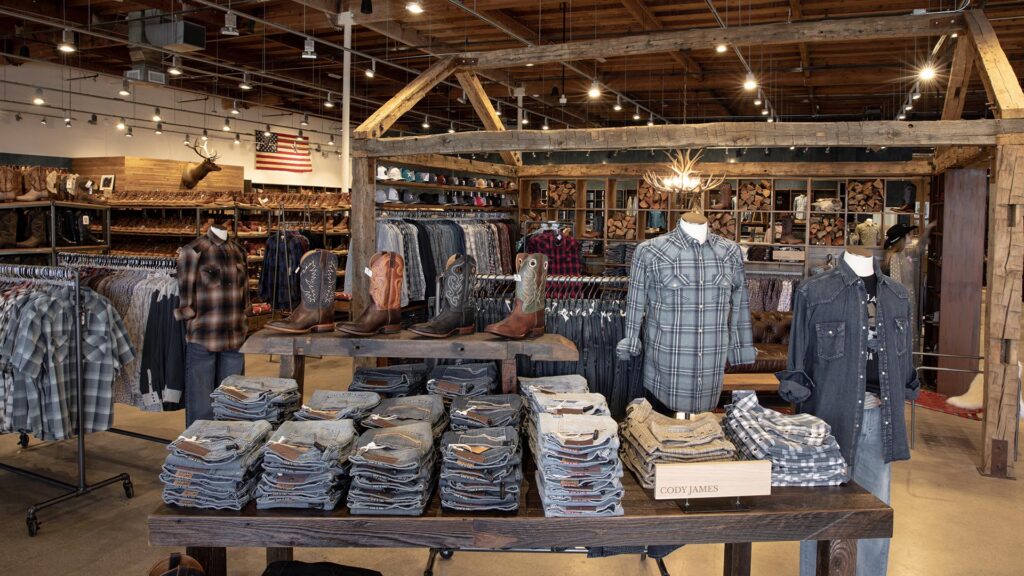
the inside of a boot barn store

The retention problem most retailers are solving wrong

Retail staff turnover is one of the most discussed and least solved problems in the industry. The average annual turnover rate in retail sits well above 60 percent. For frontline roles, it goes higher. And most of the money spent trying to fix it goes to the wrong places.

Sign-on bonuses. Pay uplifts. Flexible scheduling. These things matter at the margins. But they do not address the root cause that Mike Love, Chief Retail Officer at Boot Barn, has spent nearly a decade building against.

People do not leave retail because the pay is slightly better somewhere else. They leave because they cannot see a future where they are.

“One of the primary reasons people leave a company or even our industry overall is because they don't see a pathway to growth.”

Ron Thurston, Frontline Fridays

That insight sounds simple. Acting on it at scale is not. Boot Barn has grown by more than 300 stores in eight years. Keeping pace with that growth while maintaining a deep, development-ready internal pipeline requires a different kind of operational discipline — one that starts long before a promotion is offered.

Here is how they do it, and what retail operators of any size can take from it.

retail store manager walking through a store

Why retail employee turnover is a development problem, not a pay problem

The most ambitious people in your stores are doing a calculation you may not be aware of. They are looking at the leaders above them, the timeline to get there, and the support available to help them close the gap. If the answer to any of those is unclear, they start looking elsewhere.

This is not a theory. It is what Mike Love has watched play out across nearly four decades in retail — first in buying and planning, and then across nine years scaling Boot Barn’s store estate.

His framework for understanding it is Love’s Law: the skills that make someone excellent in their current role are rarely the skills the next role requires. A great store manager is not automatically a great district manager. A great district manager is not automatically a great regional vice president. The job changes. The skill set changes. And if no one is helping people bridge that gap, the most ambitious ones will find somewhere that will.

“What makes you good at your job today is what gets you promoted… but the skill that made me successful at my last role wasn't the skill that was going to make me successful at my next role.”

Mike Love, Chief Retail Officer, Boot Barn

The operational implication is direct: if you want to reduce retail employee turnover among your highest-potential people, you have to invest in their development before the opportunity arrives — not after they have already started to disengage.

So what: Retail operators who treat employee development as an HR function rather than an operational one will keep losing their best people to organisations that take it seriously. Development is a retention tool. Treat it like one.

retail store manager guiding a store associate

How a visible career path reduces retail staff turnover — and improves recruiting

Boot Barn’s internal promotion numbers are not accidental. They are the output of a deliberate decision to make career progression visible, structured, and achievable for anyone willing to invest in it.

Nearly half of all Boot Barn district managers came from store manager roles. Every regional vice president over the past eight years was promoted from within. These are not vanity statistics. They are recruiting tools.

When a store manager candidate is weighing Boot Barn against a competitor, Mike’s team can point to real numbers. This many district managers started where you are standing. This many regional leaders came up through the stores. The path is not theoretical. It is documented and repeatable.

“If my next regional vice president's not there, that's on me. That I didn't develop it. It's not that I didn't have the great clay to work with.”

Mike Love, Chief Retail Officer, Boot Barn

That accountability matters for more than optics. It shifts how leaders think about the people on their teams. When a regional vice president knows that the quality of the DM bench reflects on their own leadership, they become active participants in retail employee development rather than passive observers.

The balance Boot Barn strikes is also worth noting. Around half of district manager hires are internal; the other half come from outside the organisation. The internal promotes bring credibility and context. The external hires bring fresh thinking and guard against the groupthink that can set in when every leader has grown up in the same system.

So what: A visible internal pathway is one of the most cost-effective tools available for both retail employee retention and recruiting. It costs nothing to show a candidate what the path looks like. It costs significantly more to replace them when they leave because they could not see one.

Frontline worker using retail technology

What a retail training programme built by a team of two can teach every operator

Boot Barn’s Level Up programme is one of the clearest examples in retail of what structured frontline career development actually looks like at scale. It was built by a learning and development team of two people.

The structure is straightforward. Level one is required: the baseline knowledge every person in that role needs to function. Product knowledge, operational fundamentals, the non-negotiables. Everyone completes it.

Level two is self-guided. The content is available; nobody forces it. But it begins to expose people to what the next role looks like — the responsibilities of a keyholder, the priorities a store manager carries, the decisions that happen above the sales floor. The people who complete level two are showing you something about their ambition. Curiosity is the filter.

Level three is a stretch assignment. You put into practice what you studied. A keyholder builds the schedule. A store manager takes an interim district assignment in another region. The skills become real.

“If you've got twenty ASMs in a region who can finish level three and they're made to be store managers, when you're opening eighty stores a year, twenty ready-made store managers is a gift.”

Mike Love, Chief Retail Officer, Boot Barn

The point Mike makes here is easy to miss. Level Up is not just a retail employee upskilling programme. It is a supply chain for leadership. When you are opening 80 stores in a year, having 20 people who are ready — genuinely ready, with real experience — is not a nice-to-have. It is what makes the growth possible.

And it works because the pathway is visible. People know what level one requires. They know what level two unlocks. They know what level three proves. Ambition has somewhere to go.

So what: The most common reason retail training programmes fail is not budget. It is structure. People need to know what they are working toward and why it matters. Level Up works because it connects individual development to organisational growth in terms anyone can understand.

retail store managers

How to identify future leaders before they ask to be promoted

One of the most practical things Mike shares is what he is actually looking for when he walks into a store. Not performance data. Not tenure. Two behaviours.

Engage. And be curious.

Engagement is the faster signal. Does this person connect with the people around them? Do they step toward the conversation or away from it? Mike is direct about what its absence suggests: if someone is not willing to engage with a visiting leader, they may not be willing to fully engage with their customers. That matters.

Curiosity takes longer to read but is equally reliable. The person who asks about something outside their current scope — why a product is positioned a certain way, what happens in a district manager’s week, how the store visit process works — is showing you how they think about their own growth. That signal is available to any leader who is paying attention.

Both behaviours are observable without any formal retail employee development infrastructure. You do not need a programme to notice who leans in. You need leaders who are present enough to see it — and credible enough that the people worth developing are willing to show it.

So what: The organisations that build deep pipelines for retail employee development are not always the ones with the most sophisticated tools. They are the ones where leaders are watching, engaging, and investing in the people who show them something worth developing. That starts with presence — and knowing what to look for.

customers shopping at a busy retail store

What this means for retail operators thinking about frontline performance

The connection between retail employee retention and retail operational excellence is direct and underappreciated. When you lose experienced store managers, you lose execution consistency. You lose the institutional knowledge that keeps a store running well when nothing goes to plan. You lose the credibility that makes a team want to show up.

Replacing a store manager costs an estimated six to nine months of that person’s salary when you factor in recruiting, onboarding, and the performance dip while someone new finds their footing. Multiply that across a large estate and the cost of poor retail employee retention becomes one of the most significant and least visible drains on retail operational efficiency.

Boot Barn’s approach does not eliminate turnover. No organisation does. But it materially reduces the turnover that matters most — the loss of high-potential people who leave not because they are unhappy, but because they cannot see where they are going.

The solution is not complicated. Make the path visible. Build the structure. Hold leaders accountable for the development of their people. Give frontline team members a reason to invest in the organisation because the organisation is visibly investing in them.

That is what Love’s Law, Level Up, and Boot Barn’s pipeline are all pointing at. Not a retention programme. A leadership culture where development is not an event. It is the work.

Retail workers behind a counter

The standard is simple. The work is not.

Retail staff turnover will not be solved by a single initiative. But it can be substantially reduced by organisations that take development seriously — not as an HR programme but as a core operational discipline.

Mike Love’s nine years at Boot Barn are proof that it is possible to grow fast, promote from within, and build a culture where ambition has somewhere to go. The tools exist. The structure can be built by a team of two. What it requires is the leadership decision to treat development as infrastructure rather than overhead.

For any retail operator serious about reducing retail employee turnover, improving frontline performance, and building the kind of pipeline that makes growth sustainable, the question Boot Barn answers is the right one to start with: are you building leaders, or just filling roles?

Key Takeaways

  • Retail employee retention is primarily a development problem. People leave when they cannot see a pathway forward. Solving for pay without solving for development treats the symptom, not the cause.
  • A visible internal career path is both a retention tool and a recruiting advantage. Boot Barn’s pipeline statistics are not internal metrics — they are sales assets that candidates respond to in the interview room.
  • Love’s Law applies at every level of the organisation. The skills that earn a promotion rarely prepare someone for the new role. Closing that gap deliberately, before the promotion happens, is what separates development-led organisations from the rest.
  • Level Up proves you do not need scale to build effective retail employee development infrastructure. A three-tier structure built by two people has helped fuel the growth of a 550-location retail chain. Structure matters more than headcount.
  • The two signals worth looking for in every future leader are engagement and curiosity. Both are observable without any formal programme. They just require leaders who are present enough to see them.

This blog is based on Season 2, Episode 18 of Frontline Fridays with Ron Thurston. Listen on Spotify, Apple Podcasts, and YouTube at linktr.ee/frontlinefridays

YOOBIC is the AI-powered platform that helps retail and hospitality leaders connect, train, and empower their frontline teams. Book a demo here.

Book a demo and find out how

Avoid wasted hours, blind spots
and lost revenue with YOOBIC

Frontline worker hero image
Categories
Careers Training

The accidental retail career: 9 leaders on how they fell into the industry and never left

Nine guests. Nine paths nobody planned. One reason they all stayed.

An accidental retail career is one that begins as a stopgap, side job, or unplanned pivot and becomes a long-term professional path. Across two seasons of the Frontline Fridays podcast, nine retail leaders, including senior executives at Pandora, Peloton, Akris, Pollo Tropical, and the Retail Industry Leaders Association, have described their own version of that story.

Key takeaways

→  Almost none of the nine retail leaders profiled set out to work in retail. They planned medicine, law, law enforcement, literature, or corporate buying.

→  Most credit a specific mentor, manager, or moment for the pivot from a stopgap job into a career.

→  When asked why they stayed, none of them named the product. They all named the people.

→  The pattern holds across hospitality, luxury, mass, big box, and convenience retail.

→  The book Retail Pride by Ron Thurston, host of Frontline Fridays, is the source material for the broader thesis.

Ron Thurston wrote a book called Retail Pride: The Guide to Celebrating Your Accidental Career. The subtitle is the part that lands hardest.

Almost nobody we have interviewed on Frontline Fridays planned a career in retail. They walked in for a part-time job, a stepping stone, a way to pay the bills, and stayed for reasons they could not have predicted at the time. Some had their plans interrupted. Some had their plans quietly replaced. A few woke up ten years in and realized the thing they were doing on the side had become the thing they were doing.

Across two seasons of the show, we have heard nine versions of that story that we keep coming back to. They sit alongside each other in a way that feels less like a coincidence and more like a pattern. So we pulled them together. Here is what each one tells us about why retail keeps catching people who never planned to stay.

•   •   •

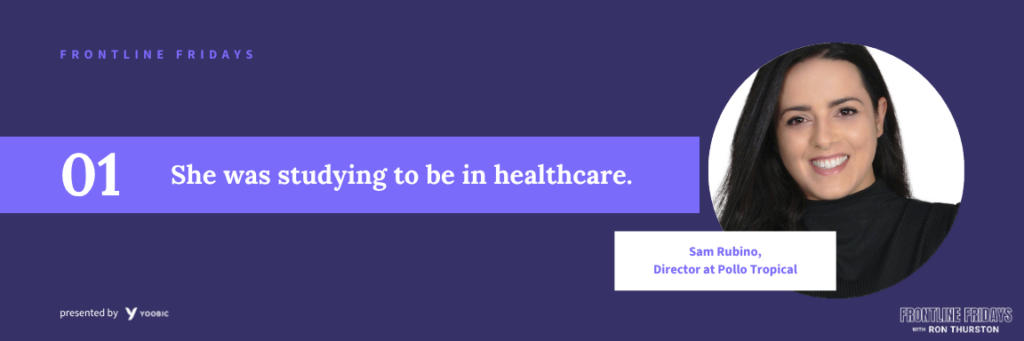
01

Sam Rubino traded a healthcare calling for a hospitality career

Sam had an innate calling toward healthcare. Service ran in the family. Her parents had a restaurant. Her grandmother had a restaurant. But the plan was medicine, and she was studying for it while bartending and serving at Outback to get herself through school.

She kept getting drawn back to hospitality. She built experience at the Ritz-Carlton. She played a pivotal role in the inception and growth of Bolay. Somewhere along the way she realized that the part she loved most was empowering other people to find their own potential. Healthcare had pulled her toward helping people. Hospitality, it turned out, was a different way of doing exactly that.

Today she runs training and communications at Pollo Tropical. If she had forced the medicine plan, she might still be wondering why the energy was not there. The career that pulls at you is usually the one worth investing in. The trick is letting yourself notice.

“In a world where genuine mentors are rare, she stands out.”

Sam Rubino, Director of Training and Communications, Pollo Tropical

Listen to the full episode: Spotify  ·  Apple Podcasts  ·  YouTube

•   •   •

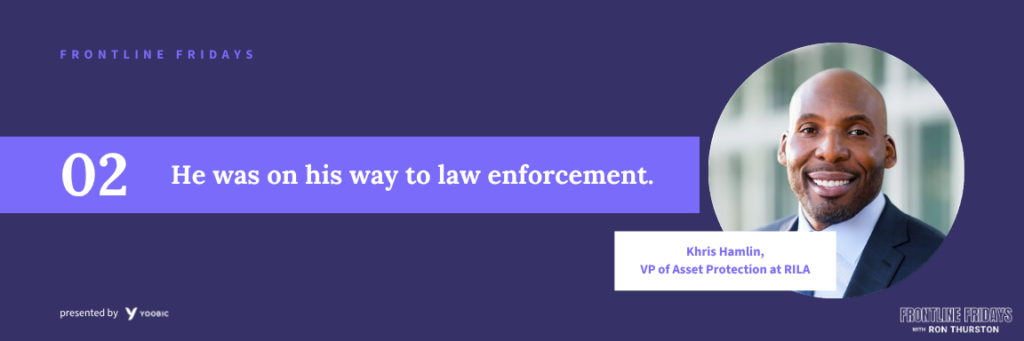
02

Khris Hamlin chose asset protection over law enforcement

Khris was studying criminal justice at George Mason. The plan was law enforcement. Retail was the job that paid the bills while he worked through his next step.

He started in asset protection at Hecht’s, the department store chain that would later become part of Macy’s. What he thought was a stopgap turned into 25 years across asset protection, operations, and store management. He moved on to senior AP roles at Belk, Nordstrom, and Saks OFF 5TH. Today he is Vice President of Asset Protection at the Retail Industry Leaders Association and runs The Khris Hamlin Company on the side, coaching the next generation of AP leaders.

The thing he picked up to pay the bills became the thing he built a 30-year career on. Sometimes a stopgap is just a stopgap. Sometimes it is the door you walked through without noticing.

“Retail is a place where curiosity becomes a career.”

Khris Hamlin, VP of Asset Protection, Retail Industry Leaders Association

Listen to the full episode: Spotify  ·  Apple Podcasts  ·  YouTube

•   •   •

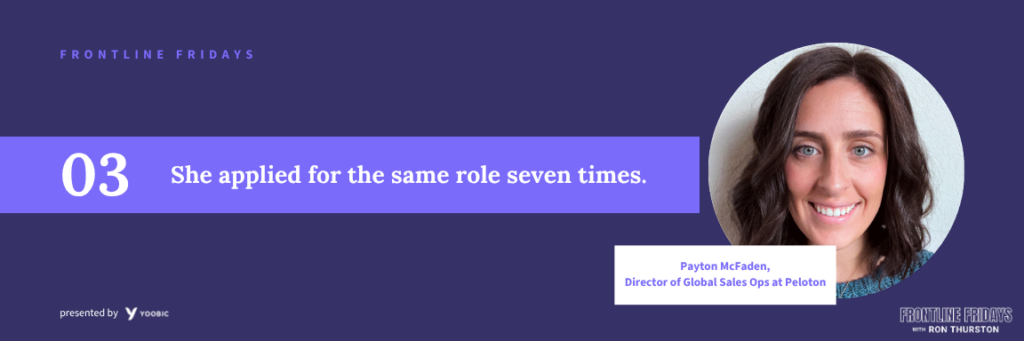
03

Payton McFaden built Peloton’s sales operations function from the inside

Payton spent her early career running stores. At Peloton, she became one of the top store managers in the company. In 2019 the brand recognized her with the “Think and Act Like an Owner” award, which sounds like a marketing line until you understand what it actually meant: she had been treating one store like it was her own business for years.

She wanted to move into corporate. She applied seven times before she got in. She talks about that number openly, because she thinks the store teams reporting to her right now should know it. When she finally crossed over, she built Peloton’s sales operations function from the inside, drawing on everything she had learned standing on the sales floor. Today she leads global sales operations.

Seven rejections is not a story most leaders tell. It is also exactly why hers is worth listening to. The path through retail is rarely linear, and the people who make it tend to be the ones who let the messiness happen without taking it personally.

“You have to be your own advocate. Nobody else is going to know you want it.”

Payton McFaden, Director of Global Sales Operations, Peloton

Listen to the full episode: Spotify  ·  Apple Podcasts  ·  YouTube

•   •   •

04

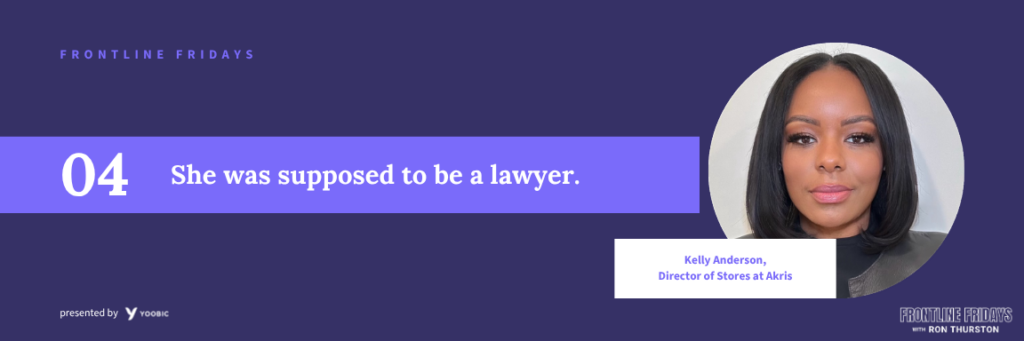
Kelly Anderson left a pre-law track for 20 years in luxury retail

Kelly was studying at York College in Queens, on track to become a corporate attorney. She had landed two prominent internships in her freshman year, ahead of graduating seniors. Then her mother got sick. Kelly became the family’s provider, working two jobs through college while she tried to keep the law school plan alive.

She shopped at an Aldo on 17th and 5th Avenue. The manager got friendly. A conversation led to an interview. She got the job. She was still conflicted about leaving law behind until a mentor teaching at Columbia gave her advice she still uses: people spend so much of their lives focusing on what they think they want. Focus on what makes you happy now, and let it grow from there.

Twenty years later she has led retail teams at Aldo, Kenneth Cole, Louis Vuitton, and Moncler. Today she is Director of Stores, Retail & Concessions at Akris, the Swiss luxury fashion house. The blueprint she had at 18 looked nothing like the career she ended up building. That is true for almost everyone. The energy is more reliable than the plan.

“Focus on what makes you happy now and let it grow from there.”

Kelly Anderson, Director of Stores, Retail & Concessions, Akris

Listen to the full episode: Spotify  ·  Apple Podcasts  ·  YouTube

•   •   •

05

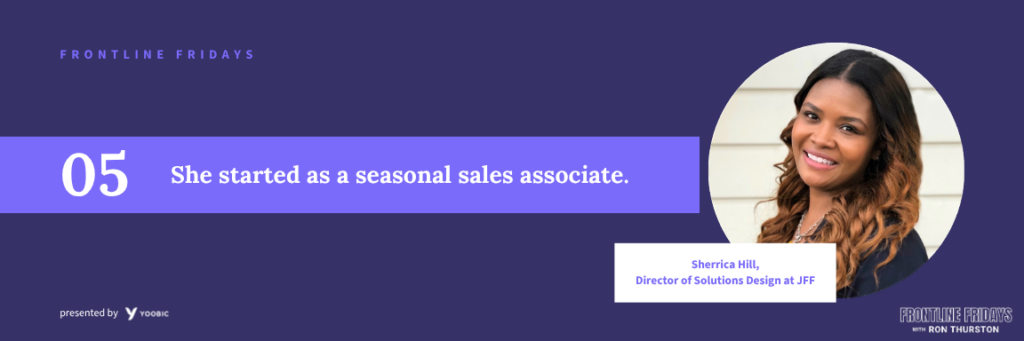
Sherrica Hill built every next role from the one she was already in

Sherrica spent two decades in retail. She started as a seasonal sales associate at Gap and advanced into corporate leadership. Years later, after taking time off with her kids, she came back through fill recruiting, hiring forty sales associates at a time for stores that needed them.

She kept pausing the process. She did not want to send people into stores that were not set up to receive them. So she added training. Then she made the case to lead Gap Inc.’s This Way ONward program, which she eventually ran, tackling systemic barriers to employment for over 15,000 underrepresented early-career talent. That work led her to Jobs for the Future, where she now designs first-job programs for the kind of young workers she used to recruit. Across all of it, she earned her degree while working full-time.

Sherrica did not wait for permission. She used the job she had to test the work she wanted to do next, then built the case for the role. That instinct, more than any single decision, is what shaped her career.

“I didn’t wait on anyone to give me opportunities. I created them myself.”

Sherrica Hill, Director of Solutions Design and Delivery, Jobs for the Future

Listen to the full episode: Spotify  ·  Apple Podcasts  ·  YouTube

•   •   •

06

Brandon Lee turned an English Lit degree into a 20-year visual merchandising career

Brandon did not study design. He studied English Lit and Communications. His first internship was at Barneys, where he was the young one on the team, sometimes literally gluing mannequin hands to the ceiling. His boss walked by once, watched him work, and let him keep going.

From there he built a 20-year career across Ralph Lauren, Bonobos, Gap, Moose Knuckles, and Brooks Brothers. Each move was a yes to the next thing that interested him. Then he left full-time employment to launch Brandon Lee Designs, his own LLC. His current clients sit across industries you would not necessarily associate with traditional VM, including cannabis and furniture.

None of that was on a plan. The literature degree taught him to read stories. Visual merchandising, as he describes it, is just another way of telling them. The point is not that English majors should do retail. The point is that careers like this one get built one yes at a time. You do not need the five-year plan. You need the next thing worth trying.

“Retail creativity is moving to a more holistic view. The window matters less. The connection matters more.”

Brandon Lee, Creative Director and Owner, Brandon Lee Designs

Listen to the full episode: Spotify  ·  Apple Podcasts  ·  YouTube

•   •   •

07

Brian Librach found the industry that fit his ADHD wiring

Brian grew up with undiagnosed ADHD in an era that had no language for it. He learned his coping mechanisms by trial and error, using the driven nature ADHD often brings to chase what energized him. School did not always work. Retail did.

He started in the stockroom. He became a district manager at 21. He climbed from the stockroom to the corner office at Urban Outfitters, PacSun, and internationally with Old Navy in Canada. He still talks about retail as the place that let him use the parts of himself other industries treated as a problem. The improvisation. The energy. The ability to read a room and adjust in real time.

Today he writes about that journey. The Retail Leader’s Roadmap is the book. The Wellwisher Company, which he co-owns with his wife, is the platform. Brian’s story is a useful reminder that retail rewards a particular kind of wiring, and that the people who get told they are wired wrong sometimes find themselves in exactly the right place.

“Retail let me use the parts of myself other industries treated as a problem.”

Brian Librach, Author and Co-Owner, The Wellwisher Company

Listen to the full episode: Spotify  ·  Apple Podcasts  ·  YouTube

•   •   •

08

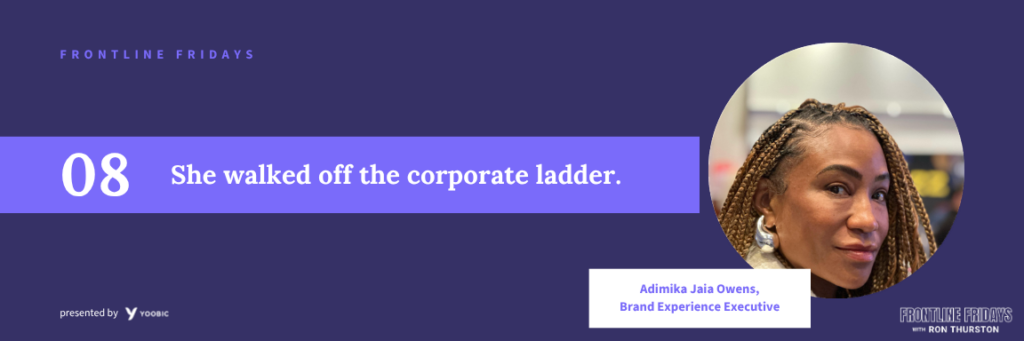
Adimika Owens stepped back to step forward

Adimika started in retail as a buyer at Bloomingdale’s after studying at Clark Atlanta University. Then she relocated to Los Angeles. She walked into a Zara and applied as a sales associate. She calls it the best career decision she ever made.

Working alongside the team that had come over from Spain showed her that retail was not just a corporate function. It was a career, and the stores were where it actually happened. Twenty-five years later she has led visual merchandising at Bloomingdale’s, Forever 21, Victoria’s Secret, and Floor & Decor. At Forever 21 she pushed for mannequins in different shapes, sizes, and skin tones before DEI was a phrase anyone was using. She calls it a small thing that signals a big thing to a customer walking in: you are welcome here.

Going from corporate buyer to sales associate looks like a step back on paper. It taught her more than the next promotion would have. The view from the sales floor is the view every retail decision should account for, and the leaders who have stood on it tend to make better calls when they leave it.

“It allowed me that real understanding. We are all here as sales associates. We all have aspirations and dreams.”

Adimika Jaia Owens, Brand Experience Executive

Listen to the full episode: Spotify  ·  Apple Podcasts  ·  YouTube

•   •   •

09

Detria Courtalis said yes to every next question at Pandora

Detria joined Pandora in 2011 as a training manager because she wanted to get into the brand. Then she raised her hand to run franchise and real estate, which at the time meant the mall stores. Then corporate stores started opening. Then she ran wholesale. Today she is Vice President of Sales for the US and Caribbean, sitting on Pandora’s North American Executive Leadership Team.

None of that was a planned career path. It was a series of yeses to the next question. She tells leaders to be Gumby. She tells store managers to raise their hands, even when they are not sure. Worst case, you get knocked down. You get up. You learn.

Earlier in her career she left Gap for a DM role at Structure when she did not get promoted at Gap. Six months in, she realized she was not ready. She calls it a dose of humble pie and one of the most useful mistakes she has made. Stretch assignments do not need to be linear, and they do not need to work the first time. They just need to teach you something.

“Raise your hand. Worst case, slap it down and try it again.”

Detria Courtalis, VP of Sales US and Caribbean, Pandora Jewelry

Listen to the full episode: Spotify  ·  Apple Podcasts  ·  YouTube

•   •   •

Why retail keeps catching people who never planned to stay

Any empty shopping mall in the day

Read the stories back to back and the pattern is hard to miss. Almost none of them planned a retail career. They planned medicine, law, law enforcement, literature, buying offices, or something else entirely. Retail was the part-time job, the lateral move, the thing they did while they figured out the real thing.

Then the real thing turned out to be this.

When asked why they stayed, none of them talk about the product. They do not talk about the discounts, the pace, or the brand on the building. They talk about the people. The teams who pushed them to apply for the corporate role. The mentors who saw a skill set they had not spotted in themselves. The store managers who asked what they wanted to do next, and then helped them get there.

Ron calls it the accidental career. That is accurate. It is also the reason retail keeps producing leaders that other industries cannot quite replicate. People stay because someone invested in them. They grow into the kind of leaders who invest in others. The cycle is the product.

If you are in this industry, you are part of it. If you lead a team, you are responsible for the next nine stories that get told.

•   •   •

The nine guests featured in this article

Each guest below was interviewed on the Frontline Fridays podcast, hosted by Ron Thurston and presented by YOOBIC.

Sam Rubino is Director of Training and Communications at Pollo Tropical. Featured on Fostering Proud Frontline Career Paths in Retail & Hospitality.

Khris Hamlin is Vice President of Asset Protection at Retail Industry Leaders Association (RILA). Featured on Asset Protection’s Key Role in Modern Retail Leadership.

Payton McFaden is Director of Global Sales Operations at Peloton. Featured on Embracing Vulnerability in Modern Management.

Kelly Anderson is Director of Stores, Retail & Concessions at Akris. Featured on Inspiring the Next Wave of Retail Talent.

Sherrica Hill is Director of Solutions Design and Delivery at Jobs for the Future (JFF). Featured on Hiring For Potential, Not Credential.

Brandon Lee is Creative Director and Owner at Brandon Lee Designs. Featured on Balancing Creativity & Operations in Retail Design.

Brian Librach is Author and Co-Owner at The Wellwisher Company. Featured on Finding Career Growth When You Feel Stuck.

Adimika Jaia Owens is Brand Experience Executive at (formerly Floor & Decor, Forever 21, Victoria’s Secret, Bloomingdale’s). Featured on Visual Merchandisers as the New Keepers of Company Culture.

Detria Courtalis is Vice President of Sales US and Caribbean at Pandora Jewelry. Featured on How to Stay Flexible When Everything is Changing.

•   •   •

Worth a read

Retail Pride: The Guide to Celebrating Your Accidental Career by Ron Thurston is the source material for a lot of how we think about frontline talent. If these stories landed, the book is worth picking up.

Every Frontline Fridays episode is on Spotify, Apple Podcasts, and YouTube.

Build careers, not just shifts

YOOBIC helps retailers turn store associates into store managers, store managers into district leaders, and district leaders into the people who run the industry next. Book a demo to see how.

Book a demo and find out how

Avoid wasted hours, blind spots
and lost revenue with YOOBIC

Frontline worker hero image
× YOOBIC Promo