TL;DR
Retail employee turnover is expensive, disruptive, and widely misunderstood. Most organisations treat it as a compensation problem. Boot Barn‘s Chief Retail Officer Mike Love treats it as a development problem — and the numbers back him up.
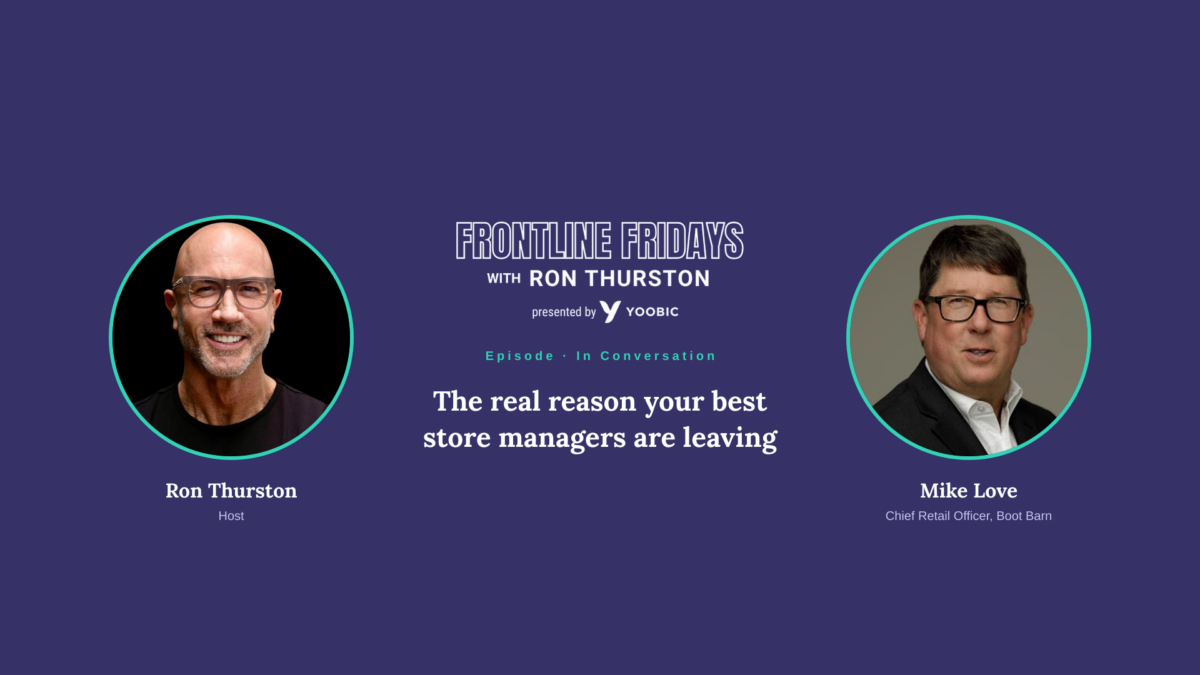
In a conversation with Frontline Fridays host Ron Thurston, Mike explains how Boot Barn has built one of the deepest internal leadership pipelines in specialty retail: nearly half of all district managers promoted from store manager roles, every regional vice president over the past eight years an internal hire, and a structured retail training programme that creates visible pathways to growth at every level.
Three things retail operators can act on today:
- Retail employee retention is a development problem first and a pay problem second. People leave when they cannot see where they are going.
- A visible pathway to growth is one of the most powerful and underused tools for reducing retail staff turnover. It also doubles as a recruiting advantage.
- You do not need a large team to build an effective retail employee development programme. Boot Barn’s Level Up was built by a team of two.
The retention problem most retailers are solving wrong
Retail staff turnover is one of the most discussed and least solved problems in the industry. The average annual turnover rate in retail sits well above 60 percent. For frontline roles, it goes higher. And most of the money spent trying to fix it goes to the wrong places.
Sign-on bonuses. Pay uplifts. Flexible scheduling. These things matter at the margins. But they do not address the root cause that Mike Love, Chief Retail Officer at Boot Barn, has spent nearly a decade building against.
People do not leave retail because the pay is slightly better somewhere else. They leave because they cannot see a future where they are.
“One of the primary reasons people leave a company or even our industry overall is because they don't see a pathway to growth.”
Ron Thurston, Frontline Fridays
That insight sounds simple. Acting on it at scale is not. Boot Barn has grown by more than 300 stores in eight years. Keeping pace with that growth while maintaining a deep, development-ready internal pipeline requires a different kind of operational discipline — one that starts long before a promotion is offered.
Here is how they do it, and what retail operators of any size can take from it.

Why retail employee turnover is a development problem, not a pay problem
The most ambitious people in your stores are doing a calculation you may not be aware of. They are looking at the leaders above them, the timeline to get there, and the support available to help them close the gap. If the answer to any of those is unclear, they start looking elsewhere.
This is not a theory. It is what Mike Love has watched play out across nearly four decades in retail — first in buying and planning, and then across nine years scaling Boot Barn’s store estate.
His framework for understanding it is Love’s Law: the skills that make someone excellent in their current role are rarely the skills the next role requires. A great store manager is not automatically a great district manager. A great district manager is not automatically a great regional vice president. The job changes. The skill set changes. And if no one is helping people bridge that gap, the most ambitious ones will find somewhere that will.
“What makes you good at your job today is what gets you promoted… but the skill that made me successful at my last role wasn't the skill that was going to make me successful at my next role.”
Mike Love, Chief Retail Officer, Boot Barn
The operational implication is direct: if you want to reduce retail employee turnover among your highest-potential people, you have to invest in their development before the opportunity arrives — not after they have already started to disengage.
So what: Retail operators who treat employee development as an HR function rather than an operational one will keep losing their best people to organisations that take it seriously. Development is a retention tool. Treat it like one.

How a visible career path reduces retail staff turnover — and improves recruiting
Boot Barn’s internal promotion numbers are not accidental. They are the output of a deliberate decision to make career progression visible, structured, and achievable for anyone willing to invest in it.
Nearly half of all Boot Barn district managers came from store manager roles. Every regional vice president over the past eight years was promoted from within. These are not vanity statistics. They are recruiting tools.
When a store manager candidate is weighing Boot Barn against a competitor, Mike’s team can point to real numbers. This many district managers started where you are standing. This many regional leaders came up through the stores. The path is not theoretical. It is documented and repeatable.
“If my next regional vice president's not there, that's on me. That I didn't develop it. It's not that I didn't have the great clay to work with.”
Mike Love, Chief Retail Officer, Boot Barn
That accountability matters for more than optics. It shifts how leaders think about the people on their teams. When a regional vice president knows that the quality of the DM bench reflects on their own leadership, they become active participants in retail employee development rather than passive observers.
The balance Boot Barn strikes is also worth noting. Around half of district manager hires are internal; the other half come from outside the organisation. The internal promotes bring credibility and context. The external hires bring fresh thinking and guard against the groupthink that can set in when every leader has grown up in the same system.
So what: A visible internal pathway is one of the most cost-effective tools available for both retail employee retention and recruiting. It costs nothing to show a candidate what the path looks like. It costs significantly more to replace them when they leave because they could not see one.

What a retail training programme built by a team of two can teach every operator
Boot Barn’s Level Up programme is one of the clearest examples in retail of what structured frontline career development actually looks like at scale. It was built by a learning and development team of two people.
The structure is straightforward. Level one is required: the baseline knowledge every person in that role needs to function. Product knowledge, operational fundamentals, the non-negotiables. Everyone completes it.
Level two is self-guided. The content is available; nobody forces it. But it begins to expose people to what the next role looks like — the responsibilities of a keyholder, the priorities a store manager carries, the decisions that happen above the sales floor. The people who complete level two are showing you something about their ambition. Curiosity is the filter.
Level three is a stretch assignment. You put into practice what you studied. A keyholder builds the schedule. A store manager takes an interim district assignment in another region. The skills become real.
“If you've got twenty ASMs in a region who can finish level three and they're made to be store managers, when you're opening eighty stores a year, twenty ready-made store managers is a gift.”
Mike Love, Chief Retail Officer, Boot Barn
The point Mike makes here is easy to miss. Level Up is not just a retail employee upskilling programme. It is a supply chain for leadership. When you are opening 80 stores in a year, having 20 people who are ready — genuinely ready, with real experience — is not a nice-to-have. It is what makes the growth possible.
And it works because the pathway is visible. People know what level one requires. They know what level two unlocks. They know what level three proves. Ambition has somewhere to go.
So what: The most common reason retail training programmes fail is not budget. It is structure. People need to know what they are working toward and why it matters. Level Up works because it connects individual development to organisational growth in terms anyone can understand.

How to identify future leaders before they ask to be promoted
One of the most practical things Mike shares is what he is actually looking for when he walks into a store. Not performance data. Not tenure. Two behaviours.
Engage. And be curious.
Engagement is the faster signal. Does this person connect with the people around them? Do they step toward the conversation or away from it? Mike is direct about what its absence suggests: if someone is not willing to engage with a visiting leader, they may not be willing to fully engage with their customers. That matters.
Curiosity takes longer to read but is equally reliable. The person who asks about something outside their current scope — why a product is positioned a certain way, what happens in a district manager’s week, how the store visit process works — is showing you how they think about their own growth. That signal is available to any leader who is paying attention.
Both behaviours are observable without any formal retail employee development infrastructure. You do not need a programme to notice who leans in. You need leaders who are present enough to see it — and credible enough that the people worth developing are willing to show it.
So what: The organisations that build deep pipelines for retail employee development are not always the ones with the most sophisticated tools. They are the ones where leaders are watching, engaging, and investing in the people who show them something worth developing. That starts with presence — and knowing what to look for.

What this means for retail operators thinking about frontline performance
The connection between retail employee retention and retail operational excellence is direct and underappreciated. When you lose experienced store managers, you lose execution consistency. You lose the institutional knowledge that keeps a store running well when nothing goes to plan. You lose the credibility that makes a team want to show up.
Replacing a store manager costs an estimated six to nine months of that person’s salary when you factor in recruiting, onboarding, and the performance dip while someone new finds their footing. Multiply that across a large estate and the cost of poor retail employee retention becomes one of the most significant and least visible drains on retail operational efficiency.
Boot Barn’s approach does not eliminate turnover. No organisation does. But it materially reduces the turnover that matters most — the loss of high-potential people who leave not because they are unhappy, but because they cannot see where they are going.
The solution is not complicated. Make the path visible. Build the structure. Hold leaders accountable for the development of their people. Give frontline team members a reason to invest in the organisation because the organisation is visibly investing in them.
That is what Love’s Law, Level Up, and Boot Barn’s pipeline are all pointing at. Not a retention programme. A leadership culture where development is not an event. It is the work.

The standard is simple. The work is not.
Retail staff turnover will not be solved by a single initiative. But it can be substantially reduced by organisations that take development seriously — not as an HR programme but as a core operational discipline.
Mike Love’s nine years at Boot Barn are proof that it is possible to grow fast, promote from within, and build a culture where ambition has somewhere to go. The tools exist. The structure can be built by a team of two. What it requires is the leadership decision to treat development as infrastructure rather than overhead.
For any retail operator serious about reducing retail employee turnover, improving frontline performance, and building the kind of pipeline that makes growth sustainable, the question Boot Barn answers is the right one to start with: are you building leaders, or just filling roles?
Key Takeaways
- Retail employee retention is primarily a development problem. People leave when they cannot see a pathway forward. Solving for pay without solving for development treats the symptom, not the cause.
- A visible internal career path is both a retention tool and a recruiting advantage. Boot Barn’s pipeline statistics are not internal metrics — they are sales assets that candidates respond to in the interview room.
- Love’s Law applies at every level of the organisation. The skills that earn a promotion rarely prepare someone for the new role. Closing that gap deliberately, before the promotion happens, is what separates development-led organisations from the rest.
- Level Up proves you do not need scale to build effective retail employee development infrastructure. A three-tier structure built by two people has helped fuel the growth of a 550-location retail chain. Structure matters more than headcount.
- The two signals worth looking for in every future leader are engagement and curiosity. Both are observable without any formal programme. They just require leaders who are present enough to see them.
This blog is based on Season 2, Episode 18 of Frontline Fridays with Ron Thurston. Listen on Spotify, Apple Podcasts, and YouTube at linktr.ee/frontlinefridays
YOOBIC is the AI-powered platform that helps retail and hospitality leaders connect, train, and empower their frontline teams. Book a demo here.
Book a demo and find out how
Avoid wasted hours, blind spots
and lost revenue with YOOBIC