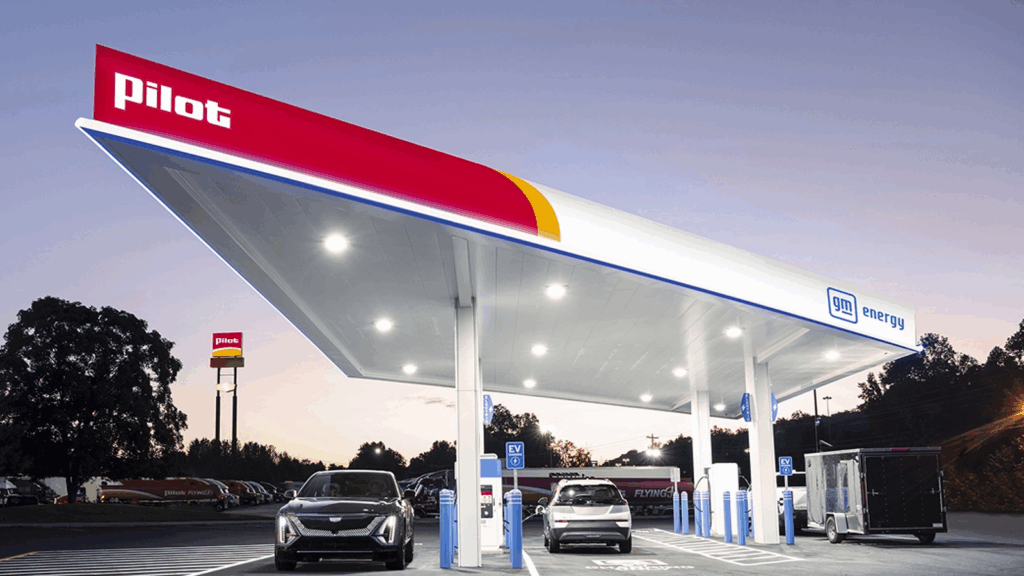
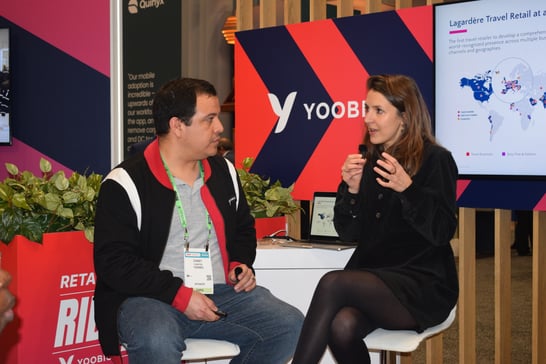
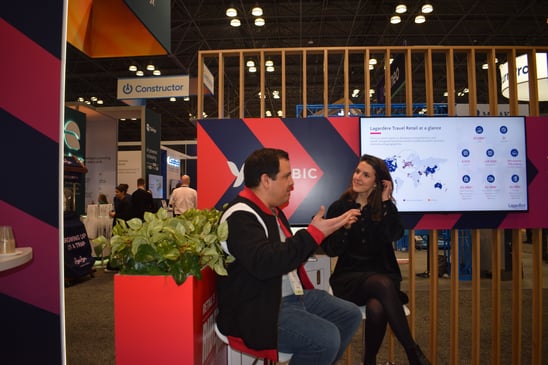
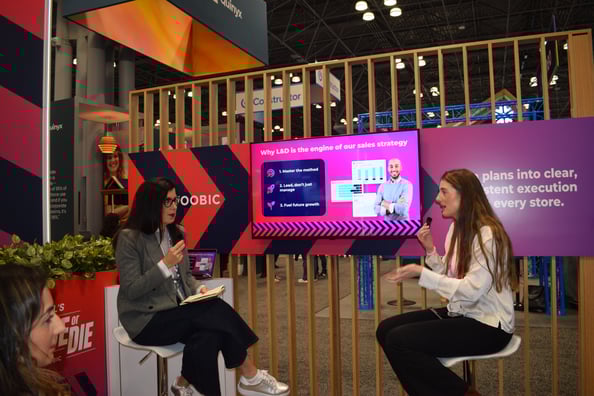
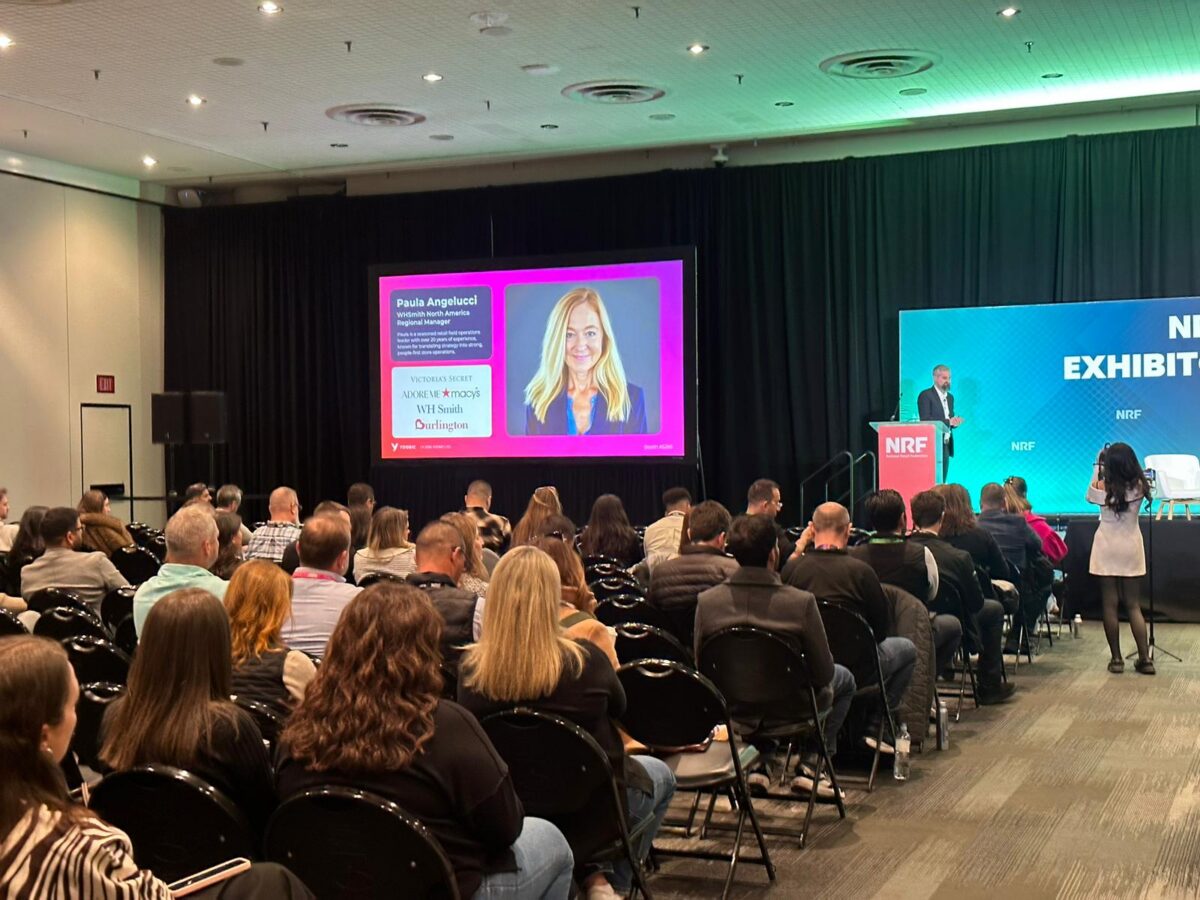
A Frontline Fridays conversation with David Dawson, VP of Retail and Digital Technology, Pilot Company
TL;DR
Pilot Company operates more than 900 travel centers that never close. For David Dawson, VP of Retail and Digital Technology, that constraint has shaped a technology philosophy built on one principle: if frontline teams are expected to show up for guests 24 hours a day, the tools they rely on have to show up for them too.
In a conversation with Frontline Fridays host Ron Thurston, David shares why simplicity is a discipline, not a default, why the best technology decisions get made closest to the work, and what happens when corporate teams actually spend time on the floor.
Three key takeaways:
Technology that doesn’t simplify the job makes it harder. Complexity is a leadership failure.
You cannot build effective frontline tools from a corporate office. Proximity to the work is non-negotiable.
AI is most valuable on the frontline when it removes friction, not when it adds features.
What is frontline technology in retail?
Frontline technology is the set of tools, systems, and platforms that store associates, store managers, and field teams rely on to run daily operations. In multi-location retail, it covers point-of-sale, task management, internal communications, mobile learning, and the integrations that connect those tools to the wider tech stack.
The shift over the last five years has been from desktop-based, back-office systems to mobile-first platforms designed for the shop floor. The goal is the same in every case: keep store leadership in front of guests and teams, not behind a computer.
The store that never closes
Most retailers get to close their doors at night. Their systems get to reboot. Their teams get to reset.
Pilot Company does not.
With more than 900 travel centers open around the clock, Pilot serves professional truck drivers, RV travellers, and commuters across 46 states and five Canadian provinces. The operation never pauses. Which means the technology powering it cannot either.
David Dawson has spent nearly 25 years building the systems that keep Pilot running: point-of-sale, payment processing, task management, and the digital tools that help cashiers, maintenance teams, and store managers deliver for guests at every hour of every day.
His perspective is grounded and practical. Technology is not a product. It is infrastructure. And when it fails the frontline, the people paying the price are the ones already doing the hardest jobs.
That belief shapes everything about how David’s team works. And it starts, perhaps surprisingly, with getting out of the office.
How do you build retail technology that actually works for store teams?
Most corporate technology teams build from assumptions. David’s team builds from evidence.
The IT Road Trip program at Pilot is exactly what it sounds like. David loads his technology team into a 15-passenger van, drives out from their base in Knoxville, Tennessee, and visits as many stores as they can reach. No agenda. No presentations. Just time in the stores, working alongside the people who use the systems every day.
The impact is consistent and immediate.
“You almost always see their perspective and their behavior change when they come back from those types of trips. They then think differently about the work that they do. They're much more conscientious about the impact that they have.”
David Dawson, VP of Retail and Digital Technology, Pilot Company
What changes is not just awareness. It is instinct. Engineers who have fronted a cooler, restocked a shelf, or watched a cashier navigate a POS system mid-rush develop a different standard for what the technology they build has to do. They stop optimising for what looks good in a demo and start optimising for what works at 3am on a busy interstate.
David asks visiting corporate staff to front the cooler as a matter of habit: to face every bottle in the cold case so the labels are visible. It is a small, unglamorous task. But it teaches something no dashboard can.
“These are the things that our frontline has to do all day every day in a 24-hour business. A 24-seven business never stops. These are the types of small things you have to do that make a big difference.”
David Dawson, VP of Retail and Digital Technology, Pilot Company
So what: For any organisation building tools for frontline teams, proximity to the work is not optional. Leaders who design systems without regularly using them build systems that serve themselves, not the people on the floor. This is the same operational principle that drives the best area manager store visit programs: closer proximity, better decisions.
Why simplicity is a discipline, not a default
David’s mantra is three words: simplify, simplify, simplify. He said it on stage at NRF. He repeats it inside his team constantly. And the reason he has to keep repeating it reveals something important about how technology organisations tend to drift.
The pull toward complexity is real. When you are deep in a problem, building a sophisticated solution feels like progress. It often is not.
Pilot learned this directly. Several years ago, David’s team built a deli management system for their food production operations. It was technically impressive. It was also, as the store teams put it, like a rocket ship.
“They said that thing is like a rocket ship. I need an advanced degree in astrophysics to use this thing. All I really needed was a camera and a monitor so I could see what's happening on the deli while I'm back in the kitchen.”
David Dawson, VP of Retail and Digital Technology, Pilot Company
The team had spent significant time and resource building something that overshot what the stores actually needed. The real solution was simpler than anything they had designed. And they only found that out by going to the stores.
This is a pattern David has observed repeatedly. Technology teams get excited about capability. Frontline teams need usability. The gap between those two things is where most enterprise technology fails.
The standard David holds his team to is direct: if a new tool does not make the job easier or better, it is not progress. It is a step backwards.
So what: Complexity in frontline technology is not a sign of ambition. It is a sign that the team building the tool has not spent enough time with the team using it. The discipline of simplicity has to be actively maintained, not assumed. The same principle applies to retail audit software selection: tools that overshoot the user’s actual job get abandoned by the frontline.
What does 24/7 retail technology require?
A 24-7 retail operation runs continuously, with no scheduled downtime, no nightly system reboots, and no break in customer service. For technology teams, that means every tool deployed has to operate across calendar-day boundaries, sync without interrupting active transactions, and remain reliable at every hour, including the small hours when support teams are not on shift.
Running a business that never closes sounds like an operational challenge. It is also a technology one.
David describes what most retail operators never have to consider: transactions that span two calendar days. Systems that cannot be rebooted. Routines that have to run continuously without a convenient window to reset or update.
For Pilot, the shift from paper-based operations to digital has been transformational. Store managers used to carry clipboards. Compliance checks happened on paper. Process guidance lived in binders stacked on shelves.
Today, those routines are digitised. Using YOOBIC as a task management platform, Pilot has moved its workforce off the back office and onto the floor. Managers who previously had to sit at a computer to complete administrative tasks can now do that work on a handheld device while they are serving guests.
“We love to see our managers out on the sales floor, having those human interactions, helping with transactions. That's where we really want the management, the leadership in the store to be, not back in the back office doing paperwork.”
David Dawson, VP of Retail and Digital Technology, Pilot Company
The operational implication is significant. In a 24-7 environment, any tool that pulls leaders off the floor is a cost. Any tool that keeps them on it is an investment. This is the same operational logic behind why retailers are digitizing store visit procedures: time recovered on the floor compounds across every shift, every store, every quarter.
AI is extending this further. David’s team is using AI to help frontline workers access information and resolve problems in real time, from troubleshooting a faulty freezer to finding the right process card without digging through binders. The goal is not automation for its own sake. It is removing the friction that slows teams down when every hour matters.
So what: The value of technology in a never-closing operation is measured in minutes, not features. Every time a manager spends less time searching for information or completing back-office tasks, that time moves to the floor, to guests, and to the team. That is the return.
The human behind the counter
Pilot’s business case is well understood: fuel, food, showers, rest stops. What is less visible is the human infrastructure that holds it together.
David describes something that reframes what frontline service means at Pilot. For a professional truck driver on a long-haul route, a Pilot cashier may be one of only one or two human interactions they have in a whole day. The other is usually a loading dock.
That is not a customer service insight. It is a human one.
“We don't take that lightly. We understand the significance of those human interactions. We understand that life on the road can be a challenge. So we try to be there for them.”
David Dawson, VP of Retail and Digital Technology, Pilot Company
It also creates a real operational challenge. Frontline teams at Pilot have to read the room quickly. Some guests need to get fuel, use the bathroom, and get back on the road. Every minute they are not driving is a minute they are not earning. Others are on a mandated break, legally unable to drive, and genuinely need the time and the human contact.
Recognising the difference is not just good service. It is the job. And it is a skill that cannot be automated.
This is where technology and leadership intersect. The role of the tool is to remove everything that gets in the way of that human interaction. The role of the leader is to make sure their team understands why it matters.
So what: Frontline technology that frees up time for human interaction is not just operationally efficient. In businesses like Pilot, it is the whole point. The tools that matter most are the ones that give people on the floor more capacity to be present with the people in front of them. This is the same dynamic behind employee engagement in retail: connectivity makes recognition possible, and recognition is what tells frontline teams the work matters.
Why field experience is not optional for retail tech leaders
Field experience for retail tech leaders is the requirement that anyone building or deploying technology for stores has direct, recurring exposure to the operational realities those stores face. At Pilot Company, that means almost all field leadership has come up through the stores. External hires brought into division-level roles are sent back to run a single store first. The principle is structural: closer proximity to the work produces better decisions about the work.
David is candid about his own position in this. As someone who has spent his career in technology, he does not carry the same credibility on store operations that his field leadership counterparts do. He has earned a different kind of credibility, through the IT Road Trip, through the relationships his team builds with store staff, and through the discipline of listening before building.
“As someone who spent my life in the office working on technology, you can't just plop me into a field leadership position and expect that I'm going to know how to run a region of stores. You have to start from being on the front lines.”
David Dawson, VP of Retail and Digital Technology, Pilot Company
The implication for technology leadership is clear. If you want your team to build tools that work for the frontline, you need people who understand the frontline. Not from a requirements document. From experience.
So what: Organisations that separate their technology teams from their store teams build tools for the wrong problem. Closing that gap is not a cultural nice-to-have. It is a product requirement.
The standard that matters
David Dawson’s philosophy is not complicated. It is just consistently applied.
If the technology makes the job easier, it is doing its job. If it does not, it is getting in the way. And the only way to know which one is true is to spend time with the people using it.
In an industry that tends to celebrate innovation for its own sake, that is a more demanding standard than it looks. It requires technology leaders to stay close to the work, resist complexity, and measure success by what happens on the floor rather than what looked good in the build.
For Pilot, with 900 locations open every hour of every day, there is no room for tools that slow teams down. The frontline does not get a reset. The technology it relies on cannot afford one either.
Key takeaways
Proximity to the work is the foundation of good frontline technology. You cannot build effective tools from a corporate office. David’s IT Road Trip program exists because there is no substitute for seeing the job firsthand.
Simplicity is a discipline that has to be actively maintained. The pull toward complexity is constant. The deli management story is a reminder that impressive technology and useful technology are not the same thing.
In a 24-7 operation, technology is measured in time recovered, not features delivered. Every minute a manager spends off the floor is a cost. Tools that put leadership back in front of guests and teams deliver the real return.
The human value of frontline work cannot be automated. For many Pilot guests, a cashier interaction is one of their only human connections all day. Technology that frees up space for that interaction is not just efficient. It is meaningful.
Field experience is a prerequisite, not a preference. Pilot’s insistence on field leadership coming from the frontline is a structural decision that keeps the organisation grounded in operational reality.
See how leading retailers turn frontline technology into store performance
YOOBIC helps retailers like Pilot Company, Michaels, and Hugo Boss strip administrative load off store managers, simplify the tools their teams use every day, and keep leadership on the floor where it matters most. Book a demo to see how it works in your store network.
Book a demo and find out how
Avoid wasted hours, blind spots
and lost revenue with YOOBIC
How do retailers digitize store operations without disrupting the frontline?
The most successful digitizations replace paper-based, back-office routines with mobile-first workflows that store managers can complete on the floor. Pilot Company moved compliance checks, task management, and process guidance from clipboards and binders to a handheld platform, which kept managers in front of guests rather than behind a computer. The principle is that any tool pulling leadership off the floor is a cost, and any tool keeping them on it is an investment.
What does 24/7 retail operations require from technology?
A 24/7 retail operation requires technology that runs continuously across calendar-day boundaries, syncs without interrupting active transactions, and operates reliably at every hour, including when support teams are not on shift. Systems cannot be rebooted on a schedule. Routines have to run without a convenient window to reset or update. The bar for reliability is significantly higher than in retailers that close overnight.
How can corporate technology teams build better tools for frontline retail workers?
The most effective approach is direct, recurring exposure to the store floor. Pilot Company runs an IT Road Trip program where the technology team visits stores in person and works alongside the people using the systems. Without that exposure, technology teams tend to build for what looks good in a demo rather than what works on a busy shop floor. Proximity to the work is what changes both standards and instincts.
Where does AI add value for frontline retail workers?
AI delivers the most value on the retail frontline when it removes friction rather than adds features. Practical applications include real-time information access (troubleshooting equipment, finding the right process), routine task prioritization, and replacing dashboard sprawl with prioritized recommendations. Hugo Boss saw a 3.2% sales uplift from YOOBIC Store Manager Copilot, an AI tool designed specifically to give store managers clarity rather than another reporting layer to interpret.
Why is field experience important for retail technology leaders?
Field experience for retail technology leaders means having direct, recurring exposure to the operational realities stores face. At Pilot Company, almost all field leadership has come up through the stores, and external hires brought into division-level roles are required to run a single store first. The principle is that organizations separating technology teams from store teams build tools for the wrong problem, and the only reliable way to close that gap is structural proximity to the work.
Retail turnover rates remain among the highest of any industry — between 60% and 80% annually, according to industry benchmarks. The cost of each departure, factoring in recruitment, onboarding, and lost productivity, runs between $5,000 and $10,000 per employee. For a retailer with hundreds of stores, the math is brutal.
Training is the most direct lever retailers have to reduce that churn, accelerate time-to-productivity for new hires, and ensure consistent execution of brand standards across every location. But the training itself has to work within the realities of frontline retail: associates who don’t sit at desks, don’t have company email addresses, and often have less than five minutes between customers to absorb new information.
That’s why the retail training platform market has evolved rapidly. Legacy desktop-based LMS platforms designed for corporate office workers are being replaced — or supplemented — by mobile-first, microlearning-native solutions built for the way frontline employees actually work.
Not every platform on this list solves the same problem. Some are purpose-built for frontline retail. Others are enterprise LMS platforms with retail applicability. Some focus on compliance and certification tracking, while others emphasize retail sales training — helping associates build product knowledge, selling techniques, and customer service skills that translate directly to revenue. The right choice depends on whether your primary challenge is frontline engagement, sales enablement, compliance tracking, content creation, or connecting training to on-the-floor execution.
We’ve evaluated the leading platforms based on frontline usability, mobile-first design, G2 ratings and verified reviews, retail customer base, and the ability to drive measurable outcomes — not just course completion.
1. YOOBIC: Best overall retail training platform
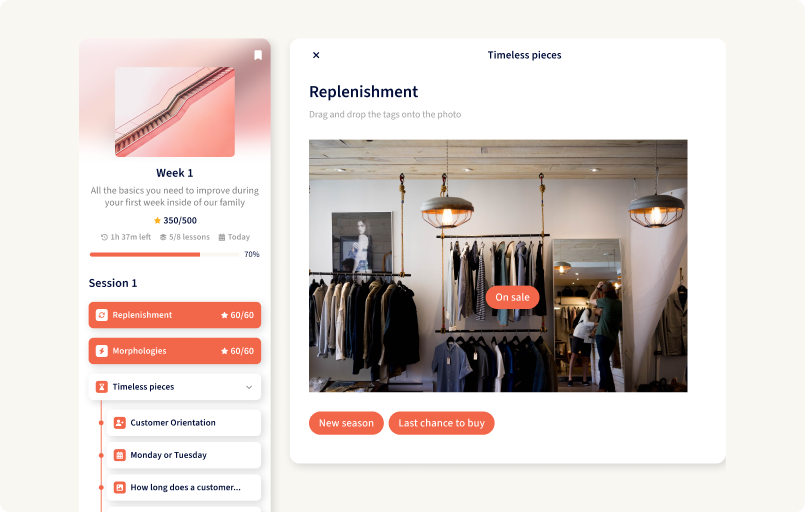
YOOBIC is the retail training platform built to empower store associates with mobile-first learning, onboarding, and upskilling programs that drive measurable store performance improvements. Unlike standalone LMS platforms that deliver training in isolation, YOOBIC connects every learning moment to real-world store execution through integrated task management and frontline communications — so associates learn, do, and apply it, all in one app.
YOOBIC was named in the 2025 Gartner® Hype Cycle™ for Corporate Learning Technologies — validating its training platform alongside dedicated LMS vendors — as part of a broader inclusion across six Hype Cycle reports that year. On G2, YOOBIC ranks #1 across Retail Execution and Retail Task Management with 27 badges across 142 reports.
What makes YOOBIC different for training?
Onboard new employees in days, not weeks
YOOBIC’s structured onboarding programs, automated learning paths, and real-time mobile training get new associates productive in days rather than weeks. Role-based course enrollment makes sure every hire receives the right content from day one. One luxury fitness customer cut onboarding time by 50% using YOOBIC.
Recurring course enrollment keeps that efficiency going long after onboarding. It automatically re-enrolls employees into mandatory compliance, SOP, and safety training, so those programs run on schedule without manual administration. That takes a recurring task off your L&D team’s plate and keeps every store current on the training it’s required to complete.
Turn learning into measurable sales impact
YOOBIC helps retailers build retail sales mastery through adaptive learning, gamification, and rewards. Product knowledge training, selling techniques, upselling strategies, and customer service skills are delivered as interactive microlearning modules that associates complete on the floor between customers. Leaderboards, performance badges, and store-vs-store competitions create a culture of continuous learning. Native certificates are awarded automatically on course completion, giving associates clear recognition for what they’ve finished and a reason to keep going. UNTUCKit deployed YOOBIC to turn training into a direct sales driver, and South African fashion group TFG increased its in-store conversion rate by 22%.
AI-powered content creation at speed
YOOBIC’s AI course creator turns existing SOPs, product specs, and brand guidelines into interactive modules in minutes, while a no-code drag-and-drop builder lets teams without technical backgrounds build courses themselves. You can set the learning goal during course creation, and the AI adapts the structure, tone, and outcomes to match, whether associates need to build a skill, change a behavior, learn something new, or stay compliant. Teams can also point the AI at existing high-performing lessons to use as a starting reference. Longchamp saves 10 hours per week on content creation using YOOBIC’s AI. Fast, multi-language translation keeps content consistent across global store networks.
Training connected to execution
When a new seasonal collection drops, the training module on product features feeds directly into a visual merchandising task, and the associate who completed the training verifies the display is set correctly. When food safety training is completed, it’s linked to the corresponding inspection checklist. The learning and the doing happen in the same workflow, in the same app.
Reporting features (have added this in because it seems to be a repeated feature that is inadequate in most other competitors listed below)
YOOBIC’s proven results and customers
Moschino deployed YOOBIC across 150+ global locations and achieved 98% course completion with a 4.7/5 course rating. TFG increased in-store conversion by 22% across 160 stores. Longchamp reclaimed 10 hours per week on content creation. Over 350 brands use YOOBIC for frontline training in 21+ languages across 80+ countries, including H&M, Boots, Lacoste, Michaels, GameStop, and David Jones.
Best for: Multi-location retailers that need a training platform where learning drives measurable sales impact, faster onboarding, and consistent store execution — not just course completion.
2. Axonify
Axonify is a frontline enablement platform that uses microlearning, AI-powered reinforcement, and adaptive learning paths to train deskless workers. The platform delivers daily 3-to-5-minute training sessions using spaced repetition to reinforce knowledge over time. Customers include Walmart, Kroger, and Lowe’s.
Axonify reports an 83% weekly login rate across its learning module, driven by its gamification mechanics and short-session format. The platform also includes two-way frontline communications and a task management module with photo verification.
Considerations: Axonify’s most consistent complaint on G2 is admin backend complexity. Reviewers have noted feeling restricted by the admin experience compared to other platforms. The platform is designed for large enterprises and may not be as accessible for mid-market retailers. Axonify’s task management and communications capabilities are secondary features layered onto a training-first platform — organizations seeking a unified operational platform where training, tasks, and communications are equally integrated may find the balance weighted too heavily toward learning.
3. Docebo
Docebo is an AI-powered enterprise learning management system supporting employee training, compliance, and extended enterprise learning. The platform offers multi-audience portals (employees, partners, customers), a content marketplace, SCORM/XAPI compliance, and AI-powered features including the Harmony search assistant and AI agent training.
Docebo is favored by large enterprises with complex training architectures that span internal staff, franchise partners, and external audiences.
Customers include Sonos, Bulk and Kiehl’s.
Considerations: Docebo is a broad enterprise LMS rather than a purpose-built frontline retail training platform. Originally designed for desktop-based corporate learning environments, the platform has since adapted to mobile rather than being built mobile-first from the ground up.
Some G2 reviewers highlight a steep learning curve due to the platform’s breadth of functionality and limited support documentation. Users also note that certain reporting and configuration customisations can require additional setup complexity and cost. In addition, some functionality sits behind premium add-ons, which reviewers describe as expensive.
Unlike retail execution platforms, Docebo does not provide integrated task management, store execution workflows, visual merchandising verification, or frontline communication capabilities. For retailers primarily training store associates on mobile devices, this can create adoption and usability challenges compared to platforms designed specifically for frontline retail teams.
4. SAP Litmos
SAP Litmos is a cloud-based LMS focused on scalable compliance training, certification management, and performance tracking. The platform offers tiered plans with a built-in content library ranging from approximately 140 to 2,000+ courses depending on plan level.
Litmos is widely cited as one of the fastest-deploying LMS platforms on the market, with a straightforward setup process.
Considerations: Some G2 reviewers describe Litmos reporting and analytics as unintuitive, with users noting that extracting meaningful compliance and learner performance insights can require significant manual effort. Common feedback also references limited customisation options for course layouts, slower load times for larger content modules, and data-heavy reports that can be difficult to navigate.
Litmos is a general-purpose corporate LMS rather than a retail-specific frontline platform. The system does not include integrated retail workflows such as merchandising training, on-floor skill validation, task execution, or direct integration with store operations. For retailers managing large frontline workforces, particularly those with high employee turnover, pricing can also scale quickly, with costs typically ranging between $4–$8 per user per month depending on plan structure and feature requirements.
5. Cornerstone OnDemand
Cornerstone OnDemand is an enterprise talent management suite that combines learning management with performance reviews, succession planning, career pathing, and compliance tracking. The platform offers real-time reporting dashboards for tracking compliance, learning, and skill trends.
Cornerstone is positioned for organizations where learning is part of a broader HR transformation, reporting into talent management rather than retail operations.
Considerations: The learner experience is Cornerstone’s most significant liability for retail frontline use. As one G2 reviewer noted, “Most people writing reviews about Cornerstone are not end-users (learners). Learners suffer horribly in Cornerstone.” For retail environments where the entire value of training depends on whether store associates actually engage with it, learner experience is not a secondary concern — it’s the primary one. The platform also requires multiple authentication steps to access learning materials, which creates friction for frontline workers who need immediate, low-barrier access. Cornerstone is priced and architected for enterprise HR departments, not for retail operations teams seeking rapid frontline training deployment. In addition, G2 reviews heavily focus on the poor customer support citing slow response times and unhek
6. 360Learning
360Learning is a collaborative learning platform that enables subject matter experts to create and publish training content without formal L&D backgrounds. The platform emphasizes peer-driven course creation, forums, and knowledge sharing.
The collaborative model is conceptually appealing for retail — the idea that experienced store managers and top-performing associates can build training from their own expertise.
Considerations: 360Learning is positioned primarily for small and medium-sized businesses and has limited proven scale with enterprise retail chains operating hundreds of locations. The platform does not offer task management, store execution workflows, or frontline communications integration. There is no native visual merchandising compliance or photo-based verification capability. For retailers who need centrally controlled, brand-consistent training content deployed at enterprise scale, the decentralized content creation model introduces quality control considerations.
7. Absorb LMS
Absorb LMS is an enterprise learning management system with strengths in compliance training, automated workflows, and audit-ready reporting. The platform is recognized for supporting regulated industries where compliance documentation and certification tracking are primary requirements.
Considerations: Absorb is a compliance-first enterprise LMS, not a frontline engagement platform. The platform does not offer mobile-first microlearning as a native format, retail-specific workflows, gamification comparable to frontline-native platforms, or integration with store execution and communications systems. For retailers where the primary training challenge is associate engagement and knowledge retention rather than compliance audit trails, Absorb addresses a secondary concern. Desktop-based LMS platforms typically achieve under 15% completion rates among frontline retail staff, compared to 80–95% from mobile-first, gamified platforms.
8. SC Training (formerly EdApp)
SC Training, now part of SafetyCulture, is a mobile-first microlearning platform offering a free plan with unlimited users, AI course creation, a library of 1,000+ editable courses, gamification, and offline mobile access.
The free tier makes SC Training attractive for independent retailers and franchise operators with minimal training budgets.
Considerations: SC Training is predominantly used by small businesses and is not designed for enterprise retail operations at scale. Reviewers have flagged limited flexibility in quiz types, strict video requirements, and a learning curve for advanced admin tasks. SSO and advanced reporting require paid Business+ plans, which begin to add up at scale. The platform lacks enterprise compliance audit trails and the administrative depth required by retailers managing training across dozens or hundreds of locations. SC Training does not offer integrated task management, store execution workflows, or frontline communications.
9. Zipline
Zipline is a frontline operations platform primarily focused on HQ-to-store communications and task coordination. The platform includes a learning resources component that allows retailers to publish and organize reference materials, guides, and training content alongside operational communications.
Zipline’s learning capabilities are part of a broader operations platform rather than a standalone training solution.
Considerations: Zipline is not a dedicated training or LMS platform. Its learning component provides resource distribution rather than structured microlearning, adaptive learning paths, gamification, or AI-powered content creation. The platform does not offer the depth of learning analytics, spaced repetition, or knowledge reinforcement mechanics found in purpose-built training solutions. Organizations evaluating Zipline specifically for retail training — rather than as an operations and communications platform with supplementary learning features — should assess whether the training depth matches their L&D requirements.
10. Rallyware
Rallyware is a sales performance enablement platform that delivers real-time product coaching, upsell prompts, and learning tasks at the point of sale. The platform uses AI to connect training directly to sales behavior, delivering content during the decision moment with the customer present.
Considerations: Rallyware serves a narrow use case — commission-driven and assisted-selling retail environments such as luxury, electronics, and beauty. The platform’s features are best suited to sales-focused roles and may be too robust or misaligned for retailers with diverse frontline training needs spanning onboarding, compliance, safety, and operational procedures. Rallyware does not offer the breadth of an enterprise LMS or the operational integration of a unified frontline platform.
How to choose the right retail training platform
Selecting a training platform for frontline retail teams is a decision that affects every store, every new hire, and every product launch rollout. The wrong choice means low adoption, wasted L&D investment, and the same knowledge gaps you set out to close. Here’s a framework for evaluating your options.
Frontline training is not corporate training
The most consequential mistake in this category is selecting a platform designed for office-based corporate learning and expecting it to work for retail store associates. Frontline workers don’t have company laptops, dedicated email addresses, or scheduled training blocks. They learn between customers, during shift transitions, and on their phones. Any platform that was built for desktop-first, email-login, hour-long course completion will see adoption collapse on the retail floor.
The data supports this: desktop-based LMS platforms typically achieve under 15% completion rates among frontline retail staff. Mobile-first, gamified platforms achieve 80–95% completion rates with the same content. The platform architecture — not the content quality — is the primary driver of that gap.
Measure engagement, not just completion
Course completion is the most common training metric, and the least useful. A 100% completion rate tells you that associates clicked through the content, not that they retained it, applied it, or changed their behavior on the floor.
The platforms that drive real training ROI measure deeper: knowledge retention over time (through spaced repetition and adaptive reinforcement), on-the-floor behavior change (through connected task execution and compliance data), and correlation between training investment and business outcomes like sales uplift, shrink reduction, and customer satisfaction.
Beware the “platform fragmentation” tax
Many retailers end up with separate systems for training (an LMS), communications (an intranet or messaging app), and task management (another app or spreadsheets). Each system has its own login, its own admin overhead, and its own data silo. The hidden cost isn’t just the subscription fees — it’s the inability to connect training effectiveness to operational outcomes. Did the visual merchandising training actually improve planogram compliance? Did the product knowledge module drive upsell rates? If training data and execution data live in different systems, these questions are unanswerable.
AI should create content and drive action, not just automate admin
AI capabilities vary enormously across this category. At the basic end, “AI” means automated course assignments or chatbot-based FAQ. At the advanced end, AI generates complete training modules from existing documents, delivers personalized learning paths based on individual performance data, and connects training gaps to execution failures with recommended interventions.
The meaningful question is whether the AI reduces the burden on your L&D team (content creation, translation, personalization at scale) and whether it connects training to business outcomes — or whether it simply adds a marketing buzzword to a conventional LMS.
Plan for retail’s reality: high turnover and constant change
Retail’s 60–80% annual turnover means your training platform is an onboarding machine first and a development tool second. The platform needs to get new hires productive within days, not weeks. It needs to support onboarding at scale without proportional increases in L&D headcount. And it needs to handle the constant content churn of seasonal promotions, new product launches, and evolving brand standards without requiring your training team to rebuild courses from scratch every cycle.
Evaluate platforms on how quickly a new course can be created, translated, and deployed across every store — and how quickly a new hire can access their first training module after day one.
Don’t separate sales training from operational training
Retail sales training — product knowledge, selling techniques, upselling strategies, customer service skills — is often treated as a separate initiative from operational training like compliance, safety, and visual merchandising. This creates a fragmented learning experience where associates toggle between platforms or, more commonly, only complete whichever program their manager prioritizes that week.
The retailers seeing the strongest sales impact from training are the ones that embed product knowledge and selling skills into the same platform and workflow as operational execution. When an associate completes a product training module and immediately receives a related merchandising task, the learning reinforces the doing. When sales performance data feeds back into the training platform to identify knowledge gaps, L&D teams can intervene with targeted content rather than blanket retraining. The platforms that connect retail sales training directly to floor execution and business outcomes deliver measurably higher ROI than those treating sales enablement as a standalone learning track.
Why YOOBIC is the best choice for retail training
“We needed a way to make our store team training more engaging and successful. When I found YOOBIC, it was a no-brainer!”
Luca Trignano, Former Global Retail Training Manager, Moschino
YOOBIC is the only retail training platform on this list that answers every question in the evaluation framework above. It’s mobile-first and built for frontline workers who train on their phones between customers. It measures engagement and knowledge retention through gamified microlearning with adaptive reinforcement — and connects that learning data directly to task execution and compliance outcomes in the same platform.
The results speak for themselves: UNTUCKit turned training into a sales driver. TFG increased in-store conversion rates by 22%. Moschino achieved 98% course completion across 150+ global stores. Longchamp’s L&D team saves 10 hours per week on content creation. These aren’t LMS metrics — they’re business outcomes that no standalone training platform on this list can match, because none of them connect learning to what actually happens on the store floor.
For retailers looking for a training platform that drives measurable sales impact and store execution outcomes — not just course completion — YOOBIC is the clear choice.
YOOBIC is the leading AI-powered retail training platform, trusted by 350+ global brands.Request a demoto see how YOOBIC can transform your frontline training.
Book a demo and find out how
Avoid wasted hours, blind spots and lost revenue with YOOBIC
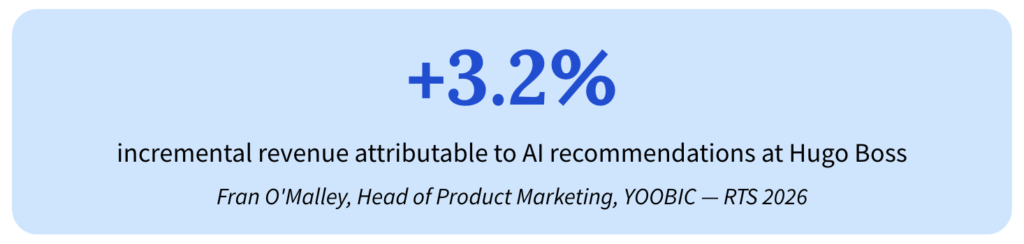
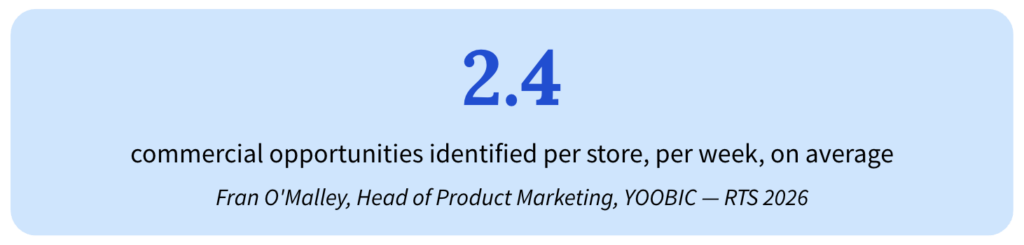
Hugo Boss delivered a 3.2% increase in incremental revenue directly attributable to AI recommendations. The mechanism: an average of 2.4 identifiable commercial opportunities per store, per week, that most networks leave undetected.
Why retail store data alone isn’t enough
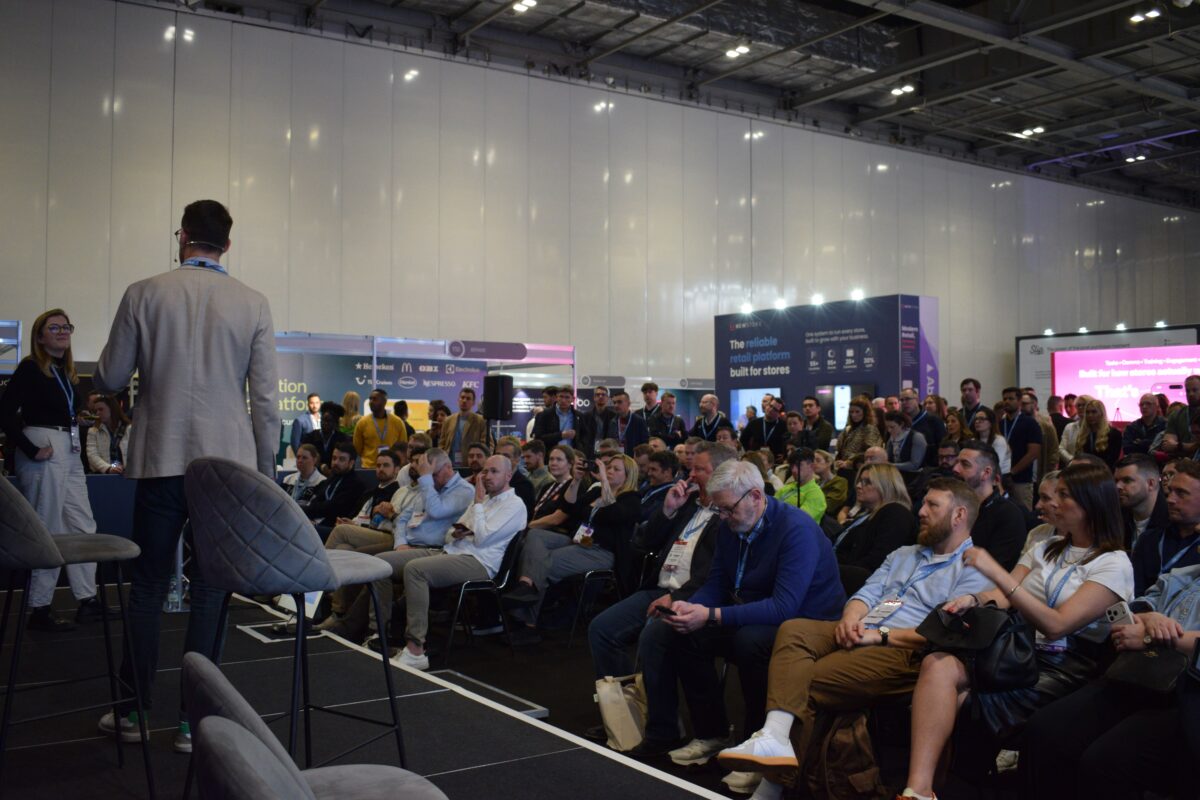
It’s 8:45am. Two people have called in sick, the Wi-Fi is down, and the morning briefing starts in 15 minutes. There is no time for spreadsheets. This is the reality Fran O’Malley, Director of Product Marketing at YOOBIC, used to open the company’s session at the Retail Technology Show 2026.
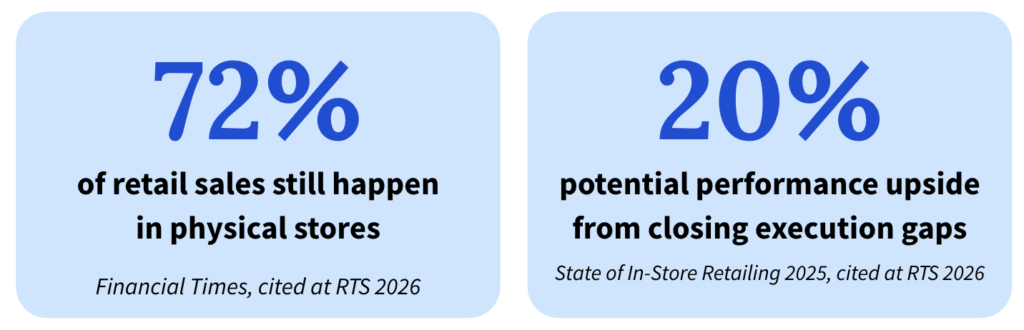
Her point was direct: when 72% of retail sales still happen in physical stores (Financial Times), and when execution gaps — missed product opportunities, non-compliant displays, undetected performance variance — are accumulating across hundreds of locations every day, the cost of getting information to store managers too late, not at all, or in a format that’s difficult to act on is material. Research cited in the session puts the performance upside of closing those gaps at up to 20%.
The session covered two AI use cases that address this directly: the Store Manager Copilot and the VM Copilot. What follows is a structured summary of what was demonstrated, what it means for operations leaders, and why the approach produces measurable results.
Why is consistent store performance so hard to achieve across a retail network?
The problem is not a lack of data — it is a lack of relevant, timely data. Each store operates across a unique combination of cluster, footfall, staffing, assortment, and past performance. Without real-time benchmarking against comparable stores, managers default to instinct. The result: performance variation that tracks manager experience rather than store potential.
Most retail networks hold significant data — sales, inventory, workforce, customer feedback. The structural problem is that this data lives in separate systems, arrives at different intervals, and reaches store managers too slowly to influence decisions made at 9am.
As the RTS session slides framed it, each store needs a personalized set of recommendations based on its cluster, past performance, team composition, location, current KPIs, and assortment. Standard dashboards and weekly trade reports cannot deliver that level of individualization at the speed the shop floor requires.
The outcome, observed across YOOBIC’s customer base, is that performance variation between stores correlates more with manager experience than with structural factors. In the absence of clear, trusted data, all managers rely on instinct. The difference is that more experienced managers tend to focus on the right activities, while less experienced managers often spend time on work that doesn’t drive results.
Operationally, this means: retailers cannot close that variation by hiring better managers or running more training. They close it by giving every manager — regardless of experience — access to the same quality of contextualized, benchmarked insight at the same time.
How does YOOBIC’s AI turn store data into action?
YOOBIC’s AI follows three steps: connect all available store data, apply predictive AI to benchmark performance and rank opportunities by impact, then route a specific recommended action to the specific role that can act on it. The output is not a new report. It is a prioritized task, delivered to the right person before the moment of decision.
This is the same operational shift explored in our guide to retail task management, where store work moves from scattered communication to structured, trackable execution.
YOOBIC described the architecture as three linked stages: connect your data, make it smart, act on it.
How YOOBIC’s AI processes store data
1. Connect — Unify inputs from point-of-sale, inventory, performance data, footfall , and external signals including weather and local events into a single connected view.
2. Analyze — Benchmark each store against a comparable peer group. Identify anomalies and commercial opportunities ranked by likely revenue impact.
3. Route — Deliver the right action to the right person. Store associates receive task guidance. Store managers get performance snapshots and opportunity alerts. District managers see cross-store rankings. HQ operations get portfolio-level compliance and campaign rollout data.
The routing logic is the critical differentiator. Insight that reaches the wrong person, or the right person too late, does not change behavior. Insight that reaches a store manager before the morning briefing — in the form of one specific action — does.
“What we do not want to do is just fire tons of notifications, flood the store, nothing gets done, they just tick that they've done it, and you're in the same place as you started.”
Bradley Capon, VP Sales, YOOBIC
Operationally, this means: AI that floods store teams with low-priority alerts produces the same outcome as no AI at all. The operational value comes from constraint — surfacing the one or two actions most likely to move the KPI that day, for that specific store.
How did Hugo Boss achieve a 3.2% revenue increase with AI?
Hugo Boss had access to data, but translating it into clear, daily priorities at the store level remained a challenge. Store managers were often required to interpret multiple signals and decide where to focus, which led to natural variation in performance. As a result, some revenue opportunities went unaddressed. YOOBIC’s Store Manager Copilot was designed to close that gap. The result: 3.2% incremental revenue directly attributable to AI recommendations, delivered through three specific use cases.
O’Malley grounded the session in Hugo Boss before walking through the product. The brand’s store managers had access to data from multiple sources — spreadsheets, emails, operational systems — but extracting actionable priorities from that data was time-intensive and inconsistent. Decisions defaulted to instinct. Performance varied significantly depending on how experienced the individual manager was.
Hugo Boss: what the challenges looked like before AI
Scattered data — managers were overwhelmed with inputs but unable to identify priorities.
Missed opportunities — teams knew they were leaving revenue on the table but could not identify where.
Beyond revenue, the Copilot produced three secondary outcomes: store managers spent more time on the shop floor and less time in the back office; the team’s understanding of which KPIs actually drive performance improved measurably; and healthy competition emerged between stores once managers could see precisely how they compared to peers.
Operationally, this means: the 3.2% revenue figure is the measurable output, but the underlying change is structural — Hugo Boss moved from a network where performance depended on manager experience to one where every manager operates from the same quality of data-driven briefing.
Use case 1: Smart briefings — replacing the pre-shift spreadsheet review
The smart briefing is a daily, automated performance summary delivered before the store opens. It surfaces yesterday’s results against target, units per transaction, average basket value benchmarked against comparable stores, predicted traffic for the day, and a specific recommended focus.
In a typical scenario, a store might beat its previous day’s target, with units per transaction above average. But average product value could still lag behind comparable stores — a sign the team is optimizing for volume over value. The recommendation: prioritize higher-value products during predicted high-traffic periods. Instead of interpreting multiple reports, the store manager walks into the morning briefing with a clear, data-backed agenda.
Operationally, this means: a manager who previously spent 30 minutes cross-referencing data before a briefing now has that synthesis waiting for them. At scale, that 30-minute saving per manager per day translates into more time on the shop floor, more coaching, and more consistent execution.
Use case 2: Commercial opportunity identification — closing the gap between stores
Every store in a retail network underperforms in at least one product category relative to comparable locations. Most of that variance goes undetected until a monthly trade review — by which point the opportunity has passed.
Operationally, this means: an average of 2.4 opportunities per store per week means the revenue gap from undetected opportunities is not marginal — it is structural and recurring.
Use case 3: KPI boosters — simulating performance before committing to action
When a KPI falls below target, a store manager faces two questions: is this gap closable today, and what specifically should I do about it? The KPI booster feature answers both.
A manager simulates the effect of a KPI shift — for example, moving units per transaction up by two points — and sees the projected impact on the day’s sales target. The system then surfaces product bundles that are performing in comparable stores, using only items currently in stock.
As Capon noted, the AI is built around the KPI agreed at project start. If average basket value is the priority, the recommendations reflect that. If volume is the focus, the logic changes. The store manager decides what to act on.
Operationally, this means: KPI simulation removes two forms of friction: managers no longer need to estimate whether a gap is closable, and they no longer need to rely on instinct or head-office guidelines to know which products to push. Both decisions are data-backed and stock-verified.
How does AI reduce the time between issuing brand guidelines and achieving compliance?
VM compliance delays are a process problem, not a people problem. Feedback loops — send guidelines, receive photos, review, return feedback, receive corrections — have historically taken days to weeks. YOOBIC’s VM Copilot breaks the loop by analyzing photos in real time at the point of execution, resolving 50% of feedback before it reaches HQ. This compresses the compliance window without adding headcount.
YOOBIC processes 80 million photos per year across its client base. Until recently, every photo required human review. That volume — which grows with every new campaign and every additional store — represents a review capacity constraint that cannot be solved by hiring alone.
YOOBIC built the VM Copilot by first understanding exactly where review time was being lost. The research process: 50 hours of customer interviews, analysis of tens of thousands of photo comments from VM teams. The finding was precise: 50% of all HQ feedback to stores was about basic brand standards — tags showing, garments not folded correctly, boxes in the wrong position. None of this required VM expertise. All of it was consuming VM team capacity.
The Copilot analyzes each photo across three categories:
How YOOBIC’s VM Copilot analyzes each photo
Each photo is assessed against brand standards to identify execution gaps and opportunities for improvement. Store teams receive clear, actionable guidance on how to improve compliance, styling, and overall display quality.
When a store team submits a photo, the Copilot provides feedback at the moment of execution — before the image reaches the HQ review queue. Store teams receive in-moment corrections. HQ teams receive a prioritized view of the images most in need of their attention, with AI analysis already surfaced.
Operational result for VM teams
Store teams receive same-session feedback — corrections happen before the next customer walks past.
50% of HQ feedback volume is resolved at source, before it enters the review queue.
HQ VM specialists see the highest-priority images first, with AI flags already attached.
The compliance loop compresses from days to hours without adding headcount.
Operationally, this means: recovering 50% of HQ VM review capacity does not just save time — it redirects skilled VM specialists away from basic standards enforcement and toward the work that actually requires their expertise: campaign styling, display innovation, and brand elevation.
What changes operationally when AI is in place?
Operational area
Without AI
With YOOBIC AI
Morning briefing preparation
30+ minutes reviewing multiple reports and spreadsheets before store opens
Automated briefing ready before the manager arrives — no preparation required
Commercial opportunity detection
Visible in monthly trade reviews, if identified at all
2.4 opportunities surfaced per store per week, benchmarked against comparable stores, in real time
Performance benchmarking
Network averages only; no peer-store comparison available at store level
Each store benchmarked against comparable sites by cluster, location, assortment, and past performance
Days to weeks, dependent on HQ review queue and team capacity
Real-time in-store coaching at point of execution; 50% of feedback resolved before HQ review
KPI improvement planning
Dependent on manager experience; instinct-driven product selection
KPI impact simulated before action; bundle suggestions verified against current stock
Performance consistency across network
Strongly correlated with individual manager experience level
Data-driven briefings reduce reliance on experience; opportunities identified consistently across all locations
Key takeaways from RTS 2026
1. The value of AI in stores is determined by routing logic, not algorithm sophistication
Insight that reaches the wrong person, or arrives after the decision has already been made, has no operational value. YOOBIC’s approach prioritizes getting the right action to the right role at the moment it can be acted on. Hugo Boss’s 3.2% revenue uplift is a routing outcome as much as a data science outcome.
2. Every store network contains recurring, identifiable revenue gaps
An average of 2.4 commercial opportunities per store per week — each benchmarked against comparable stores and verified against stock — represents a structural, recurring source of revenue that most networks leave undetected.
3. Manager experience is the variable AI is most directly designed to level
Performance variation across Hugo Boss stores correlated with manager experience, not store potential. AI that gives every manager the same quality of benchmarked, context-specific briefing reduces that dependency. The brand moved from inconsistent, experience-dependent decision-making to consistent, data-driven execution — across its entire network.
4. The VM compliance loop is a capacity problem AI solves structurally
50% of HQ VM review time was being spent on basic brand standards that required no specialist judgment. That is not a people problem — it is a process design problem. Placing AI earlier in the review cycle recovers that capacity permanently, without additional headcount, and redirects it toward work that requires genuine VM expertise.
5. The KPI northstar must be defined before deployment, not during it
YOOBIC builds its AI logic around the KPI agreed at project start. That anchor determines what data is surfaced, what opportunities are flagged, and what actions are recommended. AI without a defined priority surfaces noise.
Conclusion
The signal from YOOBIC’s RTS 2026 session was not about AI capability in the abstract. It was about where operational value lands when AI is deployed with a clear brief.
Hugo Boss’s 3.2% revenue increase did not come from a more sophisticated algorithm. It came from routing the right data to the right person at the right moment — before the morning briefing, at the point of photo submission, in the seconds before a KPI decision is made. Replicated across 2.4 opportunities per store per week, across a network of hundreds of stores, the aggregate is material.
For retail operations leaders, the question is not whether AI belongs in stores. According to Bradley Capon, VP Sales at YOOBIC, it will be in every store within a year. The question is what to prepare. The answer from this session is precise: define the KPI you are trying to move, identify where the data that would move it currently sits, and close the gap between those two things.
“We want to make sure that you're using that data effectively to make sure that you can drive sales.”
Bradley Capon, VP Sales, YOOBIC
Book a demo and find out how
Avoid wasted hours, blind spots
and lost revenue with YOOBIC
Most retail leaders invest heavily in planning strategy.
Promotions are mapped months in advance. Vendor funding is negotiated. Merchandising calendars are carefully built. Marketing teams forecast the expected lift from every campaign.
But there is one number most retailers never measure.
It doesn’t show up on a P&L. It rarely appears in executive reviews. And it almost never gets discussed on earnings calls.
Yet it can be one of the largest hidden drains on retail profitability.
That number is the retail execution gap.
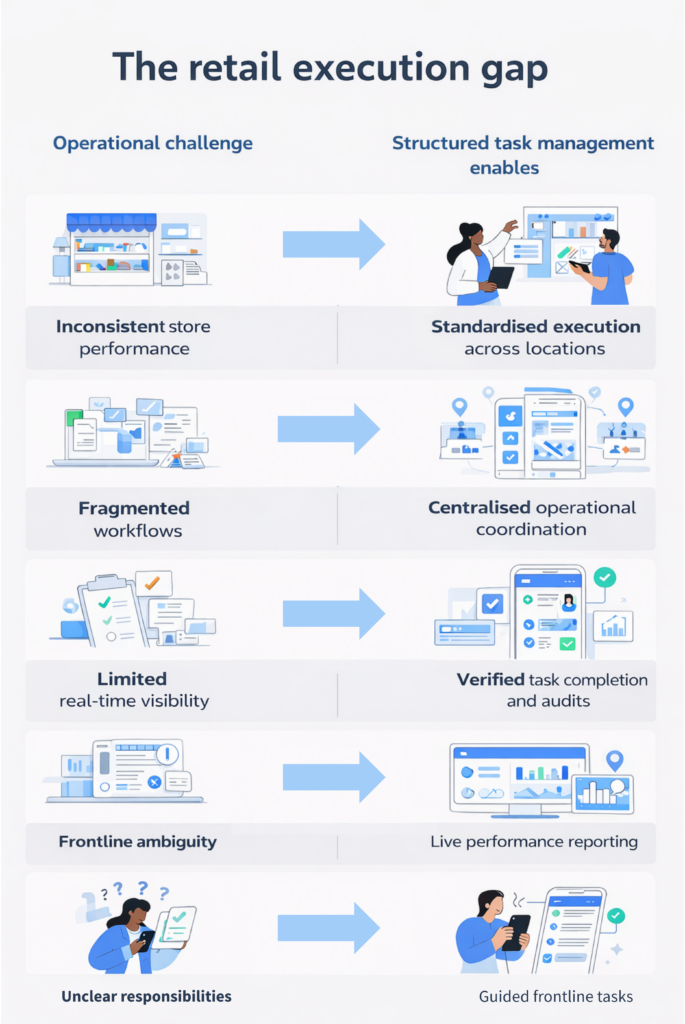
The retail execution gap is the difference between what headquarters plans and what actually happens on the store floor. Across large retail organizations, this gap can quietly destroy $10 million to $40 million in value every year, according to Boston Consulting Group.
Not because something catastrophic happens.
Because small execution failures occur every day across hundreds or thousands of stores.
A promotion launches late. Signage is placed incorrectly. A task gets skipped during a busy shift. An associate never receives the briefing for a campaign.
Individually, each issue seems small.
But across an entire retail network, those small misses compound into one of the biggest hidden leaks in retail performance.
What is the retail execution gap?
The retail execution gap is the gap between operational plans created at headquarters and how consistently those plans are executed in stores.
It occurs when store teams:
Do not receive operational communications
Misinterpret instructions
Execute tasks inconsistently
Lack the training or tools needed to follow through
When execution gaps occur across hundreds of locations, they create lost revenue, operational inefficiency, and compliance risk.
In many retail organizations, the execution gap remains invisible until leaders begin measuring store-level performance systematically.
Why do retail leaders often overestimate store execution?
Retail leaders often overestimate store execution because most organizations measure whether instructions were sent, not whether they were executed correctly.
Ask a retail COO or head of store operations what percentage of stores executed a promotion correctly this week.The answer is usually 80–85%.
But when retailers implement structured measurement — through mystery shoppers, photographic store audits and visual verification, or structured reporting — the real number is often closer to 55–65% compliance.
That means there is typically a 15–25 percentage point gap between perceived execution and actual execution.
This gap doesn’t happen because store teams aren’t trying.
It happens because most retailers lack the systems to reliably connect headquarters strategy with frontline execution.
A directive leaves HQ. An email is sent. A manager acknowledges receipt.
But somewhere between the briefing and the start of the promotion, more than one third of stores execute incorrectly or not at all.
How much does poor retail execution cost businesses?
Poor retail execution can cost large retailers millions of dollars each year. When promotions, compliance tasks, and operational processes are executed inconsistently across stores, small failures compound across hundreds or thousands of locations, leading to lost sales, wasted vendor funding, and operational risk.
Retail performance rarely fails because of one major issue.
It fails because of thousands of small execution problems that accumulate across stores.
Consider a typical grocery retailer operating 500 locations.If store-level execution breaks down in just 30% of stores, the financial impact can quickly add up:
$780,000 in lost vendor funding due to poor promotional compliance
$3.9 million in missed promotional sales
$260,000 in lost revenue from uninformed associates
$250,000 in potential regulatory or safety fines
That’s more than $5 million in preventable losses every year.
And that example is conservative.
For many large retail organizations, the cost of poor execution easily reaches eight figures annually.
The retail execution gap is usually caused by structural issues in frontline operations rather than a lack of effort from store teams. In most retail organizations, three operational gaps drive inconsistent execution: communication breakdowns, productivity friction, and workforce turnover. These gaps make it difficult for headquarters strategy to translate into consistent store-level execution.
Across large retail networks, even small operational gaps can compound quickly, affecting communication, productivity, and workforce stability.
1. The retail communication gap
One of the biggest causes of execution failure is simple: store teams never receive or fully understand operational instructions.
Most retailers rely heavily on email to communicate with stores.But email open rates from headquarters to frontline teams typically average 20–30%.Important information often gets buried in inboxes, forwarded across informal messaging apps, or printed and forgotten in back offices.
This kind of information overload is a growing operational challenge in retail. In fact, many retailers are discovering that too many messages can be just as damaging as too few.
As a result, the associate responsible for executing a promotion may never actually read the instructions.
Retailers that close this gap move away from broadcast communication and adopt:
Role-based messaging
Mobile-first communication tools
Read confirmations
Priority-based task delivery
These changes can increase communication engagement by 60–80% and dramatically improve store-level execution.
2. The retail productivity gap
Frontline retail employees often lose 15–25% of their working time to operational friction.
This includes:
Searching for information
Clarifying unclear instructions
Repeating tasks that were executed incorrectly
Navigating outdated administrative systems
The impact of this friction goes far beyond wasted time.It reduces customer-facing availability, slows store operations, and increases employee frustration.
In one large fuel and convenience retail network, operational friction across 15,000 employees was estimated to cost $28 million annually in lost productivity.
The problem isn’t employee performance.
It’s outdated operational infrastructure.
3. The retail turnover gap
Retail has some of the highest workforce turnover rates in any industry.
Many sectors experience 40–70% annual turnover, and in convenience retail it often exceeds 80%.
New employees typically take 6–10 weeks to reach full productivity.During that ramp period, they operate at roughly 60–70% of the effectiveness of experienced associates.
In high-turnover environments, a large portion of the workforce is always in this ramp phase.
That means execution quality is constantly fluctuating.
Research consistently shows that employees who feel informed, trained, and supported are 25–40% more likely to stay beyond the critical 90-day retention period.
Better frontline enablement improves both execution and retention.
How can better store execution increase retail revenue?
Improving store execution can generate significant revenue growth without requiring new stores or new products. When promotions, merchandising standards, and frontline training are executed consistently across locations, even small improvements in compliance can translate into millions of dollars in additional sales.
The retail execution gap is not just a cost problem.It is also a significant revenue opportunity.
Even modest improvements in execution consistency can generate major financial returns.
For example,if promotional compliance improves from 60% to 75%, the revenue impact can be significant.A retailer generating $1.2 million in annual revenue per store across 1,900 locations could see $11.4 million in incremental revenue from just a 0.5% improvement in execution performance.
No new stores. No new product launches.
Just better execution of the existing plan.
Training also plays a critical role.
In many retail categories — especially foodservice, convenience, and specialty retail — trained associates can achieve two to three times higher conversion rates than untrained employees.
Across thousands of customer interactions, that difference creates a major margin opportunity.
Why is the retail execution gap difficult to fix?
The retail execution gap persists because most retailers lack the systems, visibility, and operating models required to manage frontline execution at scale. In practice, three structural issues make the problem difficult to solve: limited visibility into store performance, outdated operational tools, and a rapidly changing frontline workforce.
1. Limited visibility into store execution
Most retailers lack real-time visibility into what is actually happening inside stores. Instead, they rely on delayed reporting from store visits, field audits, or mystery shopping programs.
This means execution issues are often discovered days or weeks after they occur, making it difficult for leadership to identify patterns or correct problems quickly.
2. Outdated tools for managing store operations
Many frontline operations are still managed using tools that were never designed for a mobile, deskless workforce. Frontline employees are often expected to:
Receive communications through email
Complete training through desktop learning systems
Track compliance using paper checklists
These disconnected systems create operational friction. Research shows frontline employees can lose 15–25% of their working time navigating fragmented systems, searching for information, or correcting execution errors.
3. A rapidly changing frontline workforce
Retail has some of the highest turnover rates of any industry, with many sectors experiencing 40–70% annual turnover, and convenience retail often exceeding 80%.
At the same time, the frontline workforce is increasingly made up of Gen Z employees, a generation that communicates through mobile apps, learns through video, and expects faster feedback and clearer guidance at work.
Many retail operating models, however, were designed for a different era. Store teams are still expected to rely on email communications, desktop training systems, and fragmented operational tools.
Retailers trying to manage a mobile-first workforce with legacy systems face a structural disadvantage.
How are leading retailers closing the retail execution gap?
Leading retailers are improving store execution by replacing fragmented communication and manual processes with systems that connect headquarters strategy directly to frontline execution. These systems provide real-time visibility into store performance and give teams the tools they need to execute tasks consistently across locations.
Instead of broadcasting instructions and hoping stores comply, they are building systems that connect strategy directly to execution.
That shift includes:
Targeted frontline communication delivered through mobile devices
Real-time visibility into store execution
Structured task management for store teams
Mobile-first training that accelerates onboarding
Data-driven operational insights for district managers
Retailers like Pilot Company, Vans, Michaels, David Jones, and Strand have implemented modern frontline operations platforms to improve execution consistency across large store networks.
The result is clearer communication, better operational visibility, and stronger store performance.
For retailers looking to operationalise these approaches during high-pressure retail periods, our playbook 6 Strategies for Peak Season Execution explores how leading brands structure frontline communication, task management, and store operations when execution matters most.
How is AI improving retail store execution?
AI is helping retailers improve store execution by identifying operational risks, prioritizing tasks, and giving managers real-time visibility into what is happening across their store networks. Instead of relying on delayed reporting or manual oversight, retailers can use AI to surface execution issues and guide daily operational decisions.
Store managers make more than 200 operational decisions every day, from prioritizing tasks to resolving execution issues in stores.
Frontline AI helps guide those decisions by identifying execution risks and highlighting the most important actions. For example, AI can help answer questions such as:
Which stores are at risk of missing promotional compliance?
Which tasks should managers prioritize today?
Where are execution issues emerging across the network?
Which teams need additional support?
By improving the quality of daily operational decisions, frontline AI drives improvements in:
Promotional compliance
Store productivity
Issue resolution speed
Employee engagement
Revenue performance
Retail execution rarely fails in big moments.
It fails in hundreds of small decisions every day.
AI helps retailers make those decisions better.
How can retailers measure the cost of their execution gap?
Most retail organizations have some level of execution gap between what headquarters plans and what actually happens in stores. The critical question for retail leaders is not whether the gap exists, but how large it is and what it is costing the business each year.
Without structured visibility into store execution, many retailers underestimate the financial impact of missed promotions, inconsistent compliance, and operational inefficiencies.
For many organizations, the cost of the execution gap is larger than the combined impact of several major operational initiatives.
Understanding the size of that gap is the first step toward improving store performance.
How can retailers close the retail execution gap?
Retailers close the execution gap by giving frontline teams the systems and visibility needed to execute strategy consistently across stores. This typically requires improving communication, standardizing operational workflows, and providing real-time insight into store performance.
Retail strategy is created at headquarters.But retail performance is determined in stores.
Closing the execution gap requires giving frontline teams the tools they need to execute consistently, including:
Clear communication
Structured operational workflows
Real-time execution visibility
Continuous training
AI-powered operational insights
When execution improves, small operational gains compound across store networks. Consistent promotions, better-informed associates, and faster issue resolution all contribute to stronger financial performance.
Over time, the millions lost to execution gaps can become measurable gains in revenue, productivity, and customer experience.
Book a demo and find out how
Avoid wasted hours, blind spots and lost revenue with YOOBIC
What is the biggest issue facing retail right now?
One of the biggest challenges facing retailers today is operational complexity across large store networks. Rising labor costs, high employee turnover, and increasingly complex promotions make consistent store execution difficult. As a result, many retailers are focusing on improving frontline operations and gaining better visibility into store performance.
How can retailers identify whether they have an execution gap?
Retailers can identify an execution gap by comparing headquarters plans with verified store-level outcomes. This often involves using store audits, photo verification, compliance reporting, or operational dashboards to confirm whether promotions, merchandising standards, and operational tasks are executed consistently across locations.
What metrics should retailers track to improve store execution?
Retailers typically track metrics such as promotional compliance, task completion rates, execution time for operational initiatives, training completion, and store-level performance indicators like conversion or inventory accuracy. These metrics help identify where execution issues are emerging across the store network.
What tools do retailers use to manage store execution?
Retailers often use frontline operations platforms that combine communication, task management, training, and operational analytics. These systems help ensure store teams receive clear instructions, track task completion, and provide leadership with visibility into execution across locations.
What are the 5 KPIs in retail?
Common retail KPIs include sales per square foot, conversion rate, average transaction value, inventory turnover, and gross margin. Together, these metrics help retailers understand how effectively stores are generating revenue, managing inventory, and converting customer traffic into sales.
Retail performance is determined by execution. Strategy may be defined centrally, but results are shaped on the shop floor, across every store, every day.
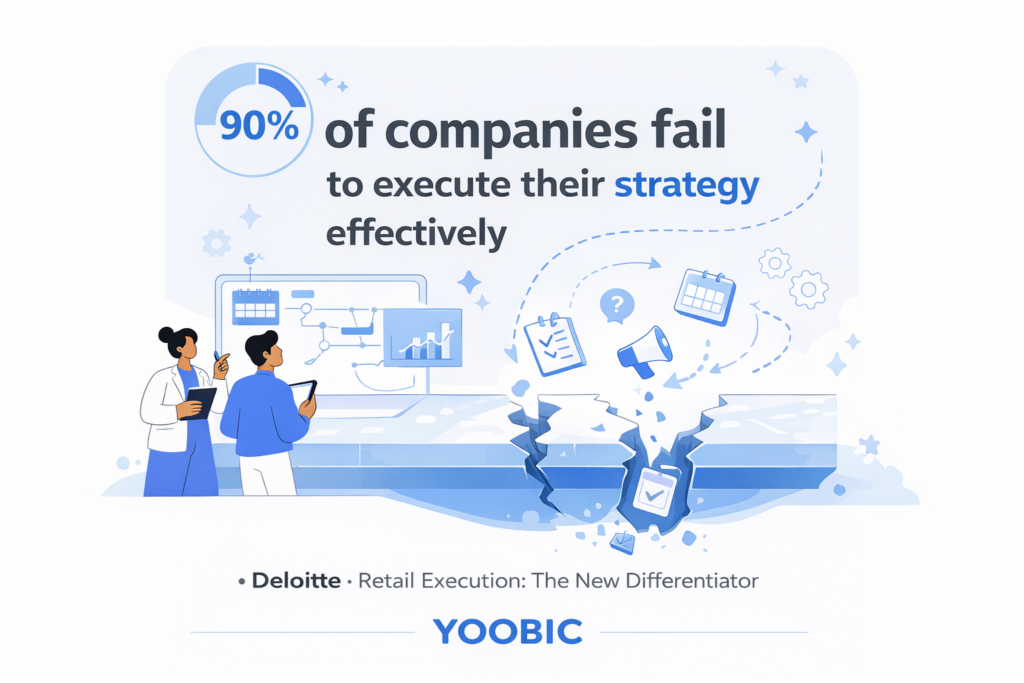
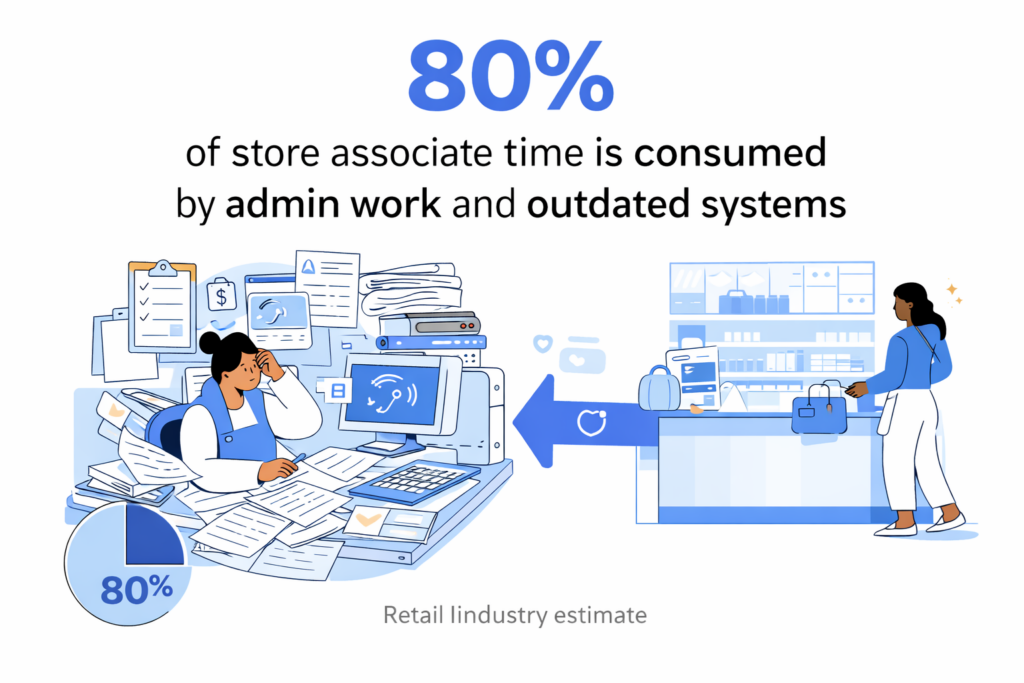
In a report titled Retail Execution: The New Differentiator, Deloitte estimates that 90% of companies fail to execute their strategy effectively. The challenge is rarely vision; it is translation — ensuring that priorities set at headquarters are carried out consistently at store level. Operational drag compounds the problem: a study by Brightpearl by Sage found that retail merchants spend approximately 332 hours per year on manual administrative tasks, time diverted away from customer engagement, coaching, and revenue-generating activity.
This disconnect between planning and store-level action is often described as the retail execution gap.
As retailers manage larger, distributed store networks and leaner teams, even minor execution breakdowns have measurable consequences, from missed promotions to inconsistent standards and operational strain.
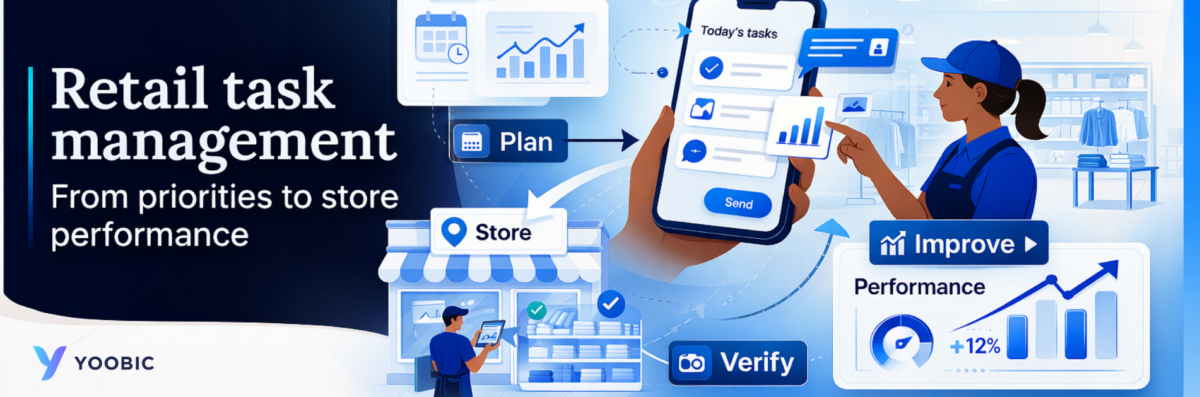
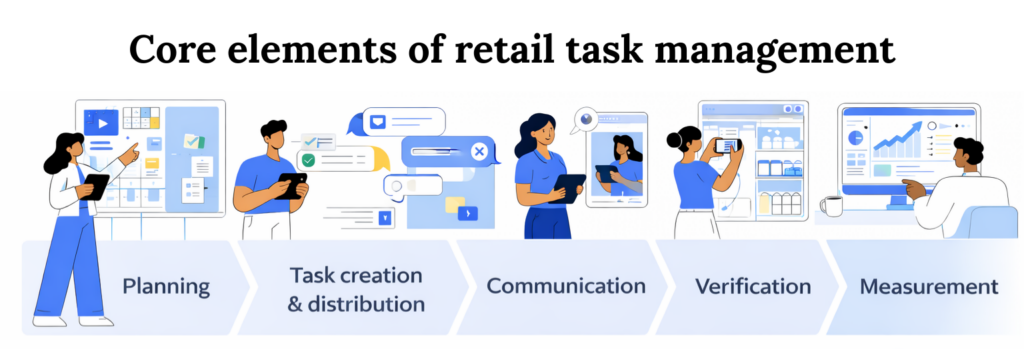
Retail task management addresses this structural gap. A structured retail task management system ensures that daily store operations, merchandising plans, and compliance requirements are not simply communicated, but completed and tracked. For multi-location retailers, retail task management software provides the visibility needed to execute consistently at scale.
Building that level of operational clarity, without increasing administrative burden, is what separates reactive retailers from those that execute with precision.
What is retail task management?
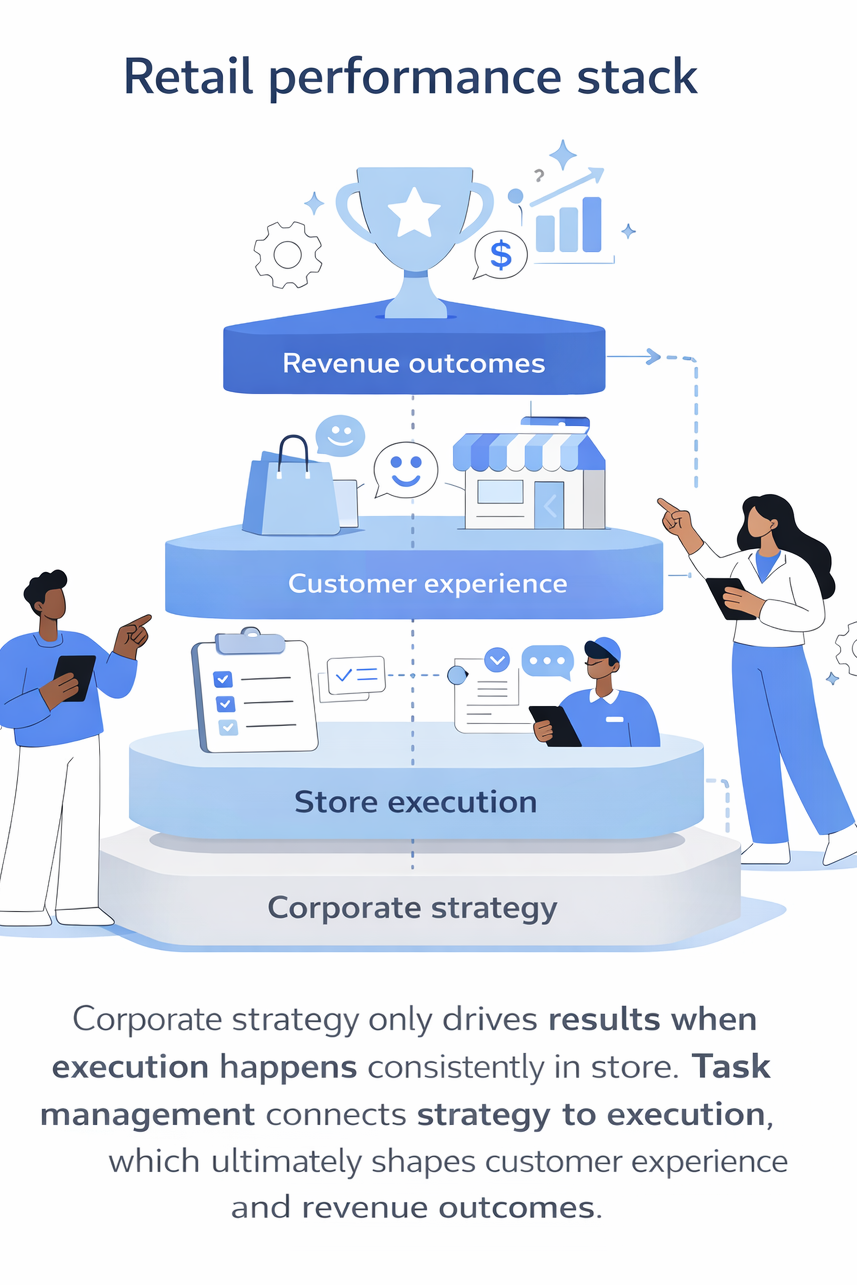
Retail task management is the system retailers use to plan, assign, and track the operational work that keeps stores running. At its most powerful, it becomes the connective tissue between what headquarters decides and what actually happens on the shop floor.
In practice, that means ensuring a product launch is set up correctly, a promotional display goes up on time, a compliance check is completed, and a planogram reset happens consistently across every store in the network, not just a handful.
Unlike generic task tools, retail task management is built for the realities of store life. Tasks must be clear, mobile-friendly, and actionable for deskless teams who are serving customers at the same time. The best systems support:
Role-based task distribution across multiple locations
Done well, retail task management turns daily operational activity into consistent, measurable execution at scale.
Why is retail task management more important than ever?
Retail task management is more important than ever because the economics and complexity of modern retail operations have fundamentally changed. Rising labor costs, omnichannel fulfillment demands, higher frontline turnover, and increased customer expectations mean that inconsistent retail task execution now directly impacts margin, brand trust, and revenue performance. Structured retail task management provides the operational control required to execute consistently across large, distributed store networks.
Retail complexity has increased dramatically. Today’s retailers operate:
Large, distributed store networks
Omnichannel fulfillment models
Frequent promotional cycles
Rapid product launches
Increasing regulatory requirements
High frontline employee turnover
Without structured retail task execution, this complexity creates variability at the store level and weakens performance across the network.
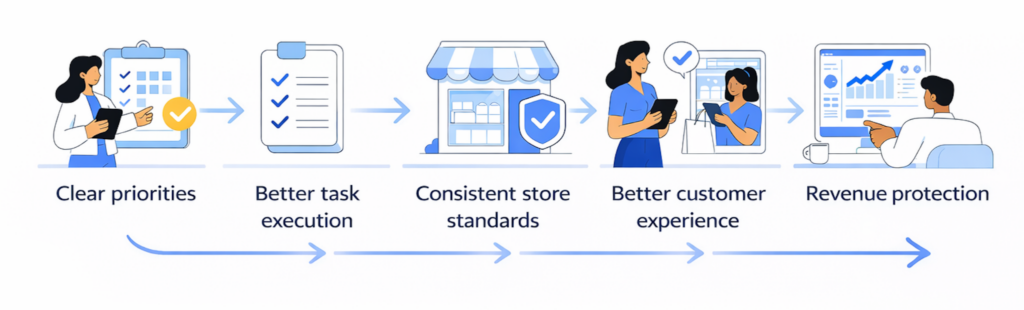
1. Protecting brand consistency at scale
Retail task management protects brand consistency by turning brand standards into measurable execution requirements across every location.
Every store represents the brand, and when execution varies, customer perception shifts with it. Inconsistent merchandising, incomplete planogram resets, missing signage, and pricing errors erode trust quickly. A Cleaning Matters survey found that 99% of customers say poor store cleanliness negatively affects their perception of a retail brand, while McKinsey research shows that 75% of consumers abandon brands due to inconsistent execution across locations.
Retail task management reinforces consistency by ensuring that:
Planograms are implemented correctly
Campaigns launch on time
Visual merchandising standards are followed
Pricing accuracy is verified
Compliance tasks are completed and validated
At scale, consistency depends on structure rather than intention.
2. Turning execution into revenue performance
Retail task management drives revenue by improving execution accuracy at store level, particularly in inventory availability and promotional compliance.
On-shelf availability issues cost the retail industry an estimated $634 billion annually, and roughly 72% of stockouts stem from store-level process failures rather than supply chain constraints. McKinsey research shows that even a 1% improvement in on-shelf availability can lift sales by 20 to 35 basis points. Retailers with mature omnichannel capabilities also report 27% lower fulfillment costs and 18% lower cart abandonment rates, according to PwC’s Retail Outlook 2026.
Revenue impact strengthens when retailers:
Increase promotional compliance
Improve on-shelf availability
Strengthen inventory accuracy
Standardize merchandising execution
Provide real-time store-level visibility
When corrective actions are assigned, prioritized, and validated early, small execution gaps are prevented from compounding across the network.
3. Increasing operational efficiency across store networks
Retail task management improves operational efficiency by reducing coordination overhead and increasing productivity per labor hour.
Retailers are operating in a high-cost labor environment where inefficiency directly impacts profitability. The UK Office for National Statistics reports that 36% of trading businesses cite labor costs as their primary challenge, and the British Retail Consortium (BRC) estimates that retail employment costs rose by £5 billion in 2025.
When task coordination relies on fragmented communication and manual follow-ups, paid hours are absorbed by clarification, duplication, and preventable rework. Retail task management reduces that friction by:
Centralizing task assignment
Clarifying ownership and deadlines
Reducing duplicated communication
Standardizing recurring processes
Providing real-time visibility into completion status
Operational efficiency is not achieved by working faster, but by removing structural friction from execution.
4. Strengthening the customer experience through execution
Retail task management elevates the customer experience by ensuring operational standards are executed consistently at the point of service.
Execution directly shapes customer perception. Total Retail reports that consumer frustration with waiting increased by 126% between 2023 and 2025. Empty shelves, long queues, and inconsistent store conditions weaken loyalty in a market where alternatives are immediate. Stores that follow structured checklists also report significantly stronger service performance, with some studies indicating improvements of up to 90%.
Customer experience strengthens when retailers:
Complete recurring store tasks on time
Standardize cleaning and merchandising routines
Prioritize high-impact service activities
Improve product availability
Provide visibility into execution quality
When execution is consistent and verifiable, service reliability follows.
What are the core elements of retail task management?
The core elements of retail task management are strategic planning, structured task distribution, contextual communication, frontline enablement, real-time execution visibility, and performance analytics. These elements form an integrated system that ensures retail strategy is implemented consistently at store level. When one element is weak or missing, execution gaps widen and performance variability increases across the network.
Retail task management functions as operational infrastructure. It aligns people, priorities, and processes so that daily store activity supports measurable business outcomes.
1. Strategic planning and standardization
Retail task management begins before a task is assigned.
Headquarters must clearly define:
What needs to happen
Who is responsible
When it must be completed
What “done correctly” looks like
Standards must be measurable and scalable across the store network. Without that clarity, performance becomes dependent on individual interpretation, introducing costly variability at scale. Research shows that only around 29% of retail initiatives are executed correctly at store level.
When expectations are vague, stores improvise, leading to inconsistent merchandising, delayed rollouts, uneven compliance, and avoidable rework. In an environment where rising labour costs are the primary pressure for 36% of trading businesses, tasks that require clarification or correction consume paid hours without improving output.
2. Structured task creation and distribution
Once standards are defined, retail task management ensures those priorities move through the organization with precision.
Tasks should be:
Assigned by role, location, or region
Prioritised based on impact
Delivered with clear deadlines
Supported by planograms, visuals, or step-by-step guidance
Automated where recurring
This structure determines whether work scales effectively or becomes unmanageable.
When distribution is fragmented, initiative overload follows. Research shows that 89% of leaders believe ineffective communication negatively affects operational performance. When priorities are delivered through disconnected systems, high-impact tasks compete with lower-value activities, leaving stores to decide what matters most.
Centralised retail task management replaces that ambiguity with structured prioritization, giving teams a single, role-specific source of truth.
3. Embedded communication and context
Retail task management must ensure that store teams understand the purpose and standards behind their work, not just the task itself.
Frontline employees need clarity on:
How a merchandising reset affects conversion
How stock accuracy protects revenue
How cleanliness reinforces brand perception
What successful completion looks like in measurable terms
When context is missing, execution quality declines. Nearly one-third of deskless employees report that they are not effectively communicated with, and more than half say company-wide updates are not relevant to their roles. Without role-level clarity, interpretation replaces precision.
Retail task management embeds communication directly within the workflow through visual standards, concise explanations, and defined proof requirements. When employees understand how their daily actions connect to measurable outcomes, consistency improves. Research published in Harvard Business Review shows that highly engaged teams are 21% more productive and 21% more profitable.
4. Frontline enablement within the workflow
Even the clearest task fails if employees lack the knowledge to complete it correctly.
Research indicates that 40% of frontline workers receive formal training once per year or less, while deskless retail turnover averages around 26%. Retailers are continually onboarding new employees into complex operational environments, increasing the likelihood of inconsistent execution.
Retail task management addresses this by embedding enablement directly into the workflow. Microlearning, visual SOPs, and certification tracking sit alongside operational tasks, making guidance available at the moment of execution rather than in a separate system.
This integration shortens time to competency, reduces first-time errors, and improves consistency across locations. Retailers implementing digital workforce systems report voluntary churn reductions of 15% to 25%, underscoring the link between clarity, capability, and retention.
5. Real-time visibility and verification
Retail task management converts operational activity into structured, verifiable data.
Without real-time visibility, leaders rely on delayed audits or fragmented reporting to assess store performance. By the time issues surface, they have often already affected sales or compliance. According to Retail Insight, on-shelf availability problems cost the industry approximately $634 billion annually, and Kaizen reports that 72% of stockouts stem from store-level process failures rather than supply chain disruption. In many cases, these losses reflect incomplete tasks or missed replenishment checks.
Modern retail task management systems provide:
Live completion tracking
Store- and region-level dashboards
Automated alerts for overdue tasks
Photo-based verification
With visibility embedded into daily workflows, managers focus on variance rather than reviewing every location manually. Earlier intervention reduces preventable breakdowns before they compound across the network.
6. Data-driven optimization and continuous improvement
The final element of retail task management is analytics.
Completion rates, compliance trends, and time-to-resolution metrics transform daily activity into measurable insight, revealing recurring gaps, training needs, and correlations between execution and sales performance. Research indicates that organizations lose an estimated 20% to 30% of operational expenditure to inefficiency, with rework accounting for up to 20% of productivity loss. Without structured task data, those losses are difficult to identify and correct.
When execution data informs prioritization and automation, decisions become more precise. Intelligent automation has been shown to deliver productivity gains of 25% or more when applied consistently across the network. Retail task management closes the loop between strategy, action, and performance.
What is the retail task management lifecycle?
Retail task management operates as a continuous lifecycle. It defines how strategy becomes structured store-level activity, and how that activity is refined through visibility and data.
This structure matters because execution failure is not marginal. According to Coresight Research’s annual study on in-store retail inefficiencies, retailers in major sectors lose an average of 5.5% of revenue to store-level execution gaps. A structured lifecycle reduces that leakage by replacing ad hoc coordination with repeatable processes.
1. Plan
Retail leaders establish clear standards, scope, ownership, and deadlines before work reaches stores. Planning ensures that labor capacity, compliance requirements, and promotional priorities are aligned in advance rather than negotiated at store level.
2. Communicate
Tasks are distributed through centralized, role-specific channels. Instructions, visuals, and measurable completion criteria are delivered together so that interpretation does not vary from location to location.
3. Execute
Frontline employees complete tasks within their daily workflow, validating completion where required. Execution is measured against defined standards, not informal confirmation.
4. Monitor
Managers gain real-time visibility into progress, compliance, and variance. Rather than relying on periodic audits, they focus on exceptions and emerging gaps.
5. Optimize
Task data is analyzed to identify recurring inefficiencies, resource imbalances, and training needs. Insights from one cycle inform the next, increasing precision over time.
Retail task management therefore functions as a structured feedback loop. Planning guides execution, execution generates data, and data refines future planning. As this cycle repeats, variability decreases and operational performance becomes more predictable.
How does retail task management improve daily store performance?
Retail task management improves daily store performance by turning operational routines into structured, prioritized, and measurable execution. It ensures that merchandising plans, inventory processes, compliance standards, and promotional launches are completed correctly and on time across the network.
Retailers lose billions each year to preventable execution breakdowns, with poor in-store merchandising alone contributing to an estimated $125 billion in lost sales across U.S. retailers annually. At the same time, UK retail labor productivity remains below pre-pandemic levels while employment costs continue to rise. In this environment, inconsistency erodes margin store by store.
Retail task management embeds operational discipline directly into daily store workflows, protecting performance at scale.
Merchandising execution and planogram compliance
Merchandising execution determines whether strategy converts into sales.
Fewer than 25% of retailers consistently meet basic shelf-accuracy benchmarks, and even minor pricing or display errors directly affect conversion.
When merchandising standards are consistently executed, revenue impact is immediate and measurable.
Inventory management and on-shelf availability
On-shelf availability is one of the most direct operational drivers of revenue.
Retailers lose over $1.7 trillion annually to stockouts, shrink, and overstock, and many of these losses originate at store level when replenishment routines, stock verification, or execution standards break down.
Retail task management systems reduce these failures by embedding structured inventory controls directly into store operations, including:
Triggered replenishment workflows
Scheduled cycle counts
Exception alerts for discrepancies
Real-time completion tracking
When inventory processes are structured and visible, stock variability declines and preventable stockouts are identified earlier. At scale, that operational precision protects revenue without increasing labour.
Operational coordination and workload management
Execution gaps widen when operational information is dispersed across email, spreadsheets, and disconnected systems, forcing managers to consolidate updates before they can address performance on the floor.
Retail task management reduces this friction by:
Delivering tasks through a single structured platform
Tracking completion automatically
Capturing validation at the point of execution
Generating real-time, consolidated reporting
With visibility embedded into the workflow, managers spend less time coordinating tasks and more time improving standards, coaching teams, and strengthening store performance.
Compliance management and audit execution
Operational breakdowns accumulate through missed checks, pricing inconsistencies, incomplete resets, and delayed corrective action.
McKinsey research shows that mismanaged strategy implementation can erode up to 10% of annual revenue in large retail organizations, much of it driven by inconsistent store-level execution.
Digital task management embeds discipline into daily operations through:
Recurring compliance workflows
Time-stamped audit trails
Automated reminders and escalations
Centralised performance dashboards
With compliance structured and visible in real time, issues are identified earlier and financial exposure is reduced.
Workforce enablement and frontline task clarity
Retail task management succeeds or fails at the frontline.
Store associates operate under significant operational load. Research shows that 38% of associate time is consumed by administrative tasks, while another 42% is spent supporting outdated technology systems. That leaves limited capacity for customer engagement, merchandising accuracy, and inventory execution, which directly impacts store performance.
A structured retail task management system improves frontline clarity by embedding:
Role-based task feeds aligned to daily store operations
Prescribed, technology-driven task guidance
Embedded microlearning within the workflow
Verified completion and retail task tracking
When task precision replaces ambiguity, execution becomes more consistent and administrative friction declines.
Inventory accuracy and omnichannel task coordination
Store task management must support both physical retail and omnichannel fulfillment.
Inventory inaccuracy remains a persistent execution gap. Research by Fluent Commerce found that 58% of retailers report less than 80% inventory accuracy, and phantom inventory can erode up to 8% of total inventory value.
These losses stem from daily execution failures: missed replenishment tasks, incomplete cycle counts, and poor coordination between backroom and shelf.
A structured retail task management system reduces this risk through:
Automated replenishment workflows
Standardized cycle counts
Real-time discrepancy alerts
Coordinated backroom and floor execution
As omnichannel complexity increases, structured task management provides the control required to protect inventory accuracy and revenue at scale.
How retail task management impacts revenue and margin
Execution gaps affect revenue through missed sales, slower service, and inconsistent store experience.
According to PwC, when retailers align operational efficiency with customer experience, sales per square foot can increase by 5–15% and conversion rates improve by 10–20%. These gains are driven by stronger execution at the shelf, faster issue resolution, and more consistent service standards.
Workforce structure also influences financial outcomes. Companies offering flexible scheduling report up to 29% higher customer satisfaction, 15% higher loyalty, and 32% more positive customer interactions, according to MyShyft. When frontline teams are supported with clearer priorities and better task coordination, customer-facing performance improves.
Retail task management software contributes to margin protection by embedding:
Centralized store task management
Continuous, real-time visibility
Prescribed task prioritization
Coordinated execution across locations
When daily store operations are structured and measurable, execution variability declines. At multi-location scale, incremental improvements in conversion, satisfaction, and labor efficiency compound into meaningful financial impact.
What features should retail task management software include?
Retail task management software should include intelligent task distribution, structured prioritization, execution validation, real-time visibility, mobile-first workflows, embedded enablement, and data-driven performance guidance. These capabilities ensure operational standards are executed consistently across multi-location store networks.
73% of frontline employees still rely on paper-based or manual processes, increasing delay and execution variability across store networks. Modern retail task management software must function as operational infrastructure: distributing work precisely, verifying quality, and providing live oversight at scale.
The following capabilities define a modern platform.
Intelligent task distribution
Retail networks are complex and highly variable. Not every task applies to every location.
Effective retail task management software allows headquarters to:
Assign tasks by role, region, store format, or cluster
Automate recurring workflows such as opening procedures, compliance checks, and replenishment routines
Embed visual instructions, planograms, and documentation directly within the task
Precision in distribution reduces noise, lowers cognitive load, and ensures frontline teams focus only on what is relevant to their store.
Prioritization and operational focus
Fragmented communication creates initiative collision.
Retail task management systems should:
Surface high-impact tasks based on urgency and business impact
Centralize directives into a single operational view
Clarify daily priorities through structured activity feeds
This shifts managers from reacting to inbox volume to executing against clearly ranked priorities.
Validation, not just completion
Execution quality cannot rely on just confirmation. Modern retail task management software must verify whether it was executed correctly.
Best-in-class platforms require:
Confirmation of completion
Validation against defined quality standards
Photo-based proof of execution
Structured root-cause reporting when tasks cannot be completed
Marking a display as “complete” does not confirm it meets brand standards. Capturing why a task failed — whether due to missing materials, inventory constraints, or operational blockers — allows headquarters to address systemic issues rather than assume compliance.
Retail task management must move beyond task tracking to execution assurance.
Real-time visibility and performance reporting
Operational control depends on live insight.
Retail task management software should provide:
Store- and region-level dashboards
Automated alerts for overdue or incomplete tasks
Continuous compliance tracking
Real-time visibility enables early intervention. Instead of discovering breakdowns in weekly reports or periodic audits, leaders can identify variance as it emerges and respond before performance declines.
Mobile-first execution for deskless teams
Retail is a deskless environment. Task management must operate where work happens.
Mobile-first platforms enable associates to:
Complete tasks directly on the shop floor
Submit verification in real time
Access operational guidance without leaving customer-facing areas
Execution improves when technology aligns with the physical realities of retail work.
Embedded enablement within the workflow
Task execution and training should not operate in separate systems.
Modern platforms integrate:
Microlearning modules
SOP access
Visual guides
Certification tracking
Embedding enablement at the moment of execution reduces first-time errors, accelerates onboarding, and strengthens consistency across multi-location networks.
AI-driven insights and execution guidance
Retail task management is evolving from activity tracking to performance direction.
Traditional systems report what happened. More advanced platforms analyze task, sales, inventory, and compliance data together to highlight where execution may be drifting from plan.
These capabilities increasingly include:
Impact-based task prioritization informed by performance signals
Detection of anomalies across stores or regions
Identification of locations that may require additional support
Manager guidance that suggests relevant follow-up actions
By correlating execution data with broader operational indicators, these systems surface areas that warrant attention. Managers are guided toward verification steps or corrective tasks, enabling earlier intervention.
The shift is subtle but significant. Retail task management moves from documenting activity to supporting informed operational decisions — reducing variability and strengthening consistency across the network.
What are the most common retail task management challenges?
The most common retail task management challenges are execution variability, administrative overload, weak accountability, delayed visibility, and frontline disengagement. These structural gaps limit a retailer’s ability to translate strategy into consistent store-level performance. Even leading retailers experience these breakdowns.
Inconsistent store performance
Execution variability is highly visible to customers. Research shows that adherence to visual merchandising and promotional standards can increase sales by up to 20%. When standards are inconsistently implemented across locations, that upside is lost.
In multi-location networks, minor deviations in planogram compliance, display setup, or promotional timing compound into measurable performance gaps.
Fragmented workflows and manual systems
Many retailers still rely on spreadsheet-based coordination for 26–50% of core workflows. When execution depends on disconnected tools, operational standards are distributed across emails, spreadsheets, and local processes rather than a single system.
This fragmentation creates version control issues, inconsistent reporting formats, and gaps between headquarters intent and store-level interpretation. Coordination becomes improvised rather than structured.
Lack of accountability
Manual systems lack closed-loop verification. Paper checklists and fragmented reporting create gaps between reported completion and verified execution.
Digital audits, by contrast, have been shown to improve operational consistency by 10–15% through real-time tracking and automated alerts. Without structured validation, accountability becomes assumption rather than measurable performance.
Limited real-time visibility
Many retailers still struggle to obtain timely, reliable data from the field. Research indicates that store-level information often takes days or even weeks to consolidate and reach headquarters.
When performance insight depends on delayed reporting cycles, leaders cannot intervene at the moment execution begins to drift. By the time issues are surfaced, promotional windows may have closed, compliance deadlines may have passed, and customer impact may already have occurred.
Real-time visibility is not about reporting volume. It is about shortening the distance between action and awareness.
Frontline disengagement
Execution is ultimately human. Yet 70% of store associates report a preference for prescribed, technology-driven tasks that clearly define what to do and when. Ambiguity increases cognitive load. Precision increases confidence. When tasks are structured and supported by clear guidance, consistency improves.
Why these challenges compound
According to the BRC, retail labor productivity in 2024 remained 4.1% below 2019 levels in the UK, despite sustained cost pressure. When productivity does not recover in line with operating costs, inefficiencies accumulate across distributed store networks.
Retail task management challenges are often coordination gaps rather than strategic missteps. Variability across locations amplifies their impact.
How do you measure the success and ROI of retail task management?
Retail task management is measured by how reliably execution translates into performance. Success is not defined by activity alone, but by whether operational consistency improves revenue, productivity, and compliance at scale.
Core execution metrics
The foundation of ROI measurement begins with operational reliability. Core metrics include:
Task completion rate
On-time completion rate
Promotional compliance rate
Planogram compliance percentage
Audit pass rates
Average task completion time
Store-level performance variance
Issue resolution time
These indicators measure whether strategy reaches the shop floor intact.
For example:
Digital workflows target 70%–99% compliance consistency, compared to materially lower execution rates under manual systems
Organizations report a 43% increase in time spent on revenue-focused activity after implementing structured digital tasking.
Consistency in execution stabilizes performance across locations, limiting the revenue erosion that comes from uneven rollout and delayed correction.
Speed and compliance are therefore operational controls, shaping how quickly value is realized and how much of it is retained.
Productivity and cost recovery
ROI is measured by how much operational waste is removed and how much labor is redirected toward revenue-generating activity.
Key indicators include:
Reduction in overtime costs
Reduction in operational expenditure
Time to task completion
Time to compliance
Reduction in execution-related rework
Organizations adopting structured digital task management report:
3–7% reduction in direct labor costs through optimized scheduling and task coordination
These improvements are measurable on the P&L. Reduced overtime lowers direct expense. Reduced rework protects paid labor hours. Faster execution shortens revenue delay.
Retail task management succeeds when labor hours produce more commercial output per shift.
Advanced performance analysis
Once execution data is centralized, retailers can move beyond tracking into correlation analysis. Advanced measurement includes:
Correlation between execution scores and sales
Time to compliance across locations
Impact of training completion on execution quality
Regional performance trends and store-level variance
At this stage, task management becomes a performance intelligence system. Leaders can identify whether underperformance stems from strategy, staffing, training, or execution gaps — and intervene earlier.
Financial return
The financial case for structured execution is measurable.
Research indicates that for every $1 invested in process clarity and operational design, organizations save $5–£10 downstream by reducing errors, rework, and wasted labor.
First-year ROI on clarity-focused operational investment is projected at 5x–9x
Execution excellence compounds. Small improvements in consistency, speed, and visibility scale across every store, every shift, and every promotion.
When execution data becomes measurable, operational management becomes proactive. And when operational management becomes proactive, revenue protection becomes systematic.
What is the future of retail task management?
The future of retail task management is predictive, AI-guided execution. Instead of documenting what happened yesterday, modern systems help retailers prioritize what should happen today. The shift is from reactive oversight to structured, forward-looking performance management.
Retail task management is shifting from activity tracking to performance direction.
AI-driven prioritization
Traditional systems distribute tasks broadly and expect managers to determine priority. Modern retail task management platforms reverse that model by ranking work dynamically based on live operational signals.
AI evaluates:
Sales velocity and SKU performance
Inventory risk and stockouts
Staffing gaps and traffic patterns
Compliance drift across locations
Managers receive structured guidance that surfaces the actions most likely to protect revenue or prevent disruption, reducing fragmentation and narrowing execution variance across locations.
When prioritization is evidence-based, execution variance narrows and commercial outcomes stabilize.
Predictive compliance monitoring
Compliance is moving from periodic inspection to continuous validation.
Instead of discovering errors during regional visits, modern systems surface execution gaps in real time. This may include automated planogram checks, exception alerts, or digital verification within the task workflow itself.
When validation is continuous rather than delayed, execution failures are corrected earlier. That shortens the window in which revenue or brand standards are exposed.
Integrated workforce intelligence
Retail task management is increasingly connected to workforce planning. Labor allocation and execution quality cannot operate in isolation.
Advanced systems support:
Dynamic staffing recommendations based on demand
Real-time task reallocation during peak trading
Alignment between scheduling and operational priorities
This integration ensures that high-impact tasks are not delayed due to staffing blind spots. In cost-constrained environments, that alignment becomes commercially material.
Cross-channel execution visibility
Physical stores now operate as both sales floors and fulfillment hubs. Retail task management is evolving to support unified execution across channels.
By integrating inventory, order, and point-of-sale data into the execution layer, frontline teams gain full operational context. Promotional campaigns, stock accuracy, and fulfillment tasks can be managed within the same structured environment.
As omnichannel complexity increases, fragmented coordination becomes unsustainable. Structured visibility enables retailers to scale without sacrificing consistency.
Real-time performance benchmarking
The next evolution of retail task management includes dynamic benchmarking across store clusters.
Intelligent systems can:
Detect anomalies in sales or execution patterns
Compare performance across similar locations
Trigger corrective “next best actions” automatically
Deliver targeted microlearning when skill gaps are detected
Performance gaps are surfaced early, and corrective action is embedded directly into the daily workflow.
The structural shift
Retail execution was once treated as a communication challenge. The emerging model treats it as an operational control system.
When retail task management combines intelligent prioritization, continuous validation, integrated workforce planning, and real-time benchmarking, execution becomes more predictable, measurable, and economically disciplined.
In margin-sensitive environments, that predictability is not incremental. It determines whether strategy translates into measurable performance at scale.
Conclusion: retail task management and store performance
Retail task management connects strategy to in-store reality. It structures how work is distributed, verified, measured, and improved across multi-location networks.
When task planning is precise, execution is validated against standards, frontline teams are enabled within the workflow, and outcomes are tracked in real time, daily operations become measurable and controllable.
That control affects core performance drivers:
Brand consistency across locations
Promotional and merchandising compliance
Revenue protection during campaigns and launches
Manager accountability and response time
Operational efficiency at scale
In complex retail environments, performance variance accumulates quietly across stores. Structured retail task management reduces that variance by creating visibility, prioritization, and accountability within everyday work.
Consistent execution across locations strengthens commercial predictability. Predictable execution protects margin, supports growth, and ensures that strategy translates into measurable store-level performance.
Retail task management FAQs
What are the 5 R’s of retail?
The 5 R’s of retail describe the core goal of retail operations: delivering the right product, in the right place, at the right time, in the right quantity, at the right price.
These principles guide merchandising, inventory planning, and store operations. Retail task management supports them by ensuring merchandising resets, pricing updates, and inventory checks are executed consistently across stores.
What is the 1-3-5 rule for task prioritization?
The 1-3-5 rule is a simple framework for structuring daily work. It suggests focusing on: 1 major task, 3 medium tasks, 5 smaller tasks. In retail stores, this approach helps managers balance high-impact operational priorities, such as promotional launches or compliance checks, alongside routine store tasks.
How do you know if store execution is breaking down?
Execution breakdowns often appear as small inconsistencies across stores. Examples include missed promotions, incomplete merchandising resets, pricing discrepancies, or delayed compliance checks.
When these issues occur repeatedly across locations, they usually indicate a coordination gap rather than isolated store problems. Retail task management systems help identify these gaps earlier by providing visibility into store-level execution.
What problems does retail task management actually solve?
Retail task management addresses the gap between strategy and store-level execution.
Without a structured system, operational priorities are often communicated through disconnected tools such as email or spreadsheets. This creates confusion around ownership, inconsistent task completion, and limited visibility into store performance.
Retail task management platforms centralize task distribution, prioritization, and verification across the store network.
When should a retailer invest in retail task management software?
Retailers typically invest in retail task management software when operational coordination becomes difficult to manage through email, spreadsheets, or paper checklists.
Common signs include inconsistent promotional execution, limited visibility into task completion across stores, and store managers spending excessive time coordinating operational updates. At this stage, structured task management provides the visibility and accountability needed to maintain consistent execution.
Operating retail in airports is a unique kind of complexity. High footfall. Tight margins. Constant movement. And teams spread across countries, formats, and brands.
For Lagardère Travel Retail, that complexity is amplified by scale. The group operates across more than 50 countries, managing three distinct business lines: Duty-Free, Convenience and Dining.
At NRF, Pauline Fradin, VP of Store Solutions & Quality, joined Casey Fuentes from YOOBIC to share how the organization is simplifying this complexity.
Lagardère approached the rollout as a replacement of systems, not an addition, creating one shared way for HQ and frontline teams to operate.
Here’s how they moved from a local pilot to a global execution standard.
What challenges did Lagardère face before modernizing frontline execution?
Lagardère’s decentralized structure supports local agility, but it also created significant blind spots. With each country’s HQ managing operations independently, there was no consistent way to reach frontline teams or track execution.
The team identified two core friction points:
Fragmented and inconsistent communication: Communication and execution tracking at the point-of-sale level relied on outdated processes and were heavily dependent on local management practices and culture.
Retention pressure: In retail, “turnover is a pain point.” Lagardère recognized that improving retention required improving engagement first, starting with better daily tools for frontline staff.
How did Lagardère approach rollout across a decentralized organization?
Lagardère deliberately started with a single-country pilot in Switzerland. The goal was to test whether a shared execution platform could improve day-to-day operations without disrupting local ways of working.
The results were decisive. After one year of use in Switzerland, the pilot delivered measurable impact:
100% adoption, with 81% weekly active usage
96% of users said they could access the right information more easily
78% reported better communication with HQ, and 83% saw improved collaboration between stores
72% believed the app had a positive impact on sales
Those outcomes gave country teams confidence and created internal momentum. As Pauline Fradin explained:
“If one, two, three countries are adopting a solution they are happy with, they can promote the solution internally. We rely on them to engage and onboard new countries.”
That peer-led momentum created a snowball effect. What began as a Switzerland pilot expanded to seven countries, and now underpins plans to scale to more than 20 countries and over 10,000 users. Lagardère has shared more detail on theSwitzerland pilot and early expansion in this article.
How did the use case evolve over time?
What started as local communication became a global execution mandate.
One of the most important insights from the session was how the platform’s role evolved over time.
Phase 1: local communication and issue resolution The first phase focused on solving a basic but persistent communication problem at the country level.
Reaching frontline staff consistently was difficult. Information was fragmented across multiple channels, and communication depended heavily on individual managers to pass updates on. As a result, messages landed unevenly, and priorities were not always clear on the floor.
YOOBIC was initially used to simplify and standardize that flow:
Communication: Teams received targeted, high-quality updates on new procedures, operational changes, and success stories, improving day-to-day engagement.
Top-down: Country HQs shared opening checklist, signage updates, and daily priorities directly with stores.
Bottom-up: Store teams reported issues in real time, from lighting problems to maintenance needs, without relying on manual escalation.
This removed dependency on informal manager-led communication, reduced fragmentation, and created faster feedback loops. Store teams started shifts with clearer priorities, and HQ teams gained a more reliable view of what was happening on the ground.
Phase 2: global retail execution With local communication stabilized, Lagardère will move to a group-level use case.
Because Duty-Free and Fashion relies on centralized assortments and a shared warehouse in France, the organization needed a consistent way to deploy merchandising plans, new products, in-store animation, and store updates across markets. In this phase, YOOBIC is being rolled out as the group’s execution platform for Duty-Free, replacing an internal homegrown tool that had become obsolete.
Merchandising plans, assortment changes, animations, and execution standards will now be distributed via a single platform across all Duty-Free and Fashion markets, empowering local teams with targeted and qualitative information while ensuring HQ-level consistency.
What changed once frontline routines were digitized?
Digitizing frontline routines has delivered measurable impact:
Time savings: Staff save an average of one hour per shift on daily tasks, freeing time for customers.
Direct access: Frontline teams can message managers directly to resolve issues in real time.
Stronger engagement: Staff report feeling better informed and more connected, supporting Lagardère’s long-term retention goals.
Execution became clearer. Communication became faster. Daily work became more manageable.
How does Lagardère ensure adoption doesn’t stall after launch?
To ensure adoption continues beyond go-live, Lagardère applies a simple but disciplined feedback loop.
One month after go-live in any country, the central team sends a survey directly through the app, asking frontline staff:
Are you happy with the solution?
What do you want to find in the solution?
What can be improved?
Combined with cross-country admin communities that share best practices, this approach ensures the platform continues to evolve rather than stagnate.
What does Lagardère’s journey show about scaling frontline operations?
Global scale doesn’t require rigid control, it requires clarity, trust, and the right systems.
By starting small, leveraging internal champions, and listening directly to frontline teams, Lagardère has built a digital foundation that supports 10,000 users without losing local autonomy.
Execution becomes shared. Visibility becomes real. Scale becomes an advantage.
FAQs
What is frontline execution in travel retail?
Frontline execution refers to how daily operational standards, merchandising plans, and tasks are communicated, completed, and validated by store teams. In travel retail, this must work across countries, formats, and constantly changing environments like airports and transit hubs.
Why is decentralization a challenge at global scale?
Decentralization supports local agility, but without shared systems it can limit visibility and consistency. Country teams may operate effectively on their own, but global corporate teams lack a clear, real-time view of execution across regions.
How did Lagardère Travel Retail approach global rollout without forcing adoption?
Lagardère started with a single-country pilot and relied on peer advocacy to expand adoption. Successful countries promoted the platform internally, creating a “snowball effect” that drove organic scale.
How did the use case evolve from local communication to global execution?
The platform initially supported country-level communication, execution and issue reporting. Over time, it expanded into a global execution layer for Duty-Free, enabling centralized merchandising and assortment changes across markets while preserving local ownership.
What measurable impact did digitizing frontline routines deliver?
Lagardère reported average time savings of around one hour per shift, faster issue resolution through direct manager communication, and improved engagement by giving frontline teams clearer daily priorities.
How does Lagardère ensure adoption continues after launch?
One month after go-live in each country, Lagardère sends a survey directly through the platform to frontline staff, asking what works, what doesn’t, and what can be improved. This feedback is paired with cross-country admin communities to continuously refine execution.
High-touch retail only works when teams know how to use the time they have. For UNTUCKit, that matters more than most.
Many stores operate with a one-to-one associate-to-customer ratio, a rare advantage in retail. But without the right skills, structure, and follow-through, that advantage is easy to waste.
At the National Retail Federation‘s Big Show (NRF 2026), Sandra Scibelli, Head of US Retail at UNTUCKit, joined Melissa Curtis, Senior Account Manager at YOOBIC to unpack how the brand links training directly to conversion, UPT, and clienteling performance.
Here’s how UNTUCKit built a certification-led training model that changed frontline behavior and business results.
What challenge was UNTUCKit trying to solve?
UNTUCKit’s selling model is intentionally complex. It is built around wardrobe construction, relationship-building, and asking the right questions, not quick greetings or transactional add-ons.
That complexity created a clear challenge:
Execution varied widely from store to store
High-touch service was not always translating into higher conversion or UPT
Training existed, but skill application on the floor was inconsistent
With what Sandra described as a “luxury” associate-to-customer ratio, the brand needed to ensure every interaction delivered real value.
The goal was simple: move beyond task completion and directly improve the customer experience in a way that showed up in performance.
How does the clienteling certification work?
UNTUCKit built a multi-step clienteling certification program inside YOOBIC to set a clear, consistent standard for clienteling execution.
To become certified, leaders must:
Complete virtual training sessions
Execute practical clienteling missions
Demonstrate real customer outreach and engagement
Certification is performance-based. Leaders are required to apply skills in real customer scenarios and show they can execute consistently on the floor.
As Sandra shared during the session, not everyone passes on the first attempt. That is intentional. The certification is designed to signal readiness, not participation.
Managers are assessed on execution quality, including:
The substance of SMS outreach
How customers are engaged
Whether skills are applied correctly in live interactions
“It is not just like, ‘Oh, check the box and you’re done.’ You have to prove that you’ve built the skill.”
Sandra Scibelli, Head of US retail, UNTUCKit
Today, 83% of store managers are clienteling certified, giving UNTUCKit a clear benchmark for clienteling capability across the business.
Why does a fail-possible model matter?
Allowing failure protects the credibility of the certification. It turns training into a meaningful standard rather than a compliance exercise.
Over time, this shifted how the program was perceived internally:
Certification became a milestone, not an attendance badge
Passing the program is now a requirement for internal promotion to store manager
The certificate carries weight because teams know it is earned
Certification now acts as a quality gate, ensuring leaders are truly ready to represent the brand in high-value customer interactions.
How did UNTUCKit scale ownership beyond store managers?
To increase impact, UNTUCKit expanded certification to assistant managers.
This shift changed how clienteling operated in stores:
Ownership moved from a single role to shared leadership responsibility
Assistant managers began actively driving outreach and follow-up
Participation increased organically as responsibility spread
So far, 36% of assistant managers are certified, and clienteling is now treated as a core area of responsibility rather than a manager-only task.
The link between certification and performance was clear.
Clienteling-driven sales increased from 5% to 9% of total revenue
48% of certified stores saw an increase in conversion
46% of certified stores saw an increase in UPT
As Sandra noted, the program nearly doubled the volume of sales coming from clienteling, making it one of the most material contributors to recent performance gains.
“We’ve almost doubled the volume of sales coming from clienteling through the clienteling certification program.”
Sandra Scibelli, Head of US retail, UNTUCKit
What is the key lesson for retailers?
Training delivers ROI when it sets a clear bar for execution and proves it on the floor.
UNTUCKit showed that a performance-based, fail-possible certification can turn skills like clienteling into measurable revenue drivers, not just learning objectives. By validating behavior, not attendance, training became a growth lever rather than a support function.
The real shift came from connecting learning, tasking, and communication in one system. Store visits, daily missions, and career progression all reinforced the same expectations, removing silos and making execution consistent across locations. The outcome was not just stronger capability, but a measurable lift in conversion across nearly half of certified stores, powered through YOOBIC.
Clienteling is a high-touch selling approach where associates build relationships, understand customer needs, and drive repeat purchases through personalized engagement.
What problem was UNTUCKit trying to solve with training?
Training existed, but clienteling skills were not being applied consistently on the sales floor or tied directly to performance outcomes.
How does UNTUCKit’s clienteling certification work?
Managers must complete training, execute real clienteling tasks, and demonstrate correct skill application before being certified.
Why is UNTUCKit’s certification “fail-possible”?
Not everyone passes on the first attempt. Allowing failure ensures certification reflects real readiness, not just participation.
How did the certification impact sales performance?
Clienteling-driven sales increased from 5% to 9% of total revenue, with nearly half of certified stores improving conversion and UPT.
Why did UNTUCKit expand certification to assistant managers?
Expanding certification distributed ownership of clienteling and increased engagement without adding operational complexity.
Retail execution breaks down when information lives off the sales floor. For Vans, that risk was growing as store communication became fragmented and increasingly desktop-bound.
Operating roughly 450 stores across multiple concepts, Vans needed teams to execute with speed, clarity, and consistency. Instead, critical updates were trapped in back-office systems, pulling managers away from customers and slowing response during peak periods.
At the National Retail Federation‘s Big Show (NRF 2026), Cris Testerman, Senior Director of Retail Operations at Vans, joined Erin Valade from YOOBIC to share how the brand replaced fragmented tools with a single mobile execution layer, just weeks before holiday.
What operational challenge was Vans trying to solve?
Vans needed to close a widening gap between HQ strategy and store execution caused by audience-agnostic, desktop-based tools.
Critical information existed, but it was not accessible in the flow of work, making execution slower and harder to validate across stores.
Before YOOBIC, store teams relied heavily on SharePoint. Every store received the same information regardless of concept, role, or relevance, creating structural friction at scale:
The desktop trap The vast majority of content was accessed via back-office desktops, pulling managers off the sales floor and away from customers.
Forced relevance filtering Stores had to work out for themselves which updates applied to them, increasing cognitive load during already busy trading periods.
No execution validation HQ had no consistent way to confirm whether messages were seen, understood, or acted on without manual follow-up.
The issue was not effort or engagement. It was signal dilution.
Why did Vans launch just before peak season?
By rolling out weeks ahead of the holiday, Vans embedded the platform into daily operations rather than positioning it as another system to adopt later.
Instead of waiting for a quieter period, Vans focused the rollout on workflows stores could not function without. Daily task management, execution tracking, and mobile communication were prioritised over broader feature adoption.
As Testerman explained:
“How do we set it up where they have no choice but to engage? Stores had to adopt YOOBIC. They wouldn’t have been able to function without it.”
Adoption shifted from encouragement to dependency.
Stores only saw updates relevant to their role or format, increasing confidence in both sending and receiving information.
Previously, mid-week changes during holiday, such as promo updates, often required district managers to call stores individually to ensure messages landed. With YOOBIC, updates could be pushed directly to the floor, targeted by audience, and acknowledged in real time.
Because irrelevant posts were filtered out by design, HQ could communicate more frequently without overwhelming teams. The result was faster pivots and clearer execution.
What unexpected behaviour emerged in stores?
Once execution lived in one place, task ownership naturally moved closer to the floor.
Although the rollout focused on centrally driven execution, managers started assigning tasks locally, tracking follow-up, and using YOOBIC as a day-to-day management tool.
This behaviour was not mandated. It emerged organically, showing that when execution is simple and visible, accountability decentralises without added process.
How did Vans improve visibility without adding admin?
Vans centralised execution data into a single mobile workflow, giving leaders visibility without increasing workload for store teams.
Previously fragmented processes were consolidated into one place where execution could be captured, reviewed, and acted on in real time.
Two workflows saw immediate impact:
Store visits District managers moved from a cumbersome, multi-tool process to structured mobile capture, making visits faster, more consistent, and easier to follow up.
Visual verification Stores uploaded floor set photos directly into YOOBIC, creating a central, searchable repository that replaced manual uploads and file chasing.
As Testerman put it:
“Trying to dig through them to find what you need was insane. It’s crazy how much easier it is now.”
Leaders gained reliable visibility across hundreds of stores, without adding steps for the field.
How is Vans using frontline insight to shape execution?
By reducing communication noise, the brand made it easier to ask store teams focused questions and act on the answers.
With fewer irrelevant updates competing for attention, Vans could deploy one- or two-question mobile surveys without disrupting the sales floor. This allowed merchandising and product teams to test assumptions directly with associates actively selling the product.
In one example shared during the session, frontline feedback revealed that customers were buying a product for reasons different from HQ expectations. That insight led to a shift in how the product was positioned internally, informed by the people closest to the customer.
What can retailers learn from Vans’ approach?
Vans showed that simplifying how information reaches the floor can unlock faster execution, better insight, and stronger adoption, even during peak season.
With store manager adoption firmly established, Vans is now focused on deeper associate engagement and faster access to information. Priorities include refining content cadences, expanding into cross-functional workflows such as safety audits, and exploring AI to reduce time spent searching for operational answers.
The lesson is not about adding more tools or content. It is about removing friction between a question and the right action.
FAQs
What operational problem was Vans trying to solve?
Vans needed to fix a disconnect between HQ strategy and store execution caused by desktop-based, audience-agnostic communication tools. Information existed, but it was not accessible in the flow of work, making execution harder to prioritise and validate across stores.
Why are desktop-based tools ineffective for retail store execution?
Desktop-based tools pull managers off the sales floor and slow down decision-making. When information is locked in back-office systems, store teams spend more time filtering relevance and chasing updates instead of serving customers.
How does targeted communication improve retail execution?
Targeted communication ensures store teams only see information relevant to their role, location, or format. This reduces noise, speeds up response times, and increases confidence that critical updates will be acted on.
How did Vans improve visibility across stores without adding admin?
The platform initially supported country-level communication, execution and issue reporting. Over time, it expanded into a global execution layer for Duty-Free, enabling centralized merchandising and assortment changes across markets while preserving local ownership.
What measurable impact did digitizing frontline routines deliver?
Vans centralised tasks, store visits, and visual verification into a single mobile workflow. This gave leaders real-time visibility across hundreds of stores without adding extra steps or manual reporting for store teams.
Why did Vans roll out new execution tools before peak season?
Rolling out before peak season made the platform operationally essential rather than optional. By focusing on business-critical workflows, Vans ensured adoption was driven by daily need, not training compliance.
In the high-velocity world of travel centers, consistency is the ultimate brand promise. For Pilot Company, one of the largest operators of travel centers in North America, that promise is kept across 900+ locations by 30,000 team members. Because guests often visit multiple Pilot locations on a single journey, every store must operate with the same high standards, 24/7.
However, maintaining this guest experience at such a massive scale presents a unique challenge: how do you ensure 30,000 people are aligned when the operation never stops?
At NRF 2026, Pilot leaders explored this question during a Big Ideas session, sharing how they are modernizing frontline execution with YOOBIC to bring clarity, consistency, and accountability to a 24/7 operation.
AI dominated conversations at NRF this year. For many retail leaders, the focus has shifted from awareness to application: how advances in AI translate into meaningful change inside stores.
AI is changing retail execution by shifting focus from analysis to action on the store floor. Instead of generating more reports, AI is now helping store managers identify the few actions that will have the greatest impact on performance, each day, in each location. This shift matters because consistent execution, not insight alone, is where retail performance is won or lost.
That shift was the focus of YOOBIC’s Big Ideas session at NRF, which examined how everyday store-level decisions shape performance across retail networks.