Clothing Store: Male Visual Merchandising Professional Uses Tablet Computer To Create Collection. Fashionable Shop Sales Retail Manager Checks Stock. Small Business Owner Orders Stylish Items
Most retail organizations measure store walk effectiveness by visit frequency and audit scores. Both are the wrong metrics.
The good news: the fixes are structural, not cultural. Here’s what high-performing field teams do differently and how to build it into your own program.
1. Measure what changes between visits, not what scores on the day
Audit scores tell you how a store performed on one specific day — often a day when the team knew the visit was coming. They tell you almost nothing about execution on day two, day fifteen, or day twenty-six.
The real measure of a store walk is its impact on the days when no one is watching. Research from StoreForce confirms this: when a store visit follows a structured observe-assess-act framework, it produces a measurable lift in conversion rate from 15.2% to 15.8% on visit day and an average basket size increase of $2.21 per transaction.
2. Build a follow-up system that actually closes the loop
Most store walks successfully identify issues. The opportunity is in what happens next.
When issues are identified but not assigned to a named owner with a deadline and a verification requirement, they don’t get resolved. Without clear accountability, the same failures resurface in every audit for months.
It’s also worth separating compliance problems from root cause failures. If a field leader identifies a consistently messy endcap and assigns a tidy-up task, they’ve treated the symptom. If they don’t investigate why it keeps happening — unclear planogram instructions, insufficient replenishment time, a confusing backroom layout — the symptom returns at the next visit. Recurring issues rarely signal a lack of effort. They signal a process that was never properly diagnosed.
Digital task verification, with photo proof and timestamps, replaces self-reporting with verifiable evidence. When a field manager marks an item non-compliant and the system immediately generates an assigned task with a deadline and a photo requirement for closure, the gap between observation and correction narrows from days to hours.
43% increase
in time spent on revenue-focused activity
reported by organizations using structured digital task management.
That return is not driven by better checklists. It’s driven by a follow-up system that consistently closes the loop.
Most district managers visit stores on a fixed calendar. It’s predictable and easy to plan — but almost entirely disconnected from where performance problems are actually happening.
Project return in year one for organizations that adopt structured digital task management.
Exception-based scheduling means visit time is directed at the stores that need it most. It’s a straightforward shift that compounds over time.
For a closer look at how area managers are restructuring their time across larger territories, see our breakdown of the area manager role in modern retail.
Store incharge training young worker. Supermarket manager giving training to a trainee.
4. Spend more time coaching associates, less time with the store manager
The most significant in-visit behavior difference between average and high-performing district managers isn’t preparation or checklist quality. It’s who they spend time with on the floor.
Average DM
Top-performing DM
Fixed visit rotation
Data-driven, exception-based scheduling
Checklist verification focus
Behavioral coaching on the floor
Speaks mainly to the store manager
Engages and coaches associates directly
Manual follow-up reminders
Digital task tracking with SLA adherence
Reviews old sales reports
Acts on real-time execution and traffic signals
Average DMs spend the majority of their visit with the store manager. Top performers engage and coach associates directly on the sales floor — because those are the people delivering the customer experience. Real-time coaching improves associate performance by up to 12%, with a direct correlation to sales growth.
Elite leaders also protect store capacity rather than adding to workload. When HQ launches a promotion that requires additional merchandising labor, a top-performing DM evaluates whether the store can absorb it alongside existing tasks and pushes back when it can’t. A mandate that exceeds store capacity won’t be executed regardless of how clearly it’s communicated.
5. Use technology to narrow the gap between finding and fix
Technology improves store walks not by generating more data, but by narrowing the time between a finding and a correction. A system that produces a comprehensive report three days after a visit is not solving the execution problem. It’s documenting it.
The most valuable capability modern execution platforms provide is a proof layer: photo verification and timestamps that replace self-reported compliance with verifiable evidence. Pencil-whipping, marking tasks complete without verifying them, is a structural response to time pressure and absent verification. A proof layer eliminates it structurally.
Direct visit schedules based on anticipated need rather than a fixed rotation
The technology doesn’t replace field leadership judgment. It removes the administrative friction that prevents that judgment from being applied where it matters most.
Every retail organization conducts store walks. The ones that drive consistent performance treat the visit as the start of an execution cycle, not the completion of a compliance obligation. That’s where the performance gap lives — and that’s where it has to be closed.
Book a demo and find out how
Avoid wasted hours, blind spots
and lost revenue with YOOBIC
UK retailers are facing £5.6bn in additional operating costs in 2025/26. In that environment, execution that relies on paper, PDFs, and manual follow-up isn’t just inefficient — it’s a direct drag on margin.
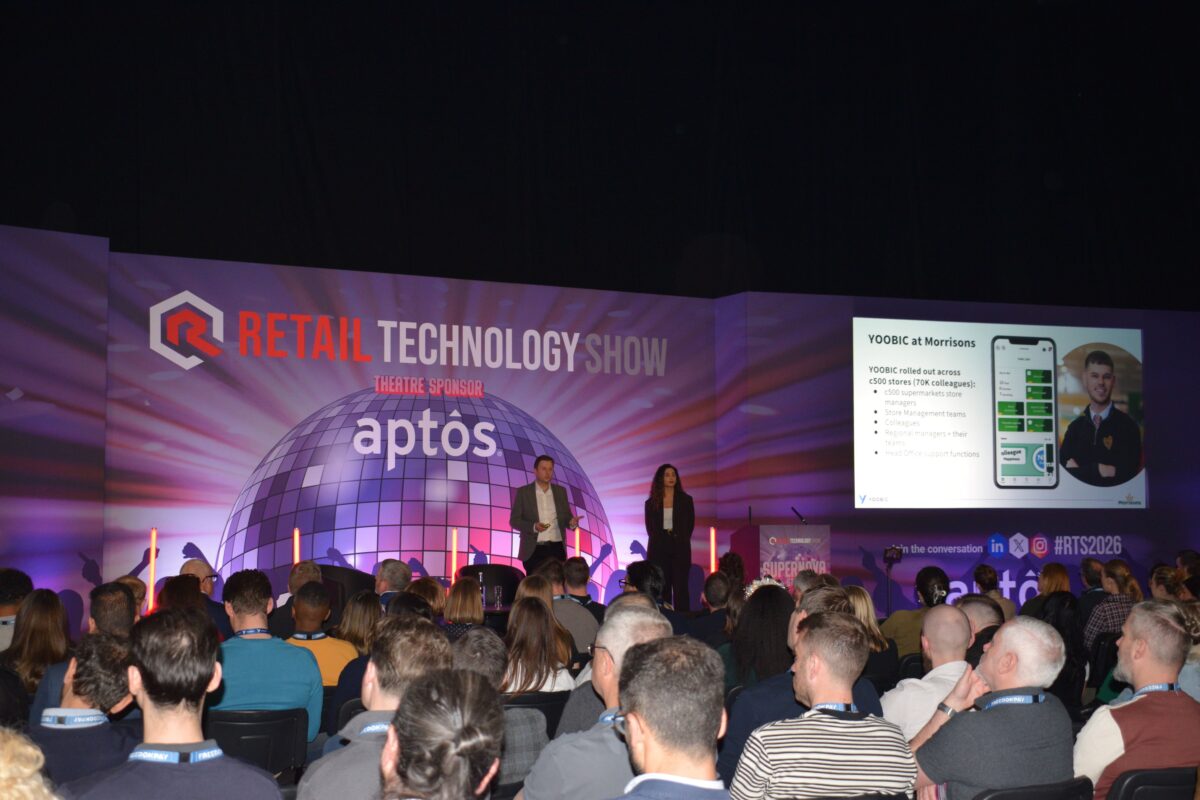
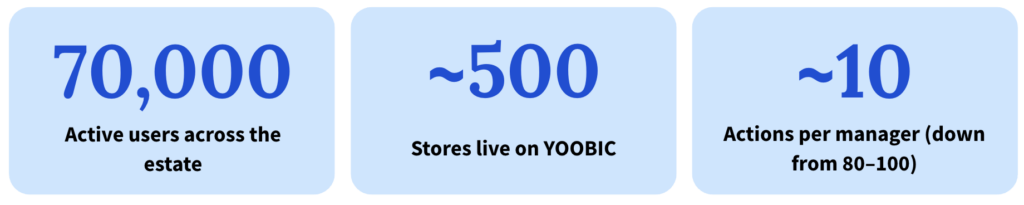
At Retail Technology Show 2026, Morrisons and YOOBIC shared how they tackled that problem head-on: replacing fragmented, paper-based task management with a single digital execution platform across approximately 500 stores and 70,000 colleagues. Weekly task volumes fell from 80–100 items to approximately 10 targeted actions per manager, routed directly to the responsible colleague.
The result: real-time completion visibility, higher promotional participation, improved safe and legal compliance, and time savings validated by internal time-and-motion studies. And with that foundation in place, Morrisons is now building toward automated tasks and an AI-generated intelligence layer — work that would not be possible without getting the basics right first.
Why store execution is a margin issue right now
UK retailers are absorbing the largest cost increase in a generation. According to research by Retail Economics and YOOBIC, the sector faces a £5.6bn operating cost headwind in 2025/26, driven by higher employer National Insurance contributions, rising minimum wage rates, and increased business rates. Margins in food retail were already thin. They are thinner now.
In that environment, operational waste is not a background inefficiency. It is a direct threat to profitability. Every task that goes unactioned, every promotion that doesn’t land as planned, every compliance check that gets missed — each one costs money the business cannot afford to lose twice.
That’s the problem Morrisons set out to solve. Gordon Macpherson, Group Productivity Director at Morrisons, knows it from the inside. He’s been the regional manager who visits a store four weeks after his last trip and can’t remember what he asked the team to do. The team remembers. They’ve been waiting to find out whether the instruction still stands.
At Retail Technology Show 2026, Macpherson and Bahareh Ghazinoori, Global VP of Account Management at YOOBIC, walked through how Morrisons rebuilt its store execution model from the ground up — and why getting that foundation right was a deliberate precondition for everything that comes next.
Here’s what they did, and what it means for any retail operations leader who recognizes the same problems in their own estate.
The system that made consistent execution almost impossible
The starting point, as Macpherson described it at the session, was an operational model held together by paper, PDFs, and manual follow-up. Each week, 80 to 100 tasks went out to stores from head office. Most of them landed with the store manager, who was expected to cascade them to the relevant colleague, then remember to check whether they had been done.
In practice, that chain broke regularly. Regional teams spent time on collation calls and spreadsheets. Supplier partners visited stores and found incomplete activations. Some came back with financial reimbursements. The cost of inconsistent execution was not abstract.
“We barely got time to do things once, never mind twice or three times.”
Gordon Macpherson, Group Productivity Director, Morrisons
The impact showed up in three ways: critical tasks were missed or poorly executed, supplier and commercial relationships were strained, and management time was consumed by follow-up rather than coaching. In a tight-margin food retail environment, none of those outcomes was sustainable.
This type of fragmented communication is one of the biggest barriers to consistent execution in stores. Learn how leading retailers are solving this in our guide to frontline communications.
The real change: fewer tasks, routed to the right person
Morrisons reduced weekly task volumes from 80–100 items to approximately 10 targeted actions per manager and routed each task directly to the responsible colleague rather than through the store manager. This removed the manual cascading dependency, gave regional teams real-time completion visibility, and freed store managers to focus on exceptions rather than administration.
When tasks go directly to the colleague responsible for completing them, accountability becomes clear and the store manager is no longer the relay point for every instruction. Macpherson illustrated this with a concrete example from the session. When Morrisons changes the café menu on a Monday morning at 9am, a task now goes directly to every café manager across the estate. The store manager can see whether it has been completed. So can the regional manager and head office. If it has not been done, the store manager receives a prompt.
“Instead of spending all their time walking everything, they can prioritize now the things that they know aren’t done, because they’ve got a prompt saying, ‘Hey, I’m not done.’”
Gordon Macpherson, Group Productivity Director, Morrisons
The trended data changes the management conversation. A regional manager who previously suspected a store had a fresh area problem can now see it in two months of data and have a specific, evidence-based coaching conversation, rather than a subjective debrief.
From planning to first store in three months
Ghazinoori was direct about the deployment model at the session: rolling a platform out to 70,000 people is a change management initiative, not a technology installation. With that many end users, there is no room to get it wrong and course-correct in public.
Morrisons went from planning to live in the first store within three months. The full rollout across approximately 500 stores followed region by region over the following months. That pace was possible because the build phase was slow and deliberate.
1. Kickoff and planning
Align on the business problems to solve. Define what success looks like before anything is built.
2. Build and design
Design use cases with the frontline in mind. Map use case complexity against expected impact, prioritizing high-impact, low-complexity actions first.
3. Pilot and testing
Deploy to a select cohort of stores. Gather direct feedback from colleagues on whether the use cases work in daily operations.
4. Single-region rollout
Validate at region level before scaling. Incorporate feedback. Confirm the design is right for the teams who will use it every day.
5. Scale across the estate
Move fast once one region is proven. The confidence built in earlier phases makes rapid scaling achievable.
Macpherson noted the team made significant changes during the testing phase based on feedback from store colleagues. Getting it right in the office was not the standard. Getting it right for the frontline was.
Morrisons did not roll out hardware alongside the platform. YOOBIC was made available on existing store devices, tablets, and back-office systems. Most colleagues opted into using their own personal devices without being asked.
Why commercial execution came before health and safety
Use case sequencing was a deliberate strategic decision, not a phasing convenience. Ghazinoori explained how the team mapped every potential use case against two variables: complexity to build, and expected impact for store teams.
Low complexity, high impact goes first. That is where the initial momentum comes from.
• Promo guidelines • In-store price changes • Store-specific memos• Marketing planner • Replaced a fragmented doc with hundreds of links to PDFs and Google Sheets
• Safe and legal audit • Temperature checks via Bluetooth probe • Health and safety checklists • Department-level task routing • Replaced a slow legacy tool; gave teams live compliance visibility for the first time
The temperature check integration illustrates how phase two raised the technical bar. When a colleague plugs a Bluetooth probe into food, the reading populates directly within the task. If the temperature falls outside the permitted range, the system triggers an automated alert and corrective action to the responsible manager. What previously required manual logging and reactive follow-up now happens automatically.
Starting with commercial use cases built familiarity with the platform before phase two introduced compliance-critical processes. Store teams had already experienced it working for them. That made adoption of the more demanding use cases smoother.
This sequencing mirrors how many retailers approach visual merchandising and promotional execution, where speed and consistency directly impact revenue.
What the data looks like now
Macpherson was measured about the outcomes at the session. Morrisons is not perfect, he said. But the foundation has changed.
The commercial evidence is visible. Higher promotional participation, better key deals performance, and sharper trade plan implementation have all moved in the right direction. Time savings for managers were validated through internal time-and-motion studies. Safe and legal compliance visibility has improved materially.
The outcome that tells the most instructive story is the two-way accountability loop. Before YOOBIC, head office issued instructions and waited for feedback to arrive through informal channels. Now the data surfaces immediately.
“9:00am we now know straight away there’s 300 cafés that couldn’t implement the new menu this morning. What’s the reason? The reason is 270 of them didn’t get the marketing. That’s unlikely to be a store problem.”
Gordon Macpherson, Group Productivity Director, Morrisons
In the previous system, 270 stores missing a menu change would have surfaced gradually through visits, complaints, and calls. The root cause would have been attributed to store performance by default. Real-time data makes the diagnosis accurate and immediate. That changes who the
Making performance visible without making it feel like surveillance
When asked about cultural pushback at the session, Macpherson acknowledged the tension directly. Making execution data visible does create accountability that did not previously exist. There is no point pretending otherwise.
How that accountability is led determines whether the platform is received as support or oversight.
“This was implemented to be a coaching tool to help and support, not to be a big stick to beat people over the head with.”
Gordon Macpherson, Group Productivity Director, Morrisons
Ghazinoori added that the rollout framing was as important as the platform itself. The question put to store teams during piloting was not whether they could use the app, but whether it would improve their day-to-day. Their feedback was incorporated before wider deployment, not after.
Seventy thousand colleagues are active users. Most opted into using the platform on their own personal devices without being asked. That is the strongest signal of how the adoption landed.
From foundation to intelligence: what Morrisons is building next
The work Morrisons completed over the past year was never just about fixing task management. It was about building the operational foundation that makes everything else possible. Paper-based processes are gone. Point solutions have been consolidated into a single platform. Health and safety, communications, and task management now run through one system, with every action routed to the right person from the start.
That foundation matters — because without it, the next two stages of this journey aren’t available. Retailers who skipped this phase, or patched it with disconnected tools, have to go back and rebuild before they can move forward. Morrisons don’t.
Automated tasks: rules-based execution at scale
The first stage beyond foundational execution is automation — and it’s important to be precise about what that means. Automated tasks are not AI. They are logic. A human defines a rule upfront; the system executes it automatically when the condition is met.
Morrisons operates between 400 and 600 AI cameras per store. When a camera detects an empty shelf, the system automatically generates a replenishment task and routes it directly to the relevant colleague. No one is watching the feed. No one has to decide whether to act. The condition is met, the task fires, and the store team gets a clear action to complete. The human role is the response, not the monitoring.
This kind of automation removes a whole category of manual detection and delegation from store operations. It’s fast, consistent, and doesn’t depend on anyone noticing the problem first.
AI-generated tasks: intelligence, not just logic
The stage above automation is meaningfully different, and the distinction is worth being clear about because the market conflates the two constantly.
With automated tasks, a human programmed the rule. The system is doing exactly what it was told to do when a specific condition occurs. With AI-generated tasks, no human defined the rule. The AI analyses multiple data streams simultaneously — sales patterns, stock levels, camera feeds, traffic data, historical benchmarks — and surfaces a recommended action that no one anticipated in advance.
“There’s no point giving data for the sake of data. It’s about what you do with that data and how you act on it.”
Bahareh Ghazinoori, Global VP of Account Management, YOOBIC
That’s the principle the AI layer is built around. It isn’t reporting what happened. It’s telling the store team what they should probably be doing right now, based on everything the system is seeing across the estate.
The longer-term vision Macpherson described is YOOBIC as the single platform every frontline colleague goes to for everything — cameras, digital shelf labels, supply chain systems, communications, and tasks all surfaced in one place. That level of integration only works if the execution layer beneath it is solid. The foundation has to come first. Morrisons built it first. That’s what makes everything above it viable.
Before and after: how task management changed at Morrisons
Dimension
Before YOOBIC
After YOOBIC
Business impact
Task volume
80–100 weekly tasks per manager
Approximately 10 targeted actions
Less noise, clearer priorities
Task routing
Cascaded via store manager
Direct to the responsible colleague
No manual delegation dependency
Completion visibility
Phone calls, follow-up visits, collation sheets
Real-time data visible to store, regional, and HO
Faster diagnosis of non-compliance
Communications
PDFs, printed docs, fragmented shared documents
Targeted, role-specific digital tasks
Relevant information reaches the right person
Accountability direction
One-way: stores accountable to head office
Two-way: stores and HO both visible in the data
Office-side failures surface alongside store failures
Safe and legal
Manual logging, slow legacy tool, no live visibility
Bluetooth probe integration, live compliance data
Time savings validated by time-and-motion study
Five takeaways from the Morrisons deployment
1. Task volume and task routing are the structural variables. Reducing from 80–100 weekly tasks to approximately 10 targeted actions was not a reduction in rigor. It was a recognition that volume without clear routing produces inconsistency. The platform makes direct routing possible. The task design makes it real.
2. Direct routing removes the manager cascading dependency. When tasks go to the responsible colleague, completion accountability is clear and the store manager can focus on exceptions. That changes the nature of the management role.
3. Use case sequencing is an adoption strategy. Starting with high-impact, low-complexity commercial use cases before moving into compliance-critical processes builds frontline familiarity and trust. Phase two works because phase one was done well.
4. Visibility creates accountability in both directions. The same data that shows a store has not completed a task also shows when head office failed to send the materials needed to complete it. Two-way visibility changes who the conversation is with.
5. The execution foundation has to come before the intelligence layer. Automated tasks and AI-generated task generation both require a functioning execution infrastructure beneath them. Morrisons built the foundation first. That sequencing is the model.
The foundation changes what becomes possible
Four weeks after a store visit, a regional manager should be able to see exactly what they asked stores to do, who completed it, and what the quality looked like. That visibility did not exist at Morrisons two years ago. It exists now.
The session at RTS 2026 traced how that change happened: a deliberate deployment, a phased use case approach, a frontline-first rollout, and a task structure that routes work to the right person from the start.
What comes next — automated tasks triggered by AI cameras, an AI-generated intelligence layer surfacing recommended actions, a single platform connecting cameras, supply chain, and communications — is only viable because that execution foundation is in place. Morrisons did not start with AI. They started with clarity about who is responsible for what, and whether it got done. That is the right sequence.
The Morrisons session in one takeaway
Store performance improves when teams focus on fewer priorities, with clearer ownership and real visibility into what gets done. But that’s only the beginning. The retailers who invest in getting that foundation right are the ones who will have access to automation and AI that actually works — because the execution layer beneath it is solid.
Book a demo and find out how
Avoid wasted hours, blind spots
and lost revenue with YOOBIC
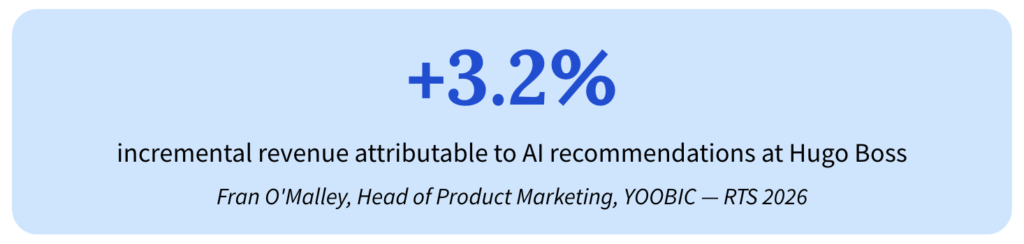
Hugo Boss delivered a 3.2% increase in incremental revenue directly attributable to AI recommendations. The mechanism: an average of 2.4 identifiable commercial opportunities per store, per week, that most networks leave undetected.
Why retail store data alone isn’t enough
It’s 8:45am. Two people have called in sick, the Wi-Fi is down, and the morning briefing starts in 15 minutes. There is no time for spreadsheets. This is the reality Fran O’Malley, Director of Product Marketing at YOOBIC, used to open the company’s session at the Retail Technology Show 2026.
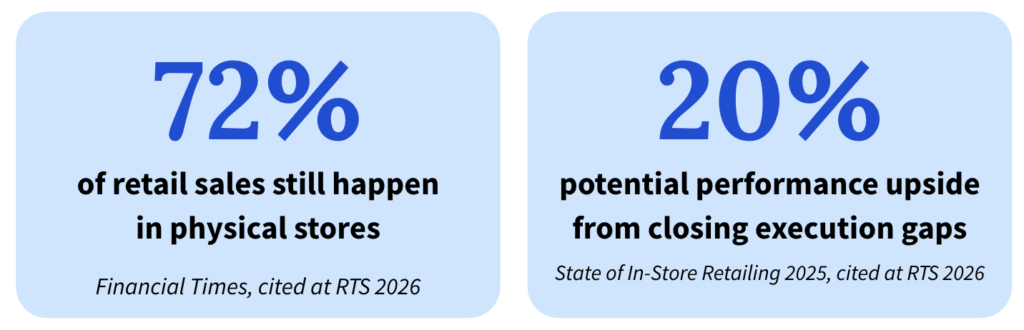
Her point was direct: when 72% of retail sales still happen in physical stores (Financial Times), and when execution gaps — missed product opportunities, non-compliant displays, undetected performance variance — are accumulating across hundreds of locations every day, the cost of getting information to store managers too late, not at all, or in a format that’s difficult to act on is material. Research cited in the session puts the performance upside of closing those gaps at up to 20%.
The session covered two AI use cases that address this directly: the Store Manager Copilot and the VM Copilot. What follows is a structured summary of what was demonstrated, what it means for operations leaders, and why the approach produces measurable results.
Why is consistent store performance so hard to achieve across a retail network?
The problem is not a lack of data — it is a lack of relevant, timely data. Each store operates across a unique combination of cluster, footfall, staffing, assortment, and past performance. Without real-time benchmarking against comparable stores, managers default to instinct. The result: performance variation that tracks manager experience rather than store potential.
Most retail networks hold significant data — sales, inventory, workforce, customer feedback. The structural problem is that this data lives in separate systems, arrives at different intervals, and reaches store managers too slowly to influence decisions made at 9am.
As the RTS session slides framed it, each store needs a personalized set of recommendations based on its cluster, past performance, team composition, location, current KPIs, and assortment. Standard dashboards and weekly trade reports cannot deliver that level of individualization at the speed the shop floor requires.
The outcome, observed across YOOBIC’s customer base, is that performance variation between stores correlates more with manager experience than with structural factors. In the absence of clear, trusted data, all managers rely on instinct. The difference is that more experienced managers tend to focus on the right activities, while less experienced managers often spend time on work that doesn’t drive results.
Operationally, this means: retailers cannot close that variation by hiring better managers or running more training. They close it by giving every manager — regardless of experience — access to the same quality of contextualized, benchmarked insight at the same time.
How does YOOBIC’s AI turn store data into action?
YOOBIC’s AI follows three steps: connect all available store data, apply predictive AI to benchmark performance and rank opportunities by impact, then route a specific recommended action to the specific role that can act on it. The output is not a new report. It is a prioritized task, delivered to the right person before the moment of decision.
This is the same operational shift explored in our guide to retail task management, where store work moves from scattered communication to structured, trackable execution.
YOOBIC described the architecture as three linked stages: connect your data, make it smart, act on it.
How YOOBIC’s AI processes store data
1. Connect — Unify inputs from point-of-sale, inventory, performance data, footfall , and external signals including weather and local events into a single connected view.
2. Analyze — Benchmark each store against a comparable peer group. Identify anomalies and commercial opportunities ranked by likely revenue impact.
3. Route — Deliver the right action to the right person. Store associates receive task guidance. Store managers get performance snapshots and opportunity alerts. District managers see cross-store rankings. HQ operations get portfolio-level compliance and campaign rollout data.
The routing logic is the critical differentiator. Insight that reaches the wrong person, or the right person too late, does not change behavior. Insight that reaches a store manager before the morning briefing — in the form of one specific action — does.
“What we do not want to do is just fire tons of notifications, flood the store, nothing gets done, they just tick that they've done it, and you're in the same place as you started.”
Bradley Capon, VP Sales, YOOBIC
Operationally, this means: AI that floods store teams with low-priority alerts produces the same outcome as no AI at all. The operational value comes from constraint — surfacing the one or two actions most likely to move the KPI that day, for that specific store.
How did Hugo Boss achieve a 3.2% revenue increase with AI?
Hugo Boss had access to data, but translating it into clear, daily priorities at the store level remained a challenge. Store managers were often required to interpret multiple signals and decide where to focus, which led to natural variation in performance. As a result, some revenue opportunities went unaddressed. YOOBIC’s Store Manager Copilot was designed to close that gap. The result: 3.2% incremental revenue directly attributable to AI recommendations, delivered through three specific use cases.
O’Malley grounded the session in Hugo Boss before walking through the product. The brand’s store managers had access to data from multiple sources — spreadsheets, emails, operational systems — but extracting actionable priorities from that data was time-intensive and inconsistent. Decisions defaulted to instinct. Performance varied significantly depending on how experienced the individual manager was.
Hugo Boss: what the challenges looked like before AI
Scattered data — managers were overwhelmed with inputs but unable to identify priorities.
Missed opportunities — teams knew they were leaving revenue on the table but could not identify where.
Beyond revenue, the Copilot produced three secondary outcomes: store managers spent more time on the shop floor and less time in the back office; the team’s understanding of which KPIs actually drive performance improved measurably; and healthy competition emerged between stores once managers could see precisely how they compared to peers.
Operationally, this means: the 3.2% revenue figure is the measurable output, but the underlying change is structural — Hugo Boss moved from a network where performance depended on manager experience to one where every manager operates from the same quality of data-driven briefing.
Use case 1: Smart briefings — replacing the pre-shift spreadsheet review
The smart briefing is a daily, automated performance summary delivered before the store opens. It surfaces yesterday’s results against target, units per transaction, average basket value benchmarked against comparable stores, predicted traffic for the day, and a specific recommended focus.
In a typical scenario, a store might beat its previous day’s target, with units per transaction above average. But average product value could still lag behind comparable stores — a sign the team is optimizing for volume over value. The recommendation: prioritize higher-value products during predicted high-traffic periods. Instead of interpreting multiple reports, the store manager walks into the morning briefing with a clear, data-backed agenda.
Operationally, this means: a manager who previously spent 30 minutes cross-referencing data before a briefing now has that synthesis waiting for them. At scale, that 30-minute saving per manager per day translates into more time on the shop floor, more coaching, and more consistent execution.
Use case 2: Commercial opportunity identification — closing the gap between stores
Every store in a retail network underperforms in at least one product category relative to comparable locations. Most of that variance goes undetected until a monthly trade review — by which point the opportunity has passed.
Operationally, this means: an average of 2.4 opportunities per store per week means the revenue gap from undetected opportunities is not marginal — it is structural and recurring.
Use case 3: KPI boosters — simulating performance before committing to action
When a KPI falls below target, a store manager faces two questions: is this gap closable today, and what specifically should I do about it? The KPI booster feature answers both.
A manager simulates the effect of a KPI shift — for example, moving units per transaction up by two points — and sees the projected impact on the day’s sales target. The system then surfaces product bundles that are performing in comparable stores, using only items currently in stock.
As Capon noted, the AI is built around the KPI agreed at project start. If average basket value is the priority, the recommendations reflect that. If volume is the focus, the logic changes. The store manager decides what to act on.
Operationally, this means: KPI simulation removes two forms of friction: managers no longer need to estimate whether a gap is closable, and they no longer need to rely on instinct or head-office guidelines to know which products to push. Both decisions are data-backed and stock-verified.
How does AI reduce the time between issuing brand guidelines and achieving compliance?
VM compliance delays are a process problem, not a people problem. Feedback loops — send guidelines, receive photos, review, return feedback, receive corrections — have historically taken days to weeks. YOOBIC’s VM Copilot breaks the loop by analyzing photos in real time at the point of execution, resolving 50% of feedback before it reaches HQ. This compresses the compliance window without adding headcount.
YOOBIC processes 80 million photos per year across its client base. Until recently, every photo required human review. That volume — which grows with every new campaign and every additional store — represents a review capacity constraint that cannot be solved by hiring alone.
YOOBIC built the VM Copilot by first understanding exactly where review time was being lost. The research process: 50 hours of customer interviews, analysis of tens of thousands of photo comments from VM teams. The finding was precise: 50% of all HQ feedback to stores was about basic brand standards — tags showing, garments not folded correctly, boxes in the wrong position. None of this required VM expertise. All of it was consuming VM team capacity.
The Copilot analyzes each photo across three categories:
How YOOBIC’s VM Copilot analyzes each photo
Each photo is assessed against brand standards to identify execution gaps and opportunities for improvement. Store teams receive clear, actionable guidance on how to improve compliance, styling, and overall display quality.
When a store team submits a photo, the Copilot provides feedback at the moment of execution — before the image reaches the HQ review queue. Store teams receive in-moment corrections. HQ teams receive a prioritized view of the images most in need of their attention, with AI analysis already surfaced.
Operational result for VM teams
Store teams receive same-session feedback — corrections happen before the next customer walks past.
50% of HQ feedback volume is resolved at source, before it enters the review queue.
HQ VM specialists see the highest-priority images first, with AI flags already attached.
The compliance loop compresses from days to hours without adding headcount.
Operationally, this means: recovering 50% of HQ VM review capacity does not just save time — it redirects skilled VM specialists away from basic standards enforcement and toward the work that actually requires their expertise: campaign styling, display innovation, and brand elevation.
What changes operationally when AI is in place?
Operational area
Without AI
With YOOBIC AI
Morning briefing preparation
30+ minutes reviewing multiple reports and spreadsheets before store opens
Automated briefing ready before the manager arrives — no preparation required
Commercial opportunity detection
Visible in monthly trade reviews, if identified at all
2.4 opportunities surfaced per store per week, benchmarked against comparable stores, in real time
Performance benchmarking
Network averages only; no peer-store comparison available at store level
Each store benchmarked against comparable sites by cluster, location, assortment, and past performance
Days to weeks, dependent on HQ review queue and team capacity
Real-time in-store coaching at point of execution; 50% of feedback resolved before HQ review
KPI improvement planning
Dependent on manager experience; instinct-driven product selection
KPI impact simulated before action; bundle suggestions verified against current stock
Performance consistency across network
Strongly correlated with individual manager experience level
Data-driven briefings reduce reliance on experience; opportunities identified consistently across all locations
Key takeaways from RTS 2026
1. The value of AI in stores is determined by routing logic, not algorithm sophistication
Insight that reaches the wrong person, or arrives after the decision has already been made, has no operational value. YOOBIC’s approach prioritizes getting the right action to the right role at the moment it can be acted on. Hugo Boss’s 3.2% revenue uplift is a routing outcome as much as a data science outcome.
2. Every store network contains recurring, identifiable revenue gaps
An average of 2.4 commercial opportunities per store per week — each benchmarked against comparable stores and verified against stock — represents a structural, recurring source of revenue that most networks leave undetected.
3. Manager experience is the variable AI is most directly designed to level
Performance variation across Hugo Boss stores correlated with manager experience, not store potential. AI that gives every manager the same quality of benchmarked, context-specific briefing reduces that dependency. The brand moved from inconsistent, experience-dependent decision-making to consistent, data-driven execution — across its entire network.
4. The VM compliance loop is a capacity problem AI solves structurally
50% of HQ VM review time was being spent on basic brand standards that required no specialist judgment. That is not a people problem — it is a process design problem. Placing AI earlier in the review cycle recovers that capacity permanently, without additional headcount, and redirects it toward work that requires genuine VM expertise.
5. The KPI northstar must be defined before deployment, not during it
YOOBIC builds its AI logic around the KPI agreed at project start. That anchor determines what data is surfaced, what opportunities are flagged, and what actions are recommended. AI without a defined priority surfaces noise.
Conclusion
The signal from YOOBIC’s RTS 2026 session was not about AI capability in the abstract. It was about where operational value lands when AI is deployed with a clear brief.
Hugo Boss’s 3.2% revenue increase did not come from a more sophisticated algorithm. It came from routing the right data to the right person at the right moment — before the morning briefing, at the point of photo submission, in the seconds before a KPI decision is made. Replicated across 2.4 opportunities per store per week, across a network of hundreds of stores, the aggregate is material.
For retail operations leaders, the question is not whether AI belongs in stores. According to Bradley Capon, VP Sales at YOOBIC, it will be in every store within a year. The question is what to prepare. The answer from this session is precise: define the KPI you are trying to move, identify where the data that would move it currently sits, and close the gap between those two things.
“We want to make sure that you're using that data effectively to make sure that you can drive sales.”
Bradley Capon, VP Sales, YOOBIC
Book a demo and find out how
Avoid wasted hours, blind spots
and lost revenue with YOOBIC
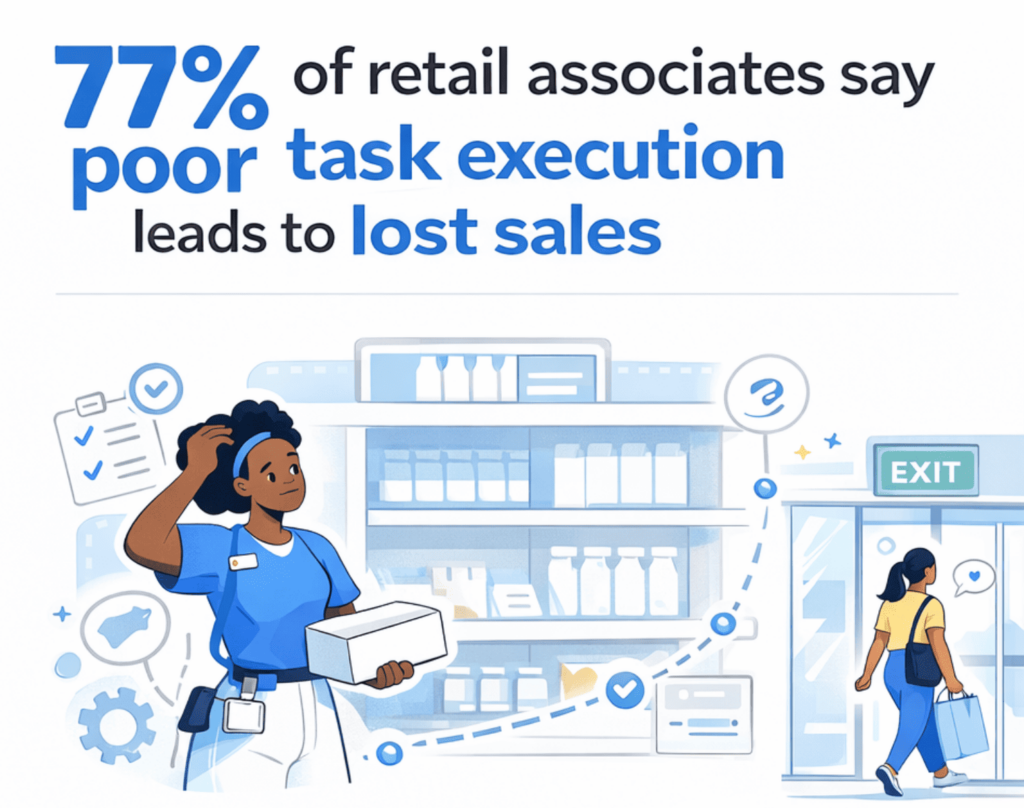
Retailers invest millions designing strategy — new promotions, new customer experiences, new omnichannel capabilities. But much of that strategy breaks down at the store level. In fact, 77% of retail associates say lost sales are directly tied to poor task execution in stores.
Most retail leaders know what needs to happen. The challenge is getting it to happen consistently — across every store, every shift. Store associates today manage far more than customer interactions. A single shift may include replenishing shelves, setting up promotions, fulfilling click-and-collect orders, completing safety checks, and responding to operational updates from headquarters. As the physical store evolves into a hub for fulfillment, brand experience, and customer service, the complexity of frontline work has increased significantly.
The impact of execution is measurable. Retailers that implement digital task management have increased on-time task completion from 66% to 98.5%, while AI-driven operational tools have reduced stockouts by 20–30%. These improvements show that consistent execution on the sales floor directly influences revenue, operational efficiency, and customer experience.
→ Discover how AI is moving from the back office to the shop floor to tackle inventory precision and streamline tasks in our AI in retail 101 guide.
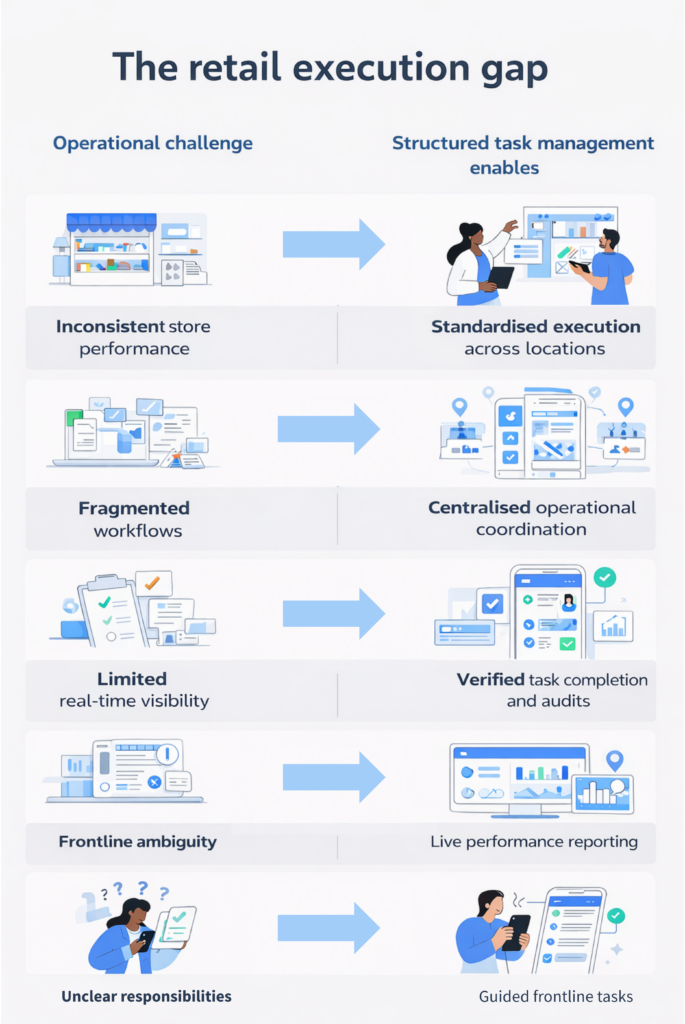
Yet in many stores, frontline work is still coordinated through fragmented systems. Without clear prioritization or real-time visibility, associates often default to completing the easiest tasks rather than the most impactful ones — creating an operational drift that widens the gap between headquarters strategy and store reality.
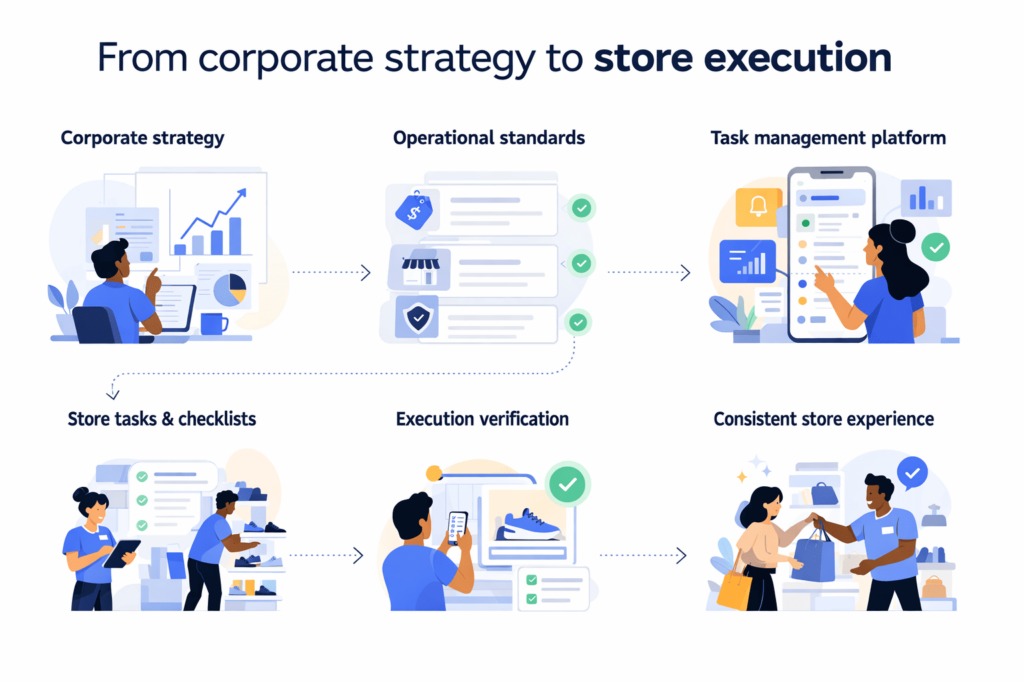
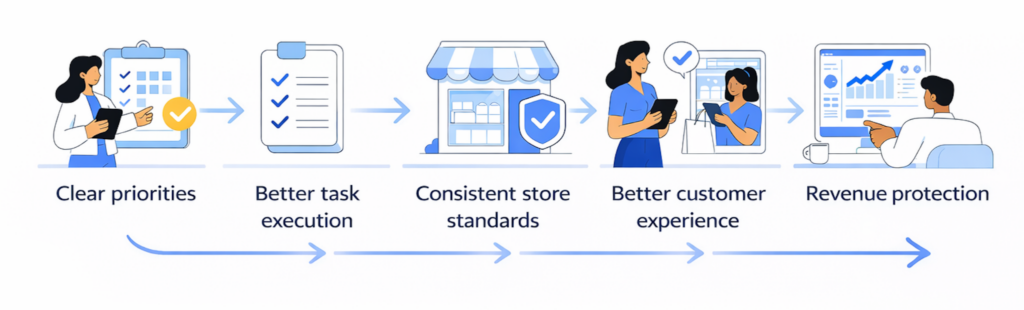
Retailers that pull ahead approach this differently. Instead of relying on ad hoc communication and manual tracking, they redesign how store work is organized, prioritized, and verified across locations. Retail task management is no longer just an operational tool — it has become a strategic capability that connects corporate priorities directly to frontline execution and gives store associates the clarity needed to deliver consistent results in every store.
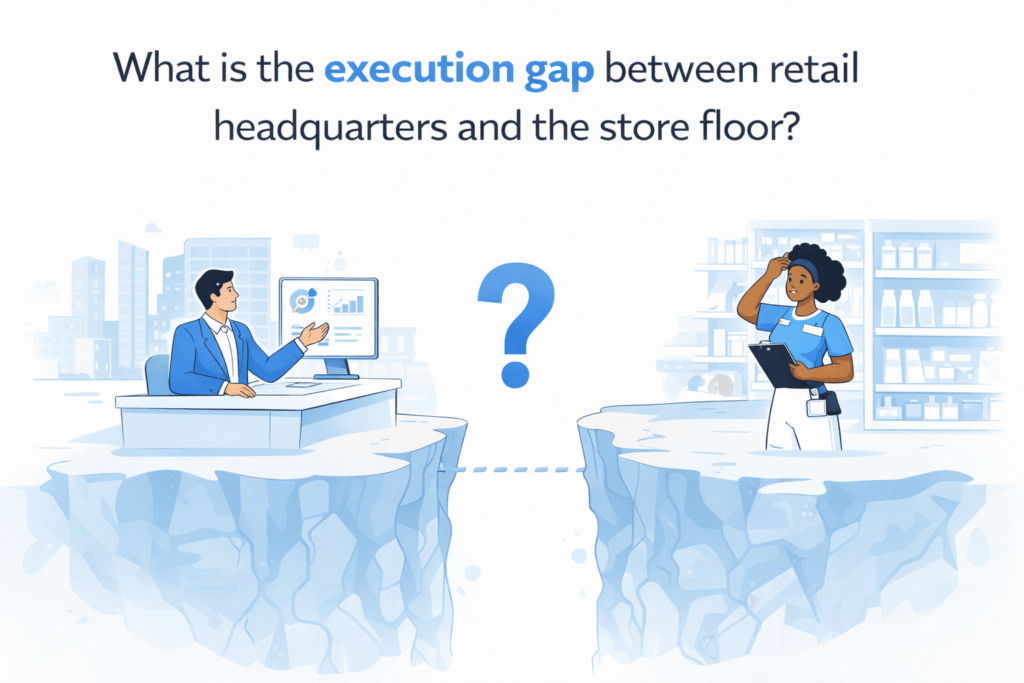
What is the execution gap between retail headquarters and the store floor?
The execution gap describes the disconnect between what retail leaders plan at headquarters and what actually happens inside stores.
Promotions, merchandising standards, and operational processes are carefully designed at the corporate level. But execution depends on hundreds or thousands of store associates carrying out those plans correctly, every day, across every location.
Closing this gap requires what many retailers recognize as a shared operational reality — where headquarters, regional leaders, and store teams all see the same priorities, tasks, and execution status in real time.
Without that shared view of operational work, strategy often struggles to translate into consistent store execution.
Headquarters launches a new promotion across hundreds of locations, expecting displays installed, pricing updated, and inventory positioned to support demand.
But inside stores, execution often varies.
Some teams install displays immediately. Others receive instructions late or through multiple channels. Pricing updates are missed, stock is not replenished in time, and visual standards differ from store to store.
Without real-time visibility into execution, leadership teams cannot see where strategy is breaking down across locations.
Why the gap happens
One of the main causes is fragmentation in how store work is coordinated.
Operational tasks often arrive through disconnected systems, leaving store teams without a single source of truth. This fragmentation creates a second, less obvious problem: prioritization.
Store associates receive multiple instructions at once, often without clear guidance on what matters most. When everything feels urgent, employees naturally default to completing the quickest or easiest tasks first rather than the most operationally important ones.
Over time, this behavior creates operational drift. Critical tasks get delayed, store standards become inconsistent, and managers spend increasing amounts of time chasing updates instead of improving performance.
The most operationally mature retailers address this challenge by redesigning how operational work flows across their organizations.
Instead of relying on fragmented communication and manual tracking, they create a shared operational environment where store tasks are clearly prioritized, centrally assigned, and visible across every location.
When operational work becomes transparent and coordinated across the organization, leaders gain something they rarely have today: confidence that strategy is being executed consistently in every store.
What does modern retail task management actually look like?
Modern retail task management is often misunderstood as simply digitizing checklists or replacing paper task lists with mobile apps. In reality, the most effective systems function as an operational coordination layer that connects headquarters strategy with day-to-day execution in stores.
For leadership teams, the value lies less in the mechanics of assigning tasks and more in the visibility, alignment, and accountability these systems create across the organization.
Real-time operational visibility
Modern task management transforms store operations from a reactive process into one that can be monitored and improved continuously.
In traditional retail environments, leadership teams rely on delayed reports, store visits, and anecdotal updates to understand whether operational initiatives are being executed correctly. By the time problems become visible, the opportunity to fix them has often passed.
Digital task management changes that. Headquarters, regional leaders, and store managers can see which tasks are assigned, in progress, or completed across every location — in real time.
This shared view allows retailers to identify execution gaps quickly, verify that campaigns are being implemented correctly, and intervene before small issues become larger operational problems.
Role-based delegation
One of the most overlooked benefits of modern task management is what it does for the store associate experience.
Operational instructions often arrive from multiple sources with little coordination. Associates must interpret priorities while managing busy store shifts.
Role-based delegation changes that dynamic. Tasks are assigned according to roles and responsibilities, ensuring that frontline associates focus on activities such as replenishment, merchandising, and order fulfillment while store leaders manage oversight and escalation.
For associates, this clarity reduces cognitive overload and removes the uncertainty of deciding what to do next. For retailers, it ensures operational work is distributed efficiently across teams.
Accountability through digital verification
Execution only matters if it can be confirmed.
Modern task management platforms verify operational work through time-stamped confirmations, photo validation of visual merchandising setups, and location-based activity tracking.
For organizations managing hundreds or thousands of locations, this verification layer transforms store execution from anecdotal reporting into verifiable operational data.
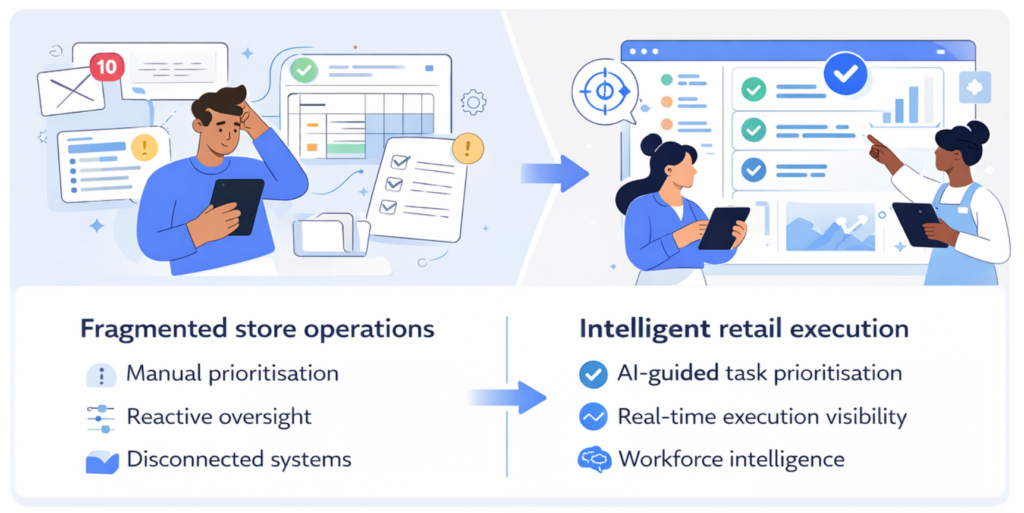
The most significant shift in modern task management is the move from reactive coordination to predictive operations.
Advanced platforms analyze operational signals such as inventory levels, demand patterns, and sales forecasts to automatically prioritize tasks for store teams.
For example, low-stock alerts can trigger replenishment tasks before shelves are empty, helping stores respond faster while reducing the cognitive load placed on frontline teams.
Taken together, these capabilities fundamentally change how store operations are managed. Retail leaders gain real-time visibility into execution, store teams receive clearer priorities, and operational decisions become increasingly data-driven.
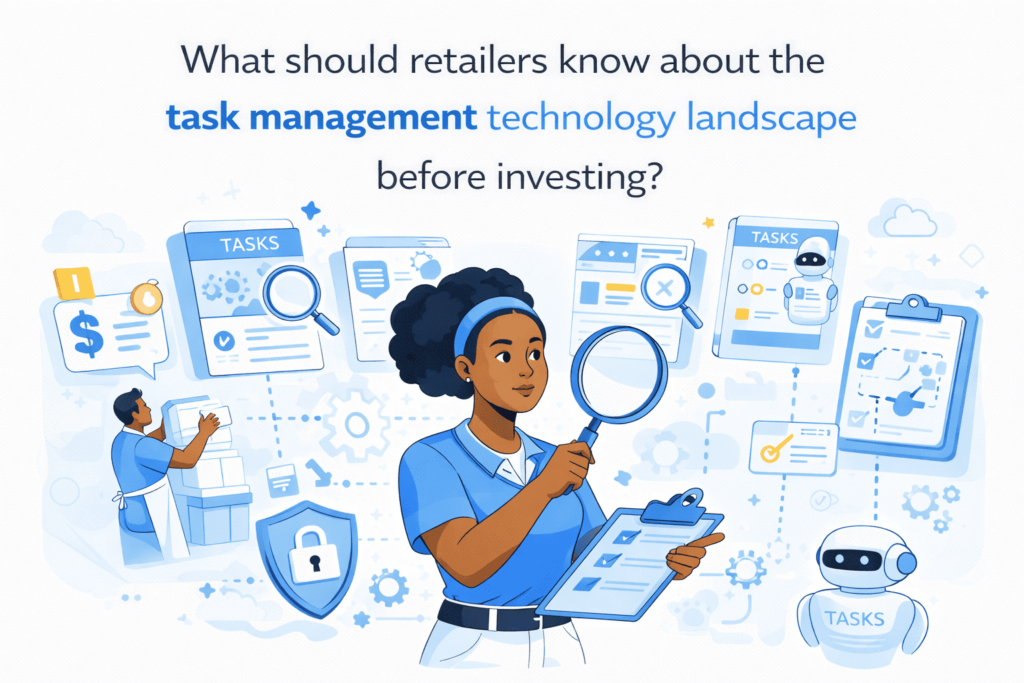
What should retailers know about the task management technology landscape before investing?
Retail task management has evolved into a significant technology category. A growing number of platforms promise to improve store execution, but they differ widely in scope, architecture, and operational focus.
For retail leaders evaluating solutions, the most important distinctions are not between individual vendors but between platform models and deployment strategies.
Enterprise platforms vs. SMB solutions
Enterprise platforms are designed for retailers operating large store networks. These systems prioritize scalability, integration with enterprise software, and visibility across hundreds or thousands of locations.
SMB-focused solutions prioritize ease of deployment and simplicity, often bundling task management with scheduling and communication tools.
Standalone platforms vs. integrated ecosystems
Some retailers choose standalone platforms dedicated to frontline execution, which often provide deeper functionality for store operations.
Others prefer integrated ecosystems where task management is embedded within larger enterprise platforms to simplify IT management.
Retailers must also decide how store teams will access operational tools.
Many organizations support bring-your-own-device (BYOD) approaches, allowing associates to use personal smartphones for work tasks. This reduces hardware costs but introduces considerations around security and workforce policies.
The most successful implementations rarely start with a list of product features. They start with a clear understanding of how operational work flows across the organization — and which technology model best supports that flow at scale.
The clearest measure of whether any of these approaches works is what happens to execution performance after implementation.
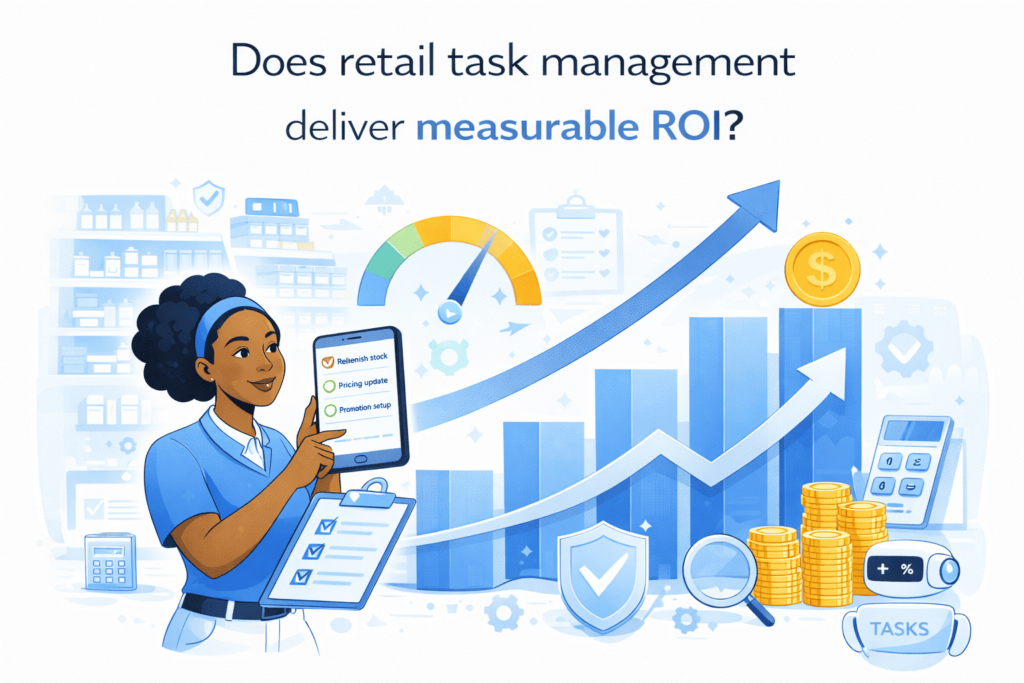
Does retail task management deliver measurable ROI?
Yes. Retailers that implement digital task management consistently report measurable gains in operational efficiency, store execution, and frontline productivity.
223,000 hours saved annually.Michaels digitized store tasks and communications across 1,350 stores, saving the equivalent of 2.5 hours per store each week. Task completion rates improved by 30%, daily customer readiness walks reached 98% compliance, and the retailer generated $1.8 million in incremental revenue by redirecting administrative time back to the sales floor.
90–95% task completion across 900 locations.Pilot Company replaced paper-based processes with digital execution, giving leadership real-time visibility into operational work across more than 900 locations and 30,000 employees. Store managers now complete tasks directly on mobile devices, significantly improving execution consistency across the network.
These results reflect a broader industry pattern. When operational work becomes visible, prioritized, and verifiable, store teams spend less time managing tasks and more time serving customers.
In a sector where small execution failures can quietly cost large retailers $10 million to $40 million per year, consistent store execution becomes a measurable commercial advantage.
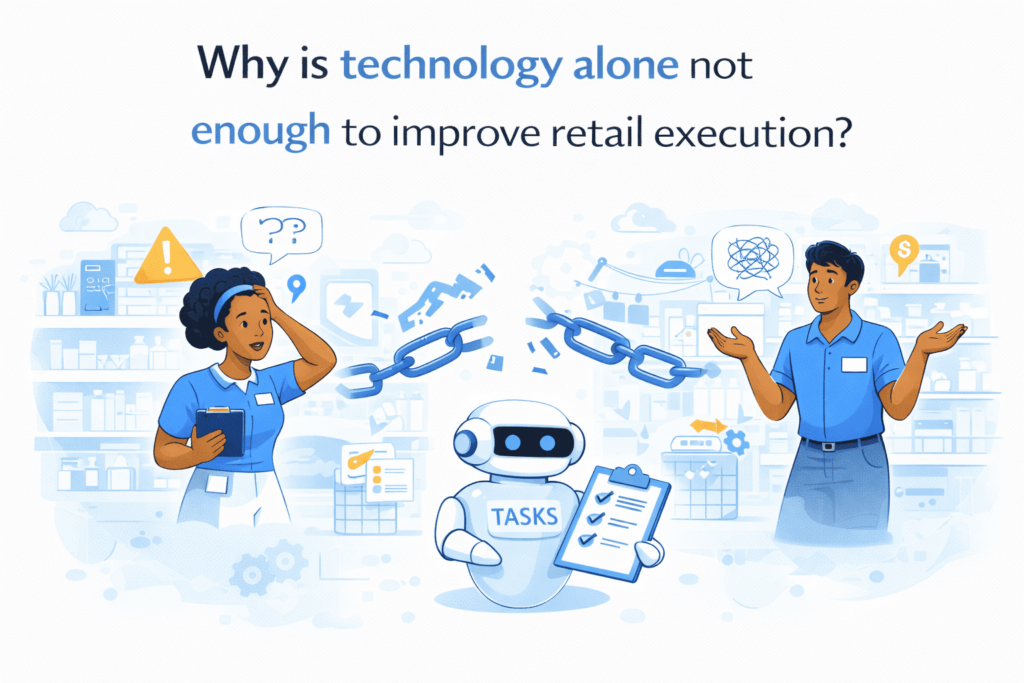
Why is technology alone not enough to improve retail execution?
No matter how advanced a task management platform becomes, its success depends on the people using it.
That is why the most successful retailers approach task management not just as a technology rollout, but as a frontline engagement strategy.
Design for the frontline, not the boardroom
Employees ignore systems that feel like additional administrative work.
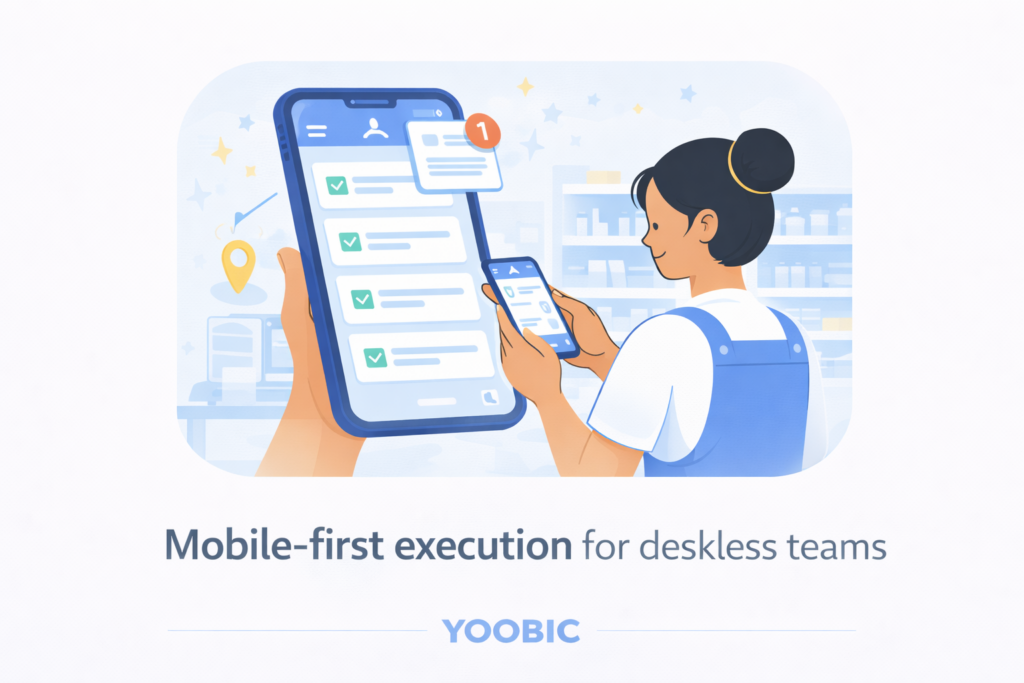
Platforms designed around frontline workflows — mobile-first interfaces, intuitive task flows, and simple confirmations — remove friction and improve adoption.
Close the knowledge gap
Most operational failures are not technology failures. They are knowledge failures.
Microlearning embedded directly within operational platforms allows associates to learn processes while completing real tasks, accelerating onboarding and improving compliance.
Recognition drives consistent behavior
Execution standards are reinforced through behavior.
Retailers increasingly use recognition tools such as leaderboards, milestones, and achievement badges to encourage consistent task completion and reinforce operational standards.
The technology itself is only an enabler — the real competitive advantage lies with the associates who execute strategy every day on the sales floor. Retailers that combine operational technology with strong frontline engagement create environments where execution becomes both visible and sustainable.
Technology is only half the battle; the true differentiator is a motivated, connected, and empowered workforce.
Between now and 2030, store operations will continue to evolve as retail becomes more connected, data-driven, and intelligent.
Three trends will reshape how retailers coordinate work across store networks.
Unified commerce operations. Store execution will increasingly connect ecommerce, supply chain, and physical retail operations.
AI-driven task orchestration. Systems will automatically generate and prioritize tasks based on real-time operational signals — helping stores respond faster while reducing the cognitive load placed on frontline teams.
Sustainability and compliance execution. Operational platforms will play a critical role in ensuring environmental and regulatory standards are executed consistently across locations.
The retailers that pull ahead will be those that treat execution as a strategic capability, not an operational afterthought.
Building this level of operational clarity is exactly what separates reactive retailers from those that execute with precision.
To find out how leading retailers turn strategy into consistent store execution, explore how YOOBIC helps operations leaders coordinate frontline work across every store.
Book a demo and find out how
Avoid wasted hours, blind spots
and lost revenue with YOOBIC
How does retail task management help store associates prioritize their work?
Retail task management platforms provide associates with a clear, prioritized list of tasks for each shift. Instead of relying on verbal instructions or scattered updates, employees can see exactly which tasks need to be completed first, helping them focus on the activities that have the greatest operational impact.
How does retail task management reduce confusion for store associates?
In many stores, instructions come from multiple channels such as emails, messaging apps, printed documents, or manager requests. Retail task management software consolidates these updates into a single system where associates can access tasks, guidelines, and priorities in one place. This reduces confusion and helps teams work more efficiently during busy shifts.
How does retail task management support store associates during busy trading periods?
During high-traffic periods, associates must balance operational tasks with customer service. Task management platforms help by clearly organizing responsibilities, assigning tasks to the appropriate roles, and allowing managers to adjust priorities in real time so associates can stay focused on supporting customers when demand is highest.
Can retail task management improve communication between headquarters and store teams?
Yes. Retail task management platforms allow headquarters teams to distribute operational updates, campaign instructions, and compliance tasks directly to stores through structured workflows. This ensures that store associates receive clear instructions and reduces the risk of messages being missed or misunderstood.
How does retail task management improve the store associate experience?
By giving associates clear priorities, structured workflows, and real-time visibility into store tasks, retail task management reduces uncertainty during shifts. Associates spend less time figuring out what needs to be done and more time focusing on customers and completing operational work efficiently.
Store managers are the backbone of every retail location. They are responsible for staffing, merchandising, compliance, and customer experience, often all at once and all day long. Yet for many, the reality of the role looks less like leadership and more like firefighting.
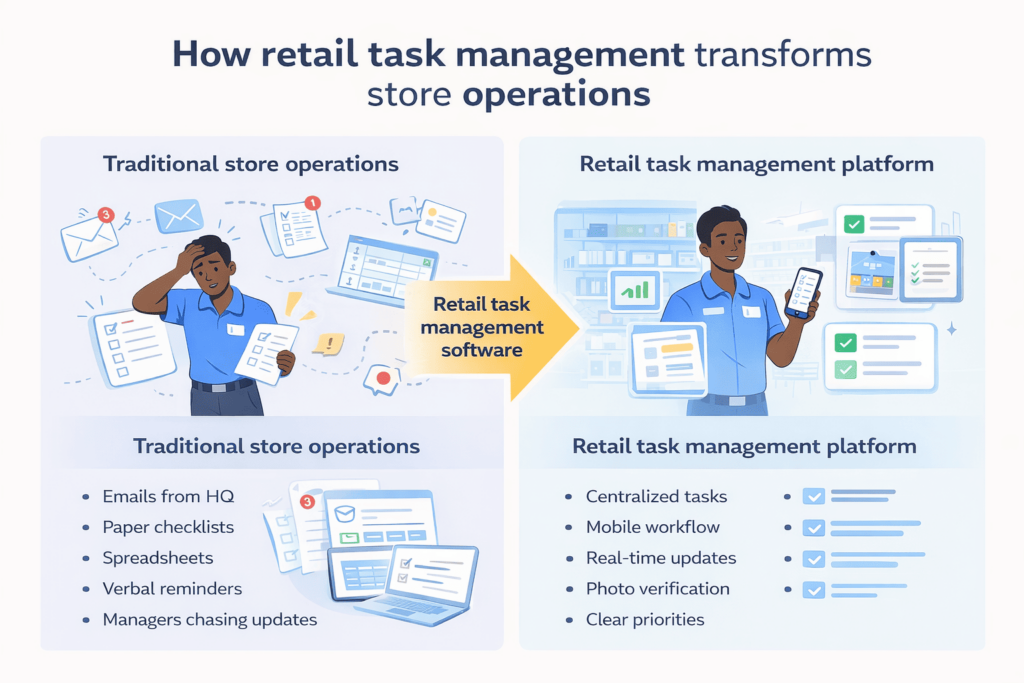
Email threads go unread. Spreadsheets sit untouched. Paper checklists disappear between shifts. The tools meant to support store operations haven’t kept up with the complexity of the job, and managers are left to fill the gaps themselves.
It’s no surprise that 40% of retail managers report daily stress and burnout due to workload and lack of support, and that 67% admit they sometimes have to “make it up as they go along” when coordinating store operations.
This isn’t a reflection of store managers’ ability. It’s the result of operational systems that were never designed for the pace of modern retail.
Retail task management software changes that. Instead of juggling scattered instructions, store managers gain a single mobile system to coordinate work, assign tasks, verify execution, and track store performance directly from the sales floor.
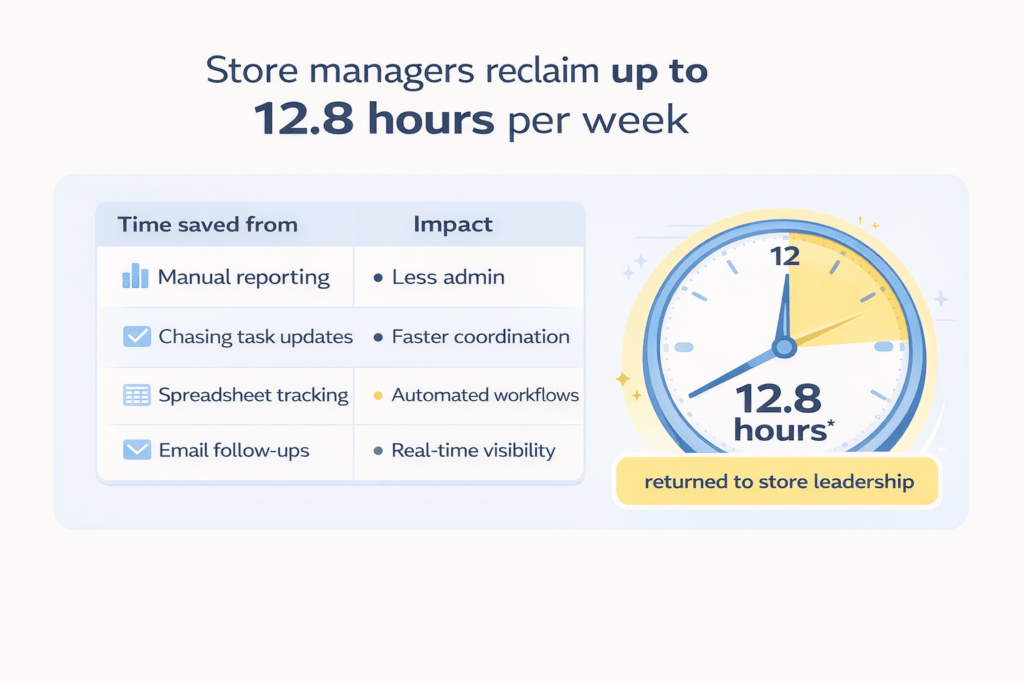
When store operations are digitized the way managers actually work, the impact is immediate. Managers can reclaim up to 12.8 hours per weekpreviously lost to administrative coordination, time that can be reinvested in coaching teams, supporting customers, and running a store with confidence.
TL;DR:
Retail task management software gives store managers a structured way to run daily store operations without relying on scattered emails, spreadsheets, or paper checklists.
Instead of chasing updates or piecing together instructions, managers use a single mobile platform to:
prioritise daily store operations and opening or closing workflows
coordinate tasks across frontline teams during each shift
verify execution in real time through checklists, photos, and audits
manage compliance, maintenance requests, and operational reporting
monitor store performance and operational trends
By turning operational standards into clear, trackable tasks, these platforms remove much of the invisible administrative workload that slows managers down.
The result is faster execution, stronger accountability across the store, and more time for managers to focus on what actually drives performance: coaching teams, supporting customers, and leading the sales floor.
What does retail task management software allow store managers to do?
At its core, retail task management software gives store managers a structured way to run daily store operations. Instead of coordinating work through scattered tools and verbal reminders, operational standards are turned into clear, trackable tasks that the entire team can see and act on.
This structure allows managers to move from reactive problem-solving to coordinated execution across the store.
Prioritise daily store operations
Every store day starts with a long list of responsibilities: merchandising updates, stock checks, safety procedures, promotional launches, and more.
Without a clear system, these tasks often arrive through multiple channels. A message from headquarters in one email. A merchandising guideline buried in a document. A reminder from a regional manager during a call.
Retail task management software consolidates these instructions into a single workflow. Managers can review daily priorities, opening procedures, and operational updates in one place, helping the team focus on the work that matters most first.
This structure also reduces “task completion bias,” the tendency for teams to complete easier tasks before the most important ones when priorities are unclear.
Assign and coordinate work across the team
Once priorities are clear, managers need to coordinate how that work gets done across the team.
Task management platforms allow store managers to assign tasks based on:
shift schedules
store zones or departments
operational priorities
As the day unfolds, managers can adjust workloads in real time, reassign tasks, and track progress across the store.
Because most platforms are mobile-first, managers can coordinate these activities directly from the sales floor rather than returning to the back office to update spreadsheets or send emails.
Verify execution across the store
In retail, assigning tasks isn’t enough. Execution has to be verified.
Retail task management software provides built-in validation tools that allow managers to confirm that work has been completed to standard. This often includes:
photo uploads of completed displays or store areas
digital checklists for operational procedures
compliance confirmations for safety and regulatory tasks
These verification steps create a clear audit trail and prevent “pencil-whipping,” where tasks are marked complete without actually being done.
The result is more consistent execution across stores and better visibility for both store and regional leadership.
Manage operational issues and store reporting
Beyond daily tasks, store managers constantly deal with unexpected operational issues.
Retail task management platforms give managers a structured way to handle these situations, including:
submitting maintenance requests
managing product recalls or compliance alerts
logging incidents or safety issues
submitting end-of-day operational reports
Instead of writing manual emails or compiling spreadsheets, managers can complete these workflows directly in the platform. Data such as sales metrics or staffing levels can often be pulled in automatically, reducing the time spent on administrative reporting.
For many retailers, this shift alone can return hours of time to store managers each week, time that can be reinvested in coaching teams and supporting customers.
→ One example of this in practice comes from Mattress Firm, where automated task management reduced 90-minute administrative routines to just 10 minutes across their store network.
Why does retail task management software give store managers time back on the sales floor?
Retail task management software reduces the hidden administrative workload that consumes much of a store manager’s day. By centralising operational tasks, reporting, and team coordination into a single system, managers spend less time managing processes and more time leading teams on the sales floor.
Retail managers often deal with what researchers call “invisible work.” This includes resolving scheduling conflicts, responding to corporate requests, troubleshooting systems, and following up on incomplete tasks.
Individually, these activities seem minor. Together, they consume hours of the workday and pull managers away from the sales floor.
Digital task management platforms reduce this coordination burden by turning store standards into structured workflows. Tasks, priorities, and completion status all live in one place, removing the need to track responsibilities across multiple tools or rely on memory.
The time impact can be significant. Retailers implementing task management systems report up to 12.8 hours per week returned to store managers, previously spent on manual coordination and administrative work.
That time allows managers to focus on the work that actually drives store performance:
coaching associates
supporting customers
monitoring execution during peak trading periods, often called “golden hours”
Reclaiming a manager’s time on the floor becomes even more critical during high-pressure trading periods like the holiday rush.
→ Our playbook on empowering frontline teamsexplores how retailers maintain consistent execution when store traffic, promotions, and operational demands all peak at once.
Instead of operating as back-office administrators, store managers can spend more time leading teams directly on the floor. In retail, that leadership presence often makes the difference between average execution and exceptional store performance.
How does retail task management software improve store execution?
Retail task management software improves store execution by turning operational standards into clear, trackable tasks that store teams can follow and verify. This allows retailers to ensure merchandising, compliance, and operational routines are executed consistently across every location.
In retail, the challenge is rarely defining what should happen in stores. The difficulty is ensuring those standards are implemented the same way across dozens or hundreds of locations.
Store managers must coordinate merchandising updates, promotional launches, operational routines, and compliance tasks while managing a live retail environment. Without a clear system, execution can vary significantly between stores, creating inconsistencies in presentation, service, and operational efficiency.
These daily inconsistencies might seem minor, but they accumulate rapidly across a large network.
→ Read our in-depth analysis to uncover how the retail execution gap costs retailers up to $40M a year and what you can do to close it.
Digital task management platforms help close this gap by translating operational expectations into actionable work that frontline teams can follow throughout the day.
This directly supports several areas that influence store performance:
store presentation: ensuring merchandising standards, signage, and promotional displays are implemented correctly
staff availability: coordinating tasks so associates remain available to support customers
checkout efficiency: maintaining operational routines that reduce bottlenecks during busy trading periods
daily store operations: ensuring replenishment, cleaning, and safety checks are completed reliably
Because managers can see progress and completion in real time, issues are identified earlier and corrected faster. Over time, this visibility helps retailers reduce the execution gaps that often appear across large store networks.
However, visibility only works when information is organized in a way that teams can actually act on. When store teams are overwhelmed by disjointed data and competing updates, execution can break down just as quickly.
The result is not simply better task completion, but more consistent store performance and a more reliable customer experience across every store.
The bottom line for store managers
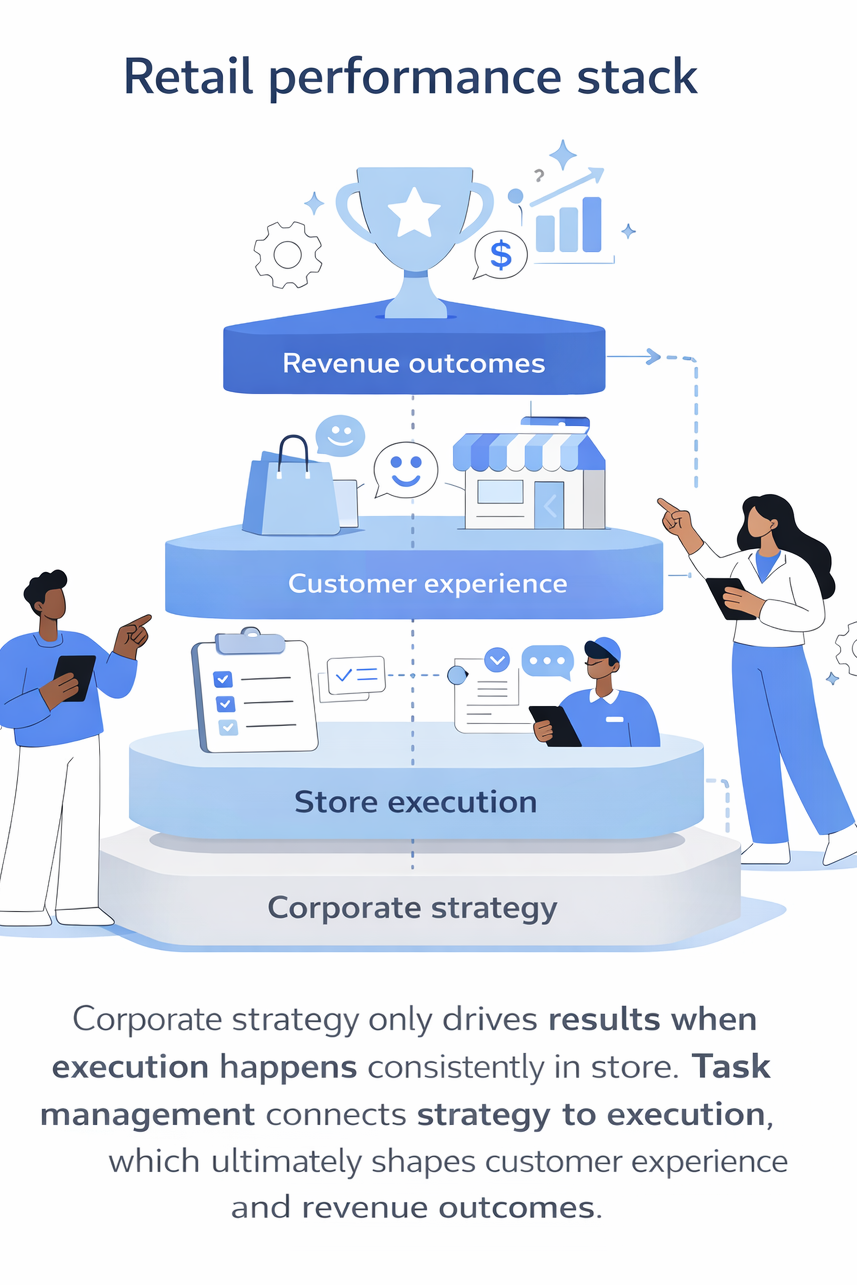
Retail rarely fails because of strategy. More often, it breaks down at the point of store execution.
Promotions are planned, merchandising standards are defined, and operational procedures are documented. But without the right systems, those plans can become inconsistent once they reach the store floor.
Retail task management software helps close that gap. By turning operational expectations into clear, trackable tasks, it gives store managers a practical way to coordinate teams, verify execution, and maintain consistency across the store.
When store execution becomes visible and structured, managers can spend less time coordinating work and more time leading teams on the sales floor where it matters most.
How is retail task management software different from basic task lists or spreadsheets?
Unlike spreadsheets or manual checklists, retail task management platforms are designed specifically for store operations. They allow tasks to be assigned to specific teams or shifts, tracked in real time, verified with photos or checklists, and reported back to regional or corporate leadership. This creates a structured operational workflow rather than a static list of tasks.
How do retail headquarters teams use retail task management software?
Headquarters teams use retail task management software to distribute operational updates, launch campaigns, coordinate merchandising changes, and monitor store execution. Instead of sending instructions through emails or documents, corporate teams can create structured tasks that are automatically delivered to the relevant stores and tracked through completion.
What features should retailers look for in retail task management software?
Retailers typically look for features such as mobile access for store teams, task prioritization, photo verification, digital checklists, reporting dashboards, and integration with other retail systems like workforce management or inventory platforms. These features help ensure tasks are clearly communicated, executed consistently, and tracked across the entire store network.
Is retail task management software difficult for store teams to adopt?
Most modern platforms are designed to be simple and mobile-first, allowing associates and managers to view tasks, complete checklists, and submit updates directly from the sales floor. Because tasks are structured and clearly prioritized, many retailers find adoption improves quickly compared to relying on multiple disconnected tools.
Retail performance is determined by execution. Strategy may be defined centrally, but results are shaped on the shop floor, across every store, every day.
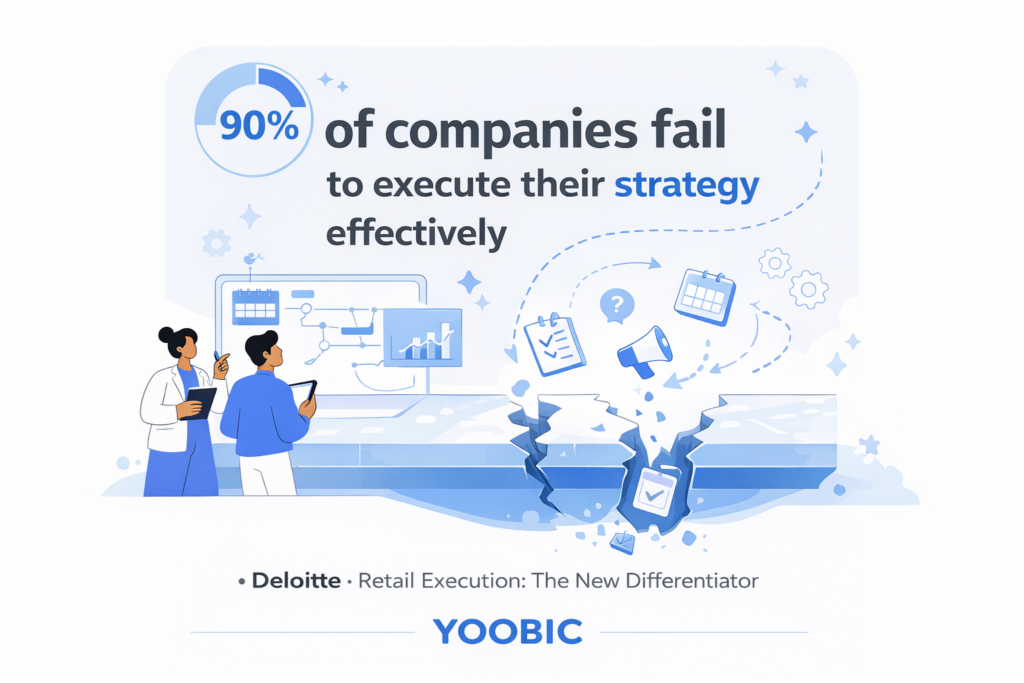
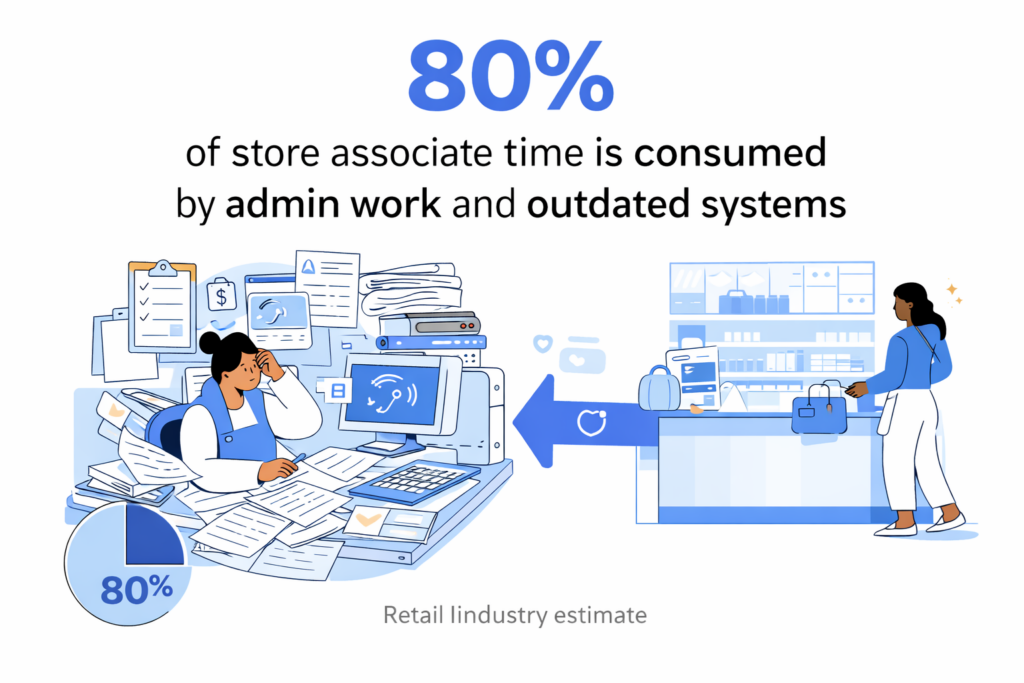
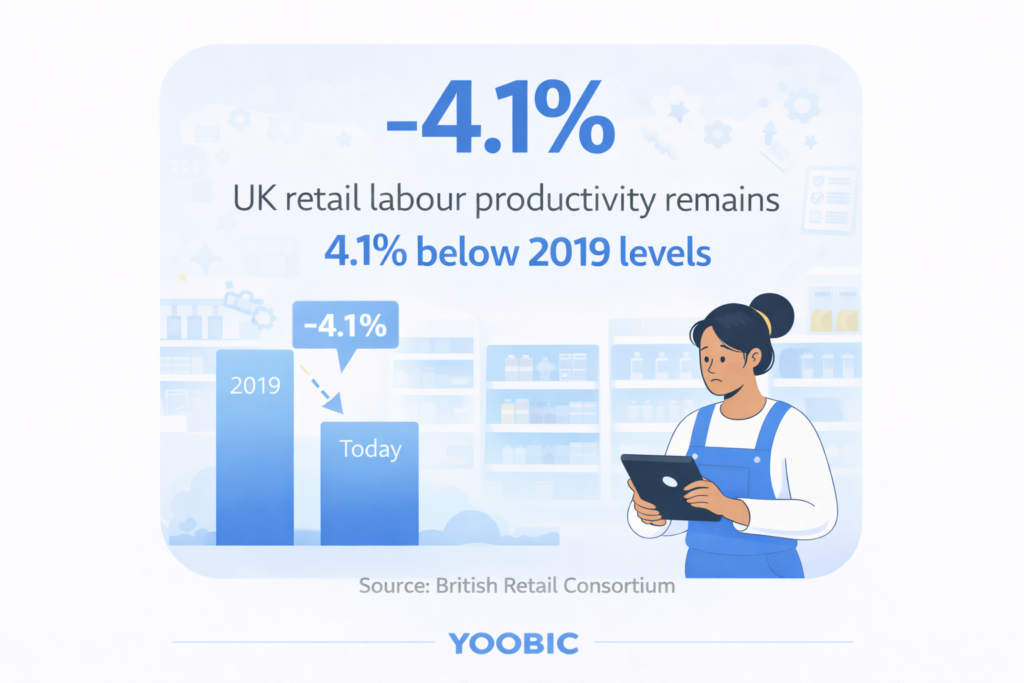
In a report titled Retail Execution: The New Differentiator, Deloitte estimates that 90% of companies fail to execute their strategy effectively. The challenge is rarely vision; it is translation — ensuring that priorities set at headquarters are carried out consistently at store level. Operational drag compounds the problem: a study by Brightpearl by Sage found that retail merchants spend approximately 332 hours per year on manual administrative tasks, time diverted away from customer engagement, coaching, and revenue-generating activity.
This disconnect between planning and store-level action is often described as the retail execution gap.
As retailers manage larger, distributed store networks and leaner teams, even minor execution breakdowns have measurable consequences, from missed promotions to inconsistent standards and operational strain.
Retail task management addresses this structural gap. A structured retail task management system ensures that daily store operations, merchandising plans, and compliance requirements are not simply communicated, but completed and tracked. For multi-location retailers, retail task management software provides the visibility needed to execute consistently at scale.
Building that level of operational clarity, without increasing administrative burden, is what separates reactive retailers from those that execute with precision.
What is retail task management?
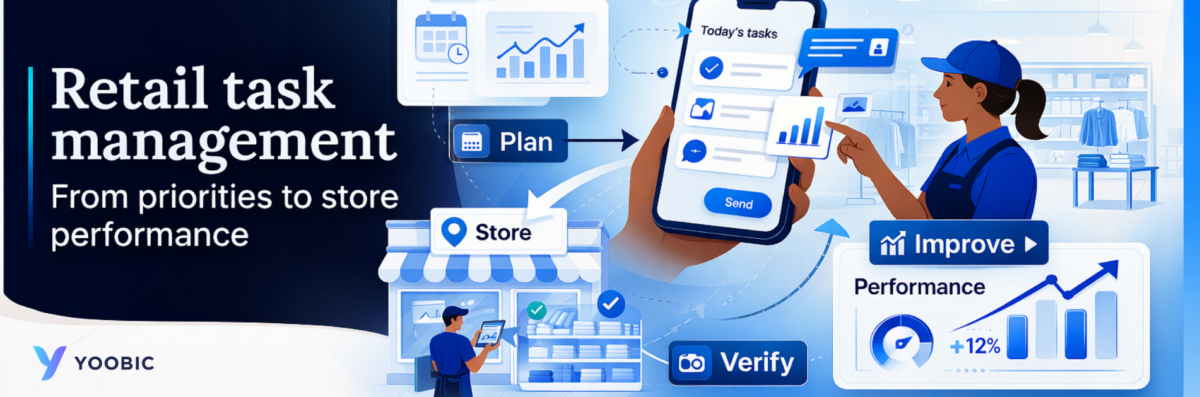
Retail task management is the system retailers use to plan, assign, and track the operational work that keeps stores running. At its most powerful, it becomes the connective tissue between what headquarters decides and what actually happens on the shop floor.
In practice, that means ensuring a product launch is set up correctly, a promotional display goes up on time, a compliance check is completed, and a planogram reset happens consistently across every store in the network, not just a handful.
Unlike generic task tools, retail task management is built for the realities of store life. Tasks must be clear, mobile-friendly, and actionable for deskless teams who are serving customers at the same time. The best systems support:
Role-based task distribution across multiple locations
Done well, retail task management turns daily operational activity into consistent, measurable execution at scale.
Why is retail task management more important than ever?
Retail task management is more important than ever because the economics and complexity of modern retail operations have fundamentally changed. Rising labor costs, omnichannel fulfillment demands, higher frontline turnover, and increased customer expectations mean that inconsistent retail task execution now directly impacts margin, brand trust, and revenue performance. Structured retail task management provides the operational control required to execute consistently across large, distributed store networks.
Retail complexity has increased dramatically. Today’s retailers operate:
Large, distributed store networks
Omnichannel fulfillment models
Frequent promotional cycles
Rapid product launches
Increasing regulatory requirements
High frontline employee turnover
Without structured retail task execution, this complexity creates variability at the store level and weakens performance across the network.
1. Protecting brand consistency at scale
Retail task management protects brand consistency by turning brand standards into measurable execution requirements across every location.
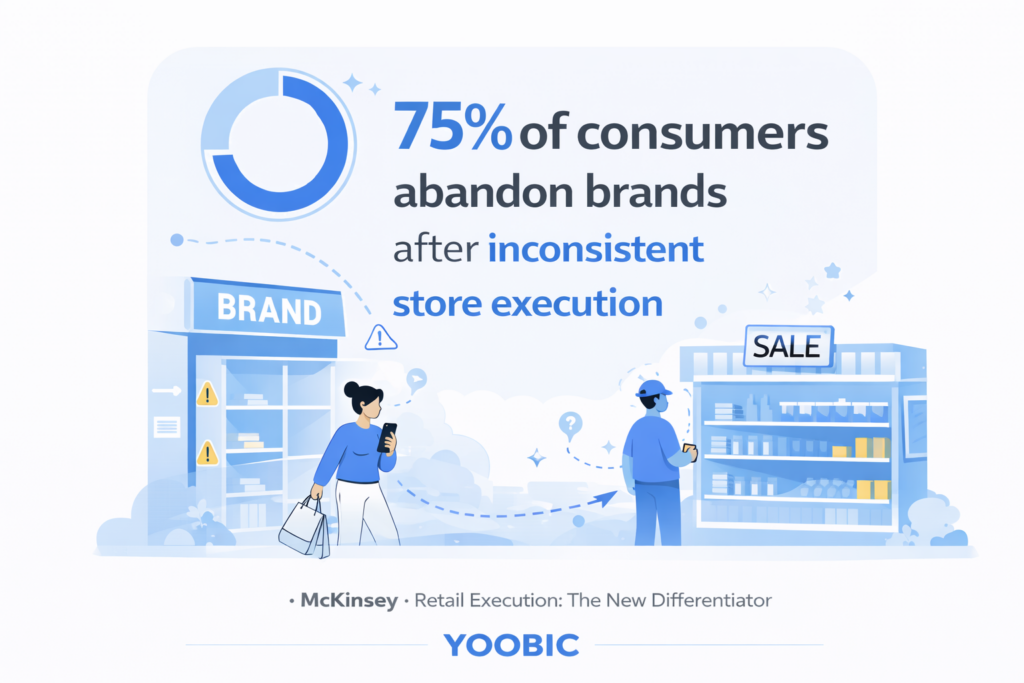
Every store represents the brand, and when execution varies, customer perception shifts with it. Inconsistent merchandising, incomplete planogram resets, missing signage, and pricing errors erode trust quickly. A Cleaning Matters survey found that 99% of customers say poor store cleanliness negatively affects their perception of a retail brand, while McKinsey research shows that 75% of consumers abandon brands due to inconsistent execution across locations.
Retail task management reinforces consistency by ensuring that:
Planograms are implemented correctly
Campaigns launch on time
Visual merchandising standards are followed
Pricing accuracy is verified
Compliance tasks are completed and validated
At scale, consistency depends on structure rather than intention.
2. Turning execution into revenue performance
Retail task management drives revenue by improving execution accuracy at store level, particularly in inventory availability and promotional compliance.
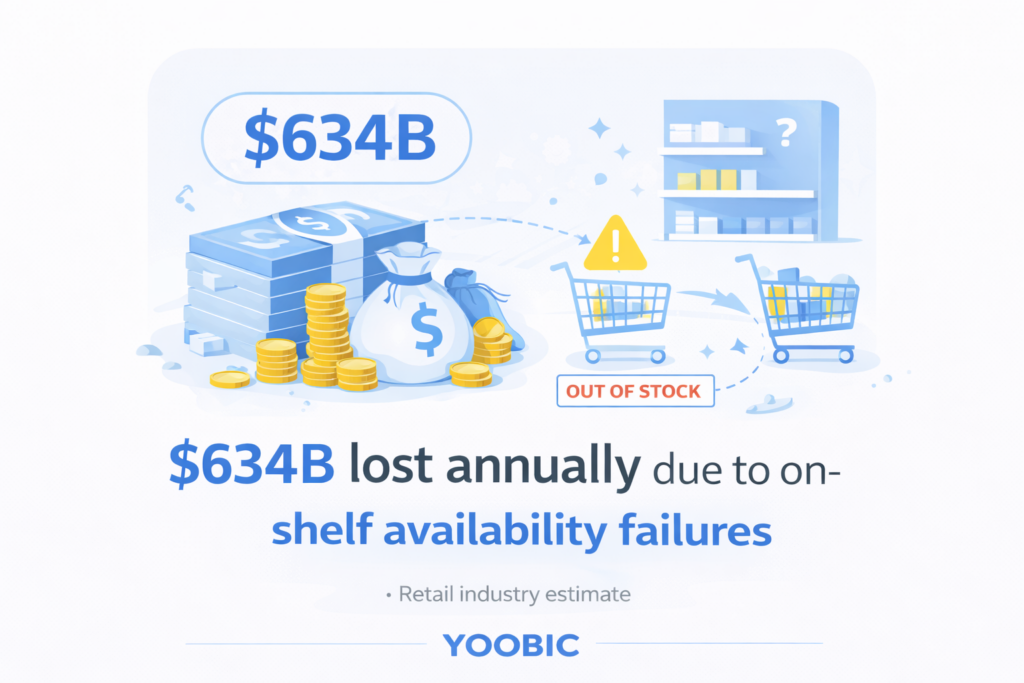
On-shelf availability issues cost the retail industry an estimated $634 billion annually, and roughly 72% of stockouts stem from store-level process failures rather than supply chain constraints. McKinsey research shows that even a 1% improvement in on-shelf availability can lift sales by 20 to 35 basis points. Retailers with mature omnichannel capabilities also report 27% lower fulfillment costs and 18% lower cart abandonment rates, according to PwC’s Retail Outlook 2026.
Revenue impact strengthens when retailers:
Increase promotional compliance
Improve on-shelf availability
Strengthen inventory accuracy
Standardize merchandising execution
Provide real-time store-level visibility
When corrective actions are assigned, prioritized, and validated early, small execution gaps are prevented from compounding across the network.
3. Increasing operational efficiency across store networks
Retail task management improves operational efficiency by reducing coordination overhead and increasing productivity per labor hour.
Retailers are operating in a high-cost labor environment where inefficiency directly impacts profitability. The UK Office for National Statistics reports that 36% of trading businesses cite labor costs as their primary challenge, and the British Retail Consortium (BRC) estimates that retail employment costs rose by £5 billion in 2025.
When task coordination relies on fragmented communication and manual follow-ups, paid hours are absorbed by clarification, duplication, and preventable rework. Retail task management reduces that friction by:
Centralizing task assignment
Clarifying ownership and deadlines
Reducing duplicated communication
Standardizing recurring processes
Providing real-time visibility into completion status
Operational efficiency is not achieved by working faster, but by removing structural friction from execution.
4. Strengthening the customer experience through execution
Retail task management elevates the customer experience by ensuring operational standards are executed consistently at the point of service.
Execution directly shapes customer perception. Total Retail reports that consumer frustration with waiting increased by 126% between 2023 and 2025. Empty shelves, long queues, and inconsistent store conditions weaken loyalty in a market where alternatives are immediate. Stores that follow structured checklists also report significantly stronger service performance, with some studies indicating improvements of up to 90%.
Customer experience strengthens when retailers:
Complete recurring store tasks on time
Standardize cleaning and merchandising routines
Prioritize high-impact service activities
Improve product availability
Provide visibility into execution quality
When execution is consistent and verifiable, service reliability follows.
What are the core elements of retail task management?
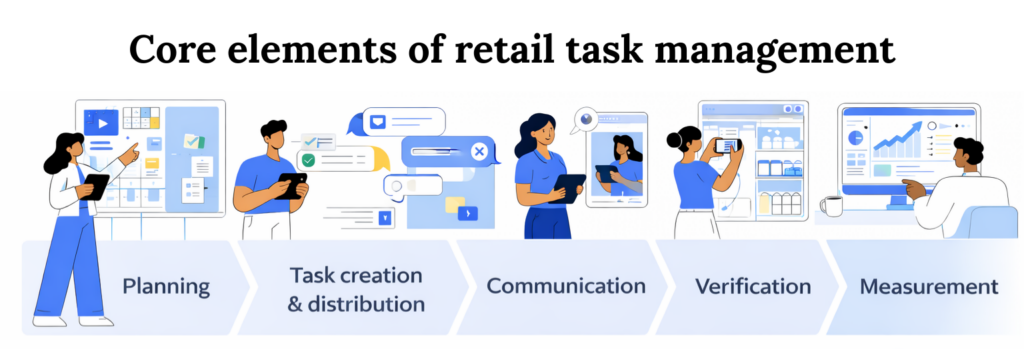
The core elements of retail task management are strategic planning, structured task distribution, contextual communication, frontline enablement, real-time execution visibility, and performance analytics. These elements form an integrated system that ensures retail strategy is implemented consistently at store level. When one element is weak or missing, execution gaps widen and performance variability increases across the network.
Retail task management functions as operational infrastructure. It aligns people, priorities, and processes so that daily store activity supports measurable business outcomes.
1. Strategic planning and standardization
Retail task management begins before a task is assigned.
Headquarters must clearly define:
What needs to happen
Who is responsible
When it must be completed
What “done correctly” looks like
Standards must be measurable and scalable across the store network. Without that clarity, performance becomes dependent on individual interpretation, introducing costly variability at scale. Research shows that only around 29% of retail initiatives are executed correctly at store level.
When expectations are vague, stores improvise, leading to inconsistent merchandising, delayed rollouts, uneven compliance, and avoidable rework. In an environment where rising labour costs are the primary pressure for 36% of trading businesses, tasks that require clarification or correction consume paid hours without improving output.
2. Structured task creation and distribution
Once standards are defined, retail task management ensures those priorities move through the organization with precision.
Tasks should be:
Assigned by role, location, or region
Prioritised based on impact
Delivered with clear deadlines
Supported by planograms, visuals, or step-by-step guidance
Automated where recurring
This structure determines whether work scales effectively or becomes unmanageable.
When distribution is fragmented, initiative overload follows. Research shows that 89% of leaders believe ineffective communication negatively affects operational performance. When priorities are delivered through disconnected systems, high-impact tasks compete with lower-value activities, leaving stores to decide what matters most.
Centralised retail task management replaces that ambiguity with structured prioritization, giving teams a single, role-specific source of truth.
3. Embedded communication and context
Retail task management must ensure that store teams understand the purpose and standards behind their work, not just the task itself.
Frontline employees need clarity on:
How a merchandising reset affects conversion
How stock accuracy protects revenue
How cleanliness reinforces brand perception
What successful completion looks like in measurable terms
When context is missing, execution quality declines. Nearly one-third of deskless employees report that they are not effectively communicated with, and more than half say company-wide updates are not relevant to their roles. Without role-level clarity, interpretation replaces precision.
Retail task management embeds communication directly within the workflow through visual standards, concise explanations, and defined proof requirements. When employees understand how their daily actions connect to measurable outcomes, consistency improves. Research published in Harvard Business Review shows that highly engaged teams are 21% more productive and 21% more profitable.
4. Frontline enablement within the workflow
Even the clearest task fails if employees lack the knowledge to complete it correctly.
Research indicates that 40% of frontline workers receive formal training once per year or less, while deskless retail turnover averages around 26%. Retailers are continually onboarding new employees into complex operational environments, increasing the likelihood of inconsistent execution.
Retail task management addresses this by embedding enablement directly into the workflow. Microlearning, visual SOPs, and certification tracking sit alongside operational tasks, making guidance available at the moment of execution rather than in a separate system.
This integration shortens time to competency, reduces first-time errors, and improves consistency across locations. Retailers implementing digital workforce systems report voluntary churn reductions of 15% to 25%, underscoring the link between clarity, capability, and retention.
5. Real-time visibility and verification
Retail task management converts operational activity into structured, verifiable data.
Without real-time visibility, leaders rely on delayed audits or fragmented reporting to assess store performance. By the time issues surface, they have often already affected sales or compliance. According to Retail Insight, on-shelf availability problems cost the industry approximately $634 billion annually, and Kaizen reports that 72% of stockouts stem from store-level process failures rather than supply chain disruption. In many cases, these losses reflect incomplete tasks or missed replenishment checks.
Modern retail task management systems provide:
Live completion tracking
Store- and region-level dashboards
Automated alerts for overdue tasks
Photo-based verification
With visibility embedded into daily workflows, managers focus on variance rather than reviewing every location manually. Earlier intervention reduces preventable breakdowns before they compound across the network.
6. Data-driven optimization and continuous improvement
The final element of retail task management is analytics.
Completion rates, compliance trends, and time-to-resolution metrics transform daily activity into measurable insight, revealing recurring gaps, training needs, and correlations between execution and sales performance. Research indicates that organizations lose an estimated 20% to 30% of operational expenditure to inefficiency, with rework accounting for up to 20% of productivity loss. Without structured task data, those losses are difficult to identify and correct.
When execution data informs prioritization and automation, decisions become more precise. Intelligent automation has been shown to deliver productivity gains of 25% or more when applied consistently across the network. Retail task management closes the loop between strategy, action, and performance.
What is the retail task management lifecycle?
Retail task management operates as a continuous lifecycle. It defines how strategy becomes structured store-level activity, and how that activity is refined through visibility and data.
This structure matters because execution failure is not marginal. According to Coresight Research’s annual study on in-store retail inefficiencies, retailers in major sectors lose an average of 5.5% of revenue to store-level execution gaps. A structured lifecycle reduces that leakage by replacing ad hoc coordination with repeatable processes.
1. Plan
Retail leaders establish clear standards, scope, ownership, and deadlines before work reaches stores. Planning ensures that labor capacity, compliance requirements, and promotional priorities are aligned in advance rather than negotiated at store level.
2. Communicate
Tasks are distributed through centralized, role-specific channels. Instructions, visuals, and measurable completion criteria are delivered together so that interpretation does not vary from location to location.
3. Execute
Frontline employees complete tasks within their daily workflow, validating completion where required. Execution is measured against defined standards, not informal confirmation.
4. Monitor
Managers gain real-time visibility into progress, compliance, and variance. Rather than relying on periodic audits, they focus on exceptions and emerging gaps.
5. Optimize
Task data is analyzed to identify recurring inefficiencies, resource imbalances, and training needs. Insights from one cycle inform the next, increasing precision over time.
Retail task management therefore functions as a structured feedback loop. Planning guides execution, execution generates data, and data refines future planning. As this cycle repeats, variability decreases and operational performance becomes more predictable.
How does retail task management improve daily store performance?
Retail task management improves daily store performance by turning operational routines into structured, prioritized, and measurable execution. It ensures that merchandising plans, inventory processes, compliance standards, and promotional launches are completed correctly and on time across the network.
Retailers lose billions each year to preventable execution breakdowns, with poor in-store merchandising alone contributing to an estimated $125 billion in lost sales across U.S. retailers annually. At the same time, UK retail labor productivity remains below pre-pandemic levels while employment costs continue to rise. In this environment, inconsistency erodes margin store by store.
Retail task management embeds operational discipline directly into daily store workflows, protecting performance at scale.
Merchandising execution and planogram compliance
Merchandising execution determines whether strategy converts into sales.
Fewer than 25% of retailers consistently meet basic shelf-accuracy benchmarks, and even minor pricing or display errors directly affect conversion.
When merchandising standards are consistently executed, revenue impact is immediate and measurable.
Inventory management and on-shelf availability
On-shelf availability is one of the most direct operational drivers of revenue.
Retailers lose over $1.7 trillion annually to stockouts, shrink, and overstock, and many of these losses originate at store level when replenishment routines, stock verification, or execution standards break down.
Retail task management systems reduce these failures by embedding structured inventory controls directly into store operations, including:
Triggered replenishment workflows
Scheduled cycle counts
Exception alerts for discrepancies
Real-time completion tracking
When inventory processes are structured and visible, stock variability declines and preventable stockouts are identified earlier. At scale, that operational precision protects revenue without increasing labour.
Operational coordination and workload management
Execution gaps widen when operational information is dispersed across email, spreadsheets, and disconnected systems, forcing managers to consolidate updates before they can address performance on the floor.
Retail task management reduces this friction by:
Delivering tasks through a single structured platform
Tracking completion automatically
Capturing validation at the point of execution
Generating real-time, consolidated reporting
With visibility embedded into the workflow, managers spend less time coordinating tasks and more time improving standards, coaching teams, and strengthening store performance.
Compliance management and audit execution
Operational breakdowns accumulate through missed checks, pricing inconsistencies, incomplete resets, and delayed corrective action.
McKinsey research shows that mismanaged strategy implementation can erode up to 10% of annual revenue in large retail organizations, much of it driven by inconsistent store-level execution.
Digital task management embeds discipline into daily operations through:
Recurring compliance workflows
Time-stamped audit trails
Automated reminders and escalations
Centralised performance dashboards
With compliance structured and visible in real time, issues are identified earlier and financial exposure is reduced.
Workforce enablement and frontline task clarity
Retail task management succeeds or fails at the frontline.
Store associates operate under significant operational load. Research shows that 38% of associate time is consumed by administrative tasks, while another 42% is spent supporting outdated technology systems. That leaves limited capacity for customer engagement, merchandising accuracy, and inventory execution, which directly impacts store performance.
A structured retail task management system improves frontline clarity by embedding:
Role-based task feeds aligned to daily store operations
Prescribed, technology-driven task guidance
Embedded microlearning within the workflow
Verified completion and retail task tracking
When task precision replaces ambiguity, execution becomes more consistent and administrative friction declines.
Inventory accuracy and omnichannel task coordination
Store task management must support both physical retail and omnichannel fulfillment.
Inventory inaccuracy remains a persistent execution gap. Research by Fluent Commerce found that 58% of retailers report less than 80% inventory accuracy, and phantom inventory can erode up to 8% of total inventory value.
These losses stem from daily execution failures: missed replenishment tasks, incomplete cycle counts, and poor coordination between backroom and shelf.
A structured retail task management system reduces this risk through:
Automated replenishment workflows
Standardized cycle counts
Real-time discrepancy alerts
Coordinated backroom and floor execution
As omnichannel complexity increases, structured task management provides the control required to protect inventory accuracy and revenue at scale.
How retail task management impacts revenue and margin
Execution gaps affect revenue through missed sales, slower service, and inconsistent store experience.
According to PwC, when retailers align operational efficiency with customer experience, sales per square foot can increase by 5–15% and conversion rates improve by 10–20%. These gains are driven by stronger execution at the shelf, faster issue resolution, and more consistent service standards.
Workforce structure also influences financial outcomes. Companies offering flexible scheduling report up to 29% higher customer satisfaction, 15% higher loyalty, and 32% more positive customer interactions, according to MyShyft. When frontline teams are supported with clearer priorities and better task coordination, customer-facing performance improves.
Retail task management software contributes to margin protection by embedding:
Centralized store task management
Continuous, real-time visibility
Prescribed task prioritization
Coordinated execution across locations
When daily store operations are structured and measurable, execution variability declines. At multi-location scale, incremental improvements in conversion, satisfaction, and labor efficiency compound into meaningful financial impact.
What features should retail task management software include?
Retail task management software should include intelligent task distribution, structured prioritization, execution validation, real-time visibility, mobile-first workflows, embedded enablement, and data-driven performance guidance. These capabilities ensure operational standards are executed consistently across multi-location store networks.
73% of frontline employees still rely on paper-based or manual processes, increasing delay and execution variability across store networks. Modern retail task management software must function as operational infrastructure: distributing work precisely, verifying quality, and providing live oversight at scale.
The following capabilities define a modern platform.
Intelligent task distribution
Retail networks are complex and highly variable. Not every task applies to every location.
Effective retail task management software allows headquarters to:
Assign tasks by role, region, store format, or cluster
Automate recurring workflows such as opening procedures, compliance checks, and replenishment routines
Embed visual instructions, planograms, and documentation directly within the task
Precision in distribution reduces noise, lowers cognitive load, and ensures frontline teams focus only on what is relevant to their store.
Prioritization and operational focus
Fragmented communication creates initiative collision.
Retail task management systems should:
Surface high-impact tasks based on urgency and business impact
Centralize directives into a single operational view
Clarify daily priorities through structured activity feeds
This shifts managers from reacting to inbox volume to executing against clearly ranked priorities.
Validation, not just completion
Execution quality cannot rely on just confirmation. Modern retail task management software must verify whether it was executed correctly.
Best-in-class platforms require:
Confirmation of completion
Validation against defined quality standards
Photo-based proof of execution
Structured root-cause reporting when tasks cannot be completed
Marking a display as “complete” does not confirm it meets brand standards. Capturing why a task failed — whether due to missing materials, inventory constraints, or operational blockers — allows headquarters to address systemic issues rather than assume compliance.
Retail task management must move beyond task tracking to execution assurance.
Real-time visibility and performance reporting
Operational control depends on live insight.
Retail task management software should provide:
Store- and region-level dashboards
Automated alerts for overdue or incomplete tasks
Continuous compliance tracking
Real-time visibility enables early intervention. Instead of discovering breakdowns in weekly reports or periodic audits, leaders can identify variance as it emerges and respond before performance declines.
Mobile-first execution for deskless teams
Retail is a deskless environment. Task management must operate where work happens.
Mobile-first platforms enable associates to:
Complete tasks directly on the shop floor
Submit verification in real time
Access operational guidance without leaving customer-facing areas
Execution improves when technology aligns with the physical realities of retail work.
Embedded enablement within the workflow
Task execution and training should not operate in separate systems.
Modern platforms integrate:
Microlearning modules
SOP access
Visual guides
Certification tracking
Embedding enablement at the moment of execution reduces first-time errors, accelerates onboarding, and strengthens consistency across multi-location networks.
AI-driven insights and execution guidance
Retail task management is evolving from activity tracking to performance direction.
Traditional systems report what happened. More advanced platforms analyze task, sales, inventory, and compliance data together to highlight where execution may be drifting from plan.
These capabilities increasingly include:
Impact-based task prioritization informed by performance signals
Detection of anomalies across stores or regions
Identification of locations that may require additional support
Manager guidance that suggests relevant follow-up actions
By correlating execution data with broader operational indicators, these systems surface areas that warrant attention. Managers are guided toward verification steps or corrective tasks, enabling earlier intervention.
The shift is subtle but significant. Retail task management moves from documenting activity to supporting informed operational decisions — reducing variability and strengthening consistency across the network.
What are the most common retail task management challenges?
The most common retail task management challenges are execution variability, administrative overload, weak accountability, delayed visibility, and frontline disengagement. These structural gaps limit a retailer’s ability to translate strategy into consistent store-level performance. Even leading retailers experience these breakdowns.
Inconsistent store performance
Execution variability is highly visible to customers. Research shows that adherence to visual merchandising and promotional standards can increase sales by up to 20%. When standards are inconsistently implemented across locations, that upside is lost.
In multi-location networks, minor deviations in planogram compliance, display setup, or promotional timing compound into measurable performance gaps.
Fragmented workflows and manual systems
Many retailers still rely on spreadsheet-based coordination for 26–50% of core workflows. When execution depends on disconnected tools, operational standards are distributed across emails, spreadsheets, and local processes rather than a single system.
This fragmentation creates version control issues, inconsistent reporting formats, and gaps between headquarters intent and store-level interpretation. Coordination becomes improvised rather than structured.
Lack of accountability
Manual systems lack closed-loop verification. Paper checklists and fragmented reporting create gaps between reported completion and verified execution.
Digital audits, by contrast, have been shown to improve operational consistency by 10–15% through real-time tracking and automated alerts. Without structured validation, accountability becomes assumption rather than measurable performance.
Limited real-time visibility
Many retailers still struggle to obtain timely, reliable data from the field. Research indicates that store-level information often takes days or even weeks to consolidate and reach headquarters.
When performance insight depends on delayed reporting cycles, leaders cannot intervene at the moment execution begins to drift. By the time issues are surfaced, promotional windows may have closed, compliance deadlines may have passed, and customer impact may already have occurred.
Real-time visibility is not about reporting volume. It is about shortening the distance between action and awareness.
Frontline disengagement
Execution is ultimately human. Yet 70% of store associates report a preference for prescribed, technology-driven tasks that clearly define what to do and when. Ambiguity increases cognitive load. Precision increases confidence. When tasks are structured and supported by clear guidance, consistency improves.
Why these challenges compound
According to the BRC, retail labor productivity in 2024 remained 4.1% below 2019 levels in the UK, despite sustained cost pressure. When productivity does not recover in line with operating costs, inefficiencies accumulate across distributed store networks.
Retail task management challenges are often coordination gaps rather than strategic missteps. Variability across locations amplifies their impact.
How do you measure the success and ROI of retail task management?
Retail task management is measured by how reliably execution translates into performance. Success is not defined by activity alone, but by whether operational consistency improves revenue, productivity, and compliance at scale.
Core execution metrics
The foundation of ROI measurement begins with operational reliability. Core metrics include:
Task completion rate
On-time completion rate
Promotional compliance rate
Planogram compliance percentage
Audit pass rates
Average task completion time
Store-level performance variance
Issue resolution time
These indicators measure whether strategy reaches the shop floor intact.
For example:
Digital workflows target 70%–99% compliance consistency, compared to materially lower execution rates under manual systems
Organizations report a 43% increase in time spent on revenue-focused activity after implementing structured digital tasking.
Consistency in execution stabilizes performance across locations, limiting the revenue erosion that comes from uneven rollout and delayed correction.
Speed and compliance are therefore operational controls, shaping how quickly value is realized and how much of it is retained.
Productivity and cost recovery
ROI is measured by how much operational waste is removed and how much labor is redirected toward revenue-generating activity.
Key indicators include:
Reduction in overtime costs
Reduction in operational expenditure
Time to task completion
Time to compliance
Reduction in execution-related rework
Organizations adopting structured digital task management report:
3–7% reduction in direct labor costs through optimized scheduling and task coordination
These improvements are measurable on the P&L. Reduced overtime lowers direct expense. Reduced rework protects paid labor hours. Faster execution shortens revenue delay.
Retail task management succeeds when labor hours produce more commercial output per shift.
Advanced performance analysis
Once execution data is centralized, retailers can move beyond tracking into correlation analysis. Advanced measurement includes:
Correlation between execution scores and sales
Time to compliance across locations
Impact of training completion on execution quality
Regional performance trends and store-level variance
At this stage, task management becomes a performance intelligence system. Leaders can identify whether underperformance stems from strategy, staffing, training, or execution gaps — and intervene earlier.
Financial return
The financial case for structured execution is measurable.
Research indicates that for every $1 invested in process clarity and operational design, organizations save $5–£10 downstream by reducing errors, rework, and wasted labor.
First-year ROI on clarity-focused operational investment is projected at 5x–9x
Execution excellence compounds. Small improvements in consistency, speed, and visibility scale across every store, every shift, and every promotion.
When execution data becomes measurable, operational management becomes proactive. And when operational management becomes proactive, revenue protection becomes systematic.
What is the future of retail task management?
The future of retail task management is predictive, AI-guided execution. Instead of documenting what happened yesterday, modern systems help retailers prioritize what should happen today. The shift is from reactive oversight to structured, forward-looking performance management.
Retail task management is shifting from activity tracking to performance direction.
AI-driven prioritization
Traditional systems distribute tasks broadly and expect managers to determine priority. Modern retail task management platforms reverse that model by ranking work dynamically based on live operational signals.
AI evaluates:
Sales velocity and SKU performance
Inventory risk and stockouts
Staffing gaps and traffic patterns
Compliance drift across locations
Managers receive structured guidance that surfaces the actions most likely to protect revenue or prevent disruption, reducing fragmentation and narrowing execution variance across locations.
When prioritization is evidence-based, execution variance narrows and commercial outcomes stabilize.
Predictive compliance monitoring
Compliance is moving from periodic inspection to continuous validation.
Instead of discovering errors during regional visits, modern systems surface execution gaps in real time. This may include automated planogram checks, exception alerts, or digital verification within the task workflow itself.
When validation is continuous rather than delayed, execution failures are corrected earlier. That shortens the window in which revenue or brand standards are exposed.
Integrated workforce intelligence
Retail task management is increasingly connected to workforce planning. Labor allocation and execution quality cannot operate in isolation.
Advanced systems support:
Dynamic staffing recommendations based on demand
Real-time task reallocation during peak trading
Alignment between scheduling and operational priorities
This integration ensures that high-impact tasks are not delayed due to staffing blind spots. In cost-constrained environments, that alignment becomes commercially material.
Cross-channel execution visibility
Physical stores now operate as both sales floors and fulfillment hubs. Retail task management is evolving to support unified execution across channels.
By integrating inventory, order, and point-of-sale data into the execution layer, frontline teams gain full operational context. Promotional campaigns, stock accuracy, and fulfillment tasks can be managed within the same structured environment.
As omnichannel complexity increases, fragmented coordination becomes unsustainable. Structured visibility enables retailers to scale without sacrificing consistency.
Real-time performance benchmarking
The next evolution of retail task management includes dynamic benchmarking across store clusters.
Intelligent systems can:
Detect anomalies in sales or execution patterns
Compare performance across similar locations
Trigger corrective “next best actions” automatically
Deliver targeted microlearning when skill gaps are detected
Performance gaps are surfaced early, and corrective action is embedded directly into the daily workflow.
The structural shift
Retail execution was once treated as a communication challenge. The emerging model treats it as an operational control system.
When retail task management combines intelligent prioritization, continuous validation, integrated workforce planning, and real-time benchmarking, execution becomes more predictable, measurable, and economically disciplined.
In margin-sensitive environments, that predictability is not incremental. It determines whether strategy translates into measurable performance at scale.
Conclusion: retail task management and store performance
Retail task management connects strategy to in-store reality. It structures how work is distributed, verified, measured, and improved across multi-location networks.
When task planning is precise, execution is validated against standards, frontline teams are enabled within the workflow, and outcomes are tracked in real time, daily operations become measurable and controllable.
That control affects core performance drivers:
Brand consistency across locations
Promotional and merchandising compliance
Revenue protection during campaigns and launches
Manager accountability and response time
Operational efficiency at scale
In complex retail environments, performance variance accumulates quietly across stores. Structured retail task management reduces that variance by creating visibility, prioritization, and accountability within everyday work.
Consistent execution across locations strengthens commercial predictability. Predictable execution protects margin, supports growth, and ensures that strategy translates into measurable store-level performance.
Retail task management FAQs
What are the 5 R’s of retail?
The 5 R’s of retail describe the core goal of retail operations: delivering the right product, in the right place, at the right time, in the right quantity, at the right price.
These principles guide merchandising, inventory planning, and store operations. Retail task management supports them by ensuring merchandising resets, pricing updates, and inventory checks are executed consistently across stores.
What is the 1-3-5 rule for task prioritization?
The 1-3-5 rule is a simple framework for structuring daily work. It suggests focusing on: 1 major task, 3 medium tasks, 5 smaller tasks. In retail stores, this approach helps managers balance high-impact operational priorities, such as promotional launches or compliance checks, alongside routine store tasks.
How do you know if store execution is breaking down?
Execution breakdowns often appear as small inconsistencies across stores. Examples include missed promotions, incomplete merchandising resets, pricing discrepancies, or delayed compliance checks.
When these issues occur repeatedly across locations, they usually indicate a coordination gap rather than isolated store problems. Retail task management systems help identify these gaps earlier by providing visibility into store-level execution.
What problems does retail task management actually solve?
Retail task management addresses the gap between strategy and store-level execution.
Without a structured system, operational priorities are often communicated through disconnected tools such as email or spreadsheets. This creates confusion around ownership, inconsistent task completion, and limited visibility into store performance.
Retail task management platforms centralize task distribution, prioritization, and verification across the store network.
When should a retailer invest in retail task management software?
Retailers typically invest in retail task management software when operational coordination becomes difficult to manage through email, spreadsheets, or paper checklists.
Common signs include inconsistent promotional execution, limited visibility into task completion across stores, and store managers spending excessive time coordinating operational updates. At this stage, structured task management provides the visibility and accountability needed to maintain consistent execution.
Internal communications can be compared to white water rafting.
If you’ve ever gone white water rafting, you’ll understand the importance of having everyone paddling at the same speed and in the same direction.
An effective internal communications strategy is a lot like the rafting guide who tells you when and how fast to paddle.
Because if everyone is doing their own thing, you’re going to have a really hard time steering the boat. And you definitely won’t make it over the first rapid.
The internal communications strategy, methods, channels and tools you choose determine whether your employees are engaged and collaboratively working towards the same goal – even when the water gets rough.
But for retailers with brick-and-mortar stores, including every employee in your internal communications network is integral to success.
That’s because the work done by store employees – like serving customers, carrying out store processes and selling products – is the lifeblood of a company.
Why is applying internal communications best practices so critical?
When done in the right way, internal communication in retail:
Improves employee engagement
Increases productivity – by as much as 25%, according to McKinsey
Keep employees informed, and creates a knowledge-sharing culture
Save busy employees time. Using social internal communications tools cuts the time employees spend looking for information by 35%
But without the right strategy and methods, your internal communications might not be reaching your store employees at all, which means they’re not reaping any of the benefits listed above.
Why don’t internal communications reach most employees?