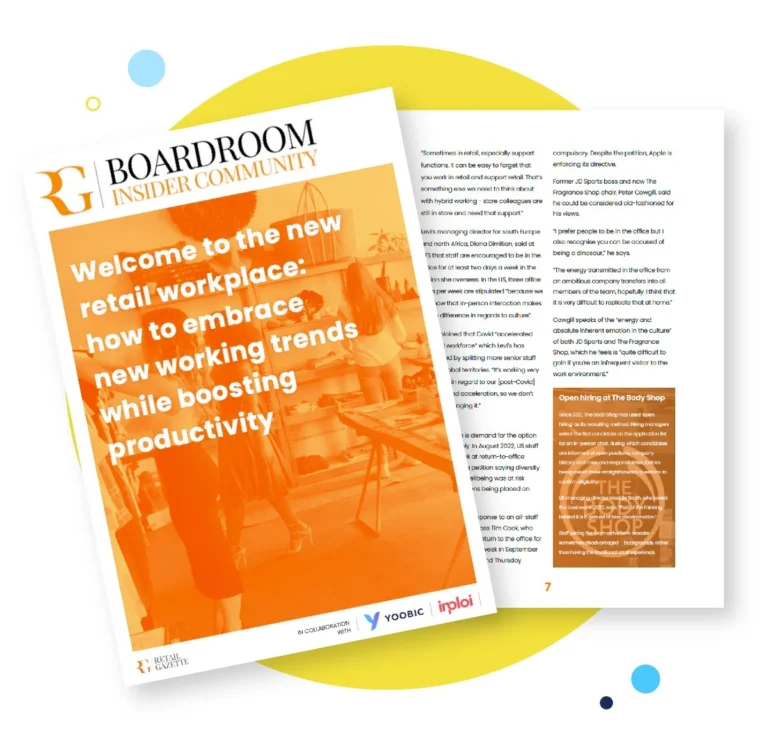
Welcome to The New Retail Workplace
The working trends that turn a disengaged frontline workforce into a productive one, with real examples from Levi’s, Primark and M&S.
Key findings
- A Workl survey of 300,000 people found retail scored just 66% on employee engagement, with only the chemicals, mining and metal manufacturing sector scoring lower.
- A 2019 study by the University of Oxford’s Saïd Business School and Erasmus University Rotterdam found workers are 13% more productive when happy.
- In a four-day-week pilot running June to December 2022, 92% of the 61 participating companies decided to continue, and 30% of those made it permanent.
Summary
UK retail is navigating a declining, high-turnover workforce, a widespread wellbeing crisis, and the biggest cost-of-living crisis in a generation. Retailers face the dual challenge of recruitment and retention while balancing productivity and adapting to post-Covid working trends such as hybrid and four-day-week models.
This report explains how flexibility, wellbeing support, engagement and competitive pay lift frontline productivity, using examples from Levi’s, Primark, Pandora, Majestic Wine and M&S. Produced by Retail Gazette in collaboration with YOOBIC and Inploi, it draws on data from Workl, The Retail Trust, the ONS, Deloitte and academic research.
What you’ll learn
- How changing retail workforce dynamics are reshaping employer strategy on recruitment and retention.
- What a productive, engaged and growth-focused retail organisation looks like in practice.
- Effective approaches to flexible working, employee wellbeing support and pay that improve frontline productivity.