
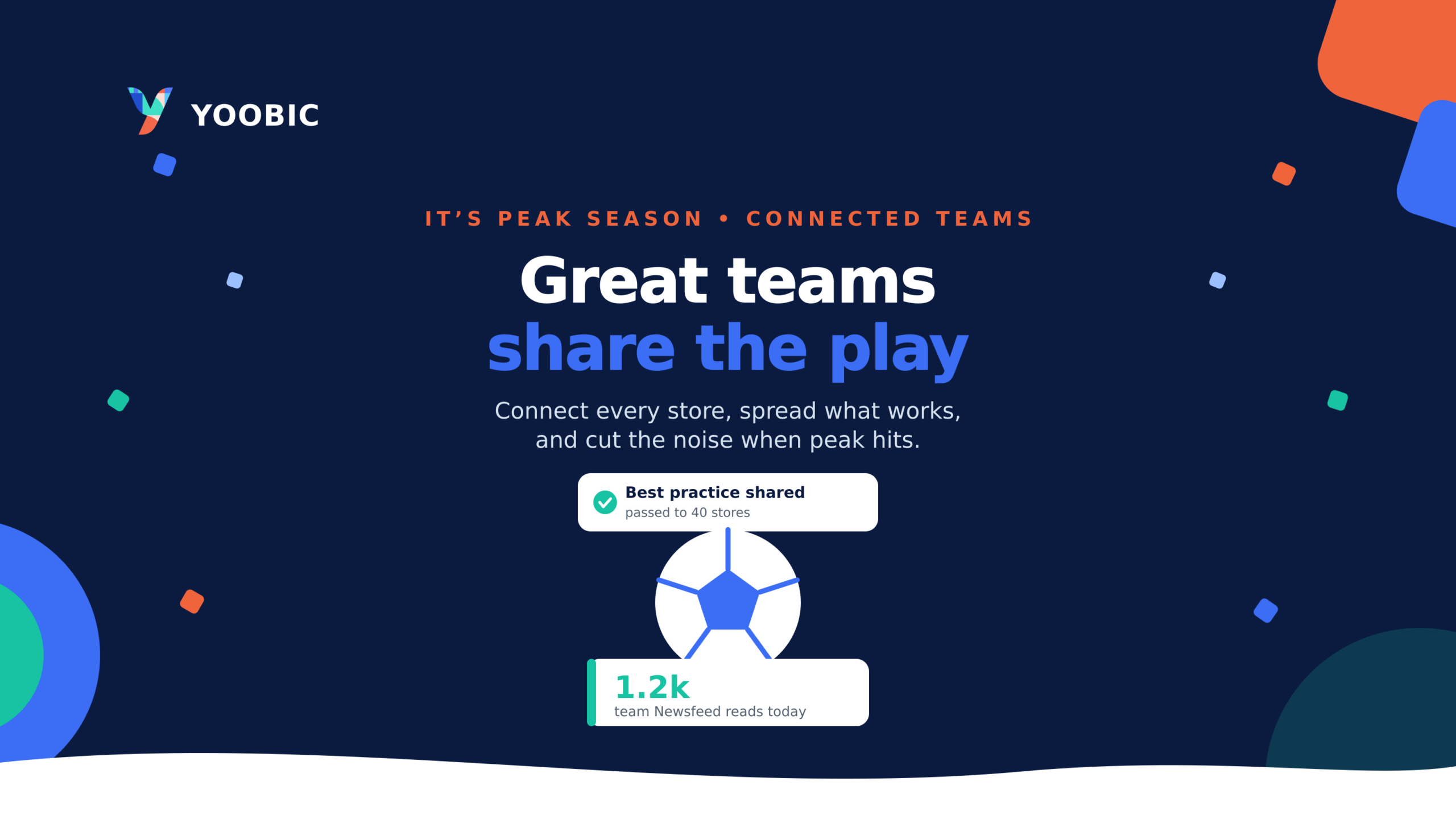
Peak season tests how well your stores share what works. The winter holidays pack weeks of higher footfall and promotional pressure into a short window. In 2026, the FIFA World Cup adds a second, sharper peak across 16 host cities in the US, Canada, and Mexico. When the pace climbs, the retailers that hold their standards are the ones whose teams pass a good idea between stores in real time, instead of letting it stay stuck in one location.
Connecting store teams comes down to three habits. Targeted communication that cuts through the noise. Open knowledge sharing, so best practices travel between stores. Visible peer recognition that shows everyone what good looks like. Put those three in one place your teams already use, and collaboration stops being an idea and becomes how the work gets done.
The best internal communication software for frontline retail teams brings targeted messaging, a shared team feed, and task management into one mobile app, so store teams reach the right people and find best practices where they already work.YOOBIC combines communication, learning, tasks, and a shared feed in a single mobile place, with feeds targeted by role and store. That keeps every update relevant and lets any store learn from the store that solved a problem first.

Why communication decides peak season performance
Frontline teams feel peak first, and they feel a communication breakdown just as fast. Too often, updates travel by email, phone, and manager-to-manager messages. That leaves store teams disconnected and best practices hidden, which slows decisions and makes the customer experience uneven from one store to the next. The fix starts with treating internal communication as core operations, not an afterthought.
This is not a soft, cultural nice-to-have. Connected store teams make faster decisions and deliver more consistent service, and customers feel the difference.
2x more likely to lead on CX
Retailers in the top quartile for employee experience are twice as likely to reach the top quartile for customer experience. How connected and supported your teams feel is part of that experience.
McKinsey
What changes when the peak is event-driven
A traditional holiday peak builds over a predictable six to eight week ramp, spread fairly evenly across the country. An event-driven peak behaves differently. It is compressed, volatile, and concentrated in specific places, including host cities, fan zones, and the streets around stadiums. Demand can swing match by match, and what one store learns on a Saturday is exactly what a nearby store needs by Sunday.
Past tournaments show how local and sudden that can be. Euro 2024 drove a projected £2.1 billion retail windfall in the UK, according to GlobalData and VoucherCodes. During Paris 2024, host cities outside the capital saw sharp spikes, with consumer spend in Saint-Etienne up as much as 214% year on year, per Visa. Sensormatic found Black Friday 2025 store traffic ran 248.9% higher than the preceding Friday. In windows like that, information has to move in minutes, not days.
THE TAKEAWAY FOR OPERATIONS
In a compressed surge, the fastest way to lift a struggling store is to pass it what a nearby store has already figured out. That only happens when knowledge moves freely between teams.
What connected store teams actually do
Connecting teams is not about sending more messages. It is about the right information reaching the right people, and good ideas traveling fast. Three habits make that real.
Share knowledge in the open
Give teams a place to swap ideas, troubleshoot, and post wins, with role-specific groups and regional channels. When best practices live in a searchable feed instead of someone’s inbox, every store can learn from the store that solved the problem first. For the foundations, see our retail communication guide.
Recognize peers in public
Peer shoutouts and visible kudos turn recognition into a learning tool. A quick photo of a strong display or a clever fix teaches faster than a long memo, and it spreads good practice across the network. The YOOBIC Newsfeed makes that easy to do at scale.
Target communication and cut the noise
Send role- and location-specific messages, so each team sees only what applies to them. Use local group chats for quick fixes. Less time scrolling past irrelevant updates means more time acting on the ones that matter.
These habits reinforce each other. A clear communication strategy keeps everyone aligned, knowledge sharing spreads what works, and recognition on a team feed makes good practice visible to everyone. If you are building the underlying plan, our guide to an effective communication strategy in retail is a useful starting point.
What this looks like in practice
GANT, the global apparel brand, gave its store teams a shared place to learn from each other across countries and time zones. The effect went beyond tidy admin. It built a sense of one connected team.
“With YOOBIC, our store associates in Shanghai are giving tips to associates in Paris. We truly believe this creates a sense of belonging and being part of a greater community.”
Maria Klingh, Global Retail Director, GANT
As knowledge moved between regions, training completion climbed and visual merchandising stayed consistent across very different markets. The store that cracked a display or a sell-through challenge could pass that on, fast.
Francesca’s saw a similar pattern. With an active team feed where people shared updates and wins, 71% of users engaged with the Newsfeed and employee sentiment rose, with a 4% increase in eNPS. When teams feel connected and heard, they stay closer to the work. You can see more ways to put that into practice in these internal communications examples.

How YOOBIC helps store teams stay connected
Teams connect when communication, learning, tasks, and a shared feed live in one mobile place, rather than scattered across separate tools. YOOBIC brings them together. Targeted feeds by role and store cut the noise, communities let teams share and solve problems, and peer recognition spreads good practice across the network. For more on putting this to work, see our guide to engaging teams with internal communications.
That shared visibility helps leaders too. They can see what is resonating across stores, spot where a team needs support, and step in early, whether the pressure comes from a holiday weekend or a match day three blocks away.
The bottom line
When knowledge moves freely and recognition is visible, your strongest store lifts the rest. That is how connected teams hold their standards when every store is under pressure at once.
Connection builds on the rest of your peak season groundwork, including the belonging you create as you hire and onboard, and the autonomy you give teams to act in the moment. Connected teams turn that foundation into shared performance.
A practical place to start
You do not need a full rollout to make progress. Pick one peak moment and build the habit there first.
- Create a single channel for your busiest window, so every store posts wins and questions in the same place.
- Move best-practice sharing out of email and into a searchable feed or community where teams can find it later.
- Make peer recognition easy. A one-tap shoutout with a photo travels further than a long message.
- Target updates by role and region, so teams stop scrolling past messages that do not apply to them.
For more tactics you can apply right away, see our tips for connecting frontline employees and supporting frontline teams with internal communications.
Ready to connect your store teams for peak season?
Download the full Six Strategies for Peak Season Execution playbook for practical tactics that help retailers share knowledge, communicate clearly, and deliver consistent results, every season and every surge.
Book a demo and find out how
Avoid wasted hours, blind spots
rnand lost revenue with YOOBIC
Frequently asked questions
What is the best internal communication software for frontline retail teams?
Look for one mobile platform that combines targeted messaging, a shared team feed, and task management, rather than separate apps teams have to switch between. The goal is to reach the right people with the right update, and to let store teams share and find best practices in the same place they do the work. YOOBIC brings those into a single mobile app, with feeds targeted by role and store.