‘Learning is crucial for your employees’
‘Your employees need to learn’
‘Learning and development is the key’
You’ve likely seen variations on these statements plastered all over Linkedin, emails and the news. By now, you’re probably aware that learning is important for frontline employees.
But what next? Understanding that learning is important is only the first step in making a commitment to employee development.

Not all employee training is created equal.
This post will explain how to create effective learning content for frontline employees in the form of a handy step-by-step guide.
Where is training going wrong?
Traditional frontline employee training has a range of flaws that make it unsuitable for effective learning. These include:
- Information dumps, where learners are overloaded with information and then don’t receive any refresher training thereafter
- Unclear learning goals
- Paper resources or classroom-style training which disrupts the flow of work
- Dull, tedious content which fails to engage the learner
- Training that’s irrelevant to the learner’s role
Deskless workers make up 70-80% of the global workforce, according to Boston Consulting Group, yet they rarely get tools and training built for desk-based staff. That gap is probably why some of these flaws feel familiar to you.
Related: 6 Barriers to Effective Learning for Frontline Employees, and How to Avoid Them
How to create effective learning content for frontline employees in seven steps
Here’s how to build training your teams will actually use, from the first skill gap to the final result.
Start by assessing needs and skill gaps
Picture a new associate who spends their first week drilled on a premium outerwear line they’ll sell twice a month. Meanwhile, the returns question customers raise on every shift never makes it into a single lesson.
Nobody checked what that role actually needed before building the content. Start the other way around: find the real skill gaps for each store role before you build a single lesson.
A stockroom lead, a cashier, and a floor associate don’t need the same path, so map each role’s gaps and design backward from there. That sorting is what YOOBIC Learning handles across hundreds of stores, with structured learning paths for every store role and built-in skill gap analysis.
Done well, the payoff is measurable, as Sportscene’s frontline learning results show:
137% increase
in frontline training completion
Sportscene
Establish the learning objectives
Pinpoint what it is that you most want learners to remember. What is the main goal of the training? Don’t expect learners to take in too much at once.
Focus each session around the one most important piece of information you want frontline employees to remember. e.g. something about a new product.
Learning needs to be targeted to employees’ roles to give them the best chance of retaining the information that they need to remember the most. Lessons should be short, focused and to-the-point.
Consider how learning best fits into employees’ schedules
Lack of time is one of the biggest barriers to learning at work, according to Gallup’s research on employee development. Learning needs to fit easily into the flow of work, or employees won’t be able to do it. For frontline teams who are on their feet or on the road all day, microlearning is ideal.
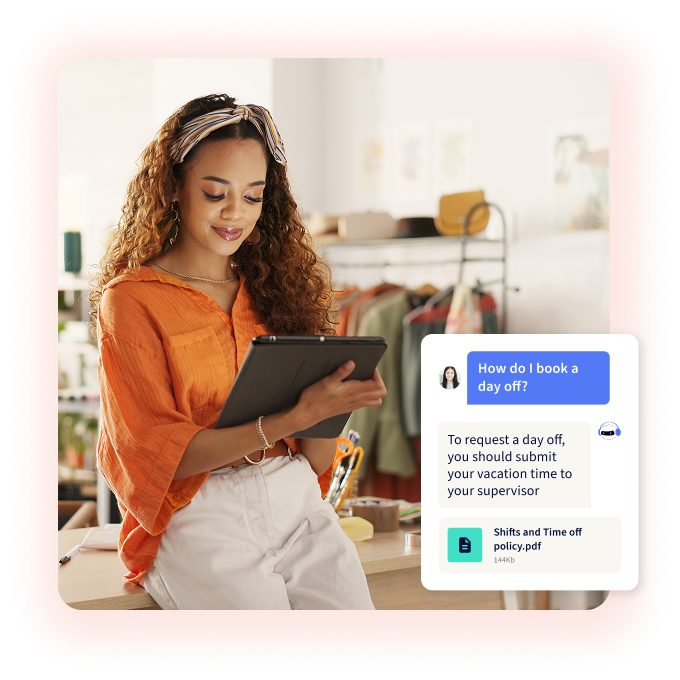
Microlearning breaks up learning content into digestible, bite-size chunks so employees can complete training on the job without disrupting their work. YOOBIC Learning is built for this, delivering mobile-first lessons in the flow of work, embedded into the daily tasks and communications your teams already use. 70% of frontline employees think app-based training would be easier.
Related: How to Use AI in Frontline Employee Training
Decide on the most engaging format
Here’s where format matters more than you might expect.
Different learners prefer to learn in different ways. Gen Z employees will be accustomed to swiping and scrolling to consume new info, whereas boomers are more likely to prefer traditional teaching methods like structured, instructor-led sessions.
Regardless of age, all learners will typically retain more information when training is interactive. There’s an old learning maxim that captures why: teach me and I may remember, but involve me and I learn.
Gamified elements like quizzes, battles, sliding scales, and scoring not only make training more fun, but also aid the retention of information.
Use relevant and accessible content
Nobody wants to read paragraphs of brain-numbing technical jargon. Use simple, accessible language that your employees can easily understand and matches the language they use on the job. Tap into your learners’ curiosity using scenario-based learning, framing information in the context of the learner’s role.
Test learners using realistic workplace situations where learners have to make decisions about how best to act. This makes training more meaningful as it mirrors the realities of learners’ jobs and rapidly builds experience handling relevant scenarios.
Related: Confidence-Based Learning: What It Is and Why Your Frontline Employees Need It
Schedule spaced repetition
Learning is a process, not an event. Without repetition, the amount people retain drops off sharply with each passing day, following the forgetting curve first described by Hermann Ebbinghaus. Spaced repetition cements information within the brain with refresher lessons to commit new information to long-term memory.
Implement spaced repetition by scheduling repeated lessons at increasingly spaced intervals. A simple schedule might look like this:
- First refresher one day after the initial training
- Second refresher one week later
- Third refresher one month later
- Further refreshers at three months and beyond
This approach encourages continuous development and shows employees that you’re genuinely invested in their progression.
Measure whether the training is working
A store manager rolled out a new onboarding module and heard nothing for six weeks. Completions looked fine, but they had no way to know whether a single new hire was actually faster on the floor. Then time-to-productivity finally showed up in the numbers, and it had barely moved.
Training content isn’t finished until you can see whether it changed behavior on the floor and moved store performance. Decide upfront what success looks like, then track it from day one.
Group the metrics so you’re not comparing unlike things:
| Metric family | What to track |
|---|---|
| Operational execution | Task completion rate and time to compliance |
| People and workforce | Training participation, completion, and time-to-productivity |
| Sales and revenue | Conversion rate and average transaction value (ATV) |
Pulling those numbers together by hand across a store estate is where most programs stall. YOOBIC Learning reports completion and participation on centralized dashboards and ties them to store performance, so you can see what’s working.
At scale, the effect is just as sharp, as the Boots SOP training results show:
65% less time
spent on standard operating procedure training
Boots
Bring tasks, communications, and learning together
Great frontline training doesn’t stand on its own. It works best when learning sits alongside the daily tasks and communications your teams already juggle, in one platform instead of three disconnected tools.
We bring tasks, communications, and learning together for more than 3 million associates across 350+ global retail brands. If you want to see how that works across your stores, there’s a simple next step.
Book a demo and find out how
Avoid wasted hours, blind spots
and lost revenue with YOOBIC