

Retail sales training teaches store associates how to turn browsers into buyers: greeting customers, finding out what they need, recommending the right products, handling objections and closing the sale in a way that fits the brand. It combines product knowledge, selling skills and plenty of practice on the floor.
It matters more than ever because shoppers arrive informed. They have read the reviews, compared the specs and checked the price online. A McKinsey study of digital consumers found that one of the main reasons people still choose a physical store is the chance to talk to a person. If the associate they talk to knows less than they do, that reason disappears.
This guide covers the skills retail sales training should build, why so much of it fails, a seven-step way to build a program, how online and in-person training fit together, a sample plan for new associates and how to measure the results. Sales training is one part of a wider program; for onboarding, operations and compliance training, see our complete guide to retail training.
What does retail sales training cover?
Good retail sales training follows the steps of a sale, from the first hello to the follow-up after the customer leaves. Each step is a skill associates can learn, practice and be coached on.
| Skill | What associates learn | On the floor |
|---|---|---|
| Greeting and approach | When and how to open a conversation without pressure | A friendly, unscripted hello within the first minute |
| Needs discovery | Open questions and active listening | The associate finds out who the purchase is for and what matters most |
| Product knowledge | Features, benefits and how products compare | Confident answers without checking a screen |
| Recommending and demonstrating | Matching products to needs and showing them in use | Two or three relevant options instead of the whole range |
| Upselling and cross-selling | Adding value the customer will actually want | Suggesting the matching accessory or care product |
| Handling objections | Responding to price, fit and timing concerns | Explaining value instead of reaching for a discount |
| Closing | Recognizing buying signals and asking for the sale | A smooth move to the till, plus loyalty sign-up |
| Clienteling | Remembering preferences and following up | A message when the customer’s size or new collection arrives |
| Omnichannel selling | Using every channel to save the sale | Ordering an out-of-stock item for home delivery from the shop floor |
Not every role needs every skill at the same depth. A fashion stylist, a beauty advisor and an electronics associate sell differently, so tailor the modules to each role and category.
Some skills pay off more than others for your brand, so certify the ones that matter most. UNTUCKit made clienteling a certified skill, where managers had to prove they could apply it with real customers before passing. Clienteling-driven sales grew from 5% to 9% of total revenue. Read the full UNTUCKit case study.
Why does retail sales training often fail?
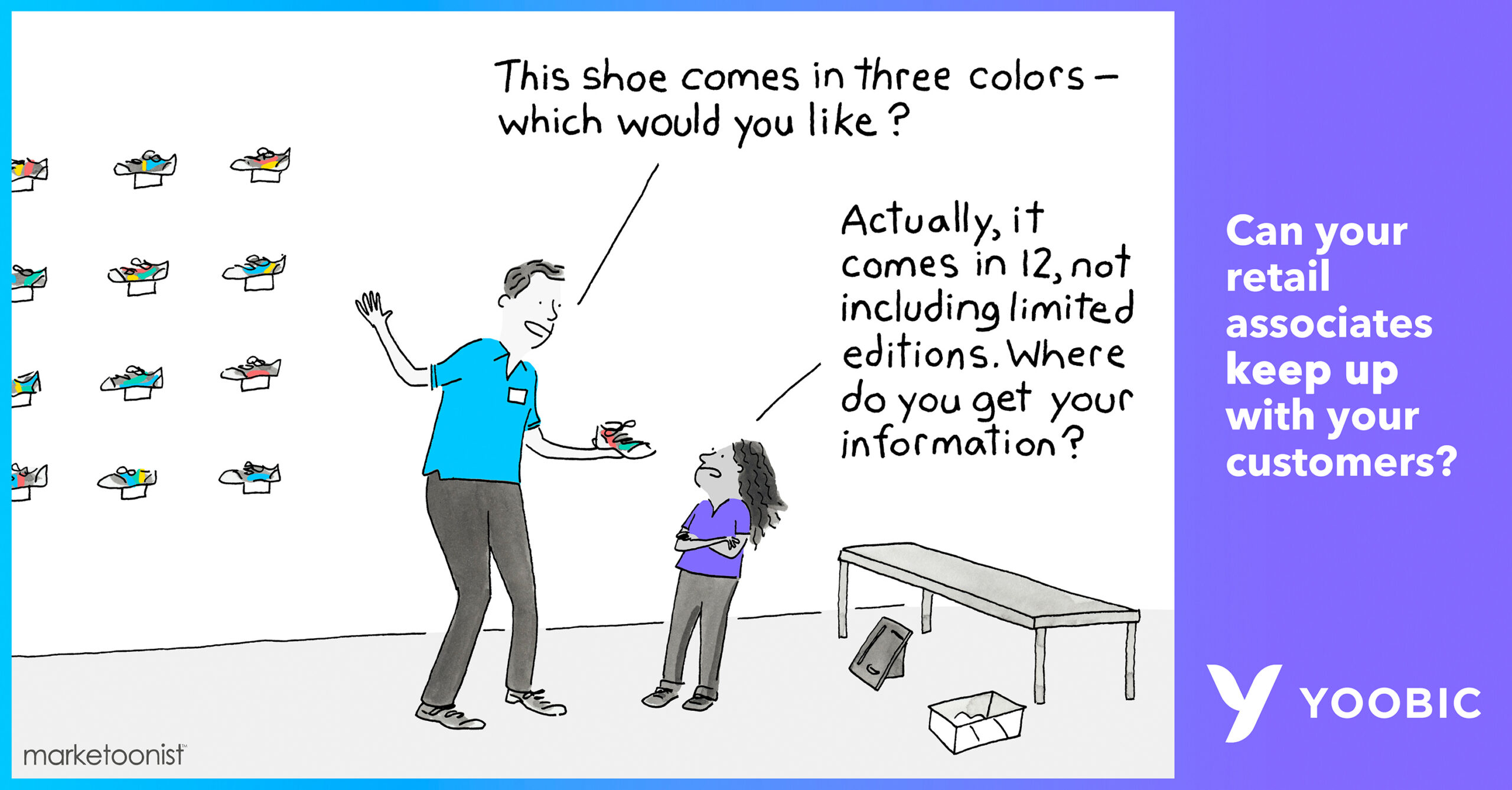
Picture a customer looking for a limited-edition sneaker that has sold out online. They come to the store, ask an associate, and find the associate has never heard of the shoe. After a trip to the stockroom and a wait for a manager, the customer leaves and buys elsewhere. The associate was willing; they simply had not been given the knowledge or the skills.
That story is common. In YOOBIC’s survey of 1,400 frontline workers, 49% said onboarding did not prepare them well for their job and 58% said their organization had not invested in their professional development. The usual causes are:
- One-off training. A day of induction is forgotten within weeks if nothing reinforces it.
- Out-of-date product knowledge. New lines and campaigns launch faster than classroom sessions can be scheduled.
- Knowledge without practice. Associates can recite the steps of a sale but have never rehearsed a tricky conversation.
- No coaching on the floor. Managers rarely have time to observe and give feedback, so habits never change.
- No link to results. If training is measured only by completion, nobody knows whether it improved sales.
How do you build a retail sales training program? 7 steps
- Define what good selling looks like for your brand. Write down your steps of the sale and the behaviors you expect at each one. A luxury brand and a value grocer will not sell the same way.
- Measure where you start. Use store KPIs, manager observation or mystery shopping to find the skills that are weakest, store by store.
- Build short modules for each skill. Keep each lesson to one objective and a few minutes, so associates can complete it between customers. Our guide to microlearning explains how.
- Practice with role-play and scenarios. Rehearse real conversations, from a hesitant first-time buyer to a price objection. GANT, for example, trains associates on how the brand connects to art, music and pop culture so they can hold more meaningful conversations with customers.
- Push product knowledge before every launch. Send a short module to every store the morning a new line or campaign arrives, so associates can answer the first question they get.
- Coach on the floor. Give store managers a simple checklist to observe one or two sales a week per associate and give specific feedback straight away. UNTUCKit rebuilt its store visits this way, cutting four- to six-hour checklist visits down to one focused hour on selling and coaching. Coaching also needs selling time to land. Michaels cut store admin and reinvested 60% of the time saved into selling hours, which drove $1.8 million in incremental revenue in its first year.
- Measure, then refresh. Check knowledge and confidence, not just completion, and compare sales KPIs before and after. Retire modules that do not move the numbers and build new ones where gaps remain.
New associates should start sales training as part of retail onboarding, then keep building their skills throughout their time with you.
Online vs. in-person retail sales training
Online retail sales training and in-person training do different jobs. The strongest programs use both.
| Online and mobile training | In-person training | |
|---|---|---|
| Best for | Product knowledge, brand stories, steps of the sale, quizzes and refreshers | Role-play, reading customers, handling objections, shadowing |
| Strengths | Consistent in every store, quick to update, fits between customers | Real practice with feedback, builds confidence |
| Limits | Cannot fully rehearse a live conversation | Hard to schedule, varies by trainer, slow to roll out |
| Use it for | Launches, campaigns and onboarding basics | Coaching sessions, team huddles and new-hire shadowing |
A practical blend: associates learn the content on their phone in a few minutes, practice it in a short team huddle or role-play, and get coached on it by their manager during the week.
Sample retail sales training plan for new associates
| When | Focus | How |
|---|---|---|
| Week 1 | Brand story, store layout, greeting and approach | Mobile modules, shadowing an experienced associate |
| Week 2 | Needs discovery and product knowledge for core lines | Modules, product quizzes, role-play with a manager |
| Week 3 | Recommending, upselling and cross-selling | Scenario practice, first observed sales with feedback |
| Week 4 | Handling objections, closing, loyalty and omnichannel | Role-play, observed sales, confidence check |
| Ongoing | New products, campaigns and skill refreshers | Short modules before each launch, weekly coaching |
How do you measure retail sales training?
Measure sales training by what changes on the floor, not by how many modules were completed. Track these before and after training, store by store:
- Conversion rate: the share of visitors who buy.
- Average transaction value and units per transaction: signs that recommending and upselling are working.
- Attachment rate: how often accessories or services are added to a core purchase.
- Customer satisfaction and loyalty sign-ups: whether the experience feels helpful rather than pushy.
- Knowledge and confidence scores: confidence-based assessments show which associates know the answer but are unsure of it, so managers know where to coach.
Training shows up in the numbers when it’s measured this way. UNTUCKit lifted units per transaction by 15%, from 2.0 to 2.3, after building selling skills and coaching into store routines. At Lemaire, stores where associates completed 90% or more of their training delivered 17.7% year-on-year sales growth, compared with 7.5% in stores with lower completion.
The bottom line on retail sales training
Customers visit stores for expert, human help. Retail sales training is how you make sure every associate can give it: a clear model of how your brand sells, short and current product knowledge, real practice and coaching on the floor, and measurement tied to sales. For more tactics, watch this on-demand webinar with Bob Phibbs, the Retail Doctor, or book a demo to see how YOOBIC Learning delivers sales training to every store.
Frequently asked questions about retail sales training
What is retail sales training?
Retail sales training teaches store associates how to turn browsers into buyers: greeting customers, finding out what they need, recommending the right products, handling objections and closing the sale in a way that fits the brand. It combines product knowledge, selling skills and practice on the floor.