
Resources Types: Ebooks & Guides
Playbook
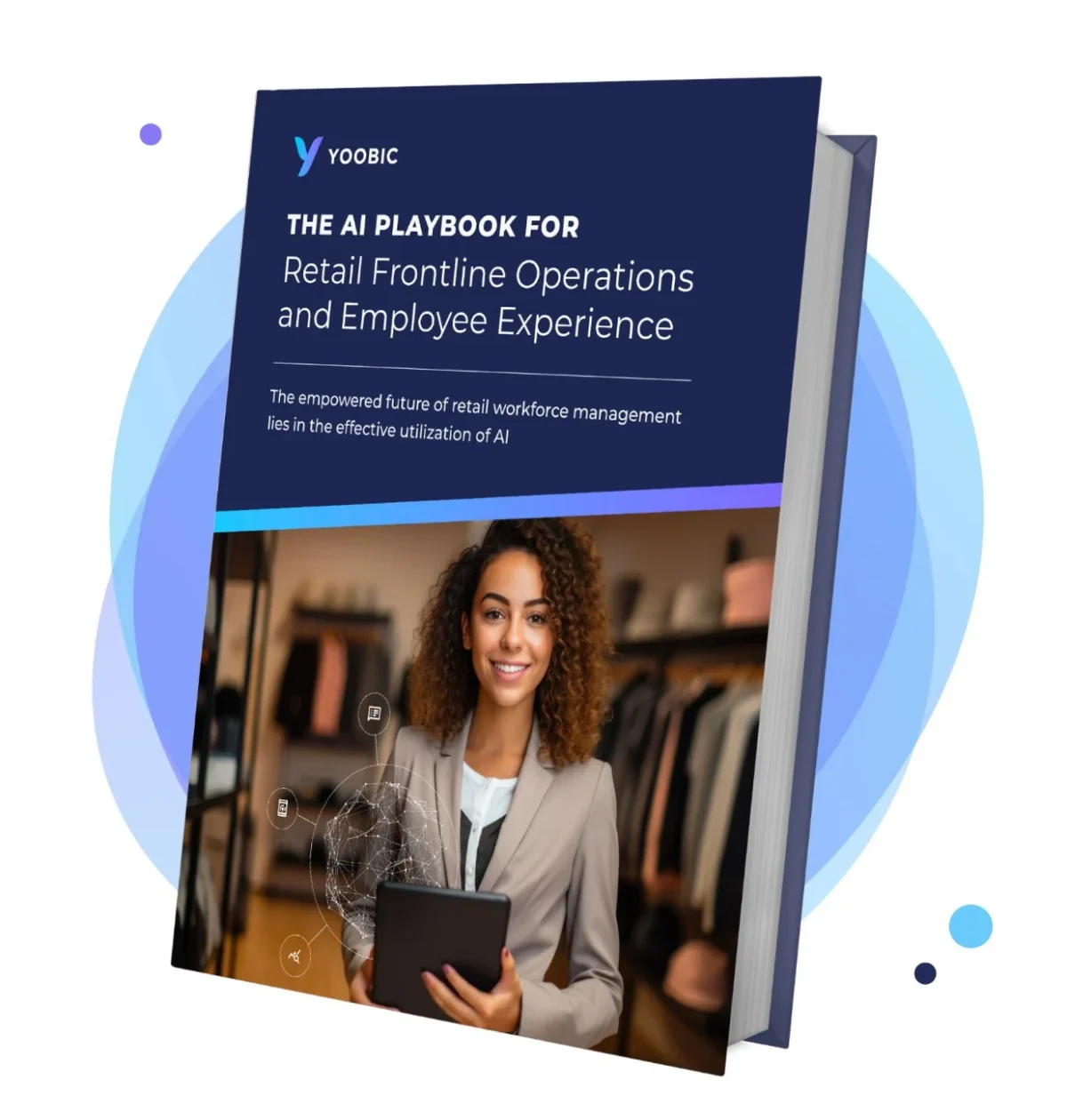
The AI Playbook for Retail Frontline Operations and Employee Experience
Three AI use cases that augment frontline workers, cut content creation time, and close the gap between HQ and stores.
Key findings
- A full third of retail leaders now list AI as their top priority when choosing new technology providers.
- Over a third of frontline teams fear automation could endanger their jobs.
- AI can reduce the time needed to create L&D content by up to 75%, while targeted repetition boosts long-term retention from as low as 10% to 90% or more.
Summary
Since the late-2022 surge in generative AI, retailers increasingly treat AI as essential to stay competitive. But many frontline employees fear automation threatens their jobs, feel disconnected from HQ, go undertrained, and still rely on paper processes. What’s missing is a clear plan to deploy AI in ways that support workers rather than replace them.
This playbook lays out three opportunities for an AI-enhanced frontline: employee communications and engagement, enablement and training, and process orchestration. It draws on YOOBIC’s 2022 Frontline Employee Experience Survey plus data and commentary from Boston Consulting Group, IDC, and Fortune Business Insights, including Leslie Hand of IDC Retail Insights and Lee Robertson of BCG.
What you’ll learn
- Where AI adds the most value across frontline communications, training, and process orchestration.
- How to deploy AI to augment frontline workers rather than replace them.
- How to plan and optimize AI investments to maximize ROI and build organizational buy-in.
Ebook
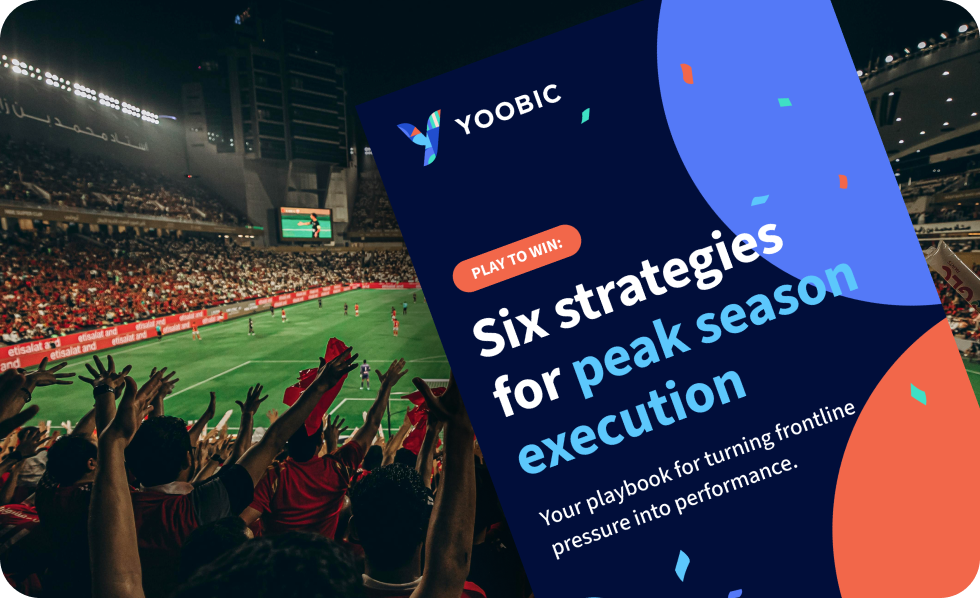
Play to win: 6 strategies for peak season execution
The six strategies leading retailers use to execute flawlessly when peak season demand surges during events such as the World Cup, back-to-school and Black Friday.
Key findings
- Peak seasons can account for up to 30% of annual revenue, making flawless execution critical.
- During the World Cup, UK consumers are forecast to spend £3.8 billion across retail and hospitality with almost £2 billion of that on food and drink alone.
- Retailers adopting activity-based labor scheduling during peak seasons have cut labor costs by up to 12% while improving both customer service and employee satisfaction.
Summary
Major sporting events like the FIFA World Cup create predictable demand surges that sharply increase operational complexity as retailers scale stores and seasonal hires. During these high-pressure periods, even minor execution gaps mean missed targets, higher costs, and frustrated customers across large, distributed store networks.
This playbook lays out six strategies for peak-season execution—belonging, empowerment, collaboration, data, standardization, and innovation—with real results from Mattress Firm, Shoprite, Desigual, Boots, CELINE, and Moschino. Market figures are drawn from VoucherCodes/GlobalData, Kantar, and McKinsey & Company.
What you’ll learn
- How to build belonging fast for seasonal hires and empower frontline teams to act decisively.
- How to turn frontline data into real-time decisions and standardize best practices across every location.
- How named retailers achieved outcomes like 95%+ on-time critical processes and 98% training completion at scale.
Report
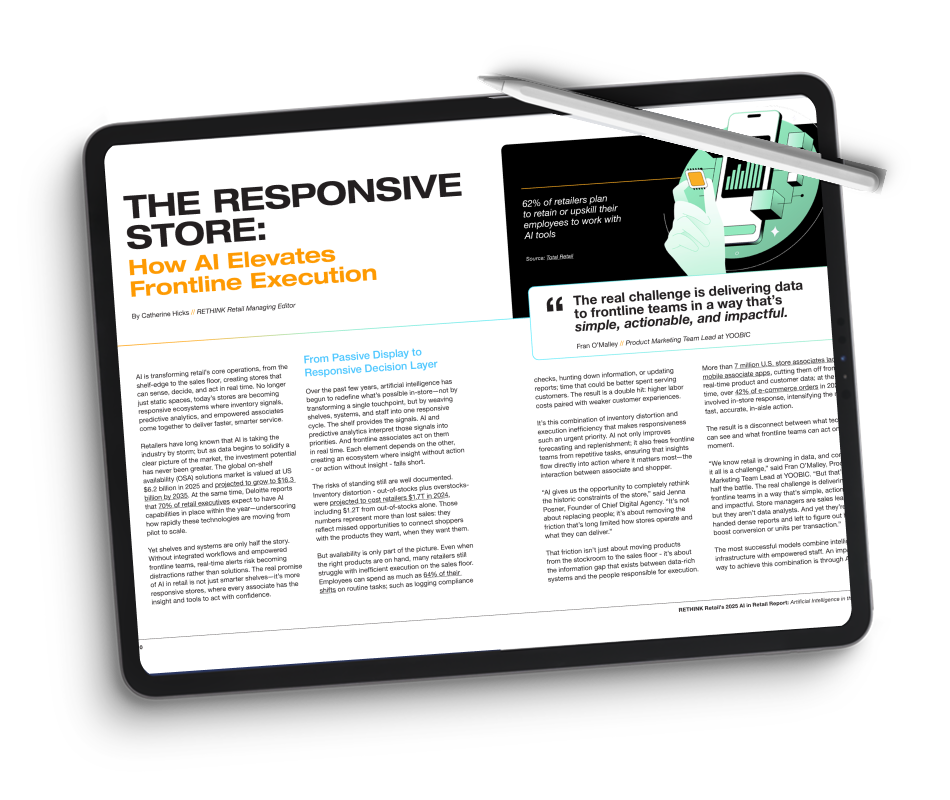
AI in Retail: Artificial Intelligence in the Everyday Store
How leading retailers are moving from AI pilots to intelligence built into every layer of the store. And what it takes to get frontline teams acting on it.
Key findings
- Store teams can spend up to 64% of their shift on routine tasks like compliance checks and chasing information, instead of serving customers.
- Out-of-stocks and overstocks were projected to cost retailers $1.7 trillion in a single year, with $1.2 trillion of that from empty shelves alone.
- Over 85% of retailers have launched or are exploring AI, and the strongest adopters report more than 2x the sales growth and 3x the profit of competitors.
- 62% of retailers plan to retain or upskill employees to work with AI tools.
Summary
AI in retail has moved past the pilot stage. Pricing engines, replenishment models, and shelf sensors now run quietly behind everyday store operations. But signals on their own do not fix execution. Store managers are sales leaders, not data analysts, and a dense report does not tell anyone what to do next.
This report from RETHINK Retail examines how retailers close that gap, covering shelf-edge data, adaptive pricing, frontline enablement, autonomous checkout, and responsible AI governance. It features insight from YOOBIC, Diebold Nixdorf, VusionGroup, Allume Group, Chief Digital Agency, and The Vitamin Shoppe, with results from Mars, Walmart, and others.
What you’ll learn
- How to turn shelf-edge signals into actions store teams can complete the same day.
- How to give associates short, role-specific guidance instead of dense reports.
- How to keep AI decisions explainable so shoppers and store teams trust them.
- Where retailers are seeing returns, from 40% time savings on routine tasks to 50% less training time.
Report
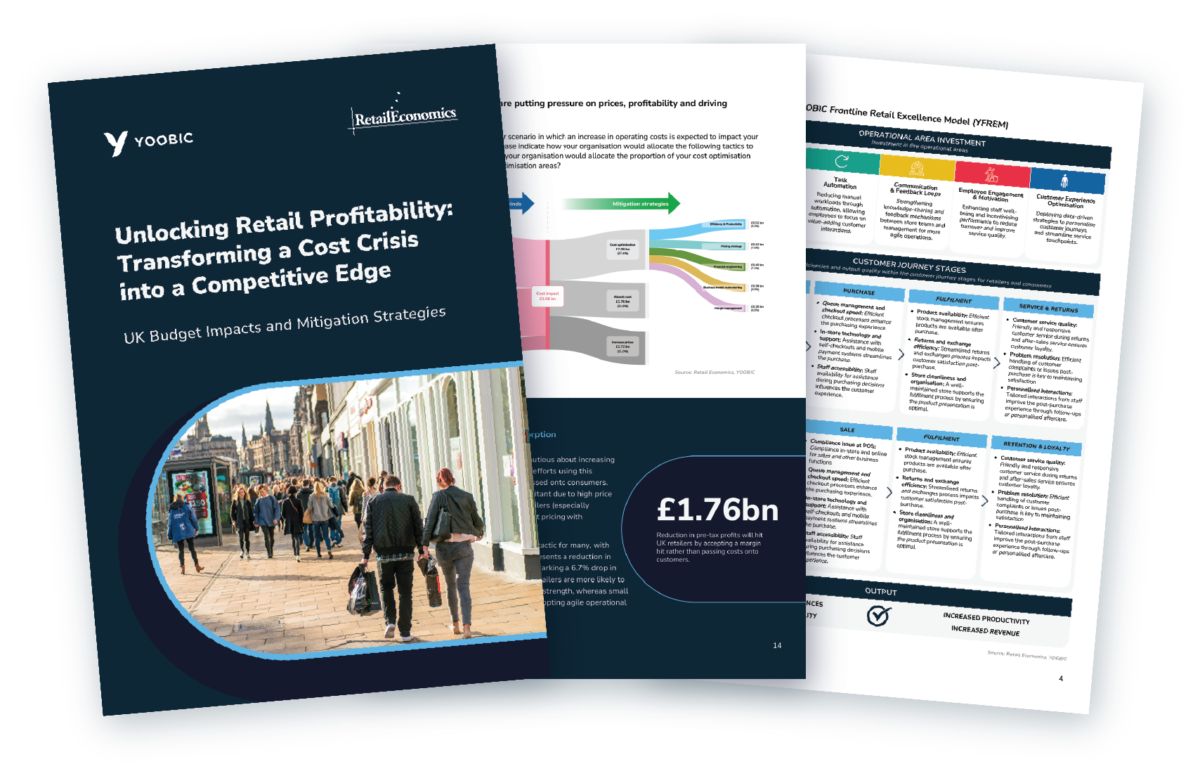
Unlocking retail profitability: transforming a cost crisis into a competitive edge
The numbers behind the £5.6bn cost surge, and the mitigation strategies UK retailers are using to protect profit.
Key findings
- UK retailers face an expected £5.6bn increase in operating costs for the industry in 2025/26.
- Absorbing costs is set to cut pre-tax profit by £1.76bn, a 6.7% year-on-year drop in industry profits.
- 100% of large retailers agree AI enhances frontline customer service interactions, compared to 70.6% of small retailers.
Summary
UK retailers are contending with a £5.6bn rise in operating costs in 2025/26, driven by higher wages, National Insurance Contributions, and business rates, all against weak economic growth and rising customer expectations. Leaders need to unlock efficiency and productivity gains across frontline operations to protect profitability without eroding customer experience.
This report quantifies the true impact of the Budget on UK retail and reveals how peers are responding. It draws on modelling and analysis by Retail Economics, a survey of 100 UK retail businesses with turnover between £10m and £5bn conducted in Q1 2025, and an interview with Paul Rowland, Retail & Technology Director at Home Bargains.
What you’ll learn
- A breakdown of projected cost increases from wages, tax contributions, and business rates by retailer size and sector.
- Benchmark data on how peers are adjusting pricing, restructuring operations, and investing in productivity.
- How Home Bargains balances cost pressure with continued investment in the frontline.

Guide
How to Choose a Mobile Learning Platform
A buyer’s guide for training dispersed frontline teams, from assessing your current program to implementing the right platform.
Key findings
- A study group that spent 70% of their learning time in the classroom and 30% in informal peer discussions scored higher on tests than the classroom-only group.
- Over half of Generation Z spend more than 6 hours per day on their phones.
- The blended learning group had higher test scores and reported enjoying the learning more than the classroom-only group.
Summary
Frontline employees in retail and hospitality shape customer perception through what they know and do, yet they rarely have regular computer access and work in some of the highest-turnover roles. With an overwhelming number of mobile learning platforms available, employers struggle to identify which one actually fits their dispersed, deskless teams.
This guide walks decision-makers through assessing their current training, defining what an effective mobile learning platform should provide, and choosing and implementing the right one. It draws on external research, including a WhatsApp mobile learning study by Barhoumi, WP Engine’s Gen Z usage data, and Kotter’s 8-step change process.
What you’ll learn
- The four ways to train frontline employees and the pros and cons of each.
- Ten questions to assess your current training program and what an effective mobile learning platform should provide.
- How to implement a new training program using an 8-step change process.
Whitepaper
5 Steps to Effective Learning for Frontline Teams
Five practical steps to make frontline training accessible, simple, and social enough to actually stick.
Key findings
- 40% of frontline employees are trained only once per year or less, and 48% of those also feel unrecognized and undervalued.
- Even when learners absorb 90% of what they are taught, the forgetting curve means they retain less than 3% within five days.
- 58% of frontline employees say the most important attributes of successful training are that it is fun and engaging.
Summary
Frontline roles in retail, hospitality, and logistics are changing fast, but training is not keeping up. Learning built for desk workers is inaccessible, disruptive, and ignores the realities of deskless, multitasking, hands-on work, leaving employees undertrained during a labor shortage where good training drives retention and makes roles more attractive.
This YOOBIC whitepaper lays out five steps to make frontline learning accessible, simple, part of the flow of work, engaging, and social. It draws on research including Harvard Business Review and Josh Bersin’s “learning in the flow of work,” plus customer results from BurgerFi, Jules, Petit Bateau, Tomlinson’s Feed, and Sportscene.
What you’ll learn
- The challenges that prevent effective frontline learning and why traditional training fails deskless teams.
- Five steps to better onboarding, training, and continuous learning for frontline workers.
- Five real-life examples of companies with frontline teams that have applied these steps.
Guide
A Guide to Effectively Training Frontline Employees
Why office-style training fails deskless workers, and five strategies that make it stick.
Key findings
- 94% of consumers would purchase more from a company if they interacted with a knowledgeable store associate.
- Dollar General’s ramped-up 2018 training program was followed by sales increasing 6.8% and customer satisfaction rising 790 points.
- Deskless employees make up 80% of the global workforce—2.7 billion people, of which 619 million work in retail, restaurants and hospitality.
Summary
Deskless employees make up 80% of the global workforce, yet training is still designed for office workers. That mismatch leaves frontline teams disengaged and undertrained, even as their knowledge and behavior directly shape customer experience, sales, retention and safety across retail, restaurant and hospitality.
This guide defines what effective frontline training looks like, why it needs to be tailored, and the challenges that make it hard. It draws on third-party research from TimeTrade, LinkedIn, CNBC and Training Magazine, and sets out five practical strategies: microlearning, mobile, gamification, social learning and context.
What you’ll learn
- How training impacts customer experience, revenue, turnover, engagement and safety.
- Why training frontline employees is fundamentally different from training office workers.
- Five strategies to improve training: microlearning, mobile, gamification, social learning and context.

Report
2024 Retail Trends Report
Four trends reshaping retail through 2025, from AI on the frontline to winning Gen Alpha’s loyalty.
Key findings
- Retailers leveraging AI experienced 2.3 times sales growth and 2.5 times profit growth compared to their peers.
- 75% of retailers plan to equip their frontline workers with mobile devices and wearables by 2025, according to IDC.
- By 2029, experts estimate Gen Alpha’s economic footprint will reach $5.4 trillion, almost as much as Millennials and Gen Z combined.
Summary
Retail is emerging from a global pandemic amid supply chain disruptions, inflation, and labor pressures. Retailers must optimize operations and cut costs while navigating rapid AI adoption, unstructured data, escalating organized retail crime, and the growing influence of Generation Alpha.
This report examines four trends shaping retail in 2024 and beyond: de-siloing data, using AI to empower frontline workers, addressing the deeper causes of organized retail crime, and building loyalty with Gen Alpha. It draws on findings from IDC, Retail Systems Research, Boston Consulting Group, and ECR Retail Loss advisor Adrian Beck.
What you’ll learn
- How retailers are de-siloing data to unlock AI's full potential across the value chain.
- How AI can enhance the frontline working experience rather than replace workers.
- How to strengthen asset protection and start building loyalty with Generation Alpha.

Guide
A Guide to Restaurant Audits
The audit playbook that protects health, brand reputation, and profit while cutting 45 minutes off every store visit.
Key findings
- There are 48 million cases of foodborne illnesses reported every year in the United States alone.
- In 2020, Chipotle paid a record $25 million fine to resolve criminal charges, the largest ever in a food safety case.
- A one-star improvement on Yelp can boost a restaurant’s profits by 9%, and 33% of guests would never eat at a restaurant rated below four stars.
Summary
The U.S. restaurant industry surpassed $1 trillion in sales in 2024 and is projected to reach $1.1 trillion in 2025. Yet a single foodborne illness outbreak can cost anywhere from $2,000 to over $2.6 million, and audits, the frontline defense, are too often dreaded, unstandardized, and stuck on paper.
This guide shows restaurant operations leaders how to run audits that actually protect the business, covering what every audit should include, how to assess your current process, and a mini audit checklist. It also shows how YOOBIC digitizes audits, reaching almost 95% area manager adoption after four months and saving 45 minutes per visit. Sales figures cited from the National Restaurant Association.
What you’ll learn
- How audit procedures impact guest experience, brand reputation, and profit.
- What every effective audit should cover, from employee safety and hygiene to allergen checks and merchandising execution.
- How to assess your current audits and follow up with a mini audit checklist.