Frontline communication has never mattered more, and it’s never been harder to get right. Deskless workers make up 70-80% of the global workforce, about 2.7 billion people. As Boston Consulting Group reports, many can’t reach the email and intranet tools built for desk-based staff. A frontline communication platform closes that gap.
Picture a new associate starting a Saturday shift. A teammate buried the weekend promotion brief in a group chat, three messages deep, in a thread they joined last month. The associate guesses at the setup, and the display goes up wrong before the first customer walks in.
Traditionally, communication with frontline teams runs top-down, with headquarters (HQ) sending written instructions through paper manuals, emails, or WhatsApp messages. Teams that only read messages scattered across those channels can’t pull together toward the same goals.
The data backs this up. In our 2022 Frontline Employee Experience Survey of 1,400 workers, 62% said they don’t feel well connected to their organization’s management and HQ.Gallup’s 2026 State of the Global Workplace report puts global employee engagement at just 20%, its lowest level since 2020.
Connecting your frontline works best when communication is part of one system with tasks and learning, not a standalone channel. Here’s how retailers are closing that gap.

What is frontline communication?
A price-match policy changes on Friday morning. The Camden store hears it at the daily huddle; the Leeds store finds out an hour later from an annoyed customer at the till.
Frontline communication is the two-way flow of information, updates, and feedback between HQ and the store teams who serve customers every day.
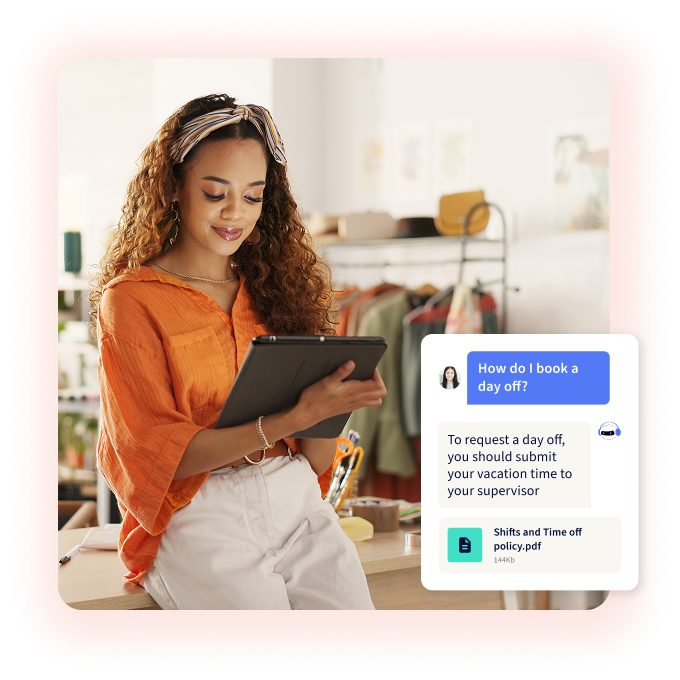
A frontline communication platform is the single, mobile-first system that carries that flow. It replaces scattered emails, texts, and paper with broadcasts, chat, feedback, and a searchable knowledge base in one place.
What sets strong frontline communication apart is simple. It targets the right people, lets you measure results, and fits the flow of daily work, not generic messaging pushed one way.
It runs in three directions: top-down from HQ, bottom-up from stores, and peer-to-peer between colleagues. You’ll see why each one matters as we go.

The challenges of frontline communication today
Consider a store manager who opens the day by rekeying the same promotion update into three different apps. Then they phone two neighboring stores to check they saw it. That’s 20 minutes gone before the doors open, and it repeats every morning.
If you’ve run a store network, you’ve felt this. Multiply that across every location and the cost adds up fast.
Store managers lose 10 or more hours a week chasing information across disconnected tools. Across the networks we work with, 37% of promotional displays also go out incorrectly or late.
Part of the problem is structural: updates scatter across email, group chats, and printed notices, so no single place holds the current version. The newest instruction is often just whoever spoke last. Here’s how that shows up on the floor:
- Fragmented channels: updates split across email, texts, and paper, so nothing has a single home
- Slow, one-way feedback: stores hear from HQ but rarely get heard back
- No line of sight: HQ can’t tell what actually reached the floor
- Untargeted messages: everyone gets everything, whatever their role or location
How companies are improving communication between HQ and frontline teams
The good news: you don’t have to accept that fragmentation. These five tactics turn one-way announcements into a genuine, two-way exchange your teams want to be part of.
1. Democratize communication
Frontline employees interact with customers every day, so they hold valuable insight into what shoppers want, which processes work, and which ones fall short. If your communication only runs top-down, that knowledge goes to waste.
Open it up to bottom-up and peer-to-peer exchange as well. The YOOBIC Communications company newsfeed carries all three directions, so associates share ideas with posts, reactions, and comments instead of just reading orders from above.
Need ideas to get started? Here are some internal communications examples for frontline employees.
2. Assess engagement
Like everything else in your operation, communication should be strategic. To engage teams, you need to know which posts actually get their attention and pull them into the conversation.
Try a mix of formats, short videos, polls, and gifs, and watch what drives the most engagement. We build read receipts and engagement analytics into the newsfeed, so you can see which posts landed automatically instead of guessing.
3. Learn from social media
Your teams already communicate through social apps in their personal lives. So a workplace feed built in that style feels familiar and easy to pick up.
Employees should be able to like and comment on newsfeed posts, just as they would on Facebook or Instagram.
Translate every comment and post into the reader’s own language. Then an associate in Madrid and one in Warsaw can react to the same update and understand each other in seconds.
4. Amplify culture
In our 2022 Frontline Employee Experience Survey, 68% of frontline employees said a strong workplace community is very important to them. You can build that sense of belonging with peer communities organized around shared interests, not just work.
These can include groups for new parents, fans of a particular sport, or a group for employees who will be celebrating Ramadan and fasting during their working day.
By targeting messages by role, location, and interest, we surface the communities most relevant to each person. Colleagues connect and support one another even when they work different shifts or locations.
5. Streamline and target
Deliver communication mobile-first, so your associates pull up documents, product details, and process steps right on the floor and get back to customers faster.
Target messages by role and location so people see what applies to them, not a flood of everything. You also get visibility into which stores acted, so nothing slips between a message and the shelf.
How to choose a frontline communication platform
Choosing the wrong system is expensive, and it’s hard to undo once teams have adopted it. One operations leader rolled out a popular messaging app. Months in, they still couldn’t tell whether a single store had read the safety update they’d sent.
The app moved messages, but proved nothing.
Here’s what to check before you commit. Use these criteria to compare any platform you shortlist:
| Criterion | Why it matters |
|---|---|
| Mobile-first for associates | Store teams don’t sit at desks, so it has to work in a pocket, mid-shift |
| Two-way and peer communication | Broadcast-only tools waste the insight your floor teams carry |
| Targeting by role and location | People should see what applies to them, not everything at once |
| Built-in engagement measurement | Read receipts and analytics tell you what actually landed |
| Multi-language support | Global teams need updates in their own language |
| Integration breadth | The platform should fit the systems you already run |
| Joined to tasks and learning | The real test: does a message turn into action, or just sit there |
Some platforms distribute messages and tasks well, but can’t tell teams what to execute or why. Others surface sharp insight, but keep it locked at HQ.
We close the loop from data to decision to action on the floor. With 200+ integrations, we fit the systems you already run, with no rip-and-replace. That’s the difference you’re really shopping for.
A business that did it right: GANT
Homeware and fashion retailer GANT wanted to build a strong company culture across a fast-growing international store network. With an auto-translated newsfeed and comments, every employee can connect across borders and read each update in their own language.
If you’ve ever tried to unify culture across regions, look at the results. Across 245 stores, the GANT case study reports 90% weekly usage and a 30% increase in training-course completion. The headline number says the most:
94%
of GANT retail employees visit the newsfeed every month
Stat source: GANT
Why YOOBIC brings frontline communication together
Connected frontline teams don’t need another standalone channel. They need communication that’s two-way, targeted, measurable, and joined to the work itself.
That’s what we deliver with one platform uniting tasks, communications, and learning. A brief written at HQ becomes a verified action on the store floor. When the message and the work live in the same place, nothing gets lost between them.
Want to see what that looks like across your stores? Book a demo and we’ll walk you through it.
Book a demo and find out how
Avoid wasted hours, blind spots
and lost revenue with YOOBIC
Frequently asked questions
What is a frontline communication platform?
If you’re comparing options, think of it as a single, mobile-first system that replaces email, group chats, and printed notices. It holds broadcasts, chat, feedback, and a searchable knowledge base in one app. Updates reach the right people, and nothing important gets lost in a personal messaging thread.