
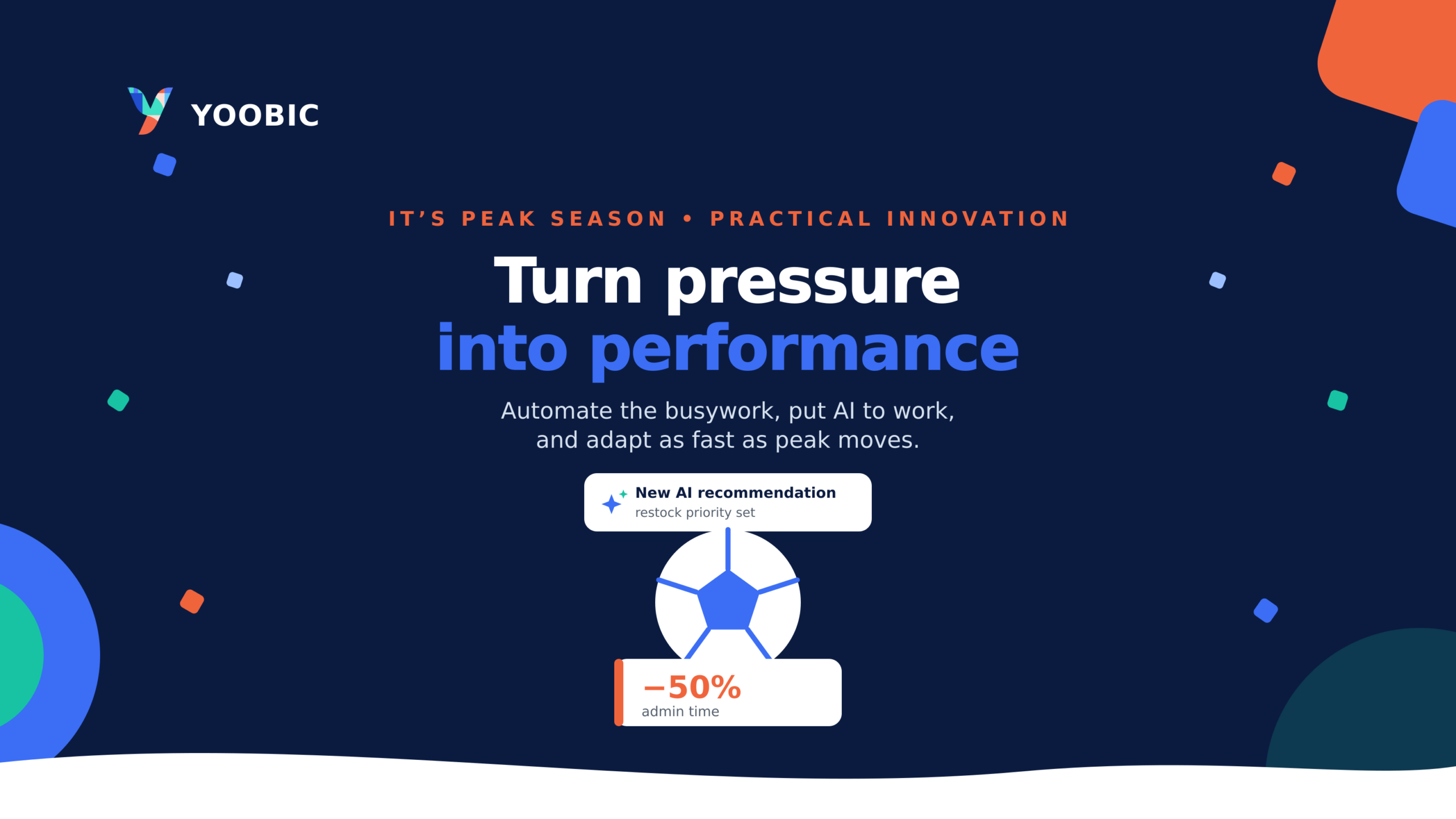
Peak season doesn’t wait. Surges in demand, shifting shopper behavior, and logistical curveballs all call for fast decisions and clean follow-through. In 2026, the FIFA World Cup adds its own curveballs across 16 host cities in the US, Canada, and Mexico, where conditions can change match by match. Yet plenty of stores are still held back by manual workarounds and disconnected tools that slow teams down exactly when speed matters most.
High-performing retailers aren’t chasing trends. They invest in practical innovation that removes friction, equips frontline teams, and turns live data into action. In practice, that comes down to three moves: automate the work that slows teams down, put AI to work where it saves real time, and adapt with data so you can adjust before issues escalate.

Why agility decides peak season performance
Agility isn’t just moving faster. It’s responding smarter, with the visibility to adapt, the tools to act, and the confidence that standards won’t slip when stakes are high. That takes more than effort. It takes systems that make the right action obvious in the moment.
The cost of standing still is real. Missed resets, inconsistent execution, and burnout often trace back to manual processes that eat time and attention.
$8.8 trillion lost
low engagement costs the global economy roughly $8.8 trillion, about 9% of GDP. Practical tools that cut friction and keep teams equipped are how retailers avoid paying into that, especially under peak pressure.
Gallup
What changes when the peak is event-driven
A traditional holiday peak builds over a predictable six to eight week ramp, spread fairly evenly across the country. An event-driven peak behaves differently. It’s compressed, volatile, and concentrated around host cities, fan zones, and the streets near stadiums. Demand can swing match by match, which rewards teams that can adjust in hours, not quarters.
Past tournaments show the swing. Euro 2024 drove a projected £2.1 billion retail windfall in the UK, according to GlobalData and VoucherCodes. Sensormatic found Black Friday 2025 store traffic ran 248.9% higher than the preceding Friday. When conditions move that fast, the retailers that keep pace are the ones who can test, learn, and roll out a change in days.
THE TAKEAWAY FOR OPERATIONS
Agility isn’t a personality trait. It’s a system. The brands that adapt fastest have already removed the friction, equipped their teams, and built the feedback loops, before the surge arrives.
What practical innovation actually requires
Innovation only works if people actually use it. The point isn’t more tools. It’s fewer, smarter ones that remove friction and free teams to focus on customers. Three moves make that real.
- Automate the friction
Replace repetitive admin with automation, move updates out of email and into mobile, and keep best practices in one place that’s always current. When the busywork shrinks, stores move faster with fewer errors and managers get time back for coaching.
- Put AI to work where it saves time
Use AI for the heavy lifting that used to take hours: drafting training content, summarizing performance for managers, and flagging where attention is needed. The aim is speed to action, not more dashboards.
- Adapt with data
Track execution in real time to spot bottlenecks early, then test, learn, and roll out improvements in weeks rather than quarters. Pilot a change with a small group, measure it, and scale what works.
These build on each other. Automation that saves time frees teams up, AI that turns data into action speeds the next decision, and digital tasks on mobile make sure the change actually reaches the floor.
What this looks like in practice

GameStop put practical innovation to work on training. Using YOOBIC’s NEO AI, its learning team built more than 120 courses, cut reporting time dramatically, and freed managers from hours of admin.
“With NEO Creator, GameStop can now generate lessons and quizzes that are 95% complete and ready for deployment within just a few clicks.”
Matthew Goodfriend, Senior Manager, Learning and Development, GameStop
12X faster reporting & 50% less admin time
GameStop saw L&D reporting run 12 times faster, store-task time drop 30%, and admin time fall by half, after using YOOBIC’s NEO AI to build 120+ courses. That’s practical innovation measured in hours given back to the floor.
Gamestop
Moschino took a similar path. It moved from lengthy, desktop-based training to mobile microlearning and rapid content updates that match the rhythm of store life, reaching 98% training participation and a 4.7 out of 5 course rating across 150+ boutiques, including its first global programs in multiple languages. You can see the same pattern in how Longchamp uses AI to scale training and execution.

How YOOBIC helps retailers innovate without the admin
Technology should remove admin, not add it. YOOBIC unifies tasks, training, communication, and performance data in one mobile experience, so teams aren’t switching between tools mid-shift. Its NEO AI speeds up content creation and surfaces insights, while live tracking and photo validation keep rollouts on schedule even when conditions shift. It’s how a modern AI approach to frontline training turns good intentions into work that actually ships.
The same thinking is reshaping merchandising, where AI is moving teams from instinct to intelligence, and store operations, where leaner workflows in your day-to-day store operations free people to focus on customers.
THE BOTTOM LINE
When innovation removes friction, equips people, and makes data actionable, agility becomes your default. That’s how retailers stay ahead during peak: clearer execution, faster decisions, and steady results across every store.
Practical innovation ties the whole peak season playbook together: the belonging you build as you hire, the autonomy teams need to act, the connection that spreads what works, the real-time data that guides decisions, and the consistent execution that holds at scale. Innovation is what keeps all of it moving at the speed of peak.
A practical place to start
You don’t need a sweeping overhaul. Pick a few high-friction moments and fix them end to end.
- Automate a high-friction task, like daily opening checks or promo photo validation, to free up time for selling and service.
- Go mobile-first, so tasks, updates, and learning happen in the flow of work rather than in the back office.
- Use AI for the slow parts, like drafting training content or summarizing performance, so managers spend less time on admin.
- Pilot, measure, scale: prove impact with a small group, then roll out quickly across the network.
- Keep support close, with instant access to district and HQ guidance, so small issues don’t become big delays.
Book a demo and find out how
Avoid wasted hours, blind spots
and lost revenue with YOOBIC