

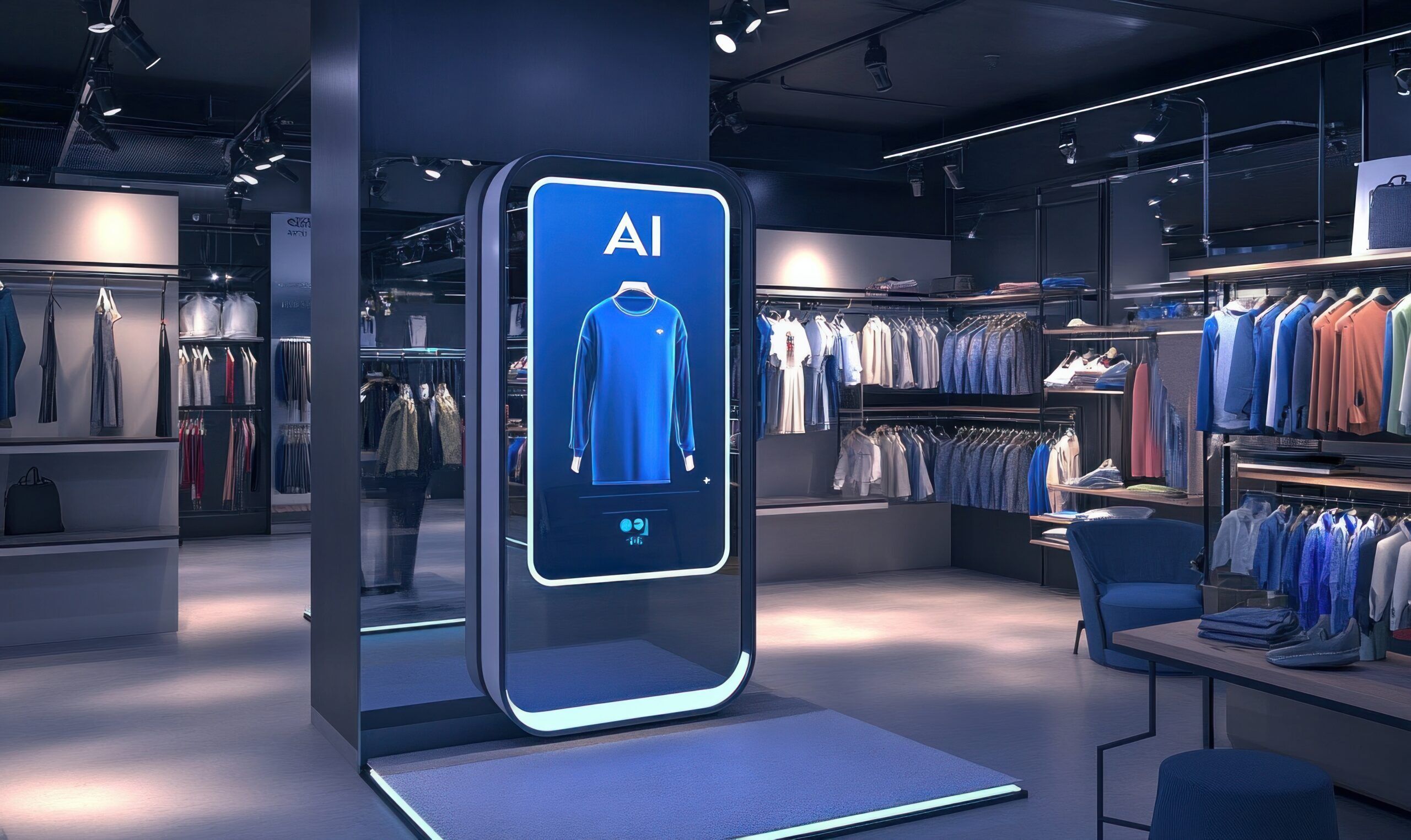
AI in retail has moved past the pilot stage. It is on the floor now, changing how stores run, how teams work and how customers shop.
The retailers acting early will set the pace rather than follow it. So here are the five retail AI trends shaping physical stores in 2026. Each section covers what it means for the people running them.
DEFINITION:
Retail AI
Retail AI covers machine learning, computer vision and generative models applied across store operations, merchandising, service and supply chain. In store operations it means using operational data to decide what store teams work on. It also means tracking whether that work changed the result.
1. AI-planned store layouts and merchandising

Store design used to be part science, part instinct. In 2026, though, it is becoming a data-led discipline.
Retailers now combine shopper movement data, foot-traffic patterns and seasonal trends. That lets them plan placements before a single fixture moves. Some run digital twins, meaning virtual replicas of the store, to test layouts against live inventory. Lowe’s built one with NVIDIA Omniverse. Planners get 3D heatmaps and augmented reality stock checks. Shelf cameras then check stock levels, flagging gaps against the planogram.
The commercial case here is stronger than most retailers assume. Chintagunta, Chu and Cebollada studied promotional execution across 5,000 stores. They found 29% of planned displays were never placed at all. Those that made it ran for only 62% of the intended campaign. Getting a display onto the floor during a campaign week lifted sales by 9.6%.
29%
Share of planned promotional displays never placed on the sales floor, across a study of 5,000 stores.
Chintagunta, Chu and Cebollada, Manufacturing and Service Operations Management.
So smarter layouts matter. Verifying that the plan reached the shelf matters just as much. VM Copilot handles the second half. It checks AI-powered visual merchandising against brand standards from a photograph. Feedback gets resolved on the floor before it reaches HQ. Canada Goose used this to close the feedback loop from two weeks down to the same morning. Longchamp then rolled new visual merchandising guidelines across 350 stores globally in six days.
2. Agentic AI moves into store operations
The next phase of store operations runs on agentic AI. These are systems that decide and act rather than wait to be prompted.
In practice an agent might trigger a restock or adjust a digital shelf price. It might draft a staff schedule from predicted footfall. Because they run in the background, managers and associates stay customer-facing.
Adoption is also moving fast. MIT Sloan Management Review and Boston Consulting Group surveyed 2,102 executives across 116 countries. They found 35% of organizations had already adopted AI agents. Another 44% plan to deploy soon. Agentic AI reached that level in about two years. Neither generative nor traditional AI moved that fast.
Still, most retailers are moving carefully, and they are right to. The hard part is not the models. It is data governance, legacy integration and running cost. So teams start with narrow use cases that prove clear gains before scaling.
YOOBIC’s AI Teammates sit in this category. Role-specific agents support audits and daily routines behind the scenes. We covered how that pipeline works in from insight to action.
3. Personalized service on the sales floor

For years personalization was an online advantage. Now, however, AI is bringing it onto the shop floor.
Loyalty data, purchase history and recommendations now reach handheld devices. Associates can greet returning customers with tailored suggestions in seconds. On-floor screens act as guided discovery tools, reading plain language about budget, size and style.
For example, UNTUCKit built its clienteling model this way. Text-based clienteling grew from 5% to 9% of total company sales in year one of its certification program. Store visits shifted from checklist reviews to focused coaching on customer conversations.
The same principle therefore applies to your own teams. Local opportunities surface on an associate’s device during the shift. They no longer wait for a head-office report the following week.
4. AI that makes store teams more effective
AI in retail is not about replacing people. It is about making them more effective, and this is where the floor-level impact is clearest.
Associates can now get short training on demand, plus instant answers to product questions. They also get step-by-step guidance through unfamiliar tasks. That speed matters most during seasonal peaks and product launches.
Meanwhile frontline adoption has genuinely shifted. BCG’s 2026 AI at Work survey found 74% of frontline workers now use AI daily or several times a week. That is up 23 percentage points on the previous year. Among regular frontline users, 42% report saving around eight hours a week.
There is a catch, though. BCG also found most organizations have not worked out how to convert that time into value. Deploying tools is not enough on its own. The saving only reaches the P&L if workflows and training change with it.
INSIGHT
Time saved is not the same as value created. Reclaimed hours only reach the P&L when someone decides what those hours get used for. That might be peak-hour floor coverage, coaching or fulfillment.
YOOBIC’s AI Assistant answers everyday questions from a retailer’s own documentation, with a source link on every answer. That cuts the support tickets reaching HQ. AI Course Creator turns existing material into ready-to-launch training. GameStop replaced an e-learning setup built on flat PDFs and quizzes.
Hugo Boss put AI recommendations straight into store teams’ hands using Store Manager Copilot. That saved 25% of store manager admin time and lifted incremental revenue by 3.2%.
3.2%
Incremental revenue lift from store-level adoption of AI-recommended priority actions, alongside 25% of store manager admin time reclaimed.
YOOBIC customer story, Hugo Boss.
5. Targeted friction removal, not checkout-free stores
The most visible AI trend is also the one being rethought. Fully checkout-free stores, built on ceilings full of cameras, have cooled quickly. The hardware costs too much and the returns arrive too slowly.
Instead, retailers are targeting specific friction points. Automated exit gates, mobile scan-and-go, and computer-vision portals that verify a basket on exit. Sam’s Club uses AI image capture at its exit doors, confirming purchases against a digital receipt. Members walk out without a manual check.
That caution is warranted, because the record is mixed. S&P Global found the share of enterprises abandoning most AI initiatives rose from 17% in 2024 to 42% in 2025. Costs outran returns. Gartner separately projected at least 30% of generative AI projects would be abandoned after proof of concept.
Consequently the lesson is to reduce real friction without redesigning the whole floor. Often the fastest wins come from tightening everyday task management, rather than rebuilding the checkout. Availability is therefore a good place to look. Corsten and Gruen put the global out-of-stock rate at 8.3%. That costs around 3.9% to 4.0% of store sales.
What this means for store leaders

The pattern across all five trends is consistent. While the tools change, the retail workforce is not disappearing. It is changing, and treating frontline labor purely as a cost no longer holds.
Meanwhile Boston Consulting Group offers a useful way to think about where the effort goes. Their 10/20/70 guideline gives 10% of effort to algorithms and 20% to technology and data. The remaining 70% goes to people and processes, because that is where change either sticks or does not.
Therefore the retailers who get value from AI in 2026 will do three things. First, they will prioritize AI that lifts productivity on the floor rather than in head office. Second, they will use AI to strengthen human service instead of substituting for it. Third, they will move quickly from pilot to chain-wide rollout. A pilot that never scales is a cost rather than an advantage.
So AI is not a back-office tool anymore. It is a frontline advantage, and the retailers moving first will set the standard. You can see how they are doing it in our customer stories.
“Taking the hours spent on manual processes out of stores pays for the platform alone.”
Steve Zawlocki, Vice President IT, Mattress Firm.
Start retailing smarter

Frequently asked questions
How has AI affected the retail industry?
AI has changed retail most visibly in personalization and demand forecasting, and most recently in how physical stores are run day to day. In store operations it now decides which performance gaps are worth acting on, generates and routes the resulting work to specific people, verifies execution from photographs, and answers frontline questions from a retailer’s own documentation. The effect on roles is a shift rather than a reduction: store managers spend less time compiling reports and more time on the floor, while associates get guidance in the moment instead of after the fact. Results are uneven, though, with S&P Global finding the share of enterprises abandoning most AI initiatives rose from 17% in 2024 to 42% in 2025.

