
Categories
Employee Engagement

How to engage frontline employees in retail: 5 strategies that work

Knowing how to engage frontline employees in retail affects retention, service quality, and sales on every shift. Engagement may sound like a corporate buzzword, but on the floor it’s very real.

Put plainly, frontline employee engagement is how connected, motivated, and invested your store associates feel in their work and in their store’s success.

Deskless workers now make up up to 80% of the global workforce, according to BCG. Yet most engagement efforts still center on people at desks.

In retail, where frontline employees are the face of the brand, failing to invest in store teams can be fatal to a business.

This post breaks down what that failure costs, the challenges you’ll face, and five strategies for how to engage frontline employees in retail.

A manager coaches an employee in a grocery produce aisle — training, coaching, supermarket operations.

Why frontline employee engagement matters

A regular walked into one of your stores on a slow Tuesday, and an associate recognized them from a purchase two weeks earlier. They remembered the jacket they’d been weighing up and had it ready to try. They left with the jacket and a reason to come back.

That moment doesn’t happen when someone feels invisible in their job. In the digital age, customers who choose to shop in-store want a personalized, human experience. Every day, your associates are the ones positioned to create it.

A YOOBIC 2022 Frontline Employee Experience Survey of 1,400 workers found that 44% don’t feel they’re making an impact at work. Only 44% feel their employer has invested in them.

That means higher turnover, diminished productivity, and lost revenue. Gallup found that engaged workforces have 10% higher customer ratings, 17% higher productivity, and 20% higher sales.

What challenges do retailers face when trying to increase engagement?

Retailers face a few predictable challenges when they try to improve engagement, and each one drives up turnover:

  • A notoriously fast turnover industry

You need to engage new workers quickly when they may only be around for a short period of time.

  • The media myth that brick and mortar is dead

Some claim brick and mortar will soon be a thing of the past, and that machines could do store teams’ jobs. These myths stop employees from feeling empowered and understanding their unique role in the buying journey.

  • Disconnection

Spread across many locations and shifts, workers rarely see their co-workers or leaders, so they feel out of the loop and unheard.

Despite these challenges, with the right strategies, you can build engaged store teams with lower turnover and better service.

How to engage frontline employees in retail: 5 strategies

1. Connect employees with tools built for the shop floor

Tools typically used to connect employees aren’t adapted to the realities of working in a store. An intranet on a desktop might work for office-based staff. It won’t reach retail workers while they’re serving customers on the sales floor.

Your store teams need to feel connected to engage with the company’s mission. Equip them with something built for the floor. In Coresight Research’s Digital Workplace retail survey, 75% of organizations that used digital workplace technology to connect employees saw frontline engagement improve.

Your associates already live on their phones between customers, so meet them there with one connected space that keeps them part of the team.

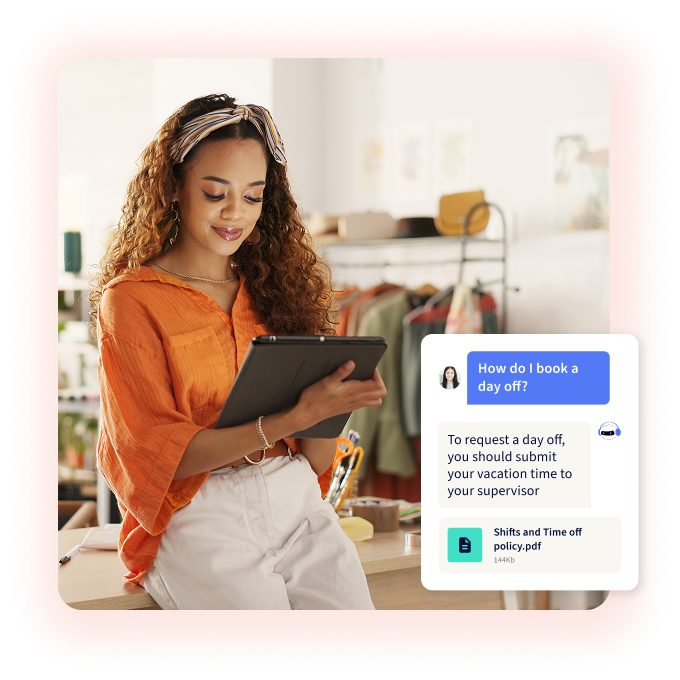
Reaching people who never sit at a desk takes a mobile hub built for the floor, so give associates a bring your own device (BYOD) policy or company phones. In YOOBIC Communications, a company newsfeed where people post polls, GIFs, and videos makes updates worth checking between customers.

2. Show them their impact

An associate spent 20 minutes helping a nervous first-time buyer. A week later, they saw their own name in a five-star review posted to the newsfeed. They hadn’t known the customer wrote in. Seeing it changed how they showed up the next shift.

When your employees understand the impact they’re having, they feel more motivated to perform at their best. Highlight it by regularly posting positive customer reviews and performance wins like higher conversion or completed training to your company newsfeed.

Emphasize their unique impact as customer-facing workers at onboarding, keep highlighting it in training, and give them the skills to create meaningful customer experiences. Deliver that training on mobile, in the flow of the working day.

For specific tips on improving the quality of training, read our guide to retail sales training.

3. Give them the chance to build a community

A strong workplace community matters to your store teams. But retail communication is often top-down, and many associates never interact with teams in other stores. They miss out on the knowledge and best practices they could learn from one another.

For employees to engage with each other, you need a platform that also allows bottom-up and peer-to-peer communication. Open up chat, peer communities, and a shared newsfeed so associates learn across stores.

To see how this can work, look at how fashion brand GANT connects and engages its store teams around the world.

Ask managers to recognize their teams with shout-outs and incentives too. Skip the classic employee of the month title. Use specific awards for things like completing the most learning, getting named in the most positive reviews, or coaching other team members.

You can also use learning to build community with social training that encourages healthy competition. Gamified courses that use points, battles, and leaderboards turn training into a social activity that connects workers.

Two women review something on a tablet together in a bright clothing store — teamwork, in-store tech, merchandising.

4. Show that you’re listening

An associate flagged that the setup instructions for a window display were unclear, using a quick note in the platform. Headquarters (HQ) rewrote them that week, and the next rollout went up without a single follow-up call. They’d watched their comment turn into a change.

Show your store teams that you value their input and that they help steer the business. Give them a way to share feedback with managers continuously in their day-to-day work. That could be on unclear task instructions, clunky processes, or a recent training course.

Give them a voice with pulse surveys sent to mobile devices and regular feedback sessions. Then, most importantly, share how you’re acting on what you hear. When employees know they’re listened to, they engage.

5. Show them where their work can take them

Here’s the part that surprises most operators. It’s easy to assume store jobs are a stopgap between other plans. In reality, plenty of frontline workers want to build a career in retail, but they can’t see the path.

“There has never been a more exciting, meaningful, and bountiful time to choose retail as a career.”

Ron Thurston, Host of Frontline Fridays

But wanting a future and being shown one are two different things.

Why would they engage with their work if they don’t believe their employer wants to help them progress?

To show you’re invested in their development, link training to progression with personalized learning paths. These paths show associates exactly what to complete to reach their goals, so they stay motivated and apply new skills on the floor.

The payoff shows up in the numbers.

The manager’s role in frontline engagement

A store manager used to start each shift by opening several dashboards to piece together what happened the day before. Now they open one briefing with three priorities and spend the reclaimed time coaching the team on the floor.

Managers shape engagement more than any perk. Gallup found that managers account for at least 70% of the variance in team engagement. So the quality of daily coaching decides how your teams feel about the work.

Store Manager Copilot turns fragmented sales, traffic, and inventory data into a daily action plan, so your managers spend time coaching instead of compiling reports. For district and area leaders, District Manager Copilot (DM Copilot) surfaces which stores need attention. It drafts visit agendas so every trip lands where it matters most.

How to measure frontline employee engagement

A regional manager noticed one store’s feedback responses drying up two weeks before its scores dropped. The silence was the signal. A short visit turned up a broken headset cart that no one had bothered to report.

You can’t improve what you don’t measure. Track a few engagement signals across your people and your execution, and review them on a steady cadence. Watch them together, not in isolation, because a dip in one often explains a dip in another.

MetricWhat it tells youHow often to review
Employee Net Promoter Score (eNPS)Whether associates would recommend working for youQuarterly
Voluntary turnoverWhether engaged people are choosing to stayMonthly
First-90-day retentionWhether onboarding sets new hires up to stayMonthly
Training completion rateWhether associates keep building their skillsWeekly
Feedback response rateWhether teams feel heard enough to speak upMonthly

Why YOOBIC is built for frontline employee engagement

Engaged store teams don’t happen by accident. They happen when tasks, communications, and learning work as one system your associates actually use. Think of the newsfeed someone checks between customers, or the learning path that shows them a future.

That’s what we bring together in a single mobile-first platform. We unite tasks, communications, and learning so a plan at HQ becomes a completed action on the floor.

When Michaels moved frontline training onto YOOBIC Learning, participation climbed sharply.

Book a demo and find out how

Avoid wasted hours, blind spots
and lost revenue with YOOBIC
Frontline worker hero image

Frequently asked questions about frontline employee engagement

What drives frontline employee engagement in retail?

Two things drive it: clarity and competence. Your associates engage when they know what to do and why it matters, and when they feel equipped to do the job well. Give them targeted communication that reaches them mid-shift, and role-based training that builds real skill. Do that, and a routine day becomes work they care about.


How does training affect frontline employee retention?

Why do frontline employees need different engagement tools than office staff?

What role do store managers play in frontline engagement?

How can retailers keep new hires engaged in a high-turnover environment?

Ready to engage your frontline teams?

Categories
Employee Engagement

How to measure employee engagement: 7 metrics for frontline teams

Employee engagement makes or breaks performance at every level of a business. Yet frontline employees in retail, hospitality, manufacturing, and logistics are often left out of the engagement conversation, despite delivering the brand experience to customers every day.

The gap is real and getting wider. Global engagement fell to 20% in 2025, the lowest level in years, and frontline workers sit below even that. The problem isn’t that leaders ignore engagement. It’s that they can’t see how engaged their frontline teams actually are. You can’t improve what you don’t measure, so this guide covers how to measure employee engagement on the frontline, and the seven metrics that matter most. For the strategy behind the numbers, see our guide to frontline employee engagement.

two employees in a warehouse working and laughing

Why measuring frontline engagement is different

Frontline engagement runs lower than office engagement, and the gap is structural. Gallup’s 2026 data puts exclusively remote workers at 30% engagement and on-site, non-remote workers at just 17%. In the US, frontline employees sit at 26% against a 32% workforce average. So measuring retail employee engagement with a once-a-year survey misses the point. Frontline work is shift-based, mobile, and fast-moving, which means engagement shifts week to week and needs continuous, operational measurement rather than an annual snapshot.

Quantitative measurement turns engagement from an HR talking point into something concrete and actionable. It lets you spot disengagement early, target your least engaged teams, build a data-backed case for new tools, and protect revenue by reducing turnover. Here are the seven metrics every business with frontline employees should track.

1. Interaction with internal communications

How employees engage with the content you share internally reveals a lot about how connected they feel. Frontline workers are often cut off from company communications: many don’t have a corporate email address, and 80% of deskless workers report they don’t get adequate communication from their employer. So measuring whether they read, react to, and act on internal content is one of the clearest early signals of engagement. See more on how to engage deskless workers with internal communications.

What to track: read rate per post or update, comments, reactions and shares, comment sentiment, and how many employees respond to a call to action. With read receipts, you can see exactly who has seen each message.

“Our employees are excited to open YOOBIC each morning. They check updates, complete their tasks, and interact with the team, all in one place.”

Eneida Guzman, Store Manager, Adore Me

2. Employee Net Promoter Score and mood

DEFINITION:

Employee Net Promoter Score (eNPS)

eNPS measures how likely employees are to recommend your company as a place to work, on a 0 to 10 scale. Subtract the percentage of detractors from the percentage of promoters to get the score. It’s a fast, repeatable signal of how your teams feel over time.

eNPS is a strong starting metric because engaged employees are the ones most likely to recommend the company. Calculate it by team, location, and region, and compare over time to track whether your engagement work is landing. Benchmarks vary widely by sector and study, so treat them as a guide, not a target.

Go beyond the standard question. Ask how strongly employees feel their manager supports their development, how clear the company’s mission is, and how they’re feeling overall. Mood tracking, where employees pick an emoji or rate their mood on a sliding scale, gives you a regular pulse and flags problems before people burn out.

3. Customer Net Promoter Score

Engaged employees go above and beyond, and customers feel it. Frontline staff physically deliver the brand experience, so a drop in employee engagement often shows up in customer scores a few quarters later. Gallup found that 69% of engaged employees feel a strong sense of responsibility for customer quality, compared with just 31% of disengaged ones. Watching customer NPS and CSAT alongside your engagement metrics helps you connect the two.

Track review sentiment, average ratings on Google, Yelp, and Tripadvisor, and how scores move over time. A consolidated view of online reviews across your network turns scattered customer feedback into one engagement signal you can act on.

“We're really trying to impact the customer experience to drive more sales, higher conversion, higher UPT.”

Sandra, Head of Retail, UNTUCKit

4. Adoption of new technology

Adoption and engagement are closely linked. When you roll out a tool that makes work easier, engaged employees use it because they want to do their jobs well. Low adoption is a warning sign, either the rollout didn’t show the value, or people aren’t engaged enough to change how they work. So adoption rate is a practical, real-time proxy for engagement.

The design matters as much as the tool. Around 60% of deskless workers are dissatisfied with their current workplace technology because it’s slow and hard to use on a phone. Give workers a voice in the tools they use and adoption climbs: Gallup found 58% of employees with real influence over technology decisions are highly satisfied, against just 24% of those with none.

If adoption is lagging, the fix is usually onboarding and ease of use, not pressure. See how to get reluctant employees on board with new tech, and the broader playbook for boosting frontline tech adoption.

5. Productivity

Engaged employees are more productive, because they find meaning in their work and understand how it fits the bigger picture. Gallup’s analysis of millions of employees shows top-quartile engagement teams deliver 18% higher sales productivity and 32% fewer quality defects than bottom-quartile teams. The reverse is costly: frustrated frontline workers lose around seven hours a month to downtime, mistakes, and absenteeism.

What to track: for retail, sales, conversion rate, basket size, and units per transaction. Across industries, watch output, error and defect rates, time to resolution, and safety incidents.

6. Absenteeism and turnover

Engaged employees show up and stay. Frontline industries carry some of the highest absenteeism and turnover rates anywhere, and engagement is the most effective lever to bring them down. Gallup found highly engaged teams see 81% lower absenteeism and 59% lower turnover in high-turnover industries.

These rates aren’t just engagement signals, they’re money. Replacing a frontline employee costs roughly 40% of their annual salary once you count hiring, onboarding, and lost productivity. So every point of turnover you remove protects both knowledge and margin.

For the strategies behind these numbers, see how to reduce employee turnover in retail.

7. Profitability and sales

This is where it all lands. Engaged teams are more profitable: Gallup puts the top quartile at 23% higher profitability than the bottom. Oxford research goes further, linking a one-point rise in employee happiness to billions in annual profit at large organizations. Engagement initiatives take time to move these numbers, which is why this metric comes last, but the link is well documented.

Measure profitability granularly, per store, restaurant, or field team, so you have a baseline to compare against once your engagement work ramps up. Useful measures include sales per square foot, average transaction value, units per transaction, and gross and net profit per location.

“Implementing YOOBIC has self-funded itself. We've seen a 22% jump in sales conversion, dramatically improved clearance sales, and created a whole new way of communicating across our stores.”

William Train, Head of Operations, Sportscene

Newer metrics worth tracking in 2026

Annual surveys are lagging snapshots that miss the day-to-day reality of shift-based work. Forward-thinking operators now track faster, more operational signals.

  • Daily negative emotions. The share of workers feeling stress, anger, or loneliness on a given day. Gallup found 40% of employees globally experienced significant stress, a leading indicator of burnout and resignation.
  • The worker voice gap on technology. The distance between how much influence workers want over their tools and how much they actually have. It directly shapes adoption and satisfaction.
  • Lost time to frustration. The roughly seven hours a month each frustrated worker loses to downtime and errors, translated into a cost your team can act on.
  • Leader behavior gaps. How frontline managers score on coaching, appreciation, and authenticity, since supervisors drive about 70% of team-level engagement variance.
Warehouse workers discussing with clipboard while working in warehouse

How to measure employee engagement without surveys

Surveys still matter, but they’re slow and easy to ignore on the frontline. The metrics above let you read engagement from what teams actually do: whether they open and act on communications, how fast they respond, whether they adopt new tools, and how their stores perform. Pair a light, regular pulse or mood check with these behavioral signals and you get a live read on engagement without waiting for an annual survey cycle.

Bringing your engagement metrics into one dashboard

Tracking seven metrics across hundreds of locations only works if the data lives in one place. The right frontline engagement platform captures most of these signals automatically: read receipts and reaction rates on communications, mood and eNPS pulses, adoption and task-completion reporting, and a consolidated view of customer reviews. That turns measurement from a manual exercise into a live dashboard your operators can act on.

YOOBIC brings communications, training, and task execution into one mobile-first app for frontline teams, with the engagement analytics, mood tracking, and reporting to measure every metric in this guide. Tracking is only step one, though. What your business does with the data is what moves engagement.

Bringing it together

There’s no single engagement number that tells the whole story, especially across the range of work frontline teams do. The seven metrics here, read together and over time, show you what’s working and what isn’t, so you can make decisions that actually support your people. Start by measuring, set a baseline, and watch the trend. The businesses that get frontline engagement right see it flow straight through to productivity, retention, and profit.

Measure what matters to your frontline

See how the YOOBIC platform captures engagement signals in one place, or explore how retailers put it to work in our customer stories.

Store execution impacts every margin decision

Give frontline teams the tools, visibility, and guidance
to execute consistently across every location.

Frontline engagement measurement FAQs

How do you measure employee engagement?

Combine behavioral signals with a light, regular pulse. Track interaction with internal communications, eNPS and mood, customer NPS, technology adoption, productivity, absenteeism and turnover, and profitability. Reading these together over time gives a fuller picture than an annual survey alone.

How do you measure team engagement on the frontline?

What are the best employee engagement KPIs?

How do companies measure employee engagement without surveys?