Restaurant training is failing frontline workers. Employees are abandoning the industry as they develop suspicions that they are stagnating in their roles due to a lack of development.

 YOOBIC
Restaurant training is failing frontline workers. Employees are abandoning the industry as they develop suspicions that they are stagnating in their roles due to a lack of development.

The meetings have been held, the money has been spent, and after extensive research, you’ve found a new piece of tech that you think will massively benefit your business. You’ve rolled it out across the company network, and are eagerly waiting to see the results from when your frontline teams start using it.

Last week we were honoured to have bestselling author and one of the Top 100 Most Influential People in Retail 2021, Ron Thurston, host our webinar: ‘How to Effectively Train and Motivate Frontline Employees‘.

A few decades ago, the term ‘AI’ might have conjured a mental picture of cyborgs taking over society. But we’ve grown used to being woken up by Alexa and asking Siri whether we need an umbrella on the way to work. Bit by bit, artificial intelligence has become part of our everyday life.
Using AI in frontline employee training means applying that same everyday intelligence to how your store teams learn. The right lesson reaches the right associate at the right moment.
At a basic level, artificial intelligence mimics the creative and problem-solving abilities of the human brain. It creates personalized experiences by collecting data about us, like how we use devices and what we prefer.
As AI works its way into more of the working day, more retailers are building it into training. That’s why choosing an AI platform for frontline and retail training has become a real decision for learning and development (L&D) and store operations teams. This post walks through the main reasons AI makes training better, what to look for in a platform, and the results you can expect.
In training, AI collects data about each learner: their role and location, the courses they’ve completed, and how well they scored on each. It also captures how highly they rated each course. This has a range of benefits:
Before you weigh those benefits, remember that where the data lives matters as much as what it captures. YOOBIC Learning is mobile-first and built for frontline store teams, not a generic learning management system stretched to fit retail. That retail focus is what turns learner data into store performance, which is the thread running through each benefit below.
A big problem with frontline employee training is that employees are often bombarded with information that is not relevant to their roles. This is a barrier to learning, as it leads to cognitive overload, resulting in employees retaining very little information. When working memory is pushed past its limit, learning and performance suffer, a pattern documented in Cognitive Load Theory.
AI enables training to be more targeted, showing learners the most relevant information and increasing the chance of it being cemented into long-term memory. AI-driven platforms like Netflix and Spotify make tailored recommendations based on what you’ve watched or listened to before. AI can personalize a learning experience the same way.
Picture an associate who only sees short, mobile lessons tied to their role, not a generic course library. They get there because YOOBIC Learning enrolls them automatically and suggests courses based on roles, events, and triggers. AI-powered adaptive quizzes then adjust to what each person already knows.
This saves learners time searching for training and deciding what to take next, which makes learning more accessible on a busy shift.
You also give people a say in how they learn. AI can recommend training based on learner preferences and the courses they’ve rated highly. That way, associates help shape an experience they’ll actually want to complete.

An associate hits a gap mid-shift: a customer asks a detailed product question, or a new promotion isn’t clear. Instead of interrupting the manager or guessing, they open YOOBIC AI and get an answer in seconds.
The Retail Assistant gives instant, source-backed answers on products, procedures, and policies right on the sales floor. Store Manager Copilot turns store data into prioritized recommendations for the day.
If an organization uses microlearning to train frontline employees, and they should, the training materials will likely include a large number of short courses. AI helps structure them into learning tracks and assign them to the right employees. This means that managers don’t have to spend as much time creating and assigning training courses for different jobs, responsibilities, and skills.
Related: A Guide to Microlearning: What It Is and Why Your Employees Need It
Using AI frees up time for managers to support frontline teams in more meaningful ways. They can hold one-to-one development meetings and talk with employees about what they need to progress. That’s the trade you want: fewer hours spent chasing courses, more time coaching the people who run your stores.

AI can automatically review learning, identify skill gaps, and establish where more training is needed. That cuts the manual effort these tasks normally take.
Linking different data sets highlights where training can aid store performance. For example, connect compliance and training data to see how a team’s completed courses line up with how well they follow store tasks.
With advanced analytics, you can proactively shape learning around what learners need and drive sales. You skip the hours of manual work it normally takes to collect, organize, and evaluate the data.
So what should you actually track? Start with a few signals that connect learning to the floor:
YOOBIC Learning brings these together in centralized analytics, with dashboards, completion tracking, and skill gap analysis. You can see which lessons move store performance and which need a rethink.
Related: Why Retailers Need to Align Sales and Operational Data
Start with the stakes. A World Economic Forum analysis found that a lack of career advancement is a top reason frontline workers in the United States leave. Replacing one costs about 40% of their annual salary.
Training that people finish, and use, is how you protect both.
The change shows up in specific stores. When Longchamp moved luxury training onto mobile learning, associates could pick up a two-minute lesson between customers instead of waiting for a classroom session.
UNTUCKit and Silhouette Group took the same path, treating training as a daily sales driver rather than a once-a-year event. Here’s what that looks like in the numbers:
in learning program participation.
Stat source: Michaels
in training completion.
Stat source: Michaels
in time spent on standard operating procedure training.
Stat source: Boots
Notice the pattern. More people start and finish training, and the training that has to happen takes less time. That’s the combination you’re aiming for when you build AI into how your teams learn.
Not every AI platform is built for a store floor. A regional L&D lead running a 10-store pilot will feel the difference fast.
A platform that assumes a desk and a quiet hour is one associates won’t open between customers. Use these criteria to weigh your options.
| What to look for | Why it matters on the floor |
|---|---|
| Mobile-first and embedded in daily workflows | Associates learn in short moments between tasks, not at a desk |
| Adaptive and personalized | Each person sees what fits their role, not a generic library |
| Retail-specific, not a generic LMS | Lessons map to store tasks, compliance, and selling |
| Analytics tied to store key performance indicators (KPIs) | You can prove training moved completion, compliance, and sales |
| Human-centric, explainable, secure AI | Teams trust recommendations they understand, with data kept private |
That last row is worth weighing carefully. Your teams will ask practical questions before they trust any recommendation:
The answer you want is an AI that stays human-centric, explainable, and safe. It shows why it made each recommendation and lets a person override it. When you evaluate YOOBIC on these criteria, you’re checking a platform built for the frontline, not adapted to it after the fact.
Organizations can use AI to support frontline employees and improve performance for each person, each team, and the wider business. This is because AI:
If you want training to stick, it has to fit the way your teams already work. AI works best for frontline teams when it’s part of how they already work, not another platform teams have to check separately. We bring tasks, communications, and learning together in one platform.
A lesson, a task, and a message reach associates in the same flow on the sales floor. To see how we use AI to fuel frontline learning and development, book a demo.
Avoid wasted hours, blind spots
and lost revenue with YOOBIC
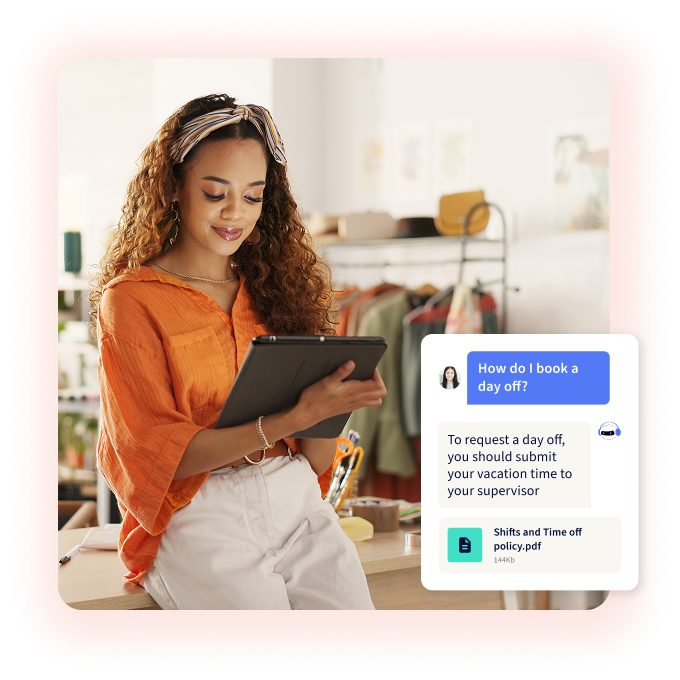
It reads signals like a learner’s role, their past scores, and the courses they rated highly, then serves the most relevant lessons next. Adaptive quizzes adjust to what someone already knows, so a seasoned associate skips the basics and a new starter gets more support. The result is a shorter, sharper path for each person on your floor.

‘Omnichannel’- the buzzword on everyone’s lips.

UK-based brewery and bar chain Brewdog recently came under fire after 61 former employees signed an open letter which circulated on social media describing a company ‘culture of fear’ in which workers were bullied and ‘treated like objects’. This negative publicity delivered a huge blow to Brewdog, who have built their reputation on their positive, value-driven social media presence. They recently reported a ’13m loss, despite a boom in the craft beer industry.

Brick and mortar is evolving. When ordering online has never been easier, physical stores need to provide far more than a transaction in order to entice customers through the doors.

If you think back to high school tests, you’ll remember how annoying it is when a friend scores higher than you after guessing the right answers, especially if you actually studied.
Performance stats alone don’t give us the full picture when assessing someone’s capability, it’s not only about arriving at the right answer, it’s about having confidence and understanding why it’s right.

It’s no secret that opening a new restaurant is a gamble. But opening a franchised location is a safer bet than starting from scratch with a new, independent restaurant, right? Wrong.

By Fabrice Haiat, CEO & Co-Founder @ YOOBIC