

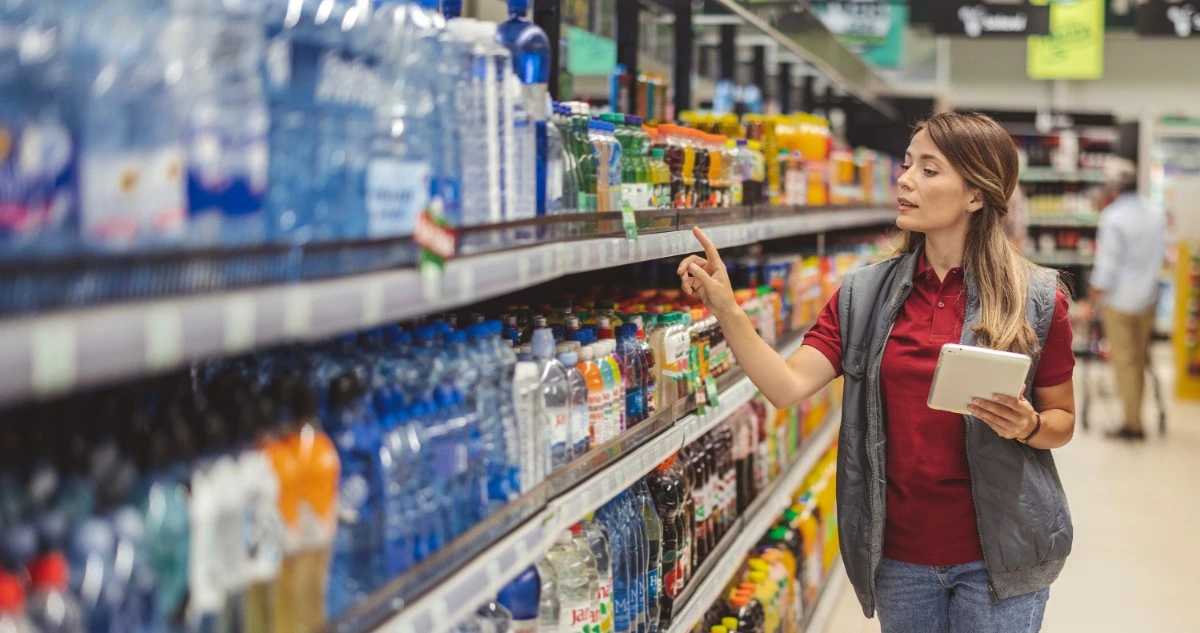
Grocery store operations cover everything it takes to run a supermarket while it trades: receiving deliveries, filling shelves, checking dates on fresh food, keeping counters safe, serving customers at the checkout and handing over cleanly between shifts.
Every one of those jobs lands on store teams, and most stores run them with less time than the plan assumes. Grocery margins are thin, so a missed date check or a promotion that never reaches the shelf comes straight off the bottom line.
This guide covers what grocery store operations include, five ways to increase productivity in supermarkets, and how to measure it. Along the way, we look at how grocers use YOOBIC’s grocery store operations platform to digitize store tasks, communications and training.
DEFINITION:
Grocery store operations
Grocery store operations are the daily activities, routines and systems that keep a supermarket running while it trades, from receiving and replenishment to fresh food checks, merchandising, checkout, food safety and shift handovers.
How do you improve productivity in grocery store operations?
You improve productivity in grocery store operations by taking paper and guesswork out of the routines store teams repeat every day. Grocers that run daily checks, promotions, food safety records and training in one mobile app, such as YOOBIC, give teams clear priorities and give managers real-time visibility, so time moves from admin back to the shop floor.
In practice, that comes down to five changes:
- Digitize store operations to gain real-time visibility
- Streamline internal store communications
- Simplify repetitive store processes
- Digitize regional team processes
- Upskill store teams in the flow of work
What do grocery store operations include?
Grocery store operations span every department and every shift. These are the core areas, with a guide to each.
| Area | What store teams do | Go deeper |
|---|---|---|
| Receiving and replenishment | Check deliveries, fill shelves and fix gaps before customers see them | Produce department management |
| Fresh food and date checks | Rotate stock, pull near-date items and record what was wasted and why | Deli operations and bakery shrink |
| Markdowns and food waste | Reduce prices at the right time and keep waste records accurate | Markdown strategy and food waste |
| Food safety and compliance | Temperature checks, HACCP records, cleaning schedules and product recalls | HACCP records |
| Merchandising and promotions | Build displays, follow planograms and check price labels | Promotions and marketing |
| Store audits and visits | Daily inspections and regional store visits with photo proof | Grocery store audits |
| Workforce and shift handovers | Schedule associates, assign daily tasks and hand over between shifts | Task management |
What we see in the YOOBIC app
Store teams have submitted about 68 million tasks in the YOOBIC app across our customers. A few patterns stand out for grocers.
- Store standards and routines drive the most volume, with 20.5 million tasks submitted.
- Food safety and quality comes next, with 16.5 million tasks submitted.
- Merchandising and promotions is the most widely used task type. More retailers run merchandising tasks than any other type.
- Health, safety and security tasks have the highest completion rate of any category.
1. Digitize grocery store operations to gain real-time visibility
One of the challenges that grocery stores face is the lack of real-time data on store performance.
Store managers and regional teams need to know how well their stores are executing their tasks and processes, such as inventory management, merchandising, pricing, promotions, customer service, safety, and compliance.
However, many retailers still rely on manual and paper-based methods or legacy tools to manage their grocery operations. This leads to several problems, such as:
- Delayed decision-making and problem-solving
- Inconsistency and errors in store execution
- Poor communication and collaboration among store teams
To overcome these problems, grocers need to digitize their supermarket operations to drive operational efficiency. Modern retail operations software can also help them to:
- Track, measure, and improve their store execution in real-time. Store managers and regional teams can monitor their store performance indicators, identify issues and gaps in store execution and take corrective actions quickly.
- Ensure consistency and accuracy in store execution. Store teams can access clear and updated instructions for every task and process they need to perform. They can also report their completion status and provide feedback with photos and comments.
- Enhance communication and collaboration among store teams. Store teams can communicate with each other and with their organization in a non-hierarchical and engaging way. They can also share best practices, tips, and ideas to improve their store performance.
Here’s how Lidl France streamlines supermarket operations across 1,500 stores
Lidl has been expanding strongly throughout Europe for over 40 years. They needed to achieve visibility at the regional and national level for their supermarkets.
By implementing YOOBIC’s retail operations software, Lidl is able to conduct daily supermarket inspections and assign action plans right inside the YOOBIC app. That means store teams can access and act on these plans from their phones, right in the flow of work.
Now, Lidl’s store leaders and store teams can effectively collaborate in real-time through easy photo sharing and comments. At headquarters, leaders get the visibility they need to check stores are compliant with company guidelines at any time, and operational compliance has risen 11% across 1,500 supermarkets.
“Before, it was difficult for us to know in real time the situation of our supermarkets in the territory. Now, we are able to monitor everything, and know our strengths and areas for improvement.”
Thibaut Lièvre, Head of Sales Organization, Lidl France
Watch how Lidl digitizes grocery store operations to drive operational excellence and productivity.
See it in practice: how a daily store inspection becomes an action plan with photo proof.
2. Streamline internal store communications and boost frontline engagement
When store teams are not informed of the latest news, updates, and instructions, they can’t perform their best in a rapidly changing environment.
This also affects their engagement and motivation, as they feel disconnected from the organization’s purpose and vision.
Streamlined communication is essential for creating a positive and productive store culture. It helps store teams to coordinate their tasks, share their feedback, and learn from each other. Just as important: it helps them to feel valued, recognized, and supported by their peers and managers.
However, many grocery stores still rely on outdated and inefficient methods of communication, such as emails, phone calls, or printed documents, and often a combination of these. These methods are not suitable for the fast-paced and dynamic nature of retail, where store employees need to be on the floor, supporting customers.
To improve store communications, grocery retailers can use modern retail communications software that helps them to:
- Reach every store employee with important news and updates on their mobile devices, regardless of their location or role. This ensures that everyone is on the same page and aligned with the organization’s goals and strategies.
- Encourage store teams to share their successes, challenges, questions, and ideas with each other and with their managers. This creates a sense of community and collaboration among store employees, as well as a feedback loop for continuous improvement.
- Make communication fun and interactive by using GIFs, emojis, polls, comments, and likes. This increases the engagement and retention of store employees, especially the younger generations who are used to social media platforms.
Grocery chains increasingly move store messaging off WhatsApp groups and email into a frontline communication platform such as YOOBIC, where posts are targeted by role and store, read confirmations show who has seen an update, and the AI Assistant answers associates’ questions from approved content. Our guide to frontline communications covers what to look for.
3. Simplify repetitive store processes that are necessary but eat up valuable time
Repetitive store processes are the routine and mundane tasks that store teams have to perform every day, such as opening checklists, daily store reports, inventory checks, product recalls, and so on. These processes are essential for ensuring the smooth running of the store, but they can also take up a lot of time and resources that could be better spent on serving customers and improving the store experience.
However, many grocery stores still rely on manual and paper-based methods to complete their repetitive store processes. This leads to several problems, such as:
- Wasted time and resources
- Increased errors and inconsistencies
- Limited visibility and accountability at the corporate and regional level
To increase productivity in their supermarkets, grocery retailers need to simplify their repetitive store processes by using retail task management software. It enables food retailers to:
- Save time and resources. Store teams can complete their processes on their mobile devices with a few taps and clicks. This eliminates the need for paper forms and reduces the time spent on completing the processes.
- Ensure accuracy and consistency. Store teams can access clear and updated instructions on their mobile devices for every process they need to perform. They can also report their completion status and provide feedback with photos and comments.
- Improve visibility and accountability. Store managers and regional teams can monitor the progress and results of every process in real-time. They can also identify issues and gaps in completing the processes and take corrective actions quickly.
Here’s how Vitalia, a German health food retailer, digitized all recurring store processes

Vitalia struggled with time-consuming store communication and manual processes, leading to inconsistent implementation across stores and a lack of visibility into store operations. Vitalia needed to digitize all store processes like weekly checklists, marketing and promotional campaigns, and product recalls.
With YOOBIC’s task management, Vitalia doubled the completion of promotional campaigns in its stores, cut the time spent on product recalls by 50%, and opened seven new stores without adding admin staff.
“We were able to massively increase both sales and monthly advertising campaigns. Weekly product hits and promotions are consistently completed. Completion of promotional campaigns in the branches has doubled. This wouldn’t have been possible without YOOBIC.”
Florian Lindner, Operations Manager, Vitalia
Read the full Vitalia case study to see how Vitalia modernized its store operations to scale its store network.
Product tour
See a fresh food check from task to proof
Take a self-guided tour of how YOOBIC sends recurring checks to store teams and shows head office what was done.
Task from HQ
Complete fresh food date check
Due 9:00 · Photo proof
✓ Completed with photo
4. Digitize your regional team processes to empower them to support stores remotely
Regional team processes are the activities that regional teams perform to support and supervise their stores, such as store visits, audits, and coaching.
These processes are essential for ensuring the quality and consistency of store performance, as well as providing feedback and guidance to store teams. However, many grocery stores still rely on in-person visits to conduct their regional team processes. This leads to several problems, including:
- Limited coverage and visit frequency
- Reduced effectiveness and inconsistencies in reporting and follow-up actions
- Increased risk and liability
Grocers need to digitize their regional team processes so they can conduct some of them remotely. Modern retail operations software can help grocery retailers:
- Broaden coverage and frequency. Regional teams can use video calls, photos, and live chats to communicate with store teams and inspect store conditions without traveling. This allows them to visit more stores more often and provide better support.
- Improve effectiveness and efficiency. Regional teams can use digital checklists, reports, and action plans to document and communicate their findings and recommendations. This reduces delays, errors, and inconsistencies in reporting and follow-up actions.
For what to check on each visit and how often, see our guide to grocery store audits.
Here’s how Lidl France’s regional teams run store visits, audits and coaching remotely
Before implementing YOOBIC, Lidl faced challenges with their regional team processes. The communication between HQ, regional, and store teams was complex and inefficient. Regional teams spent a lot of time preparing store visits, collecting information, building action plans, and consolidating data into reports.
With YOOBIC, Lidl France’s regional teams now have better visibility into store performance and ensure the correct deployment of projects and equipment to meet company standards.
“YOOBIC enables me to send the completed store visit report directly to the supermarket. This way, the supermarket manager can instantly see the photos, action plans, and comments I’ve made in the app.”
Miki Otosaka, Area Sales Manager, Lidl France
5. Upskill store teams through quick, digestible learning, right in their flow of work
Upskilling store teams means providing them with the knowledge and skills they need to perform their tasks efficiently and effectively. This can improve their productivity, customer satisfaction, and employee retention.
However, many grocery retailers still rely on traditional training methods, such as in-person sessions, take-home materials, or conventional e-learning courses. These methods are not suitable as they are not accessible or engaging for the majority of store employees who are often deskless, and may not have a corporate email address or a desktop computer.
To accelerate onboarding and upskilling of their store teams, grocery retailers can use mobile learning that provides short, digestible, and fun learning content that fits into their flow of work. Mobile learning helps grocery retailers:
- Make training available to every employee, wherever they are, on the phone they already use on shift.
- Make training content short and easily digestible, so it fits into a store associate’s flow of work and gets new employees in their roles as quickly as possible.
- Make training content fun, engaging, competitive and social, so everyone has a reason to come back for more.
Here’s how Naturalia, a leading French organic grocer, upskills store employees in the flow of their work
Naturalia is a leading French organic grocery retailer.
Naturalia recognized the need to give its store teams regular and engaging training on topics such as product knowledge, customer experience, and safety. The company wanted to replace its existing onboarding and training e-learning platform with one that every store employee could use on a mobile device and that connected to its HR system.
With YOOBIC’s gamified micro-learning, Naturalia is able to deliver short and interactive learning sessions to its store teams, regularly, which allows workers to consistently build their skills, confidence, and performance.
“The YOOBIC solution enables us to reach every member of our workforce. Onboarding and e-learning courses accessible on mobile phones have enabled us to be more agile in managing the onboarding and training of our employees throughout their working life.”
Mélody Le Barbenchon, HR Director, Naturalia
How do you measure productivity in grocery store operations?
You measure productivity in grocery store operations by tracking what store teams get done against the hours they work, alongside the outcomes that hit margin. The metrics that matter most are:
- Sales per labor hour: the headline measure of labor productivity, tracked by store and by department
- Task completion rate: the share of assigned tasks completed on time, with photo proof where it matters
- Compliance and audit scores: how well each store meets food safety, merchandising and brand standards
- On-shelf availability: how often products are on the shelf when customers look for them
- Waste and shrink as a share of sales: what fresh food and markdowns are costing each department
- Time spent on admin: hours managers and associates lose to paperwork, reports and chasing updates
Compare stores against each other, not only against target. When two similar stores have very different completion rates, the gap usually points to a process or a manager, and that’s where a regional visit pays off.
How can grocery store managers and associates be more productive?
Grocery store managers become more productive when they spend less time working out what to do and more time on the floor. Store Manager Copilot in YOOBIC interprets each store’s operational and performance data and ranks the actions most likely to move today’s numbers. A manager reviews each recommendation and accepts it in one tap, which builds an editable action plan that goes straight into the store team’s task list.
Associates become more productive when everything they need sits in one place. In YOOBIC, the same app holds their tasks, store updates and training, and the AI Assistant answers questions about procedures and products from the retailer’s approved content, so nobody has to leave a customer to find a manager.
For a wider look at AI across store operations, forecasting and shelf availability, see our guide to AI tools for retail.
Ask it like you’d ask a colleague
See how the AI Assistant answers store teams’ questions from your own procedures, inside the app they already use.
Increase productivity across your supermarkets
To adapt and thrive, grocery retailers need to streamline their store operations and increase productivity with technology that:
- Digitizes grocery store operations for real-time visibility
- Streamlines internal store communications and enhances frontline engagement
- Simplifies repetitive store processes that consume valuable time
- Digitizes regional team processes to enable remote store support
- Upskills store teams through quick, digestible learning integrated into their workflow
Grocers that get these basics right free up time for what customers notice: full shelves, fresh food and a team that has time to help.
Book a demo to see these strategies in action and learn how YOOBIC helps grocery retailers like Lidl drive operational excellence across their stores.
Frequently asked questions about grocery store operations
How do grocery stores operate?
Grocery stores operate by receiving deliveries, filling shelves, checking fresh food, serving customers at the checkout and keeping every department safe and compliant, all while the store trades. Head office sets the plan, and store teams carry it out through daily routines, tasks and checks. Grocers that run those routines in one mobile app, such as YOOBIC, can see what every store has done in real time.
What are store operations in retail?
How to improve store operations?
What are the responsibilities of a grocery store worker?
What are the biggest challenges in retail?
Book a demo and find out how
Avoid wasted hours, blind spots and lost revenue with YOOBIC


